
The 10-year Treasury yield climbed to roughly 4.79% Tuesday, its highest level since January 14, 2025, as fresh U.S.-Iran hostilities near the Strait of Hormuz drove oil prices sharply higher and revived inflation fears across global bond markets. Intraday prints vary slightly by source: CNBC pegged the move at 4.7880%, Yahoo Finance cited a 4.788% settlement, and Reuters flagged an intraday high of 4.798% with a last print near 4.77%. Whichever number you use, the direction is identical: yields are moving up fast, and traders need to understand the mechanics behind it today.
This matters right now because the same trigger pushing yields higher is also changing how markets price the Fed's next move. Money markets have swung from pricing roughly a one-third chance of a September hike to something closer to two-thirds in just a few trading days.
The Number: The 10-year Treasury yield at about 4.79% is a 20-month high, and the 30-year closed the session at 5.272% after touching a 19-year high of 5.323% earlier this month.
What the 10-Year Treasury Yield Is Doing Today
The 10-year yield rose to roughly 4.79% this session, its highest print since January 2025, alongside a global bond selloff that hit Japan, the U.K., and euro zone debt markets simultaneously.
This is not an isolated U.S. story. Japan's benchmark 10-year yield jumped to 3% for the first time since 1996, while Japan's 2-year yield touched a 31-year high of 1.81%. U.K. 10-year gilts rose to 5.2341%, a level not seen since June 2008, and the U.K. 30-year gilt spiked to 5.8856%, its highest since March 1998.
Our read: when four major sovereign bond markets sell off together in the same session, the market is repricing a global inflation shock, not reacting to one country's data print.
On the U.S. long end, the 30-year Treasury yield ended the session at 5.272%, after that 5.323% 19-year high earlier this month. Yahoo Finance reports that move alone has already added upward pressure on mortgage rates, auto loan rates, and other consumer borrowing costs.
Why Is the 10-Year Treasury Yield Rising Now?
The immediate trigger is a sharp oil price spike tied to U.S.-Iran strikes around the Strait of Hormuz, a chokepoint that once handled about 20% of the world's oil shipments. Higher energy prices feed directly into inflation expectations, and that pushes yields up because investors demand more compensation for holding long-duration debt when inflation risk rises.
Brent crude was last seen trading around $92 to $94 a barrel, up nearly 4% on the day by some accounts and, per Yahoo Finance, roughly 30% above where it stood before the war began. West Texas Intermediate futures moved in tandem, with reports ranging from $88.05 to just over $89 a barrel.
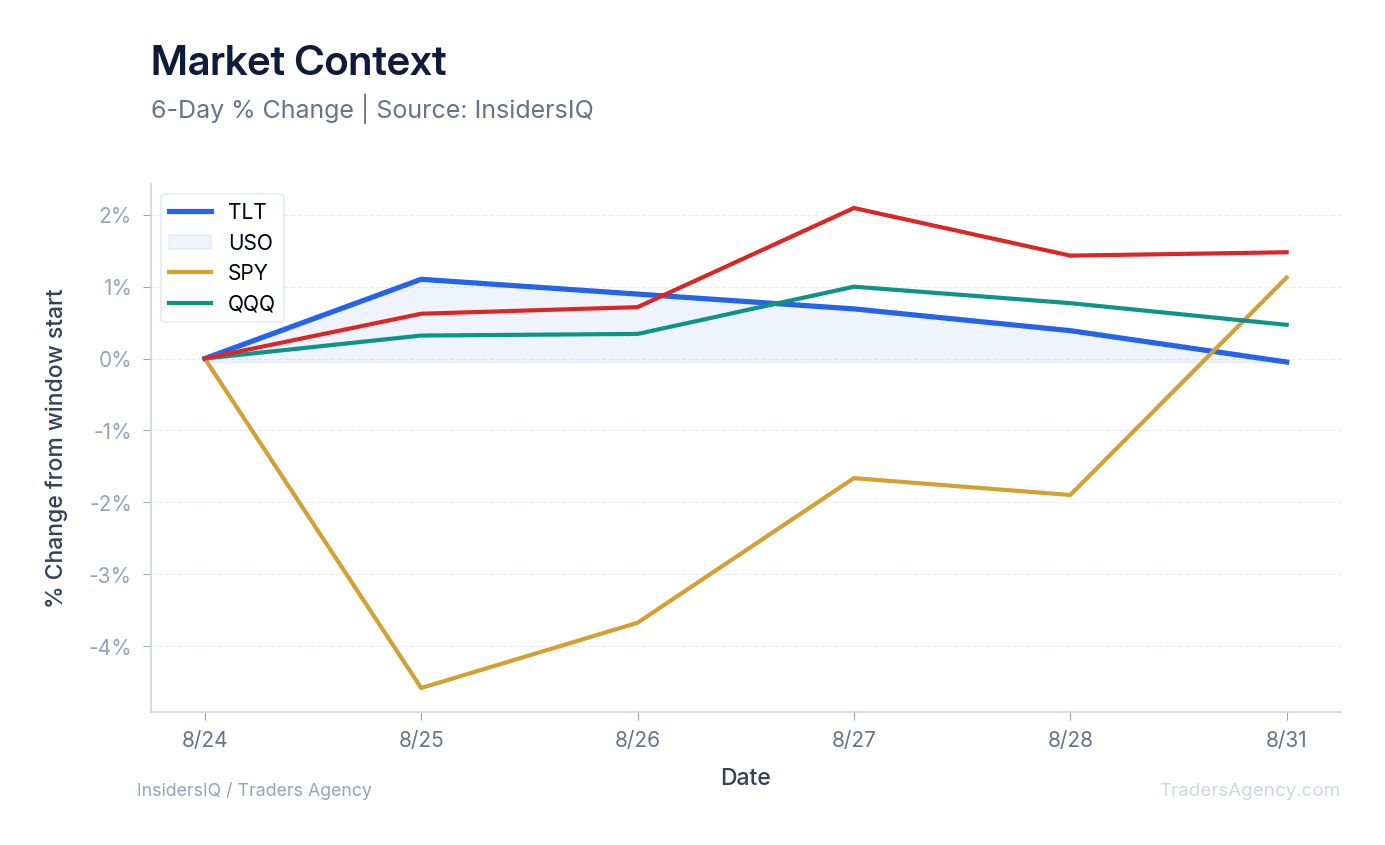
The cross-asset data we're tracking over the past 10 trading days lines up with that story:
- USO: up +1.13%, tracking the oil move that is driving the inflation story.
- TLT: essentially flat at -0.05%, reflecting the tug-of-war between rising yields, which push bond prices down, and safe-haven demand.
- SPY: up +0.47% over the window, though it slipped in Tuesday's session as yields spiked.
- QQQ: up +1.48% over the window, with the same Tuesday reversal.
Leon Ferdinand Bost, an analyst at Metzler, described the setup in a note cited by Yahoo Finance: "Global bonds are facing a perfect storm of rising inflation fears, driven by higher energy prices, which are in turn raising rate hike expectations," with fiscal concerns and heavy supply weighing on the long end.
How Are Fed Rate-Hike Odds Shifting?
September hike odds have moved dramatically. Yahoo Finance reports money markets priced a 65% probability of a Fed rate increase at the September 16 meeting, up from roughly one-third before Fed Chair Kevin Warsh's Friday speech. Reuters put the figure at 68%, up from about 35% before those comments.
We want to be clear about what this pricing does and does not tell us. A jump in hike-odds pricing reflects how traders are repositioning, not a decision the Fed has made. Another Fed rate hike remains a meaningful possibility, and the August jobs and CPI reports, both due before the September 15-16 meeting, could still shift that probability in either direction. Softer readings could strengthen the case for the Fed to continue holding rates steady.
What's driving the repricing
- Energy-driven inflation fears: oil's surge toward $92 to $94 a barrel on Brent has reawakened inflation concerns markets had largely priced out.
- Rate expectations catching up: futures markets are pricing odds roughly double where they sat just days ago.
- Fiscal and supply pressure: total U.S. public debt surpassed $40 trillion last month, more than 120% of annual economic output, adding a structural layer of concern about long-end supply.
Want expert trading insights delivered daily?
Join thousands of traders who rely on Traders Agency for market analysis and trade ideas.
Join Traders AgencyWhat Yield Level Signals a Danger Zone for the 10-Year?
The coverage we're tracking frames this move as a potential tipping point for the 10-year Treasury, with the 30-year's 5.323% 19-year high already cited as a level that has added pressure on mortgage and auto loan rates. NBC News notes the 10-year is the benchmark borrowing rate behind most common consumer lending: mortgages, auto loans, and credit card debt.
That means average consumers are likely to face higher borrowing costs in the weeks and months ahead if this yield move holds. For traders, the practical read is simpler: every basis point higher on the 10-year adds friction to rate-sensitive sectors, housing, autos, and high-multiple growth stocks that get valued off long-duration discount rates.
The 10-Year Yield Chart in Context
Looking at the longer 10-year yield history, Tuesday's move to roughly 4.79% marks the highest level since January 14, 2025, a full 20-month stretch without a comparable print. That is a meaningful reference point for anyone measuring this move against the past two years.
For traders watching intraday feeds, volatility could stay tied to headlines out of the Strait of Hormuz and to any shift in oil pricing. The 2-year Treasury yield and other short-end instruments are worth watching too, since they tend to react more quickly to Fed-odds repricing than the long end.
What Traders Should Watch Into the September Fed Decision
Key dates and levels on our radar
- Friday's jobs report: economists polled by Reuters expect employers added just 56,000 jobs last month; the unemployment rate currently stands at 4.1%.
- August CPI data: due before the Fed's September 15-16 meeting, one of two remaining inputs that could move hike odds meaningfully.
- Oil price trajectory: continued escalation near the Strait of Hormuz could keep Brent elevated and sustain upward pressure on yields.
- 30-year Treasury yield: watch whether it retests the 19-year high of 5.323% touched earlier this month.
- Equity reaction: Tuesday saw the Dow fall 208.81 points (0.39%) to 52,977.92, the S&P 500 drop 28.96 points (0.38%) to 7,657.18, and the Nasdaq Composite fall 161.21 points (0.61%) to 26,210.06.
Longbow Asset Management CEO Jake Dollarhide framed the broader stakes to Reuters: "The global bond selloff is putting worldwide central banks on notice."
What We're Watching: Friday's jobs report and the August CPI print are the next hard data points that could either confirm or unwind this week's repricing of September hike odds from roughly one-third to about two-thirds.
The Bottom Line
The 10-year Treasury yield near 4.79% is the clearest signal yet that oil-driven inflation fears are back on the table, and futures markets have already repriced September rate-hike odds toward two-thirds. We're watching Friday's jobs report and the upcoming CPI print closely, because those releases could shift the picture in either direction, and no single release is likely to settle the Fed's September call on its own. Until then, rate-sensitive sectors and long-duration assets stay exposed to headline risk out of the Strait of Hormuz.
Want expert trading insights delivered daily?
Join thousands of traders who rely on Traders Agency for market analysis and trade ideas.
Join Traders AgencyKey Takeaways
- The 10-year Treasury yield hit roughly 4.79% Tuesday, its highest level since January 14, 2025, with sources citing slightly different intraday prints (4.7880% per CNBC, 4.788% per Yahoo Finance, an intraday high of 4.798% per Reuters).
- The selloff is global, not just a U.S. story: Japan's 10-year yield hit 3% for the first time since 1996, Japan's 2-year yield touched a 31-year high of 1.81%, and U.K. 10-year gilts rose to 5.2341%.
- The 30-year Treasury yield closed at 5.272% after touching a 19-year high of 5.323% earlier this month.
- Money markets have repriced September Fed rate-hike odds from roughly one-third to about two-thirds in just a few trading days (65% per Yahoo Finance, 68% per Reuters), tied to oil-driven inflation fears from U.S.-Iran tensions near the Strait of Hormuz.
- Friday's jobs report and the upcoming August CPI print are flagged as the next data points that could confirm or unwind this week's repricing, though no single release is likely to settle the Fed's September decision on its own.
DISCLAIMER: Traders Agency does not offer financial advice. The information provided is for educational purposes only and should not be considered financial advice. Traders Agency is not responsible for any financial losses or consequences resulting from the use of the information provided. Trading carries inherent risks and may not be suitable for all individuals. You are advised to conduct your own research and seek personalized advice before making any investment decisions, recognizing the potential risks and rewards involved.
- CNBC: Bond yields soar as fresh U.S.-Iran tensions revive inflation concerns · accessed Sep 1, 2026
- Yahoo Finance: Global bond yields hit multiyear highs amid oil-driven inflation fears · accessed Sep 1, 2026
- Reuters via Global Banking & Finance Review: Bond Yields Rise, Oil Prices Fuel Inflation Worries, Stocks Slip · accessed Sep 1, 2026
- Fortune: U.S. bond yields hit highest since January 2025 as oil rises · accessed Sep 1, 2026
- NBC News: Oil prices surge on U.S. Iran strikes, deepening inflation fears · accessed Sep 1, 2026
- BBC News: US borrowing costs hit fresh highs over inflation fears · accessed Sep 1, 2026
- Trading Economics: US 10 Year Treasury Note Yield · accessed Sep 1, 2026
See more from Traders Agency on Google
Make us a preferred source and our market analysis will appear more prominently in your Google Search, Top Stories, and AI results.
Add to Preferred Sources