
The wheel strategy is a cyclical income approach that pairs selling cash-secured puts with selling covered calls on the same underlying stock. You begin by selling a put to collect premium, and if you get assigned, you pivot to selling calls against the shares you now own. It's built for traders who want steady income while staying genuinely willing to own the stock.
You've probably seen traders talking about collecting "rent" on their favorite names. That's usually this strategy at work. By the end of this guide, you'll know exactly how each leg fits together, what a full cycle looks like with real numbers, and when this approach makes sense for your account.
We teach the wheel often because it gives traders a structured way to get paid for patience. The mechanics aren't complicated once you see them in action, but the strategy does demand discipline around strike selection and capital commitment.
What Is the Wheel Strategy in Options Trading?
Bottom Line: The wheel strategy options approach turns waiting into income by paying you premium at both the entry and exit points of a stock position you're willing to own. It only works as a repeatable process if you size positions sensibly, pick strikes you'd actually be comfortable with, and never chase premium at a strike below your cost basis.
The wheel is a repeating options cycle: sell a cash-secured put, collect premium, and either keep that premium if the put expires worthless or take assignment of shares. From there you sell covered calls against those shares until they get called away, then start the cycle over.
The logic is simple. You're paid to wait for a price you'd be happy to buy at, then paid again to wait for a price you'd be happy to sell at. Think of it as running a small rental business on a stock you already like. You collect rent whether or not the tenant ever moves in or out.
This works because of theta decay, the erosion of an option's extrinsic value as expiration approaches. Every day that passes without the stock moving dramatically against you, time decay works in your favor as the option seller.
Key Concept: The wheel is two income strategies stitched into a loop. Cash-secured puts pay you to wait for a lower entry price. Covered calls pay you to wait for a higher exit price. Assignment is the hinge that connects them.
How Does the Wheel Strategy Work Step by Step?
Running the wheel comes down to four repeating steps. Here's the sequence we walk members through:
- Step 1: Sell a Cash-Secured Put on a stock you're genuinely willing to own, at a strike below the current price, with enough cash set aside to buy 100 shares per contract.
- Step 2: Collect the Premium immediately at trade entry, which lowers your effective cost basis if you end up assigned.
- Step 3: Take Assignment if the put finishes in-the-money at expiration, receiving 100 shares per contract at the strike price. Because these are American-style options, early assignment is also possible when the put moves well in-the-money.
- Step 4: Sell Covered Calls against those shares, repeating month after month until they're called away, then return to Step 1 and begin again.
Each stage carries its own risk profile, so we treat them as four distinct decisions rather than one automatic motion. The trader who blindly rolls into the next leg without reassessing the stock is the trader who gets hurt.
How Do You Start the Wheel Strategy With Cash-Secured Puts?
A cash-secured put means you sell a put option while holding enough cash to buy 100 shares per contract if assigned. This is the entry point of the wheel, and it's where you set your effective purchase price for the stock.
Here's a working example. Say a stock trades at $97. You sell the $95 put expiring in 30 days for a $2.50 premium, which is $250 total per contract.
| Parameter | Value |
|---|---|
| Stock Price | $97 |
| Put Sold | $95 strike, 30 days to expiration |
| Premium Collected | $2.50 per share ($250 per contract) |
| Cash Secured | $9,500 |
| Breakeven | $92.50 ($95 strike minus $2.50 premium) |
| Max Gain on This Leg | $250 if the stock closes above $95 |
| Max Theoretical Loss | $9,250 (stock to zero, less premium) |
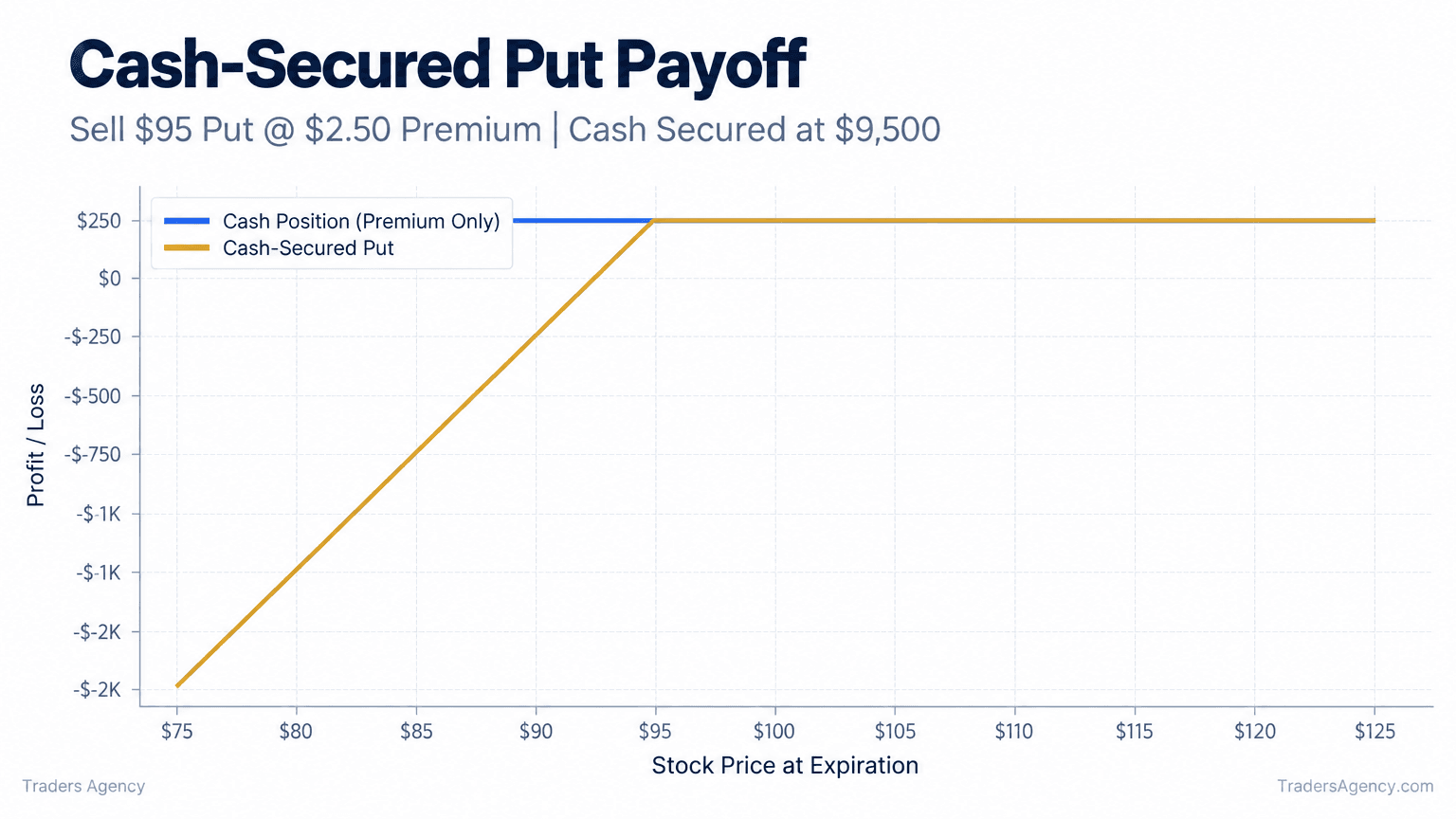
If the stock stays above $95 through expiration, the put expires worthless, you keep the full $250, and you can sell another put the following month. This is why so many traders screen for stocks with enough premium at the right delta range. For the put leg, we generally target 0.20 to 0.30 delta, which balances meaningful premium against a reasonable probability of assignment.
Want expert trading insights delivered daily?
Join thousands of traders who rely on Traders Agency for market analysis and trade ideas.
Join Traders AgencyWhat Happens When You Get Assigned and Sell Covered Calls?
If the stock closes below your strike at expiration, you're assigned 100 shares per contract at the strike price. Your effective basis becomes the strike minus the premium collected, which in our example is $92.50 per share.
From here you sell a covered call, a call option written against shares you already own. Say you sell the $100 call expiring in 30 days for $1.50, or $150 per contract. That adds to your income and sets a defined exit point above your basis.
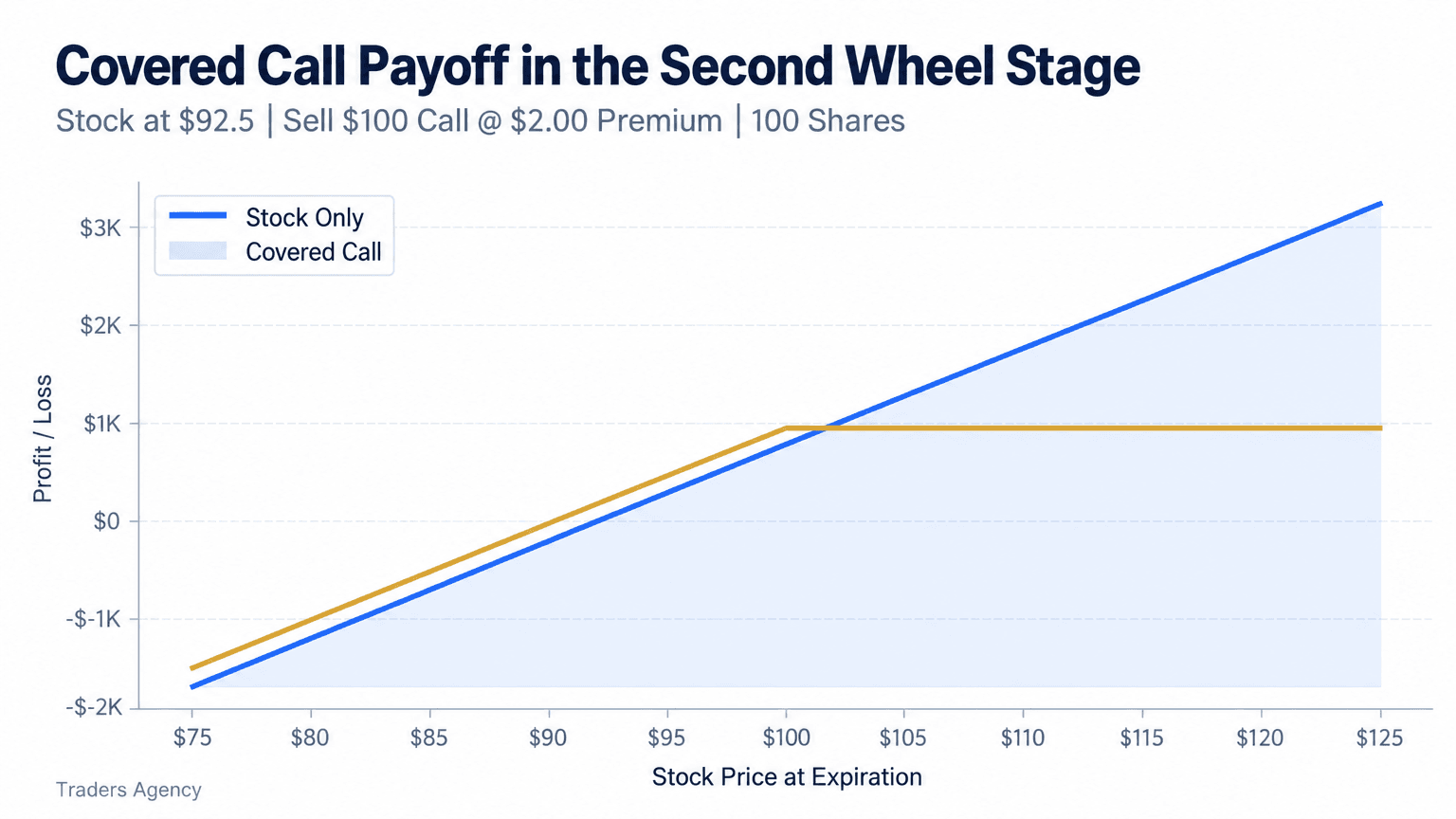
If the stock rises above $100, your shares get called away at that price. Here's how the full cycle adds up:
| Component | Amount per Contract |
|---|---|
| Put Premium Collected | +$250 |
| Call Premium Collected | +$150 |
| Capital Gain ($95 assignment price to $100 exit) | +$500 |
| Total Cycle Profit | $900 on roughly $9,500 committed |
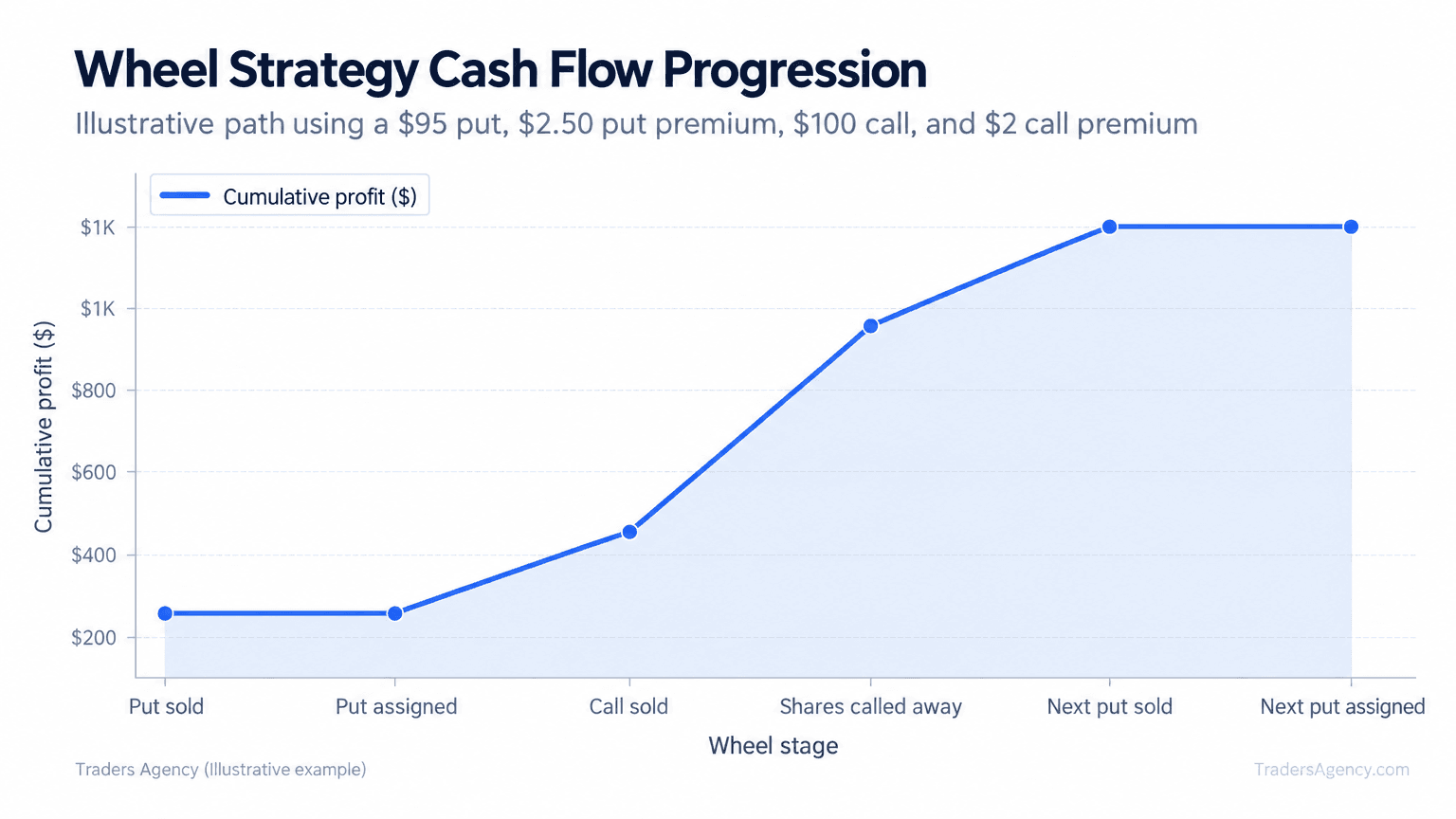
Note that measured from your $92.50 effective basis instead, the $750 share gain plus the $150 call premium lands on the same $900 figure either way you account for it. Counting the put premium twice is the most common accounting mistake here. Once the shares are gone, you return to Step 1 and sell another put.
Is the Wheel Strategy Profitable?
The wheel performs best in flat to moderately bullish markets because it generates premium income from both legs. It underperforms simply holding shares during strong rallies, and it can produce real losses when a stock drops sharply and stays depressed.
Realistic annual premium income from running the wheel consistently often lands in the 8% to 15% range on deployed capital, though that varies heavily with stock volatility and market conditions. This is not a strategy that produces outsized gains quickly. It's built for steady, repeatable income.
Results differ wildly from trader to trader because the outcome depends almost entirely on stock selection and discipline during drawdowns. The traders who struggle are usually the ones who picked a name for its premium rather than its quality, then refused to accept the loss when the thesis broke.
Watch Out: The wheel does not protect you from downside. If an assigned stock falls 40% and stays there, premium income will not come close to covering the paper loss. Only run this on stocks you'd be comfortable holding through a rough stretch.
What Are the Common Mistakes When Running the Wheel Strategy?
We see the same handful of errors from traders new to this approach:
- Chasing high premium on volatile stocks without asking whether they'd actually want to own the shares for six months.
- Ignoring assignment risk around earnings, where implied volatility looks attractive but a single gap move can blow straight through your strike.
- Underestimating capital requirements, since cash-secured puts tie up the full notional value and limit how many positions you can run at once.
- Selling calls too close to your basis after assignment, which locks in a loss if the shares get called away below cost.
- Overlooking tax treatment, because repeated assignment and premium collection generate frequent short-term gains taxed at ordinary income rates.
Some traders also apply the 3-5-7 rule, the standard risk-management guideline that caps risk at 3% of capital on any single trade, 5% across correlated positions, and 7% of total portfolio risk at one time. It's a framework rather than a formula, but it does help standardize position sizing across repeated cycles.
Which Stocks Are Best for a Wheel Strategy?
The best wheel candidates are liquid, moderately volatile names you'd be comfortable owning for months if assigned, with tight bid-ask spreads and consistent options volume across multiple strikes.
We avoid stocks with binary outcomes: pending litigation, speculative clinical trials, or anything where a single headline can cut the price in half. In practice, that means focusing on large-cap and well-established mid-cap names with orderly price action and healthy open interest. Before committing real capital, we encourage traders to review assignment mechanics directly through the Cboe Options Exchange educational materials, which cover exercise and settlement in detail.
A useful wheel strategy options screener filters for implied volatility rank, average daily options volume, and a share price range that actually fits your account size. There's no point identifying a great setup on a $400 stock if you can't secure $40,000 in cash per contract.
Our Risk Management Checklist
- Keep wheel exposure to no more than 15% to 20% of total portfolio capital per underlying.
- Set a mental or hard stop if the stock drops 15% to 20% below your effective basis.
- Track assignment probability using delta, not premium size alone.
- Confirm margin and cash requirements with your broker before stacking multiple cash-secured puts.
- Never sell a covered call at a strike below your cost basis just to collect premium.
Run the wheel with that discipline in place and you have a repeatable income process. Skip it, and you have an expensive way to accumulate stocks you never wanted.
Want expert trading insights delivered daily?
Join thousands of traders who rely on Traders Agency for market analysis and trade ideas.
Join Traders AgencyDISCLAIMER: Traders Agency does not offer financial advice. The information provided is for educational purposes only and should not be considered financial advice. Traders Agency is not responsible for any financial losses or consequences resulting from the use of the information provided. Trading carries inherent risks and may not be suitable for all individuals. You are advised to conduct your own research and seek personalized advice before making any investment decisions, recognizing the potential risks and rewards involved.
See more from Traders Agency on Google
Make us a preferred source and our market analysis will appear more prominently in your Google Search, Top Stories, and AI results.
Add to Preferred Sources