
You've probably seen the screenshot. A trader turns a few thousand dollars into a six-figure balance on a single options play, posts it to a trading forum, and collects thousands of upvotes. What you don't see are the far larger number of traders who took the same trade idea and lost most or all of their stake. That gap between what gets posted and what actually happens is where this lesson lives.
Position sizing and risk management is the practice of deciding how much money to put into a single trade based on your account size, your risk tolerance, and the distance to your stop-loss. It's the single biggest reason some traders survive years of market swings while others blow up an account in one afternoon. We're going to show you exactly how it works, with real numbers, so you can apply it the next time you're tempted to go all-in on a speculative play.
By the time you finish, you'll know how to calculate a position size for any trade, you'll understand why the math behind consecutive losses is so brutal, and you'll have a set of max-loss rules you can use starting with your very next trade.
What Is Position Sizing, and Why Does It Matter for YOLO Trades?
Bottom Line: Position sizing and risk management works because it keeps any single trade, including a YOLO play, from being able to wipe out an account, which is what lets a trader stay in the game long enough for a sound strategy to actually play out over many trades. The traders who blow up accounts usually aren't wrong about the trade idea itself; they're wrong about how much to risk on it.
Position sizing is the process of determining how many shares, contracts, or dollars you allocate to a single trade, based on your total account size and how much you're willing to lose if the trade goes against you. It matters most on YOLO (You Only Live Once) trades because those are typically high-volatility, high-conviction bets where the temptation to oversize is strongest.
The term "YOLO play" comes from retail trading culture, popularized on social media forums where traders post screenshots of enormous gains (or losses) from single, concentrated bets, often in short-dated options. The mechanics are simple: a trader identifies a stock they believe will move sharply, buys options or shares with a large chunk (sometimes all) of their account, and either wins big or loses it all.
The problem isn't the trade idea itself. Plenty of YOLO plays are built on reasonable theses about earnings, Federal Reserve decisions, or merger speculation. The problem is sizing. When a trader puts 50%, 80%, or 100% of an account into one position, a single wrong move doesn't just hurt. It can end a trading career.
Key Concept: Position sizing determines whether a losing trade is a setback or a disaster. Your trade idea might be right 40% of the time, but if your sizing is wrong, that 40% win rate won't save you.
What Is the Kelly Criterion and How Does It Apply to Position Sizing?
The Kelly Criterion is a formula developed at Bell Labs in the 1950s for information theory, later adopted by gamblers and investors, that calculates the optimal percentage of a bankroll to risk on a bet, based on your edge (win probability) and the payout odds. In trading, we adapt it to answer one question: how much of my account should I risk on this specific trade?
The simplified formula looks like this:
Kelly % = W − [(1 − W) / R]
W = your win rate as a decimal (60% = 0.60)
R = your average win divided by your average loss (reward-to-risk ratio)
Say you run a strategy that wins 55% of the time, and your average winner is 1.5 times the size of your average loser. Plug it in:
| Input | Value |
|---|---|
| Win rate (W) | 0.55 |
| Reward-to-risk (R) | 1.5 |
| Calculation | 0.55 − [(1 − 0.55) / 1.5] = 0.55 − 0.30 |
| Full Kelly result | 0.25, or 25% of the account |
That sounds like an enormous bet, and that's exactly why most professional traders use what's called "half Kelly" or "quarter Kelly." Full Kelly sizing is mathematically optimal for long-term growth, but it produces swings in account value that almost nobody can stomach emotionally.
Watch Out: Treat the Kelly number as a ceiling, not a target. Most retail traders are better served using a small fraction of it, or skipping it entirely in favor of the simpler fixed-percentage method below.
How Do I Calculate My Position Size?
To calculate your position size, divide your maximum dollar risk per trade (account size multiplied by your risk percentage) by the dollar distance between your entry price and your stop-loss. That gives you the number of shares or contracts you can buy while staying inside your risk limit.
Here's the position sizing formula we teach:
Position Size = (Account Size × Risk %) / (Entry Price − Stop-Loss Price)
Walk through it step by step with a real example:
- Step 1: Set your account size. In this example, you're working with a $10,000 account.
- Step 2: Choose your risk percentage. You decide to risk 1% per trade, which equals $100 of maximum loss.
- Step 3: Define your entry and stop. The stock trades at $50, and your stop-loss sits at $47. Your risk per share is $3.
- Step 4: Divide. $100 ÷ $3 = 33 shares. That's your maximum position for this setup.
- Step 5: Place the order and the stop together. The position size only protects you if the stop actually exists in the market.
| Parameter | Value |
|---|---|
| Account Size | $10,000 |
| Risk Per Trade | 1% ($100) |
| Entry Price | $50.00 |
| Stop-Loss | $47.00 |
| Risk Per Share | $3.00 |
| Position Size | 33 shares (about $1,650 of capital) |
| Max Loss If Stopped | $99 |
Notice what the formula does automatically: your position shrinks as the stop-loss widens, and grows as the stop tightens. That's the mechanism keeping your dollar risk constant no matter how volatile the setup is.
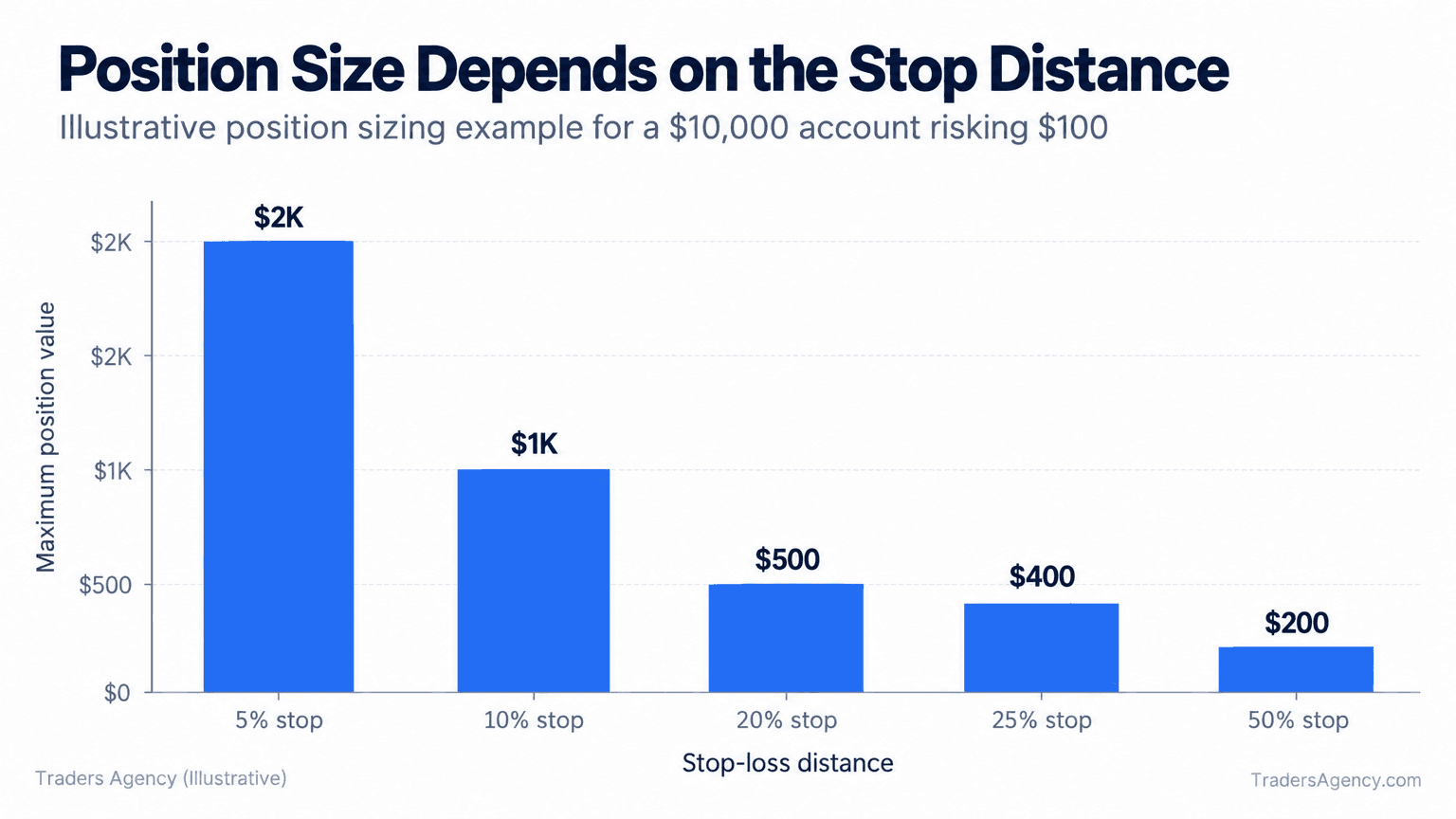
As the chart shows, the wider your stop (common in speculative options trades where premiums swing fast), the smaller your position has to be to keep dollar risk fixed. This is exactly where most YOLO traders go wrong: they size their contracts the same way whether the stop is 5% away or 50% away.
Many brokers build a position sizing calculator right into their platforms, and free versions are easy to find online. Run your numbers through one before every trade until the formula becomes second nature.
Want expert trading insights delivered daily?
Join thousands of traders who rely on Traders Agency for market analysis and trade ideas.
Join Traders AgencyWhat Is the 1% Rule in Risk Management?
The 1% rule states that a trader should never risk more than 1% of a total trading account on a single trade. On a $10,000 account, your maximum acceptable loss on any one trade is $100, no matter how confident you feel about the setup.
The rule exists because of a simple, brutal math problem: losses compound against you faster than wins compound for you. Lose 50% of your account and you don't need a 50% gain to get back to even. You need a 100% gain, because you're now working from a smaller base.
| Drawdown | Gain Required to Break Even |
|---|---|
| −10% | +11% |
| −25% | +33% |
| −50% | +100% |
| −75% | +300% |
| −90% | +900% |
Why Consecutive Losses Are the Real Danger
No trader wins every time. Even a strategy with a 60% win rate will occasionally produce a losing streak of 5, 8, or 10 trades in a row, purely from randomness. The question isn't whether you'll hit a losing streak. It's whether you'll survive it.
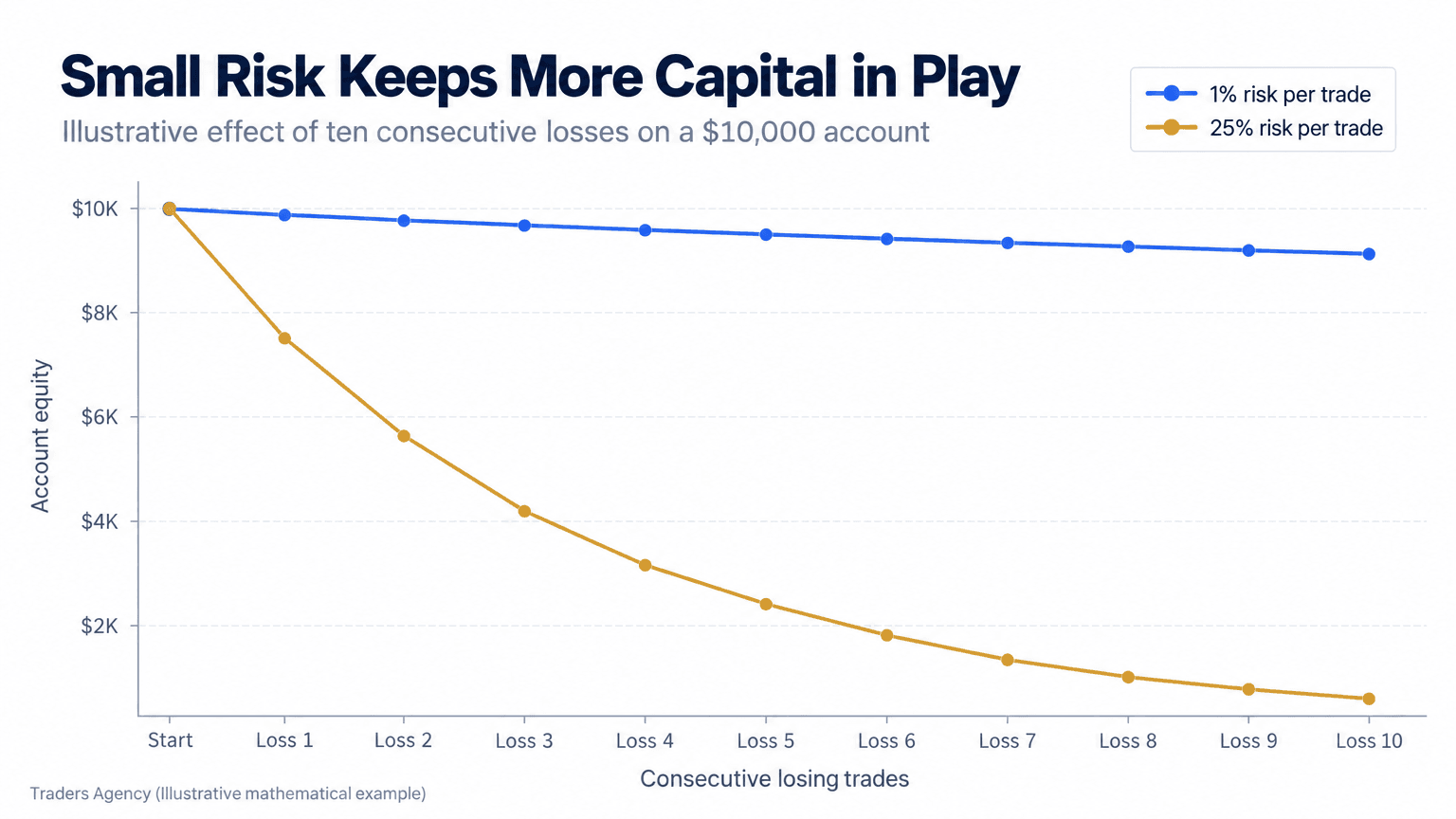
Look at the difference. A trader risking 1% per trade who takes 10 losses in a row still has roughly 90% of the account intact. A trader risking 25% per trade, a common YOLO-style allocation, is left with less than $600 from a starting $10,000, a loss of more than 94%. Same number of losing trades. Wildly different outcomes.
That's the core reason position sizing and risk management matters more than win rate. A trader who sizes properly can be wrong most of the time and still come out ahead over a year.
Bankroll Lessons From Poker, Applied to Trading
Professional poker players almost never sit down at a table with their entire net worth. They set aside a specific bankroll, a fixed amount of money dedicated solely to playing, and they refuse to risk more than a small slice of it on any single hand or session.
We teach our members to apply that exact logic to speculative trading:
- Create a separate "play money" account. Make it a fixed dollar amount you're genuinely prepared to lose entirely, fully separated from your core investing or retirement funds.
- Size the bankroll as a small percentage of net worth. Many traders allocate 1% to 5% of investable assets to speculative plays and keep the rest in longer-term, lower-risk positions.
- Treat each YOLO-style trade as a single "hand." A poker player wouldn't push the entire bankroll in on one hand, so don't put your whole speculative allocation into one options contract.
- Write reload rules before you need them. If the play money account hits zero, that's a signal to step back and reassess, not an invitation to wire in more cash and "win it back."
This approach keeps the excitement and the learning value of speculative trades without putting your financial stability on the line. It's a position sizing risk management strategy borrowed from a world that has spent decades studying how to survive variance.
How Do You Set a Max Loss Per Trade, Per Day, and Per Week?
Beyond the per-trade 1% rule, we recommend hard loss limits across longer time frames, especially for traders drawn to high-volatility, short-dated options plays.
| Time Frame | Limit | Action If Hit |
|---|---|---|
| Per trade | 1% to 2% of your speculative allocation | Size down or skip the trade |
| Per day | 3% in combined losses | Stop trading for the day |
| Per week | 10% drawdown | Review what happened before placing another trade |
| Per month | 25% drawdown | Reassess the strategy and current market conditions |
These numbers aren't arbitrary. They're built to make sure a bad week doesn't turn into a blown-up account, and a bad month doesn't turn into a blown-up year.
The 3-5-7 rule in trading is a related framework some traders prefer: risk no more than 3% of capital on any single trade, keep total exposure across all open trades under 5%, and aim for winning trades that return at least 7% more than the average loser. Different packaging, same core idea: cap your exposure before you need to.
Watch Out: Loss limits only work if you set them in advance and write them down. Deciding "how much is too much" in the middle of a losing streak is the one moment your judgment is least reliable.
Why Does Survivorship Bias Make YOLO Gains Look Easy?
Survivorship bias is the tendency to focus on winners while ignoring the much larger pool of losers, which creates a distorted picture of how likely success really is. In trading communities, it shows up constantly as viral gain screenshots.
Think about the math. If 1,000 traders each place a speculative bet on the same earnings play, and only 5% produce a large win, that's still 50 traders posting spectacular gains. Those 50 screenshots spread fast. The 950 losses rarely get posted at all.
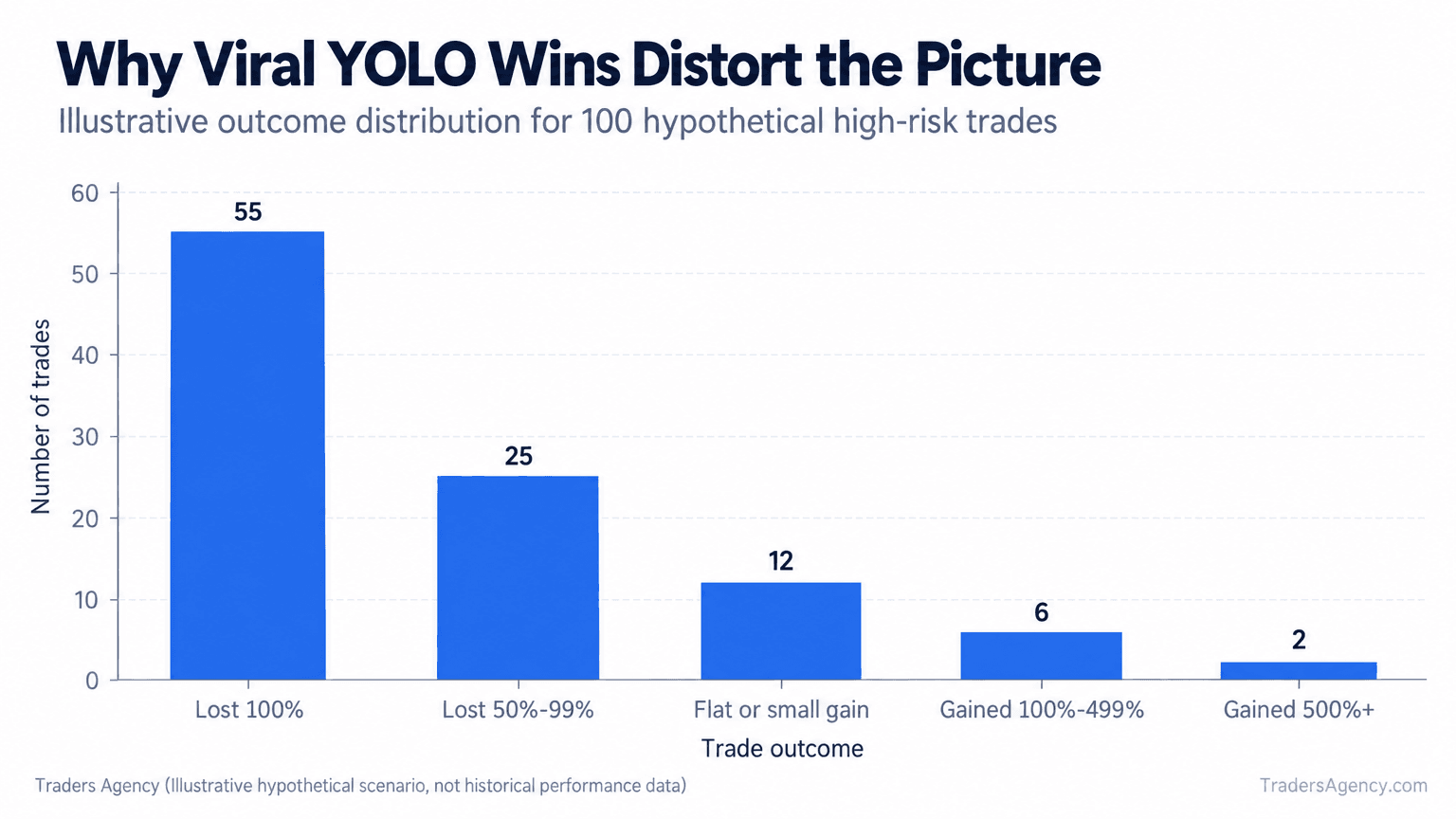
The visual above is hypothetical, but it reflects something real: the trades you see celebrated online are a tiny, cherry-picked slice of every trade actually placed. New traders scroll through a feed of nothing but winners and start believing the odds are far better than they are. That misperception is precisely what pushes people to abandon position sizing and risk management altogether, because "everyone else" seems to be winning big.
When Should You Use Strict Position Sizing, and When Do Traders Skip It?
Strict position sizing belongs on every single trade, no exceptions, but it matters most during high-volatility events like earnings releases, Federal Reserve announcements, and biotech trial results, where price swings are largest. Traders tend to skip it exactly when confidence is highest, which is precisely when the risk of oversizing peaks.
Here are the mistakes we see most often:
- Doubling down after a loss to "win it back faster" instead of sticking to the formula.
- Ignoring position size on options because contracts feel like smaller, cheaper bets than buying shares outright, when the leverage actually magnifies risk.
- Treating high conviction as permission to break the 1% rule, as though conviction and outcome were the same thing.
- Mixing play money with core investing funds, so one losing speculative trade reaches into retirement savings.
Position sizing works alongside the other tools you may already use: stop-losses, options spreads that cap maximum loss, and diversification across uncorrelated positions. It isn't a replacement for a trading strategy. It's the layer that decides whether your strategy gets enough trades to prove itself.
Our education team publishes new strategy guides and market analysis every week, and position sizing shows up in nearly all of them for one reason: it's the habit that keeps you in the game long enough for everything else you learn to pay off.
Want expert trading insights delivered daily?
Join thousands of traders who rely on Traders Agency for market analysis and trade ideas.
Join Traders AgencyDISCLAIMER: Traders Agency does not offer financial advice. The information provided is for educational purposes only and should not be considered financial advice. Traders Agency is not responsible for any financial losses or consequences resulting from the use of the information provided. Trading carries inherent risks and may not be suitable for all individuals. You are advised to conduct your own research and seek personalized advice before making any investment decisions, recognizing the potential risks and rewards involved.
See more from Traders Agency on Google
Make us a preferred source and our market analysis will appear more prominently in your Google Search, Top Stories, and AI results.
Add to Preferred Sources