
A protective put strategy is an options technique where a trader who owns at least 100 shares of a stock buys a put option on that same stock to limit downside risk while keeping upside potential open, minus the premium paid. It works like an insurance policy: you pay a premium upfront, and in exchange you get a guaranteed floor price for your shares, for the life of the option, no matter how far the stock falls. We built this guide to walk you through exactly how it works, with real numbers, so you can decide whether it belongs in your own trading plan.
By the time you finish reading, you'll know how to set up a protective put, how to pick a strike price and expiration date, what your max loss and breakeven actually look like, and when this strategy makes sense versus when it's simply a waste of premium.
What Is a Protective Put Strategy?
Bottom Line: A protective put sets a hard floor under a stock you already own by paying a premium for the right to sell at a fixed strike price, so losses stay capped no matter how far shares fall while upside stays open above the cost of the put. It only pays off as insurance, not as a profit engine, so the premium cost and expiration date need to make sense relative to the position before using it.
A protective put strategy combines two positions: owning shares of stock, and buying a put option on that same stock. The put gives you the right (not the obligation) to sell your shares at a set price, called the strike price, any time before the option expires.
Think of it like car insurance. You pay a monthly premium, and if you total your car, the insurance company cuts you a check instead of leaving you with nothing. A put option works the same way for your stock. If the stock crashes, your put lets you sell at the strike price you locked in, even if the market price is far lower.
This matters because owning stock alone exposes you to the full value of your position (a stock can theoretically go to $0). A protective put caps that downside at a known number, while your upside stays open.
Key Concept: A protective put pairs 100 shares of long stock with one long put contract. The premium you pay is the cost of insurance, and the strike price becomes the floor under your position.
Why It Works
The mechanics come down to one simple fact: put options increase in value as the underlying stock price falls. When you own both the stock and a put, losses on the stock are offset by gains on the put once the price drops below your strike.
That offsetting behavior is why we teach the protective put as one of the first risk-management structures new options traders should understand. It's one of the most widely used hedges among long-term stockholders, and the contract specifications are standardized across the major options exchanges like the Cboe.
How Does a Protective Put Work?
A protective put works by pairing 100 shares of stock with one put contract (each standard contract covers 100 shares), creating a position where losses below the strike price are offset dollar for dollar by gains in the put.
Here's the structure, broken into its basic parts:
- Own the underlying stock, a minimum of 100 shares per contract you plan to buy.
- Buy one put option per 100 shares, choosing a strike price below the current stock price.
- Pay the premium for the put, which is your cost of protection.
- Hold until expiration, or sell the put early if you no longer need the protection.
The put's sensitivity to the stock is measured by delta, which tells you how much an option's price moves relative to a $1 move in the stock. A put bought "out of the money" (strike below current price) typically carries a delta between -0.20 and -0.40, meaning it moves less dramatically than the stock itself until the stock approaches the strike.
Choosing Strike Price and Expiration
For traders setting up their first hedge, our team recommends keeping it simple:
- Strike price: Pick a strike 5% to 10% below the current stock price. This keeps premium costs reasonable while still protecting against a serious drop.
- Expiration: Choose an expiration that covers your expected holding period, commonly 30 to 90 days out. Shorter expirations are cheaper but require more frequent renewal.
- Cost check: Compare the premium to the stock's recent price swings. If the put costs more than 5% of your stock's value for a short-dated option, it may be too expensive relative to the protection it delivers.
Protective Put Strategy Example With Numbers
Here's a protective put strategy example using specific figures so you can see exactly how the math works.
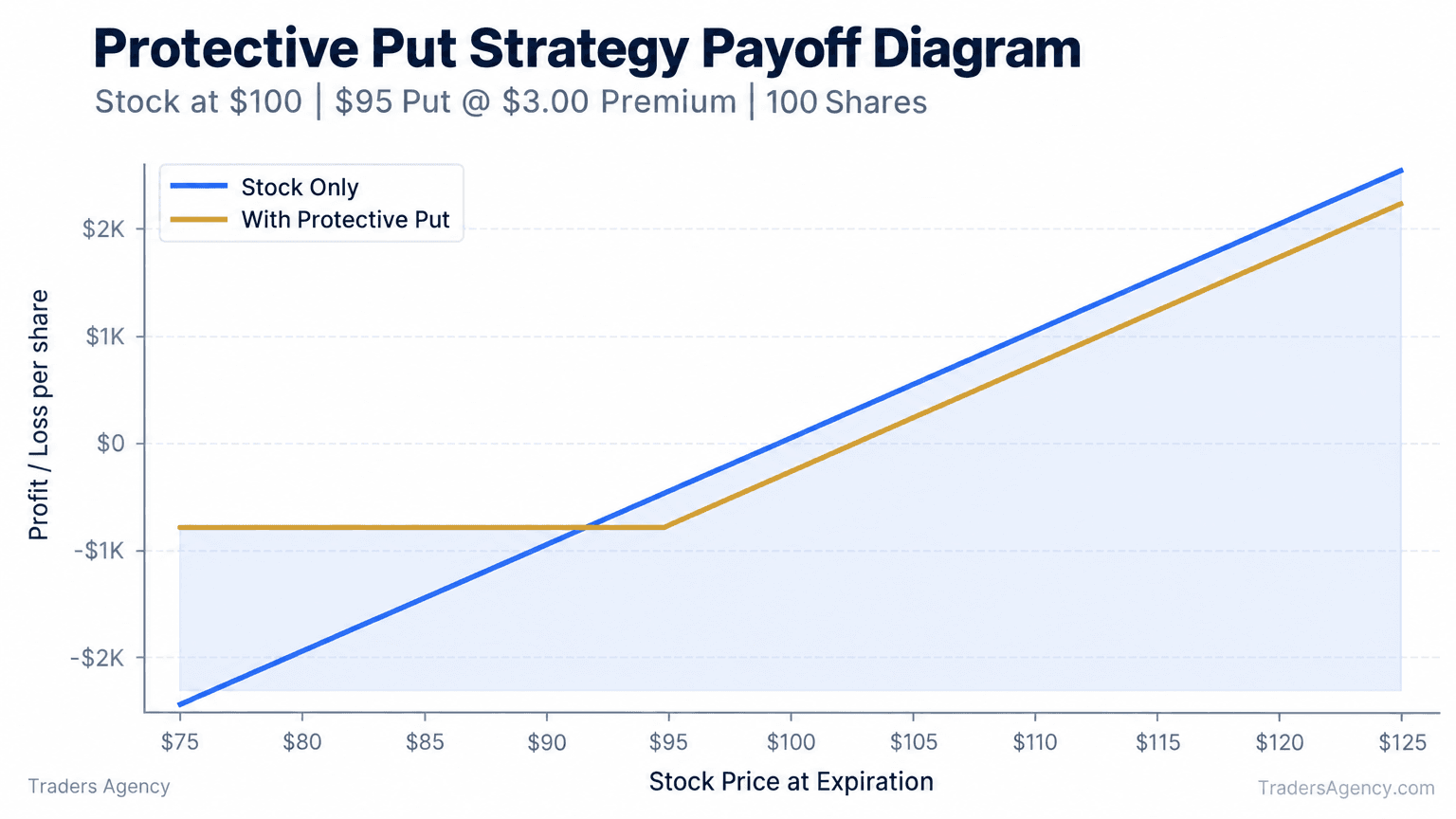
Suppose you own 100 shares of a stock trading at $100 per share, for a total position value of $10,000. You're worried about a pullback over the next two months, so you buy one put option with a $95 strike, expiring in 60 days, for a premium of $3.00 per share ($300 total, since one contract covers 100 shares).
The Setup
| Parameter | Value |
|---|---|
| Stock Owned | 100 shares at $100 = $10,000 |
| Put Purchased | $95 strike, 60-day expiration |
| Premium Paid | $3.00/share = $300 total |
| Breakeven | $103.00 ($100 cost basis + $3 premium) |
| Max Loss | $800 ($500 stock loss to strike + $300 premium) |
The Outcomes
| Scenario | Stock Price at Expiration | Result |
|---|---|---|
| Best Case | $120 | +$1,700 ($2,000 stock gain, put expires worthless) |
| Breakeven | $103 | $0 |
| Sideways / Slight Dip | $98 | -$500 ($200 stock loss + $300 premium) |
| Worst Case (hedged) | $70 | -$800 instead of -$3,000 unhedged |
In the best case, your upside stays open, minus the cost of the insurance. In the worst case, you exercise the put and sell at $95, so your loss is capped at the $5 per share move down to the strike plus the $3 per share premium. That's $800 rather than the $3,000 you'd be down holding the stock naked.
The sideways case is the one traders tend to dislike: the stock drifts to $98, the put never pays out, and you're down $500. That's exactly how insurance behaves when you don't need to file a claim. The protective put max loss is capped and known the moment you place the trade, which is the entire point of the strategy.
Want expert trading insights delivered daily?
Join thousands of traders who rely on Traders Agency for market analysis and trade ideas.
Join Traders AgencyIs a Protective Put a Good Strategy for You?
Whether a protective put strategy fits depends on your goals. It works well for investors who want to keep holding a stock long term but are nervous about a near-term drop. It works poorly for traders trying to squeeze maximum return out of every dollar deployed.
The question "is a protective put a good strategy" comes up constantly, and the honest answer is that it depends on your situation. If you're holding a large, concentrated position (company stock from your employer, for example) and can't sell it for tax or policy reasons, a protective put is a smart way to hedge without liquidating.
On the other hand, if you're trading a smaller position where you could simply sell the stock and walk away, paying ongoing premiums for protection will eat into returns more than it's worth.
Cost of Protection vs. Potential Loss
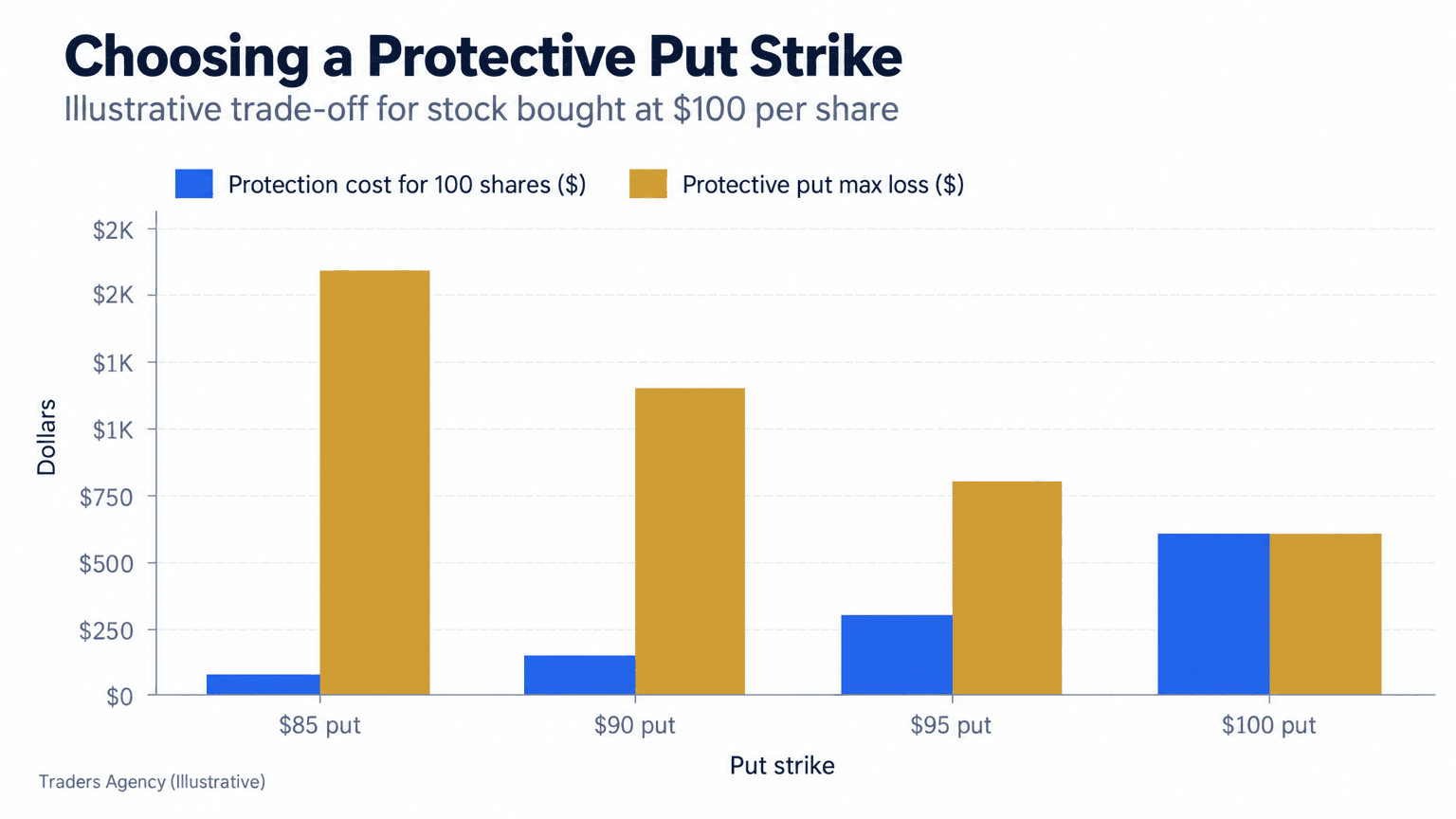
This is where the real decision-making happens. Here's how three strike choices compare for that same $100 stock, using 60-day puts:
| Put Strike | Approx. Premium | Max Loss (incl. premium) |
|---|---|---|
| $95 | $3.00 ($300) | $800 |
| $90 | $1.75 ($175) | $1,175 |
| $85 | $0.90 ($90) | $1,590 |
Notice the tradeoff: a higher strike costs more but caps your loss tighter. A lower strike is cheaper but lets more loss accumulate before the put starts working for you.
How Implied Volatility Changes the Math
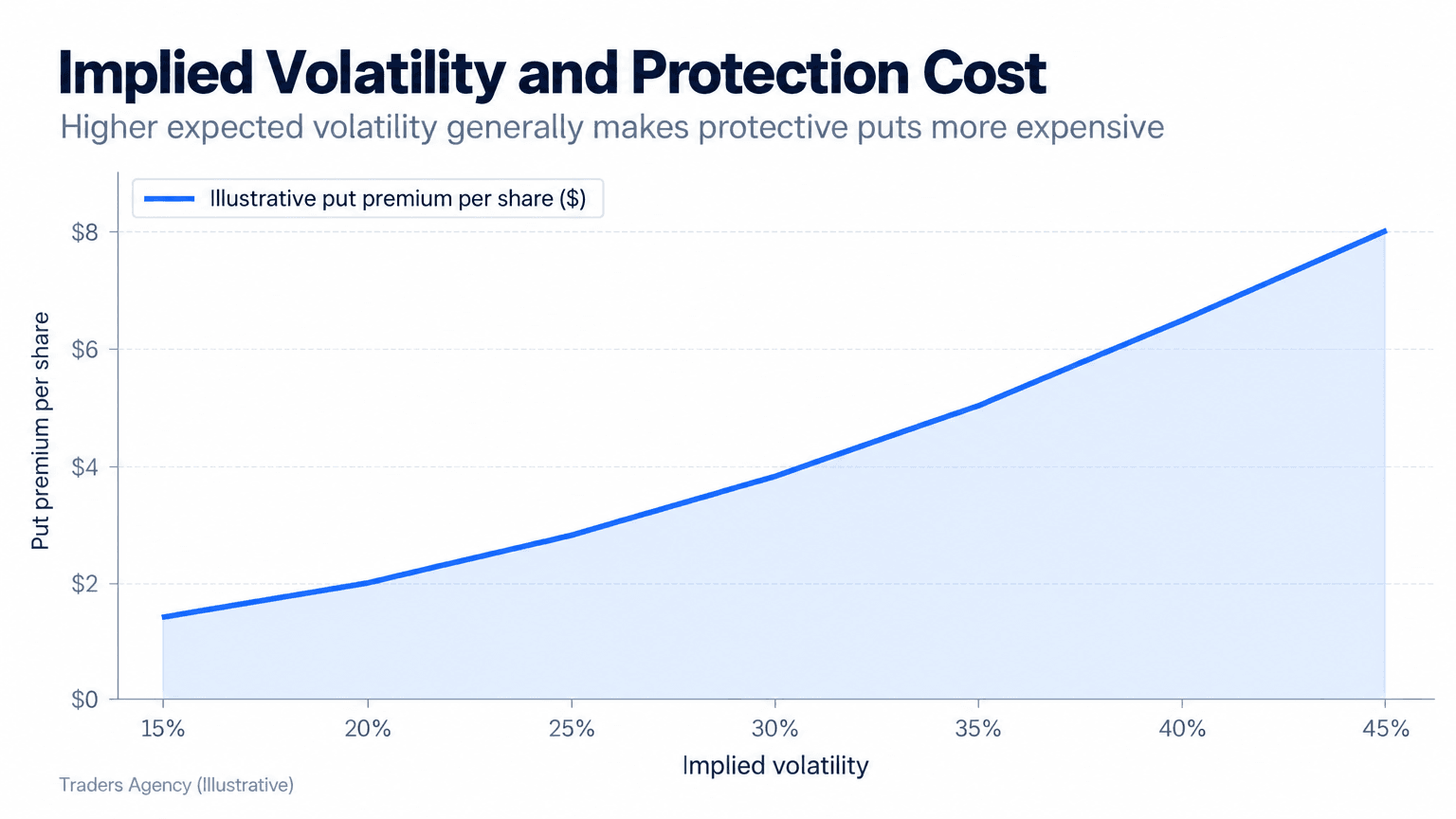
Put premiums aren't fixed. They move with implied volatility (IV), which measures how much the market expects a stock to swing. Higher IV means pricier puts, because there's a greater perceived chance the stock could fall far enough to make the put valuable.
That sensitivity is measured by vega, the Greek that tracks how much an option's price changes for each 1% move in implied volatility. A put with high vega gets noticeably more expensive when volatility spikes, which often happens right before earnings reports or during broad market stress.
There's also theta, the Greek representing time decay. Every day that passes, your put loses a small amount of value simply from time running out, even if the stock doesn't move at all. That's the carrying cost of your insurance policy.
Watch Out: Buying protection after a stock has already dropped usually means buying into elevated implied volatility. You pay top dollar for the hedge at the worst possible moment. We teach members to price protection before the event they're worried about, not during the panic.
What Is the Difference Between a Protective Put and a Covered Put?
A protective put and a covered put strategy sound similar but are structurally opposite. A protective put pairs long stock with a long put to protect an existing position. A covered put pairs short stock with a short put, which is a bearish, income-generating structure with very different risk characteristics.
In a covered put, you've already sold the stock short (betting it falls) and you sell a put against that position to collect premium. That caps your profit if the stock falls and adds to your losses if the stock rises, since short stock carries theoretically unlimited upside risk.
The protective put, by contrast, is built for investors who are bullish or neutral long term but want insurance against a near-term drop. If you're new to options, keep these two straight. They serve opposite purposes in a portfolio.
How Do You Execute a Protective Put?
To execute a protective put, you need to own (or simultaneously buy) 100 shares of the stock, then place a separate order to buy one put contract with a strike price below the current stock price and an expiration date that matches your hedging timeframe.
Here's the step-by-step process we walk our members through:
- Step 1: Confirm Your Share Count, verifying you own at least 100 shares of the stock you want to protect.
- Step 2: Open the Options Chain for that stock inside your brokerage platform.
- Step 3: Select an Expiration Date that covers the period of risk you're actually worried about, commonly 30 to 90 days out.
- Step 4: Choose a Strike Price below the current market price, typically 5% to 10% lower.
- Step 5: Place a "Buy to Open" Order for one put contract per 100 shares owned.
- Step 6: Monitor and Decide before expiration whether to exercise the put, sell it for whatever value remains, or let it expire worthless.
Most brokers classify this as a simple, defined-risk strategy because your maximum loss is locked in the moment you place the trade. That's also why protective puts are available at lower options-approval tiers than multi-leg spreads at nearly every major brokerage.
When Should You Use a Protective Put Strategy?
A protective put fits best when you're holding a stock you want to keep for the long term but you're facing a specific window of uncertainty: an earnings report, a broader market downturn, or a concentrated position you can't easily sell.
Good Conditions for a Protective Put
- You hold a large or concentrated position in a single stock.
- You expect short-term volatility but remain bullish long term.
- You want to avoid triggering a taxable sale by selling the stock outright.
- Implied volatility is still reasonably low when you buy the put, which keeps the premium manageable.
When to Skip It
- The stock barely moves, and the premium cost outweighs realistic downside risk.
- You're trading a small position where simply selling the stock is cheaper and simpler.
- Implied volatility is already very high, making the put expensive relative to the protection it offers.
Pairing With Other Strategies
Some traders combine this with a covered call and protective put, a structure known as a collar. Selling a covered call against the stock helps offset the cost of the protective put, though it also caps your upside. That's a more advanced combination worth studying once you're comfortable running protective puts on their own.
Do Large Investors Use Put Options?
Yes. Major institutional investors, including Berkshire Hathaway, have disclosed using put options in their portfolios over the years, though typically as part of broader derivative positions rather than simple retail-style protective puts on individual holdings. You can review those disclosures yourself through SEC EDGAR filings.
The takeaway for everyday traders isn't to copy institutional structures line for line. It's to recognize that using options for risk management is a mainstream, widely accepted practice, not a fringe or overly speculative tactic.
Risk Management Checklist
Before you place a protective put, run through this quick checklist:
- Position size: Only hedge positions large enough to justify the premium cost.
- Max loss: Know your dollar max loss before entering (cost basis minus strike, plus premium).
- Expiration timing: Match the put's expiration to the actual period of risk you're concerned about.
- Cost threshold: If the premium exceeds roughly 5% of position value for a short-dated put, reconsider the strike or the expiration.
- Re-evaluation: Revisit the hedge as expiration approaches, because your protection ends the moment that contract does.
Remember This: A protective put won't make you money on its own. It's a tool for staying in a stock you believe in while putting a hard floor under your worst-case outcome.
Our education team publishes new strategy guides and market analysis every week, and we build each one around real numbers you can test against your own positions.
Want expert trading insights delivered daily?
Join thousands of traders who rely on Traders Agency for market analysis and trade ideas.
Join Traders AgencyDISCLAIMER: Traders Agency does not offer financial advice. The information provided is for educational purposes only and should not be considered financial advice. Traders Agency is not responsible for any financial losses or consequences resulting from the use of the information provided. Trading carries inherent risks and may not be suitable for all individuals. You are advised to conduct your own research and seek personalized advice before making any investment decisions, recognizing the potential risks and rewards involved.
See more from Traders Agency on Google
Make us a preferred source and our market analysis will appear more prominently in your Google Search, Top Stories, and AI results.
Add to Preferred Sources