
0DTE options trading means buying or selling options contracts that expire the same day they're traded. No overnight exposure, no extended time value, and almost no room for error. What began as a niche tactic has turned into one of the most discussed phenomena in retail trading, and it now accounts for a large share of total options volume on the major indexes.
You've probably seen the chatter: traders posting same-day options wins (and losses) with screenshots showing triple-digit percentage swings in a matter of hours. Some of that is genuine skill. A lot of it is survivorship bias mixed with luck. We want to walk you through what 0DTE options trading actually is, how it works mechanically, and where the real opportunities and real dangers sit.
By the end of this guide, you'll understand the mechanics behind same-day expiration contracts, two concrete trade structures our team teaches, and the specific conditions under which we'd tell you to stay away entirely.
What Is 0DTE Options Trading?
Bottom Line: 0DTE options trading can work as a legitimate tool, but only with defined risk, small position size, and a written exit plan before entry. Treated as a lottery ticket instead of a process, the compressed timeline and fast decay make it a quick way to lose capital.
0DTE stands for "zero days to expiration." It describes an options contract that expires on the very same trading day it's bought or sold, which means there's no overnight holding period and no multi-day theta decay to manage.
The 0DTE meaning in trading comes down to timing. A standard option might have weeks or months until expiration, giving the underlying price time to move in your favor. A 0DTE contract has hours, sometimes less. That compressed timeline changes everything about how the position behaves.
Most 0DTE activity centers on index products like SPX, SPY, and QQQ, which carry listed expirations every trading day of the week. Individual stocks are a different story: for most names, same-day expiration only exists on expiration Fridays, and liquidity is often too thin to trade safely.
Key Concept: A 0DTE option expires at the close of the same session in which you trade it. Every dollar of extrinsic value you pay has only hours left to justify itself, which is what creates both the explosive leverage and the brutal decay.
How Does 0DTE Options Trading Work?
0DTE options trading works by exploiting the final hours of an option's life, when time decay (theta) accelerates and price movement in the underlying has an outsized effect on the contract's value. Traders use this compressed window to speculate on direction or to collect premium that evaporates quickly.
Because so little time remains, the extrinsic value of a 0DTE option is small relative to a weekly or monthly contract. That means a move of just a few points in the S&P 500 can swing a 0DTE option's price by 20%, 50%, even 100% within minutes. That leverage is what draws retail traders in, and it's also exactly what makes these contracts dangerous without a plan.
Market makers hedge their exposure to these contracts using the underlying index or futures, which creates feedback loops. When large volumes of 0DTE contracts get bought near a certain strike price, dealers may need to buy or sell the underlying to stay hedged, sometimes reinforcing the exact price move traders were betting on.
Why Has 0DTE Options Trading Grown So Fast?
0DTE options trading has grown because exchanges expanded daily expirations across the major indexes, giving traders a cheap, defined-risk way to express short-term views without overnight exposure. Retail platforms then made access to these contracts nearly frictionless.
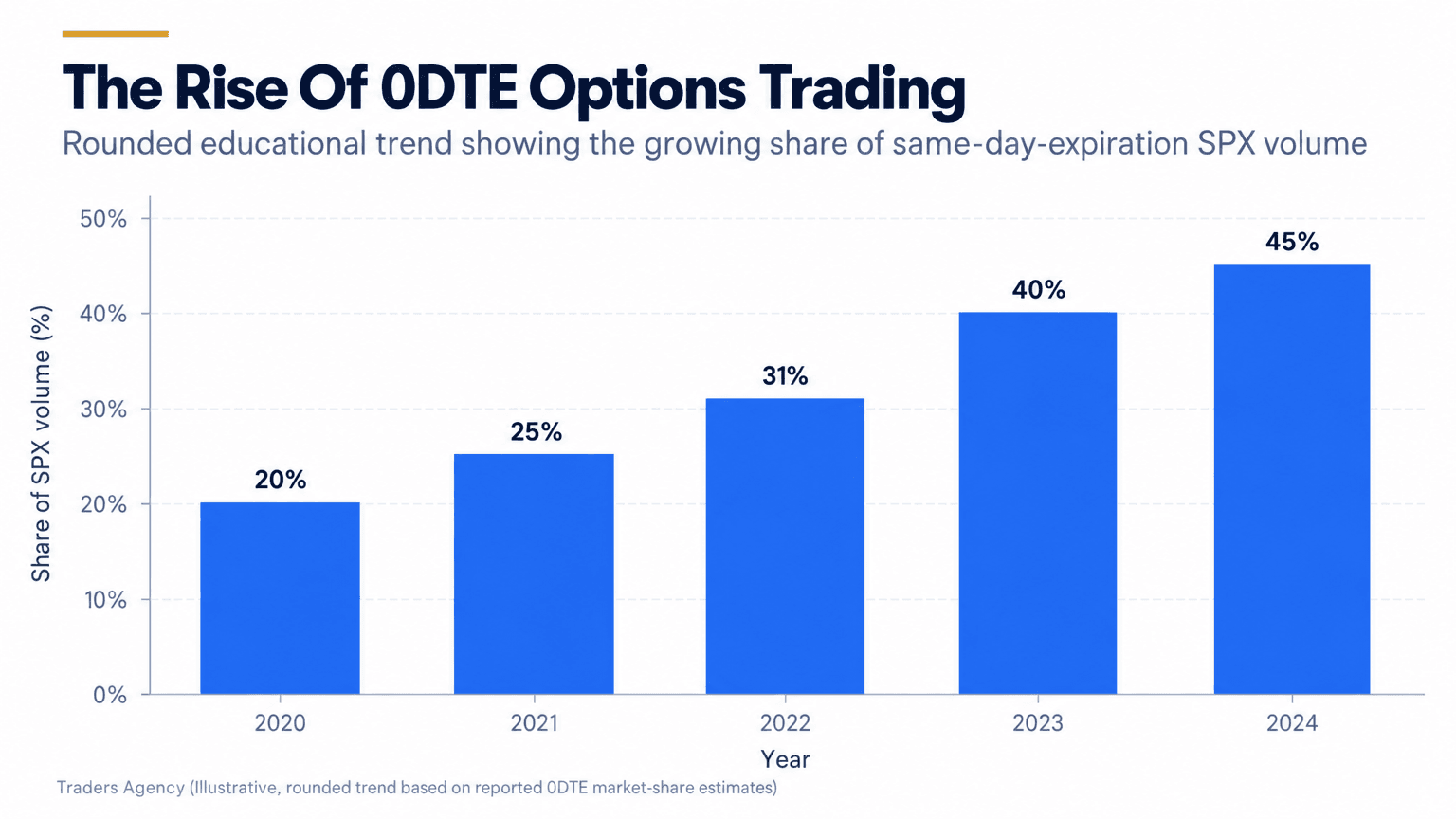
The Cboe now lists SPX options expiring every single weekday, a change that opened the door to same-day strategies that simply didn't exist a decade ago. Combine that with commission-free trading apps, and you get a market where a trader can put on a position at 10am and close it by 3pm without paying overnight margin or worrying about an earnings gap.
There's a cultural piece here too. 0DTE options trading reddit threads and trading forums turned same-day options into a kind of spectator sport, with posts documenting rapid account swings. That attention pulled in more participants, which pulled in more volume, which pulled in more attention. It's a feedback loop built on visibility as much as strategy.
Three structural drivers explain most of the growth:
- Expanded listings: Daily expirations on SPX, SPY, and QQQ removed the need to wait for a weekly or monthly cycle.
- Defined risk, no overnight exposure: Buyers know their max loss upfront and aren't exposed to news that breaks after the close.
- Leverage at a lower dollar cost: Same-day contracts are cheaper than longer-dated ones, letting traders control more notional exposure per dollar risked.
Want expert trading insights delivered daily?
Join thousands of traders who rely on Traders Agency for market analysis and trade ideas.
Join Traders Agency0DTE Options Example: A Same-Day Straddle vs. Strangle
Here's a concrete 0DTE options example using SPX on a day with an economic data release scheduled for 8:30am. Follow the sequence we'd teach a member working through this setup:
- Step 1: Identify the Setup. SPX is trading at 5,000 on the morning of expiration, with a scheduled data release on the calendar. A known event on the clock is what makes a volatility structure worth considering in the first place.
- Step 2: Define the View. We expect a large move but have no confident read on direction. That pushes us toward buying volatility rather than guessing which way price breaks.
- Step 3: Choose the Structure. Compare an at-the-money straddle against a wider, cheaper strangle, then decide which breakeven you can realistically reach.
- Step 4: Manage the Exit. Set a profit target and a time-based exit before entering, because a same-day option that hasn't worked by early afternoon rarely recovers.
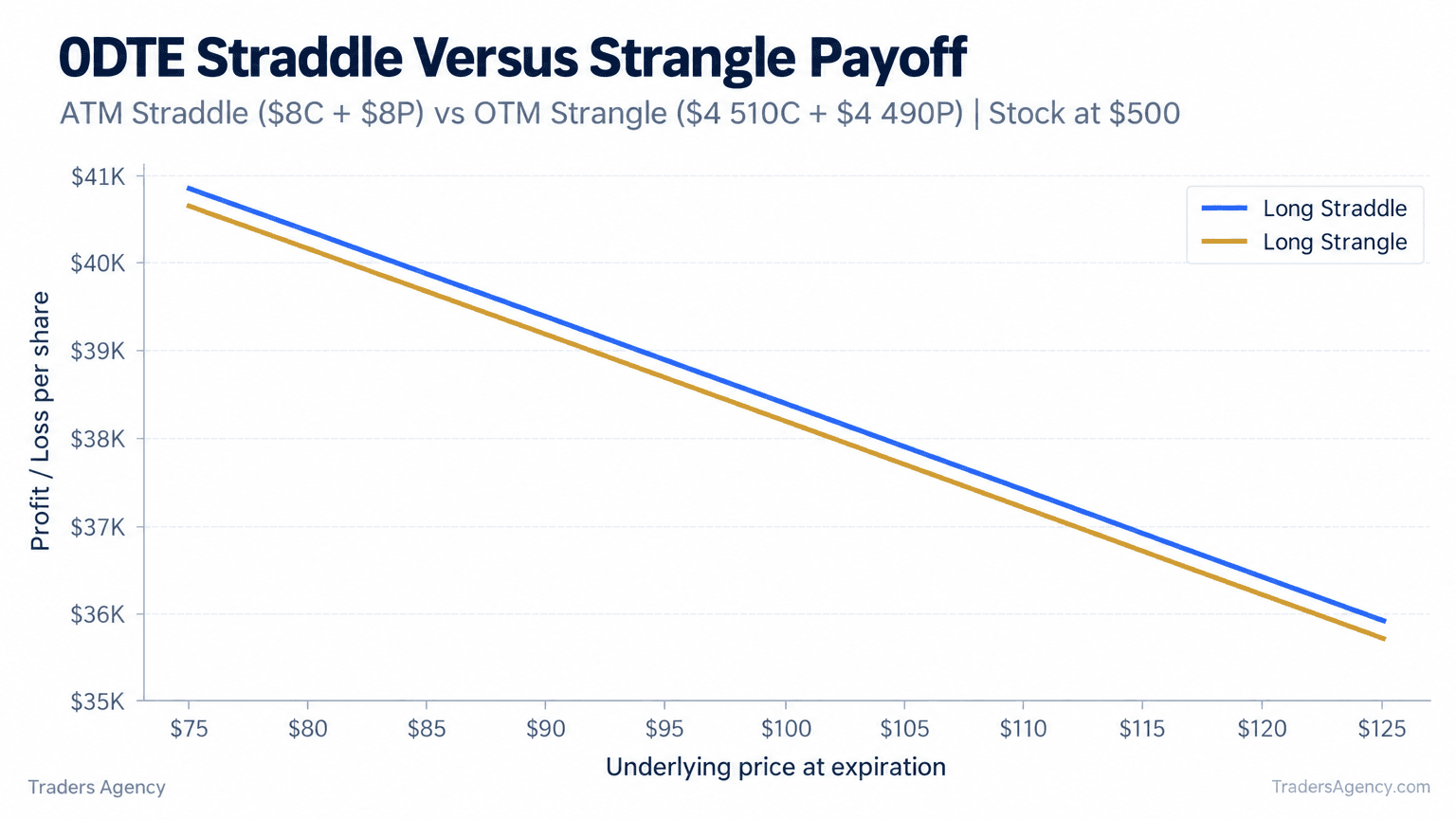
Trade 1: The Long Straddle
Buy the 5,000 call and the 5,000 put, both expiring that day.
| Parameter | Value |
|---|---|
| Underlying | SPX at 5,000 |
| Call Premium | $12.00 |
| Put Premium | $11.50 |
| Total Cost | $23.50 ($2,350 per contract) |
| Upside Breakeven | 5,023.50 |
| Downside Breakeven | 4,976.50 |
| Max Loss | $2,350 if SPX pins exactly at 5,000 into the close |
| Max Gain | Theoretically unlimited on the call side, substantial on the put side |
Trade 2: The Lower-Cost Strangle
Buy the 5,020 call and the 4,980 put instead, both slightly out of the money.
| Parameter | Value |
|---|---|
| Call Premium | $5.50 |
| Put Premium | $5.00 |
| Total Cost | $10.50 ($1,050 per contract) |
| Upside Breakeven | 5,030.50 |
| Downside Breakeven | 4,969.50 |
| Max Loss | $1,050 |
| Trade-Off | Cheaper with less capital at risk, but needs a bigger move to turn profitable |
The most likely outcome on a typical data-release day: SPX moves 15 to 25 points in one direction, which leaves the straddle at or just under breakeven (it needs more than 23.50 points of movement to profit) while the strangle finishes at a loss unless the move clears roughly 30 points. This is exactly the trade-off we walk through with members before any 0DTE options trading strategy goes live in a real account.
What Are the Best 0DTE Options Strategies?
The best 0DTE options strategy depends entirely on what you're trying to express: a directional view, a volatility bet, or a premium-collection play. There's no single winner, but a few structures show up repeatedly in professional and serious retail use.
- Long straddles or strangles: Used ahead of known events (CPI releases, Fed decisions) when a big move is expected but direction is unclear.
- Credit spreads (defined-risk): Selling an out-of-the-money vertical spread to collect premium when you expect the market to stay range-bound into the close.
- Iron condors: Two credit spreads combined to profit from low realized movement, popular with traders comfortable managing multiple legs.
- Single-leg directional buys: Simple calls or puts for traders with strong conviction on direction, accepting faster decay in exchange for simplicity.
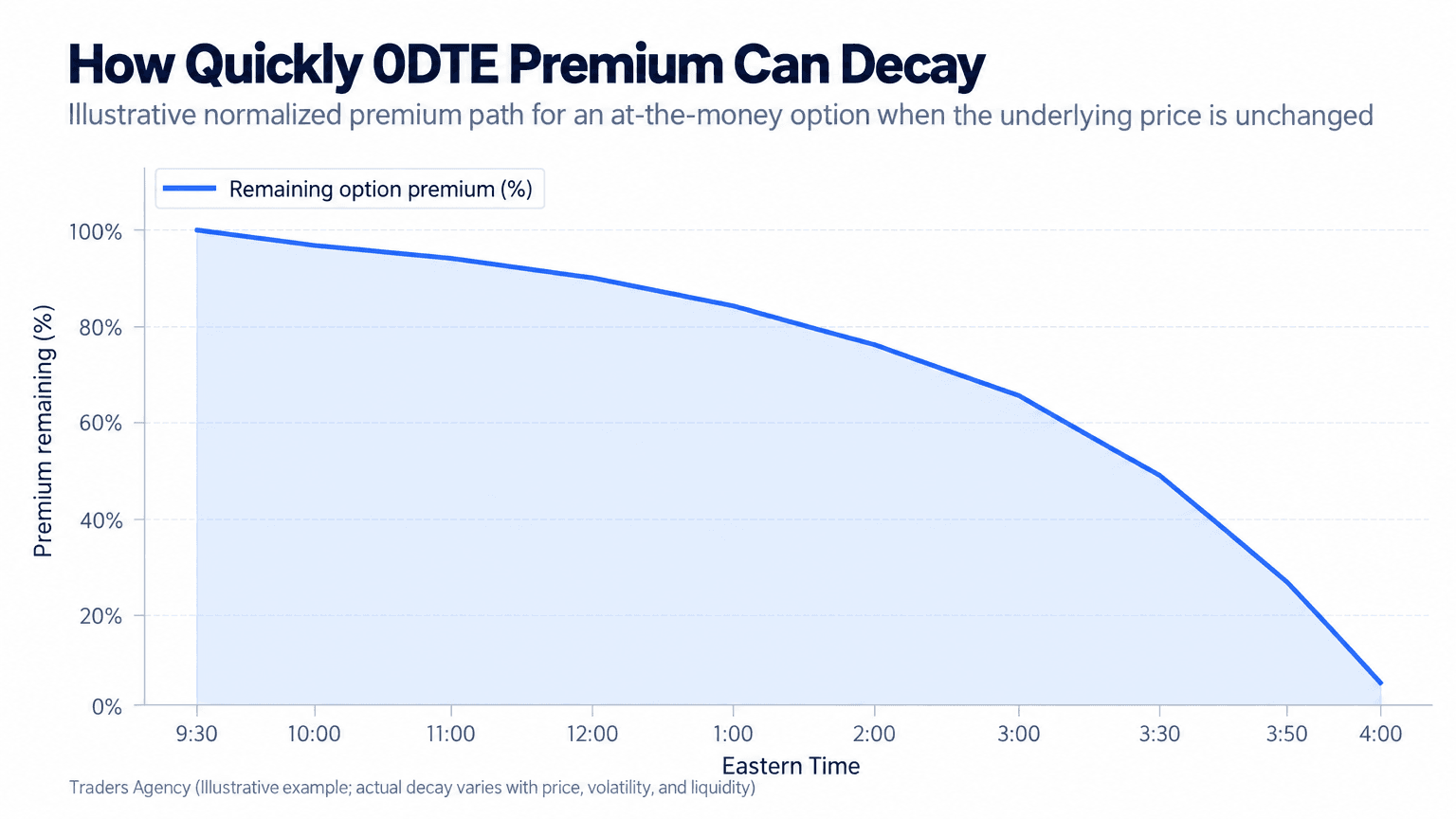
We generally steer members toward defined-risk structures (spreads and condors) over naked single-leg buying, because the decay curve on a same-day long option is brutally fast once you're past midday.
What Are Common Mistakes in 0DTE Options Trading?
The biggest mistake we see is holding a losing 0DTE position too long, hoping for a reversal the clock simply won't allow. The second is sizing positions as if they were multi-day trades, when the leverage and decay profile of a same-day contract call for noticeably smaller size.
Other errors we run into regularly:
- Trading without a hard exit plan: Entering with no predefined stop or time-based exit, then freezing when the trade moves against you.
- Ignoring real liquidity: Not every strike on the 0DTE options list has tight bid-ask spreads, and trading illiquid strikes eats returns through slippage.
- Chasing size after a loss: Doubling up to "win it back" in the same session, a pattern that turns a bad day into an account-ending one.
- Copying trades from social media: Screenshots from 0DTE options trading reddit threads rarely show the full account history, just the one lucky trade.
Watch Out: Position size is the single most common failure point in same-day options. A contract that can gain 100% in minutes can lose 100% just as fast, so we size 0DTE trades at a fraction of what we'd risk on a multi-day position.
When Should You Avoid 0DTE Options Trading?
Stay away from 0DTE options trading around major unscheduled news events, in the final 30 minutes of a volatile session, and whenever bid-ask spreads widen beyond what your planned profit target can absorb. In those conditions, execution risk outweighs any edge you think you have.
Low-liquidity windows are also poor times to initiate new positions: the open right after a long holiday weekend, or the last few minutes before the close on a quiet summer Friday. Spreads widen, fills get worse, and the mechanical edge that makes these trades viable disappears.
If you can't watch the position actively for the rest of the session, that's another reason to sit out. A 0DTE trade is not a "set it and check later" position.
What Are the Risks of 0DTE Options Trading?
Beyond individual trade risk, there's a broader structural question the market has been watching closely: dealer gamma exposure created by the sheer volume of same-day contracts now trading.
When options volume concentrates heavily around same-day expirations, market makers' hedging activity can amplify intraday price swings rather than dampen them. We treat this as a developing concern for index-level volatility, particularly on days when heavy 0DTE flow clusters around round-number strikes.
Are 0DTE options profitable? They can be, but both data and experience suggest most retail traders lose money on these contracts over time, thanks to the speed of decay and the difficulty of timing same-day moves precisely. Profitability tends to favor traders using defined-risk structures and disciplined exits over those buying directional options outright.
Keep these risk factors front of mind:
- Decay speed: Theta burn accelerates sharply in the final two to three hours of trading.
- Liquidity gaps: Spreads can widen fast during volatile moments, hurting both entries and exits.
- Pin risk: Prices settling near a heavily traded strike at expiration can create unexpected outcomes, including surprise assignment in physically settled products like SPY and QQQ (SPX is cash-settled, so no shares change hands).
- Systemic amplification: A high concentration of 0DTE volume may contribute to sharper intraday swings market-wide.
Our view is straightforward: same-day options are a legitimate tool when you pair them with defined risk, small size, and a written exit plan. They are a fast way to lose capital when you treat them as lottery tickets. Learn the mechanics first, paper trade the structures, then let real money follow a process you've already proven to yourself.
Want expert trading insights delivered daily?
Join thousands of traders who rely on Traders Agency for market analysis and trade ideas.
Join Traders AgencyDISCLAIMER: Traders Agency does not offer financial advice. The information provided is for educational purposes only and should not be considered financial advice. Traders Agency is not responsible for any financial losses or consequences resulting from the use of the information provided. Trading carries inherent risks and may not be suitable for all individuals. You are advised to conduct your own research and seek personalized advice before making any investment decisions, recognizing the potential risks and rewards involved.
See more from Traders Agency on Google
Make us a preferred source and our market analysis will appear more prominently in your Google Search, Top Stories, and AI results.
Add to Preferred Sources