
Choosing between weekly options vs monthly options is a core decision about time horizons that every trader must make. You find a great stock setup, open the options chain, and suddenly face a wall of expiration dates. It can be overwhelming to decide which expiration cycle fits your specific trade idea. We're going to walk you through exactly how these two expiration types behave differently in the live market, and by the end of this guide, you'll know precisely which one to use for your next trade.
Our team teaches traders that time is just as important as price direction when trading options. If you pick the wrong expiration date, you can lose money even if the stock moves exactly how you predicted. By the end of this guide, you will understand the mechanics behind time decay and price sensitivity, see concrete examples of how to apply these contracts to your account, and learn the specific strategies that work best for short-term trades versus long-term holds.
What Is Weekly Options Trading?
Bottom Line: The choice between weekly and monthly options is not just about cost , it is about matching the expiration to the time horizon of your trade idea. Weeklies offer lower premiums and faster setups but punish hesitation, while monthlies provide more room for a thesis to play out with less intensive daily management. Getting the expiration right matters as much as getting the direction right.
Weekly options trading is the practice of buying or selling options contracts that expire at the end of the current week, typically on Friday. Unlike standard monthly options that expire on the third Friday of every month, weeklies offer short-term trading opportunities with lower absolute premiums and faster time decay.
Standard monthly options have been the foundation of the derivatives market for decades. The Chicago Board Options Exchange (Cboe) introduced weekly options to give traders more precision around short-term events. Today, you can find a massive weekly options list for major indices and highly liquid individual companies.
Think of monthly options like renting an apartment for a full month. You pay more upfront, but you have guaranteed shelter for 30 days regardless of what happens. Weekly options are like renting a hotel room for the weekend. The upfront cost is much lower, but your time runs out very quickly.
Key Concept: Weekly options typically expire every Friday at the close of trading (4:00 PM Eastern Time). If a holiday falls on a Friday, they expire on Thursday. Monthly options always expire on the third Friday of the calendar month.
How Do Weekly Options Work?
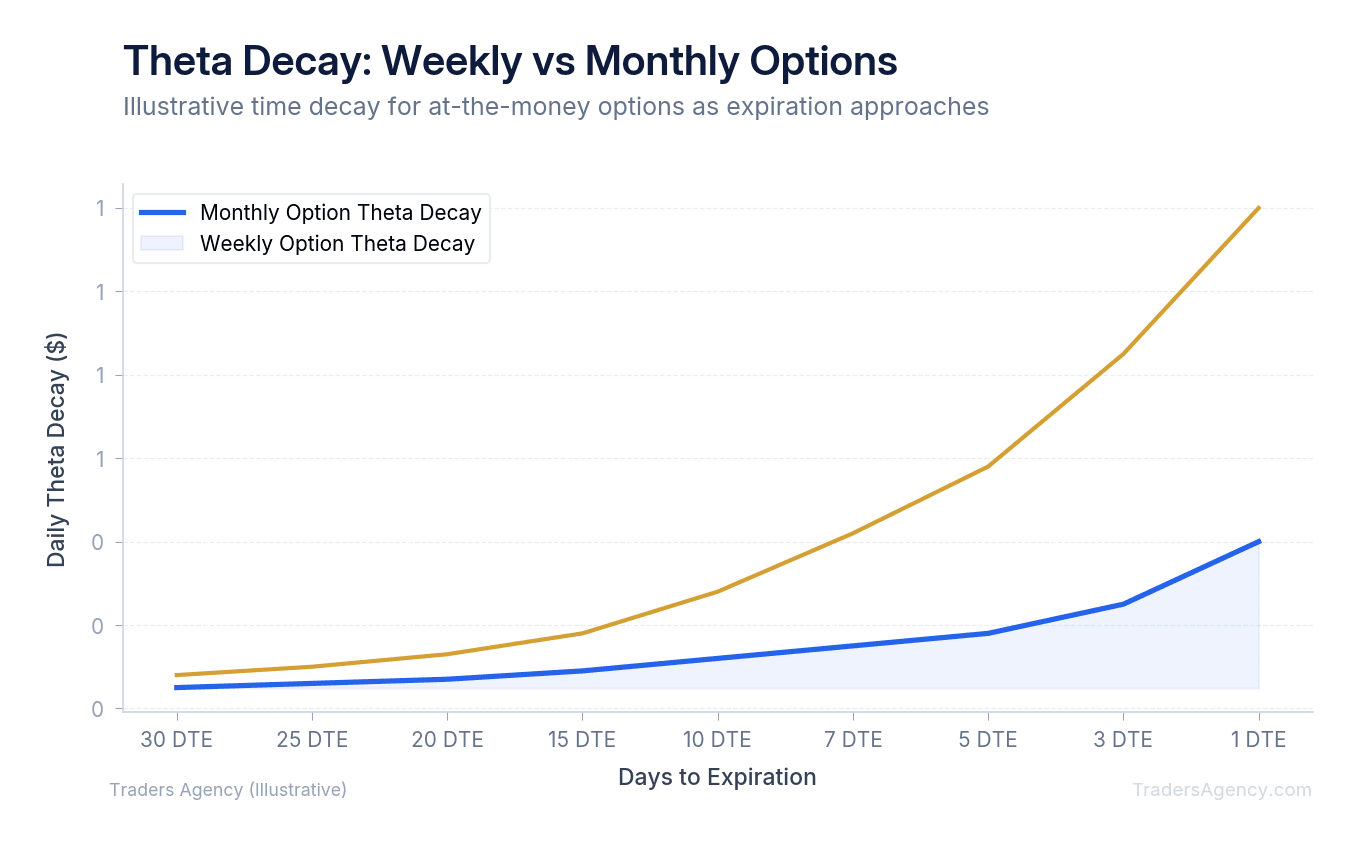
Options contracts are wasting assets. As expiration approaches, the contract loses its extrinsic value. This process is called theta decay. For weekly options, this decay happens at an incredibly rapid pace.
If you buy a weekly call option on a Monday morning, the clock is already ticking loudly. By Wednesday afternoon, if the underlying stock has not moved in your favor, the option's premium will drop significantly. The market prices in the fact that there is very little time left for the stock to make a meaningful move.
We teach our members that buying weekly options is a low-probability event. You are fighting a steep uphill battle against time. However, option sellers love weeklies. Sellers collect the premium and profit rapidly as the clock runs out.
How Monthly Options Work: More Time, Smoother Greeks
Monthly options give your trade room to breathe. Because they typically have 30 to 60 days until expiration when you enter the trade, their price movements are much smoother. The daily time decay is minimal during the first few weeks of the contract's life.
Our team recommends monthly options for beginners. They give your trade time to work out. If you buy a monthly call and the stock drops for three days, you still have four weeks for the stock to recover and push into profit territory.
Because you are buying more time, monthly options require more upfront capital. The absolute premium is higher. A monthly option might cost $300 per contract, while a weekly option on the same stock might only cost $80. You are paying a premium for the safety of time.
How Do the Greeks Compare Between Weekly and Monthly Options?
Weekly options have significantly higher theta and gamma than monthly options. This means weeklies lose their time value much faster, and their delta changes more violently with small stock movements. Monthly options feature lower daily time decay and lower sensitivity to sudden price swings.
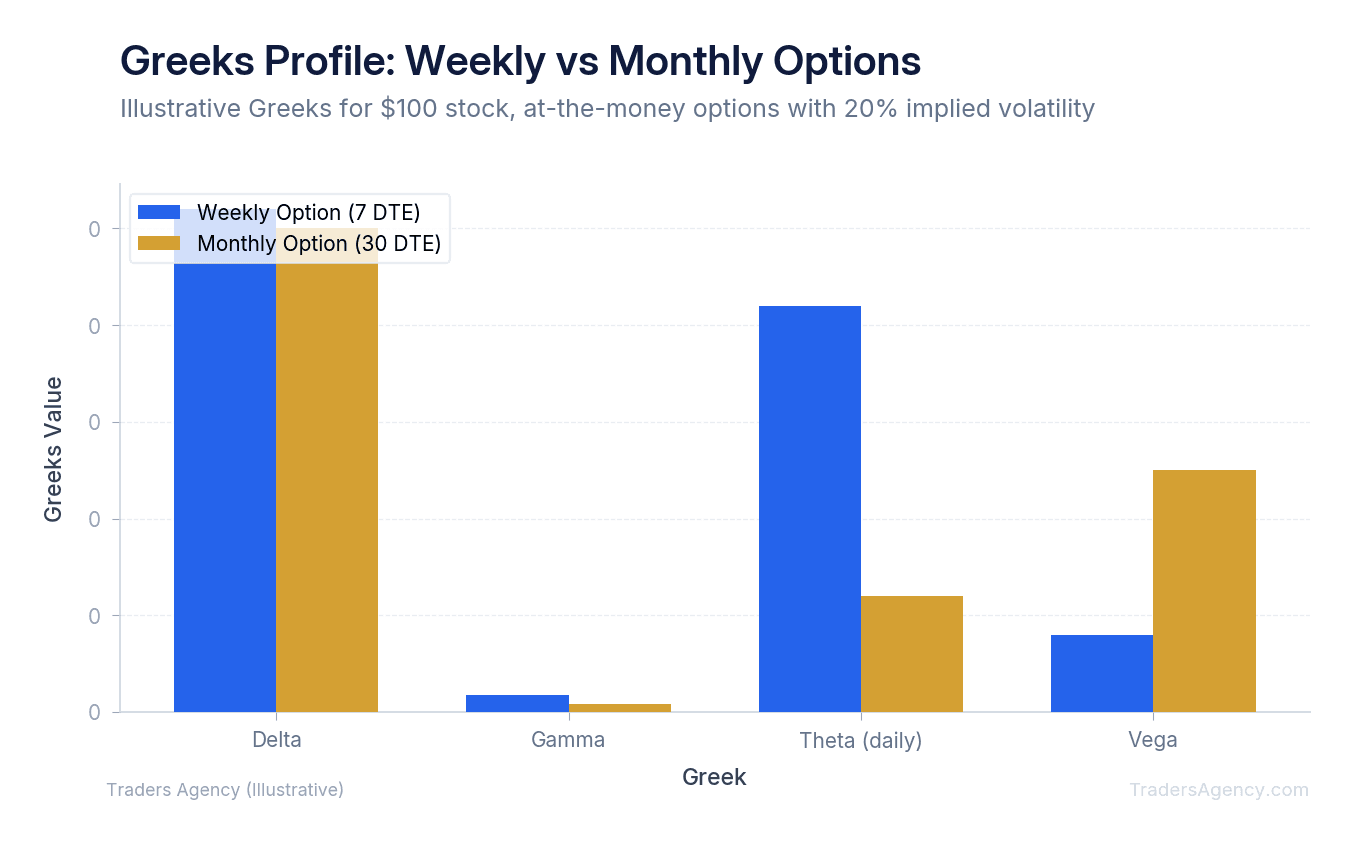
Here's how the Greeks behave differently based on the expiration timeline:
| Greek | Weekly Options | Monthly Options |
|---|---|---|
| Theta (Time Decay) | ~$12/day (3 days to expiration) | ~$2/day (30 days to expiration) |
| Gamma (Delta Sensitivity) | High: a $1 stock move can double or wipe out value | Low: delta changes slowly and predictably |
| Vega (Volatility Sensitivity) | Lower sensitivity to IV changes | Higher sensitivity to IV changes |
Watch Out: High gamma in weekly options means your position can swing from profitable to worthless in a matter of hours. If you're buying weeklies, you must monitor the trade constantly.
Want expert trading insights delivered daily?
Join thousands of traders who rely on Traders Agency for market analysis and trade ideas.
Join Traders AgencyStep-by-Step Example: A Covered Call Strategy
Here's a concrete example using real numbers. We'll look at Apple (AAPL), currently trading at $150 per share. You own 100 shares of AAPL and want to generate income by selling a covered call. You must choose between a weekly option expiring in 5 days or a monthly option expiring in 30 days.
The Weekly Execution
- Sell the $155 strike weekly call expiring this Friday.
- Collect a $1.00 premium, which equals $100 in cash deposited into your account.
- Monitor through Friday and let the option expire or close early if needed.
| Scenario | AAPL Price at Expiration | Outcome |
|---|---|---|
| Best Case | $154.99 | Option expires worthless. Keep $100 premium + 100 shares. |
| Worst Case | $130.00 | Keep $100 premium, but shares lose $2,000. Breakeven: $149.00 |
| Most Likely | ~$150 | AAPL stays flat. Collect premium and repeat next Monday. |
The Monthly Execution
- Sell the $155 strike monthly call expiring in 30 days.
- Collect a $3.50 premium, which equals $350 in cash deposited into your account.
- Monitor over the month and potentially buy the option back early once time decay does its job.
| Scenario | AAPL Price at Expiration | Outcome |
|---|---|---|
| Best Case | $154.99 | Option expires worthless. Keep $350 premium + 100 shares. |
| Worst Case | $130.00 | Keep $350 premium, shares lose $2,000. Breakeven: $146.50 |
| Most Likely | ~$150 | AAPL fluctuates. Buy back option early for a profit. |
Key Concept: Selling four consecutive weeklies might generate $400 over a month, compared to $350 for one single monthly option. However, the weekly approach requires constant management, higher trading fees, and exposes you to assignment risk four times instead of once.
Which Strategies Work Best With Weekly vs Monthly Options?
Short-term directional trades and premium-selling strategies like iron condors work well with weekly options due to rapid time decay. Monthly options are better suited for long-term directional bets, debit spreads, and beginner-friendly covered calls because they provide more time to be right.
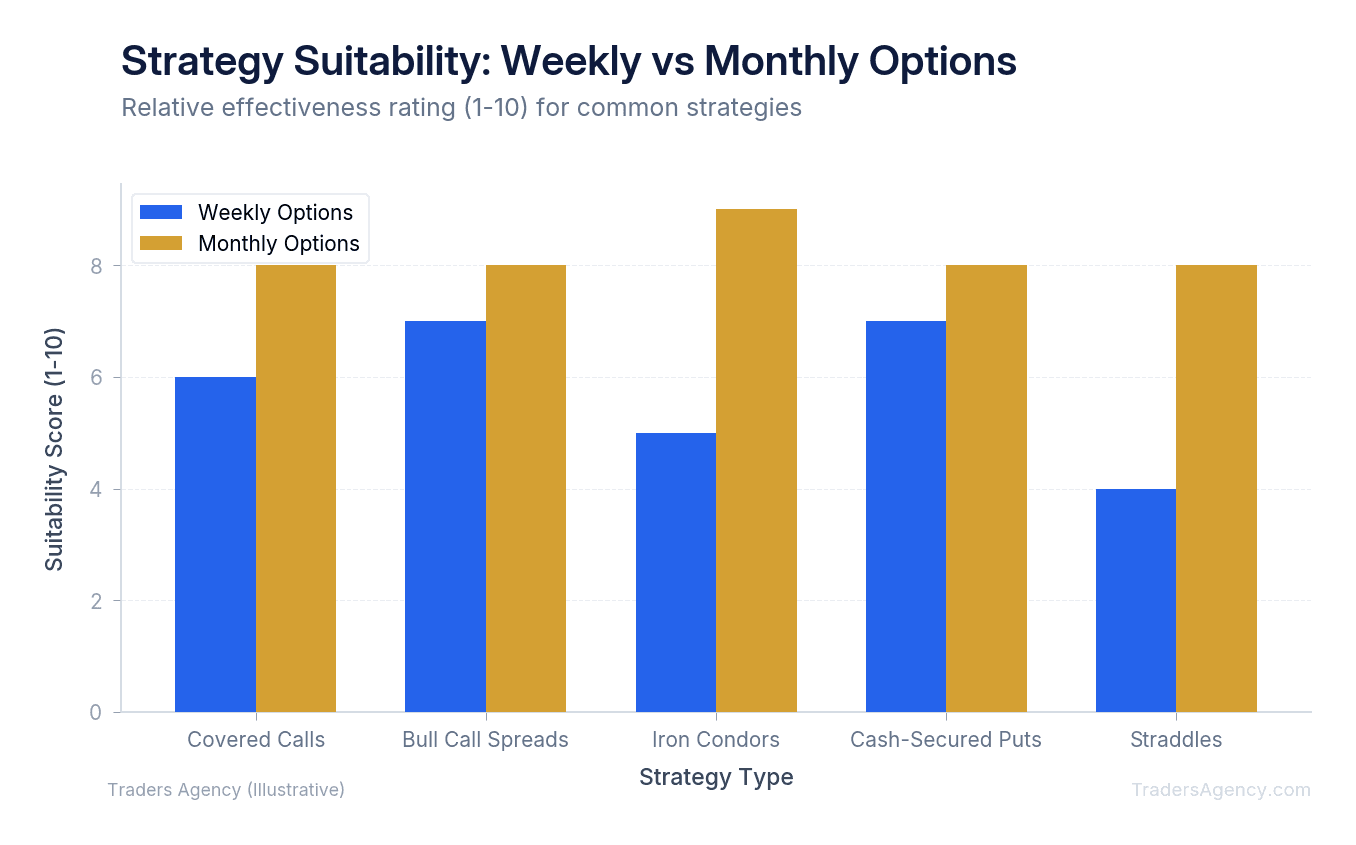
Here is exactly how our team aligns specific strategies with the correct expiration cycles:
1. Buying Long Calls and Puts
Always use monthly options when buying single-leg calls or puts. Buying weeklies is a low-probability gamble because time is working against you too quickly. We prefer to buy options with at least 45 to 60 days until expiration. This gives the stock time to make the anticipated move before theta decay destroys the contract's value.
2. Selling Credit Spreads
A highly effective strategy involves selling credit spreads on weekly expirations. Advanced traders often sell weekly credit spreads to capture rapid theta decay. You can collect premium quickly as the Friday expiration approaches. However, you must be prepared to close the trade early if the stock moves against your short strike.
3. Iron Condors
Iron condors perform exceptionally well in the 30-to-45-day window. We prefer using monthly options for iron condors because it allows us to place our short strikes further away from the current stock price. This creates a wider profit tent and a higher probability of success.
4. Covered Calls and Cash-Secured Puts
If you are looking for top stocks with weekly options to run the wheel strategy, stick to highly liquid names. You can easily find stocks with weekly options under $20 like Ford (F) or SoFi (SOFI) to practice covered calls with smaller account sizes. We suggest starting with monthly options to learn the mechanics, then transitioning to weeklies once you are comfortable managing early assignment risk.
What Are the Risks of Trading Weekly Options?
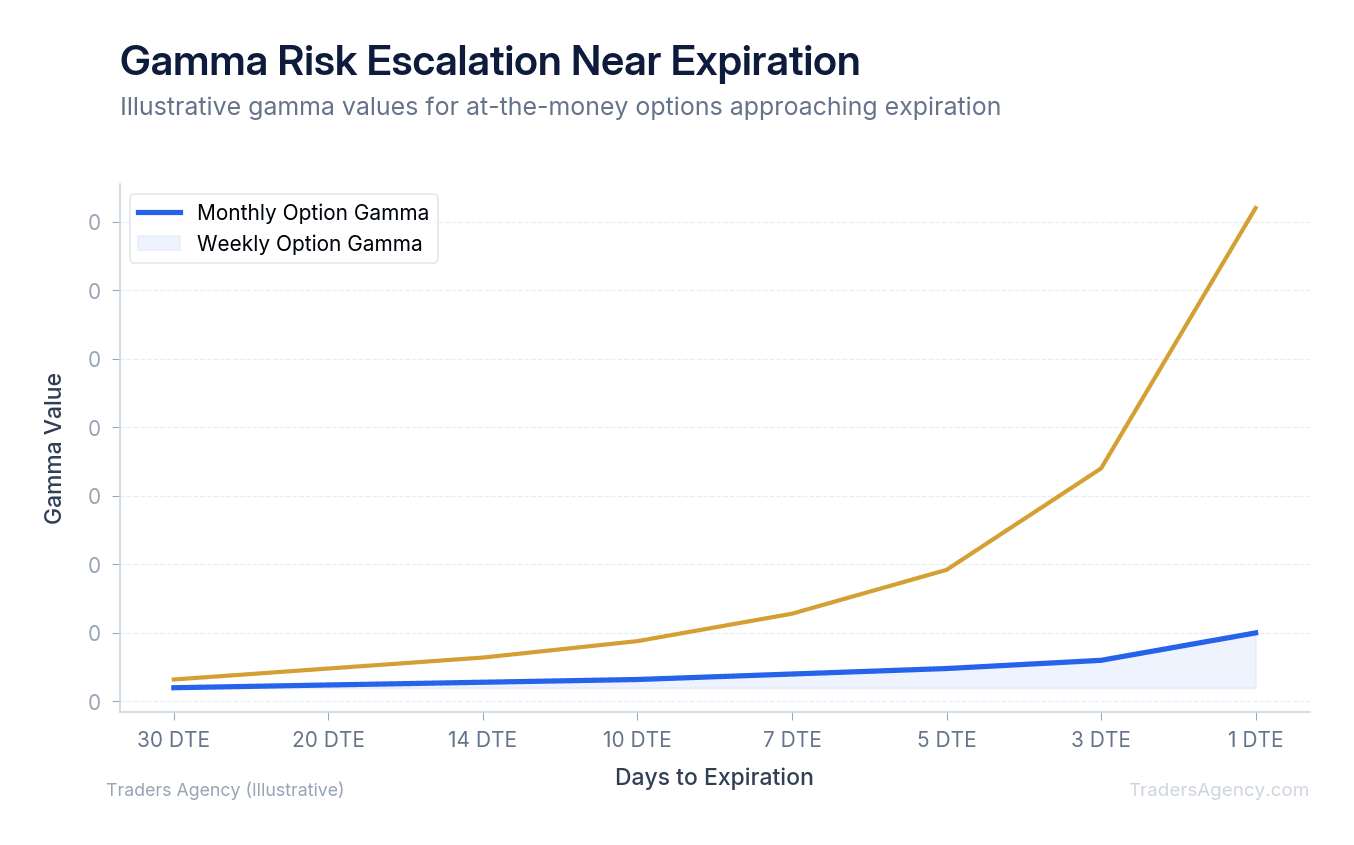
The primary risks of weekly options are accelerated time decay and extreme price volatility. Because they expire in just a few days, a minor adverse move in the underlying stock can result in a total loss of the premium paid before you can react.
Gamma risk accelerates rapidly as expiration approaches. A small dip in the stock price on a Thursday afternoon can turn a profitable weekly call into a completely worthless contract by Friday morning. The delta changes so fast that you cannot adjust your position in time.
Another major risk is assignment risk. If you sell a weekly option and the stock moves into the money, you have very little time to roll the contract out to a future date. You are highly likely to be assigned, meaning you will be forced to buy or sell the underlying shares on Friday afternoon.
Watch Out: Weekly options often suffer from wider bid-ask spreads. If a stock is not heavily traded, the gap between the bid and the ask price can eat up your entire potential profit. Always ensure the open interest is in the thousands before entering a weekly contract.
The SEC's investor education resources frequently warn retail traders about liquidity issues in short-term options. This is something we reinforce with our members constantly.
How Do You Choose Between Weekly and Monthly Options?
Your choice between weekly options vs monthly options dictates your entire risk management plan. You cannot trade them using the same position sizing rules.
Here's our framework for making the right decision:
- Define your time horizon. If you are trading an earnings report or a specific news event happening tomorrow, a weekly option provides the exact precision you need. If you are trading a long-term technical breakout on a daily chart, a monthly option is the only logical choice.
- Size your position correctly. For monthly options, we teach our members to allocate no more than 2% to 5% of their total account capital per trade. For weekly options, that allocation should drop to 1% or less. Weekly options are essentially binary events that will either pay out quickly or go to zero quickly.
- Match your expiration to your chart timeframe. Trade weekly options based on hourly or 15-minute charts. Trade monthly options based on daily or weekly charts. Aligning your timeframes is the easiest way to improve your options trading consistency.
- Set strict stop losses on weeklies. If you buy a weekly option and the contract value drops by 50%, cut the trade immediately. You do not have enough time for a recovery. Hoping for a Friday afternoon miracle is not a trading strategy.
| Factor | Weekly Options | Monthly Options |
|---|---|---|
| Best For | Event trades, premium selling, scalping | Swing trades, directional bets, beginners |
| Position Size | 1% or less of account | 2%-5% of account |
| Chart Timeframe | 15-min to hourly | Daily to weekly |
| Management | Active, daily monitoring required | Less frequent check-ins |
| Premium Cost | Lower absolute cost | Higher absolute cost |
Want expert trading insights delivered daily?
Join thousands of traders who rely on Traders Agency for market analysis and trade ideas.
Join Traders AgencyKey Takeaways
- Weekly options expire at the end of the current week (typically Friday), while standard monthly options expire on the third Friday of every month , giving traders two distinct time horizons to match against their trade thesis.
- If a weekly option drops 50% in value, the article recommends cutting the trade immediately: there is not enough time remaining for a recovery.
- Position sizing differs by expiration type: weekly options warrant 1% or less of account capital per trade, while monthly options can support 2%-5% allocations.
- Picking the wrong expiration date can result in a loss even when the stock moves in the predicted direction, because time decay works against the buyer regardless of price movement.
- Weekly options fit event-driven trades, premium selling, and scalping on 15-minute to hourly charts; monthly options are better suited to swing trades, directional bets, and less active management on daily to weekly charts.
DISCLAIMER: Traders Agency does not offer financial advice. The information provided is for educational purposes only and should not be considered financial advice. Traders Agency is not responsible for any financial losses or consequences resulting from the use of the information provided. Trading carries inherent risks and may not be suitable for all individuals. You are advised to conduct your own research and seek personalized advice before making any investment decisions, recognizing the potential risks and rewards involved.
See more from Traders Agency on Google
Make us a preferred source and our market analysis will appear more prominently in your Google Search, Top Stories, and AI results.
Add to Preferred Sources