
You've probably seen this happen before. You find a perfect trade setup, but buying a straight call option requires too much upfront capital. You want to reduce your cost by selling another option against it, but you worry about the market moving while you try to enter both trades separately. That's exactly the problem a multi leg options order solves, and we're going to show you how to use them properly.
What Is a Multi-Leg Options Order?
Bottom Line: Multi-leg options orders exist to solve one specific problem: the execution gap that creates unintended risk when you try to build a spread one leg at a time. The practical takeaway is that strict limit pricing, per-leg liquidity checks, and aggregated Greek monitoring are what separate clean executions from costly ones. Get those three things right and the broker's routing does the rest.
A multi-leg options order is a single trade execution that simultaneously buys and sells multiple option contracts with different strike prices or expiration dates. Instead of buying a call and selling another call in separate steps, the broker routes them together. This means all legs fill together or not at all.
Think of it like ordering a combo meal at a restaurant instead of buying a burger, fries, and a drink separately. The broker packages your individual option contracts into a single order ticket. You get one fill confirmation, one net price, and zero gap between executions.
Key Concept: A multi-leg options order combines two or more option contracts into a single execution package. All legs fill together, eliminating the risk of partial fills and adverse price movement between entries.
The primary reason our team recommends this approach is to eliminate leg risk. Leg risk occurs when you try to build a spread manually. If you buy your long call and the underlying stock price suddenly drops before you can sell your short call, your expected pricing is completely ruined. A combined order prevents this by requiring the exchange to fill all parts of the trade together or reject the entire order.
This packaging process involves combining multiple strikes and expirations. The more contracts you add to the ticket, the more complex the pricing becomes.
What Are the Most Common Multi-Leg Option Strategies?
The most common multi-leg option strategies include vertical spreads, iron condors, straddles, and butterflies. These setups combine multiple option contracts to define risk, lower upfront capital requirements, or generate income. Traders use them to profit from specific market conditions like high volatility or sideways price action.
A vertical spread is the simplest form, using exactly two legs. You buy one option and sell another of the same type (call or put) in the same expiration cycle. This caps your maximum profit but heavily reduces your total capital at risk.
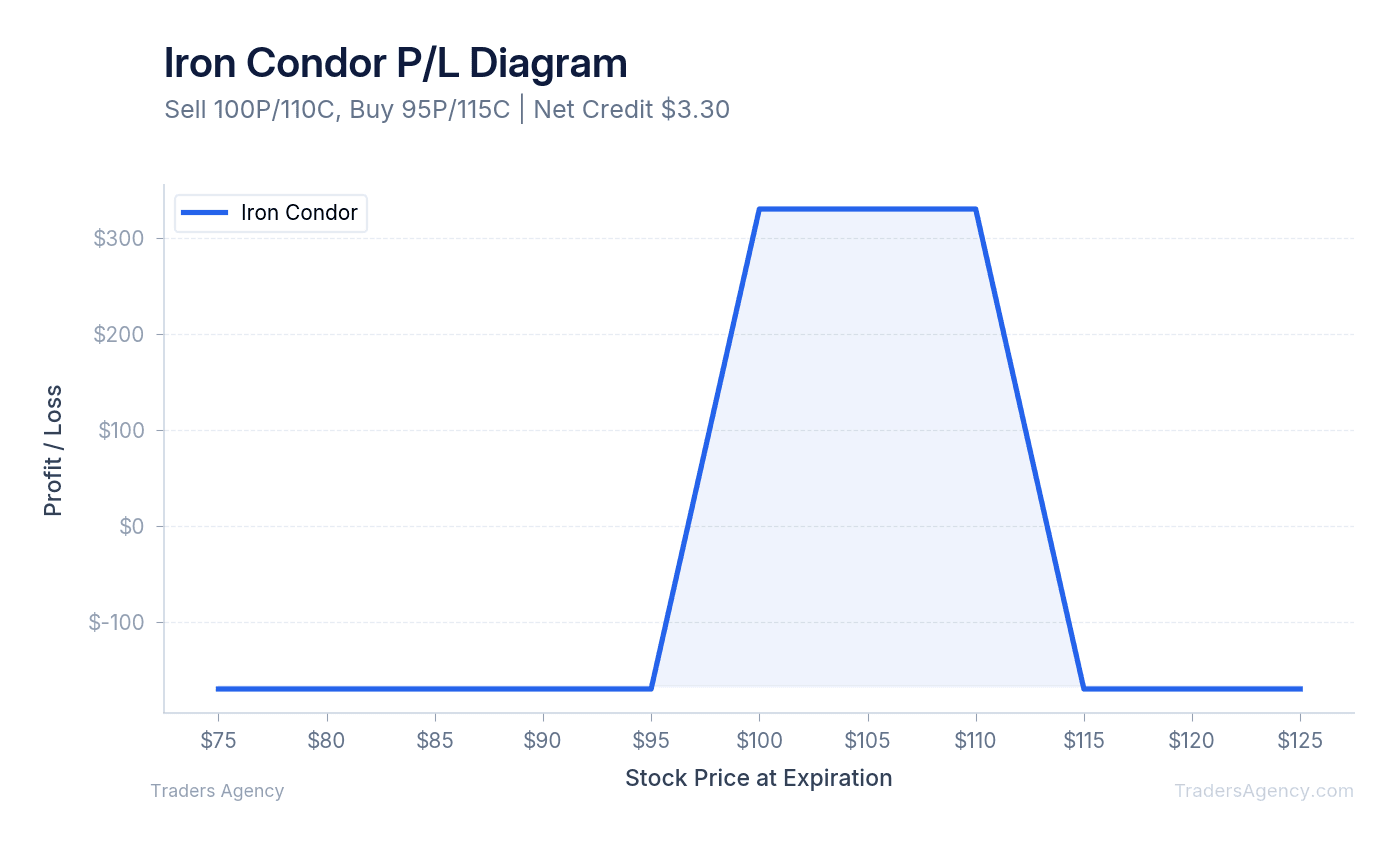
An iron condor is a classic four-leg strategy. It involves selling a call spread and selling a put spread on the same underlying asset. You want the stock to stay between your short strikes so all options expire worthless.
While two and four-leg strategies are standard, some professional traders take this much further. You might occasionally hear about a 6-leg option strategy or even an 8-leg option strategy. These highly complex setups usually involve layering multiple condors or adding ratio hedges to an existing portfolio. For the vast majority of retail traders, anything beyond four legs creates unnecessary execution hurdles and excessive commission costs.
What Is a Multi-Leg Limit Order?
A multi-leg limit order is a specific instruction to your broker to execute a complex options trade only at your specified net price or better. This guarantees you will not pay more or receive less than your target amount for the entire combined package of options contracts.
When you trade a single option, you look at the bid and ask price for that specific contract. When you trade a spread, you must look at the net price of all contracts combined. If you use a market order, the broker will cross the bid-ask spread on every single leg of your trade. This results in terrible fill prices.
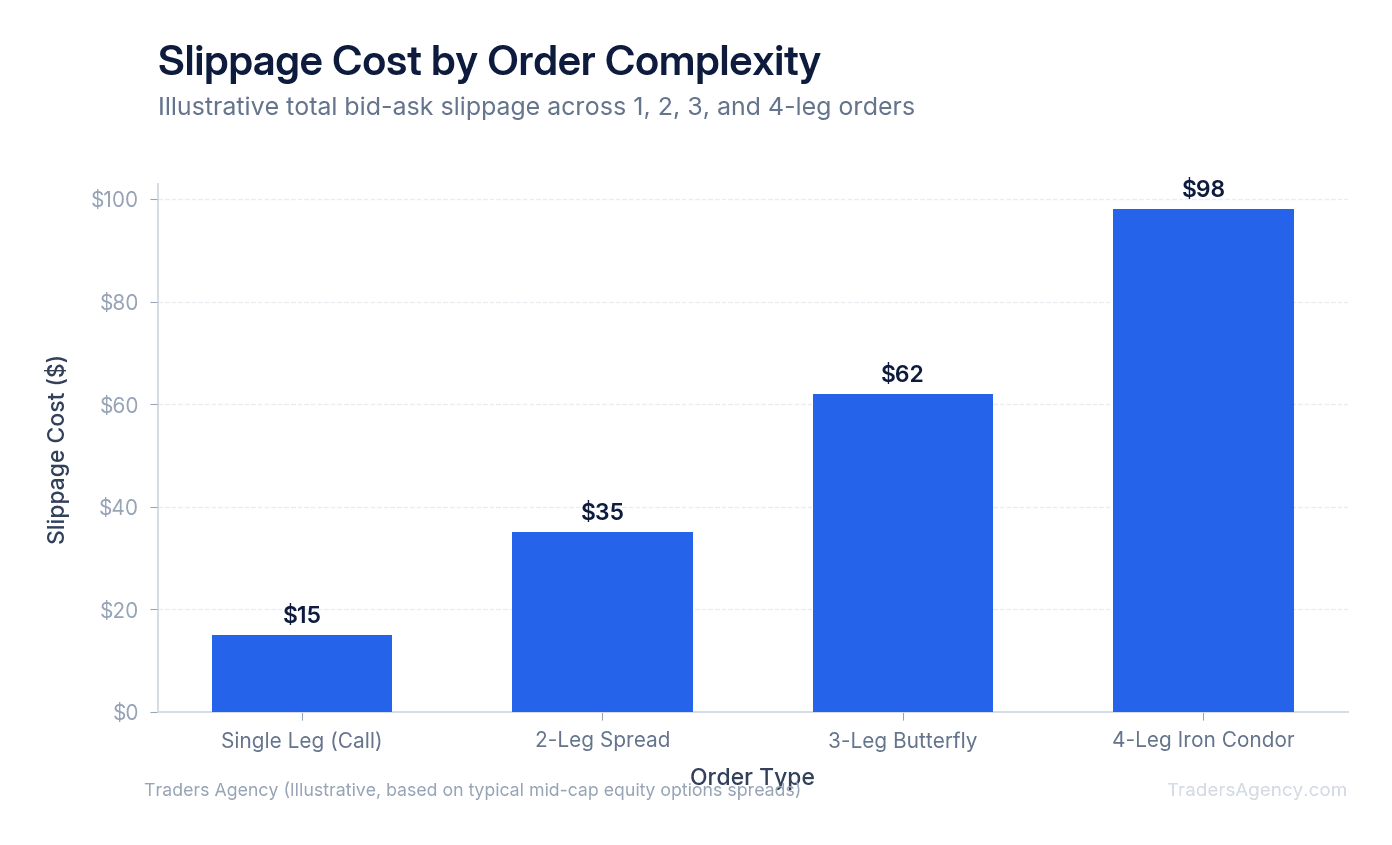
We teach our members to always use limit orders for complex spreads. Slippage is the difference between the expected price of a trade and the price at which it actually executes. When you route a multi-leg order, slippage compounds across each leg.
If you trade a four-leg iron condor and you lose $0.05 to the bid-ask spread on each leg, you have instantly surrendered $0.20 (or $20 per contract) just to enter the trade.
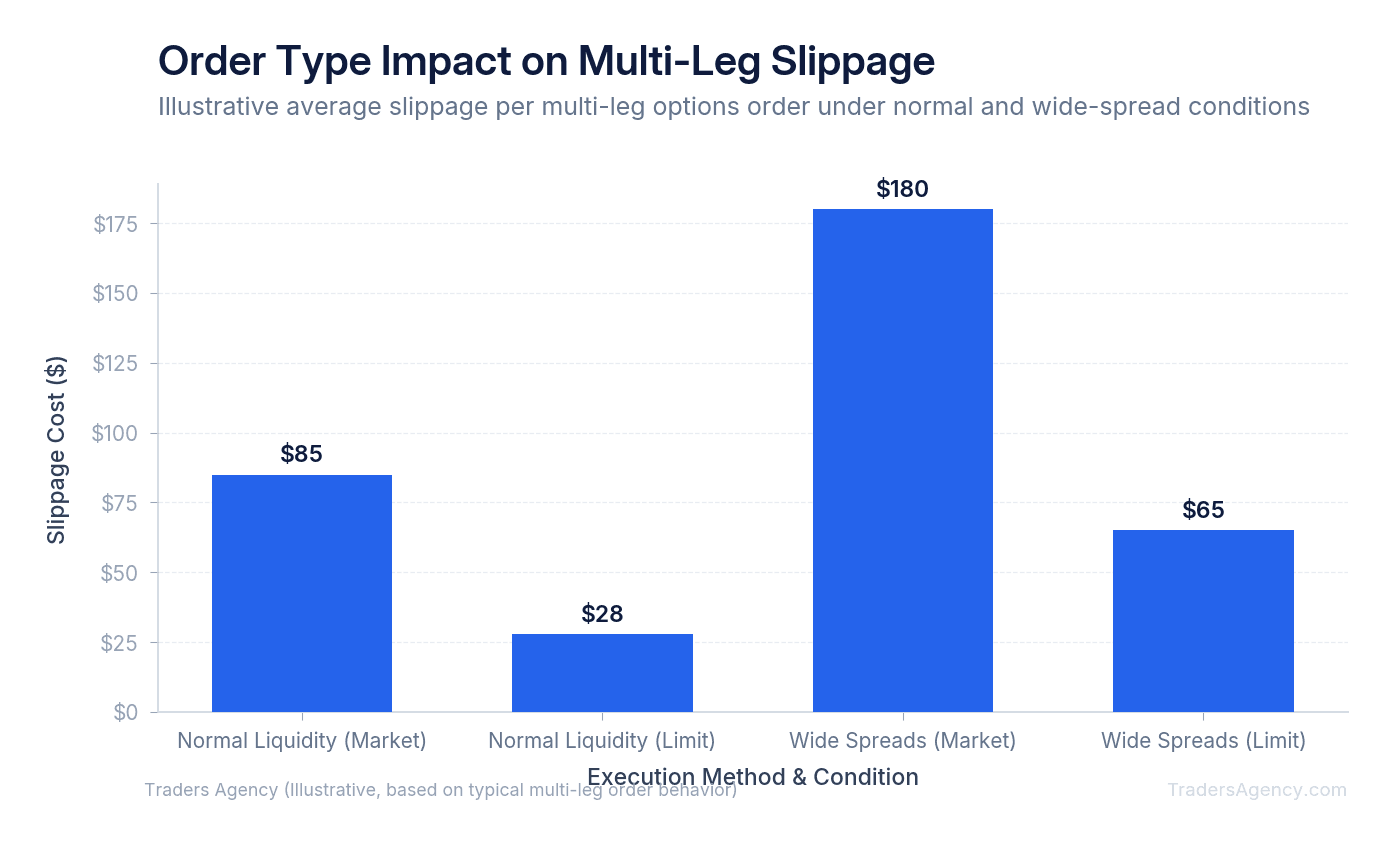
Watch Out: Never use market orders on multi-leg spreads. Market makers will fill you at the worst possible price on every leg, compounding your slippage. A missed trade is always better than entering at a massive mathematical disadvantage.
By setting a strict limit price, you force the market makers to meet your terms. If they refuse, the trade simply does not fill. Missing a trade is always better than entering a trade at a massive mathematical disadvantage.
Want expert trading insights delivered daily?
Join thousands of traders who rely on Traders Agency for market analysis and trade ideas.
Join Traders AgencyHow Does a Multi-Leg Options Order Work Step by Step?
To understand how this works in practice, we'll walk through a concrete multi-leg options order example using a bullish vertical call spread. We'll use a hypothetical setup on Apple (AAPL) to demonstrate the mechanics.
Assume AAPL is currently trading at $150 per share. You believe the stock will rise to $155 over the next 30 days. Buying the $150 strike call option outright costs $4.00 (or $400 total). You want to reduce this cost.
- Structure the Trade: Instead of buying the single call, you decide to build a debit spread. You will buy the $150 call and simultaneously sell the $155 call in the same expiration cycle.
- Buy to Open 1 AAPL $150 Call (Ask price: $4.00)
- Sell to Open 1 AAPL $155 Call (Bid price: $1.50)
- Calculate the Net Price: You do not enter these as two separate trades. You open your broker's order ticket and select a vertical spread. You input both legs. The gross cost of the long call is $4.00, but you receive $1.50 in premium for the short call. Your net cost is $2.50 (or $250 total). You enter a limit order for exactly $2.50.
- Understand the Outcomes: By using a multi-leg options order, you clearly define your risk and reward before the trade even executes. Review the table below for the complete breakdown.
| Parameter | Value |
|---|---|
| Underlying | AAPL at $150 |
| Long Leg | $150 Call, paid $4.00 |
| Short Leg | $155 Call, received $1.50 |
| Net Debit | $2.50 ($250 total) |
| Maximum Risk | $250 (AAPL closes below $150) |
| Maximum Reward | $250 (AAPL closes above $155) |
| Breakeven Point | $152.50 |
Many traders use a multi-leg options calculator provided by their brokerage to visualize these exact breakeven points and maximum loss scenarios before they click the buy button.
How Do You Manage Risk When Running Multi-Leg Options Positions?
When you trade multiple option contracts together, you cannot look at the risk of each leg in isolation. You must manage the net risk of the entire position. This requires understanding how the "Greeks" aggregate across your trade.
The Greeks are mathematical calculations that measure how an option's price responds to changes in the market. The three most important metrics for complex orders are delta, theta, and vega.
When you buy an option, you have positive exposure. When you sell an option, you have negative exposure. In a complex spread, these values offset each other.
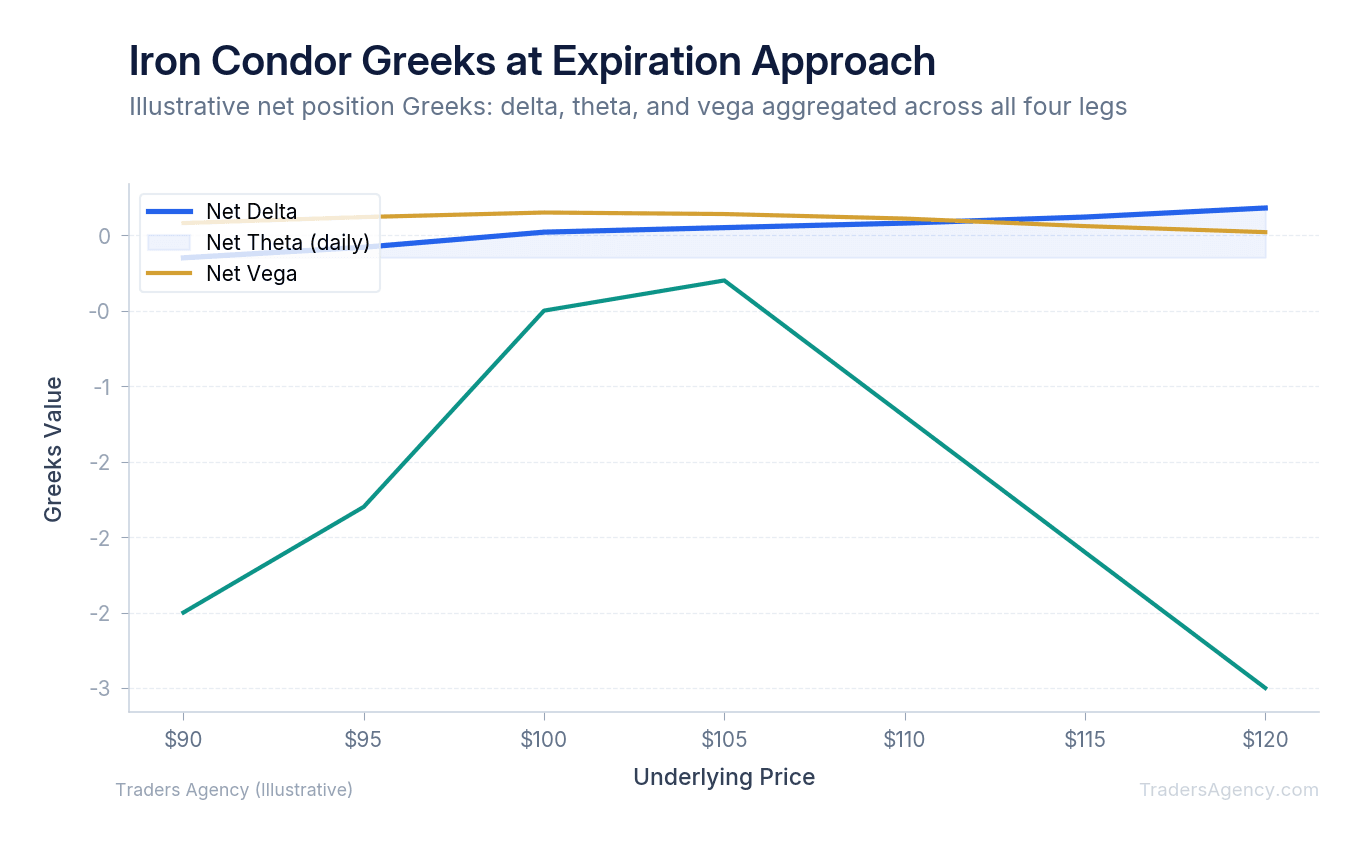
If your long call has a delta of 0.50 and your short call has a delta of -0.30, your position has a net delta of 0.20. This means your combined spread will gain roughly $0.20 for every $1.00 the underlying stock moves up.
Our team prefers to track net theta closely. Theta measures time decay. If you are trading an iron condor, your short options will decay faster than your long options. This gives your overall position a positive net theta, meaning the trade makes money from the simple passage of time.
Key Concept: In a multi-leg position, your net Greeks tell the real story. A positive net theta means time is working in your favor. A low net delta means you have minimal directional exposure. Always manage the aggregate, not the individual legs.
You must also manage your overall account allocation. We recommend risking no more than 2% to 3% of your total account equity on any single spread. Because multi-leg trades often have capped maximum losses, it is easy to calculate exactly how many contracts you can afford to trade while staying within your risk parameters.
Platform-Specific Execution Tips for Multi-Leg Orders
Not all brokerages handle complex orders the same way. The routing algorithms and order books differ significantly depending on the platform you choose.
Most major brokers route these trades to the Complex Order Book (COB) at the Chicago Board Options Exchange (Cboe). The COB is a specialized matching engine designed specifically to pair up buyers and sellers of spreads. Routing to a dedicated complex order book generally provides better pricing than trying to fill individual legs on the open market.
If you are using Fidelity's multi-leg options tools, you will find their "Directed Trade" feature highly useful. Fidelity allows you to build your spread and view the net bid and ask prices clearly. They also provide a price improvement algorithm that frequently fills limit orders a few pennies better than your requested price.
Interactive Brokers caters to advanced traders by offering a tool called the SpreadTrader. This interface allows you to view a matrix of all possible combinations for a specific expiration cycle. You can click directly on the matrix to populate a complex order ticket instantly.
TD Ameritrade (now part of Schwab) uses the thinkorswim platform. We find their "Analyze" tab to be the best tool for visualizing multi-leg risk. You can build your trade, simulate price changes, and adjust the date to see exactly how your net Greeks will perform over time.
Universal Execution Rules
Regardless of the platform you use, follow these rules every time you enter a multi-leg order:
- Never use market orders on spreads. Always use limit orders at your target net price.
- Always check open interest on individual legs. If one leg of your spread has zero open interest, the market maker will widen the bid-ask spread dramatically, making it very difficult to get a fair fill.
- Avoid the first 15 minutes of the trading day. Options pricing is often erratic right after the opening bell, and bid-ask spreads are at their widest.
- Start at the mid-price and adjust. Place your limit order at the midpoint between the net bid and net ask. If it doesn't fill within a few minutes, move your price by $0.01 to $0.02 increments toward the natural side.
Watch Out: If one leg of your spread has very low open interest or wide bid-ask spreads, your entire multi-leg order will suffer from poor execution quality. Always verify liquidity on every individual leg before submitting the combined order.
By taking the time to understand how these orders execute and how to manage the net risk, you can trade spreads with confidence. Stick to strict limit pricing, monitor your aggregated Greeks, and let the broker's routing algorithms do the heavy lifting.
Want expert trading insights delivered daily?
Join thousands of traders who rely on Traders Agency for market analysis and trade ideas.
Join Traders AgencyKey Takeaways
- A multi-leg options order routes all contracts simultaneously, meaning every leg fills together or not at all, which eliminates the gap risk of building a spread manually.
- Leg risk is the core problem this order type solves: if you buy a long call and the stock drops before you can sell the short call, you are exposed to a loss that a combined order would have avoided entirely.
- When adjusting your limit price to get a fill, move in $0.01 to $0.02 increments toward the natural side rather than jumping to the market price.
- Low open interest or wide bid-ask spreads on even one leg will degrade execution quality for the entire multi-leg order, so verify liquidity on every individual leg before submitting.
- Managing a multi-leg position requires monitoring aggregated Greeks across all legs, not just the individual contracts in isolation.
DISCLAIMER: Traders Agency does not offer financial advice. The information provided is for educational purposes only and should not be considered financial advice. Traders Agency is not responsible for any financial losses or consequences resulting from the use of the information provided. Trading carries inherent risks and may not be suitable for all individuals. You are advised to conduct your own research and seek personalized advice before making any investment decisions, recognizing the potential risks and rewards involved.
See more from Traders Agency on Google
Make us a preferred source and our market analysis will appear more prominently in your Google Search, Top Stories, and AI results.
Add to Preferred Sources