
You've probably watched a stock climb steadily, hit a specific price, and suddenly drop like it slammed into an invisible ceiling. Or maybe you've seen a stock fall for days, only to bounce perfectly off a specific dollar amount. That's not random chance. Those reactions happen because millions of market participants are watching the exact same support and resistance price levels. By the end of this guide, you'll know exactly how to spot these hidden barriers, draw them on your charts, confirm them with volume, and trade them with confidence.
What Are Support and Resistance Levels?
Bottom Line: Support and resistance are not arbitrary lines on a chart. They are price zones where real orders from real participants are concentrated, which is exactly why price reacts at the same levels repeatedly. Master the skill of identifying these zones across multiple timeframes, confirm them with volume, and every other technical strategy you apply will become sharper and more reliable.
Support and resistance levels are specific price points on a chart where buying or selling pressure historically pauses or reverses a stock's trend. Support acts as a price floor where buyers step in to stop a decline. Resistance acts as a price ceiling where sellers take control to halt an advance. These levels form because traders remember where price has reacted before, and they place orders around those same zones again and again.
We keep our charts clean and simple, focusing only on the levels that actually matter. Our approach strips away the noise so you can see the price zones that institutional traders, algorithms, and retail participants are all watching at the same time.
Key Concept: Support is a price floor where buying pressure stops a decline. Resistance is a price ceiling where selling pressure stops an advance. These levels work because large numbers of traders place orders at the same historical price points.
How to Draw Support and Resistance on a Chart
To draw support and resistance, you need to identify areas where price has reversed direction at least two or three times. You connect these historical peaks or troughs with horizontal lines to create price zones. These lines help you anticipate where future price movements might stall or reverse.
Many new traders make the mistake of drawing dozens of lines on their screen. That just creates confusion. We teach our members to focus on the most obvious, well-tested levels. If a level doesn't jump off the chart at you, it probably isn't worth marking.
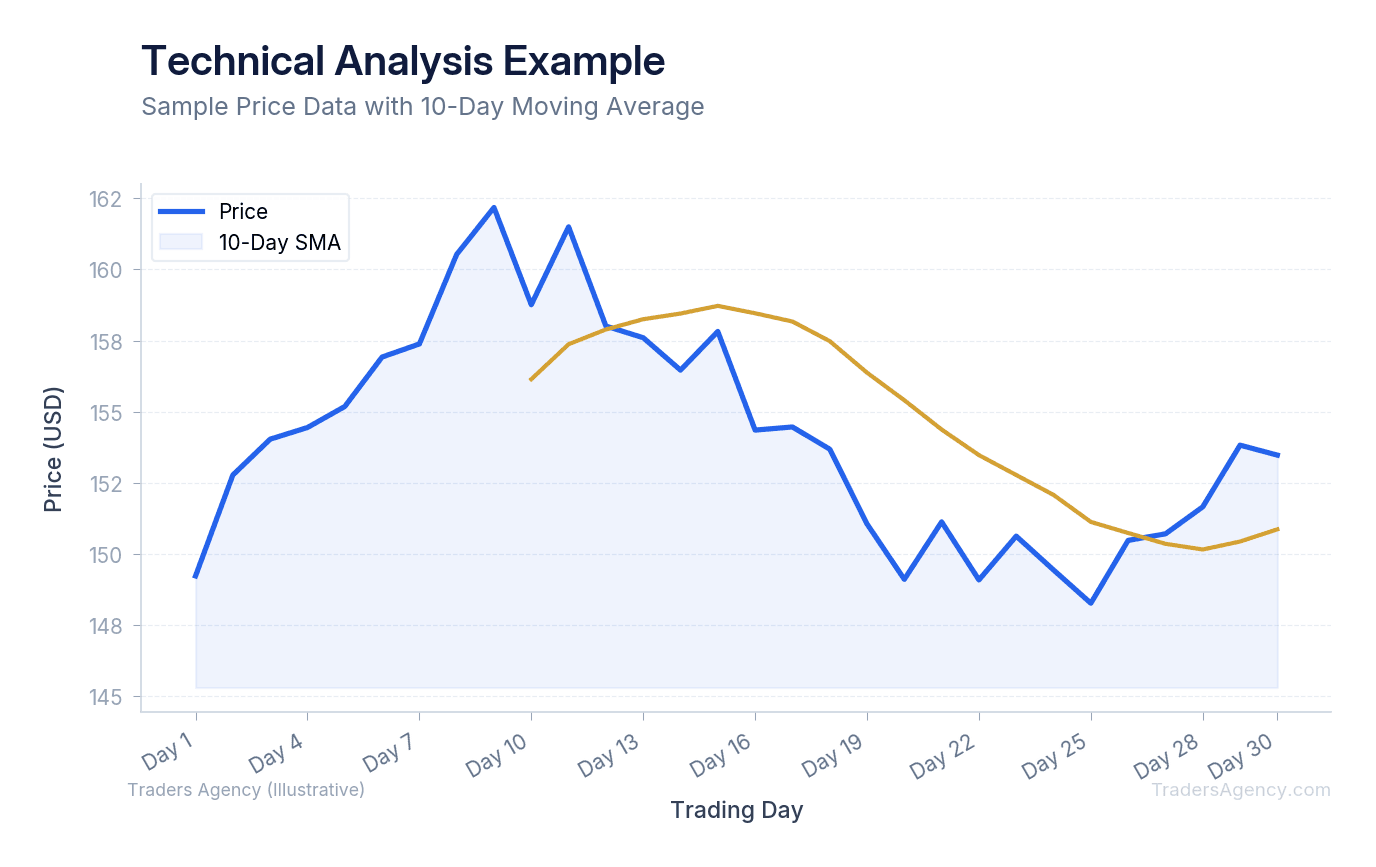
Here is the exact process our team uses to map out a chart:
- Start on a Higher Timeframe. We always begin our analysis on a higher timeframe than the one we plan to trade. If you want to day trade on a 5-minute chart, find your major levels on the daily chart or hourly chart first. Higher timeframes carry more weight because they represent a larger sample size of buying and selling decisions.
- Identify the Obvious Peaks and Valleys. Look for the extreme highs and extreme lows on your screen. You want to find "V-shaped" bounces or sharp rejections. If a stock rallied to $150.00 and immediately sold off, that's a clear point of resistance. If it dropped to $135.00 and quickly bounced back up, that's a clear point of support.
- Apply the 3-Touch Rule. A single bounce is just a data point. Two bounces create a potential trend. Three touches suggest a well-established support or resistance level. We look for areas where price has tested a level at least three times without breaking through. Keep in mind, though, that each test also absorbs some of the resting orders at that price, so a level tested too many times may eventually give way.
- Draw Zones, Not Just Lines. Price rarely stops at the exact same penny every time. Instead of drawing a single thin line, we recommend drawing a narrow rectangle to represent a price zone. A stock might find support anywhere between $49.80 and $50.20. Treating these areas as zones prevents you from getting shaken out of a trade just because the price dipped slightly below a whole number.
Why Does Broken Support Turn Into Resistance?
This is one of the most reliable patterns in technical analysis, and it all comes down to market psychology and trapped traders. When a stock falls below a known support level, buyers who purchased at that floor are now losing money. When the price eventually rises back to that original level, those trapped buyers sell to break even, creating new resistance.
This concept is known as polarity. Understanding the mechanics behind it will give you a significant edge.
Imagine a scenario where Ticker XYZ has bounced off $100.00 four different times over the past month. Retail traders and large institutions alike recognize this floor. They buy shares at $100.00, expecting another bounce.
Suddenly, bad news hits the market. The stock crashes straight through the support level and drops to $90.00.
Think about the psychology of the buyers who bought at $100.00. They're sitting on a painful loss. They don't want to sell at $90.00 and lock in that loss. Instead, they hold on and hope the stock recovers. When the stock finally climbs back to $100.00, those trapped buyers are thrilled just to get their money back. They hit the sell button to exit at breakeven.
This flood of selling pressure turns the old support floor into a brand new resistance ceiling. The exact opposite happens when a stock breaks out above resistance. That old ceiling becomes a new floor as buyers step in to defend their breakout level.
Key Concept: The Rule of Polarity. When support breaks, it becomes resistance. When resistance breaks, it becomes support. This happens because trapped traders create new order flow at the old level.
Why Do Psychological Round Numbers Act as Support and Resistance?
Support and resistance levels don't just form at random prices. They frequently occur at clean, round numbers. Humans naturally think in whole numbers, and this psychology directly impacts how the stock market functions.
Retail investors tend to place limit orders at whole numbers. If a trader wants to buy a stock, they rarely place an order at $48.73. They usually place it at $50.00 or $45.00. This order clustering behavior directly affects price action at round numbers. It creates massive clusters of buy and sell orders at specific intervals:
- Decade numbers: Prices ending in zero like $20.00, $50.00, or $80.00.
- Century numbers: Major milestones like $100.00, $200.00, or $500.00.
- Half-century numbers: Midpoints like $50.00 or $150.00.
When a stock approaches a major milestone like $100.00, it almost always experiences turbulence. Sellers place profit targets just below the century mark at $99.90 to ensure their orders fill. Buyers place stop losses just below the level at $99.50. This concentration of orders creates a self-fulfilling prophecy, turning the round number into a heavy resistance zone.
Our team teaches traders to anticipate these reactions. If you're holding a profitable trade and the stock is approaching a major century mark, we recommend taking partial profits before the price actually hits the round number.
Want expert trading insights delivered daily?
Join thousands of traders who rely on Traders Agency for market analysis and trade ideas.
Join Traders AgencyHow Do You Use Volume to Confirm Support and Resistance Levels?
Volume is the total number of shares traded during a specific period. We use volume to determine whether a support or resistance level is actually significant. A price level is only meaningful if large amounts of money change hands there.
If a stock bounces off a support level on very low volume, we don't trust the bounce. Low volume means institutional buyers aren't participating. If a stock bounces off a support level on massive volume, we pay close attention. High volume proves that major market participants are actively defending that price.
Here's how we read volume at key levels:
- High Volume Rejections: If a stock hits resistance and gets rejected with volume that is double its average daily volume, that ceiling is incredibly strong.
- Low Volume Breakouts: If a stock breaks through resistance but the volume is lighter than normal, it's likely a false breakout. The price will probably fall right back below the line.
- High Volume Breakouts: If a stock pushes through a resistance ceiling on a massive volume spike, the breakout is legitimate. Buyers have overwhelmed the sellers.
| Volume Signal | What It Means | How to Trade It |
|---|---|---|
| High volume rejection at resistance | Sellers are firmly in control | Avoid buying; consider a short or wait for a pullback |
| Low volume breakout above resistance | Likely a false breakout (bull trap) | Do not chase; wait for a retest on higher volume |
| High volume breakout above resistance | Confirmed breakout with real buying pressure | Enter long after candle closes above the level |
| High volume bounce at support | Institutional buyers are defending the floor | Enter long with a stop below the support zone |
| Low volume bounce at support | Weak bounce; support may not hold | Stay on the sidelines until volume confirms |
Here's a specific example. Assume a stock trades an average of 2 million shares per day. It approaches a known resistance level at $75.00. If it breaks above $75.00 and the daily volume spikes to 6 million shares, that's a confirmed breakout. The heavy volume tells us that new buyers have aggressively entered the market.
Multi-Timeframe Confluence for Higher Conviction
The best trading setups occur when multiple timeframes tell the exact same story. We call this multi-timeframe confluence. When you stack levels from different timeframes on top of each other, you dramatically increase your odds of a successful trade.
A support level found only on a 15-minute chart is relatively weak. It might hold for a few hours, but a strong daily trend will easily crush it. However, if a 15-minute support level lines up perfectly with a daily support level, you have a high-conviction setup.
Here's the workflow our team recommends for finding confluence:
- Open the weekly chart and draw lines at the absolute highest and lowest points of the year.
- Drop down to the daily chart and draw lines at the major swing highs and swing lows from the past three months.
- Drop down to the 1-hour chart to find short-term zones where price is currently reacting.
When you do this, you'll often find areas where a daily level and an hourly level overlap. For example, your daily chart might show major support at $120.00. When you zoom into the hourly chart, you might see that the stock has bounced off $120.15 three times this week.
This overlapping zone between $120.00 and $120.15 is a high-probability area to look for a trade entry. You're aligning your short-term execution with the long-term trend.
How to Trade Bounces and Breakouts at Key Levels
Now that you know how to draw and confirm support and resistance levels, you need to know how to actually trade them. There are two primary strategies we teach our members: trading the bounce and trading the breakout. We'll walk you through a specific example for each approach.
Strategy 1: Trading the Bounce at Support
This strategy involves buying a stock when it dips into a known support zone, expecting the historical floor to hold. It's a great strategy for range-bound markets.
Let's say Ticker ABC has been trading in a channel between $40.00 support and $50.00 resistance for two months.
- Identify the Setup: The stock drops from $48.00 down to the $40.00 support zone.
- Execute the Trade: Wait for a green candle to form on your chart, proving that buyers are stepping in. Buy 100 shares at $40.50.
- Set Your Stop Loss: Protect your capital if the floor breaks. Place a stop loss order at $38.90, safely below the support zone.
- Set Your Profit Target: Aim for the top of the range at $49.00, stepping out just before the $50.00 resistance level.
| Parameter | Value |
|---|---|
| Ticker | ABC |
| Entry Price | $40.50 |
| Stop Loss | $38.90 |
| Profit Target | $49.00 |
| Risk Per Share | $1.60 |
| Reward Per Share | $8.50 |
| Risk-to-Reward Ratio | 1:5.3 |
Strategy 2: Trading the Breakout Through Resistance
This strategy involves buying a stock exactly when it pushes through a historical ceiling. You're betting that the broken resistance will trigger a wave of new buying pressure.
Let's say Ticker DEF has failed to break above $80.00 four times this year. Every time it hits $80.00, sellers push it down.
- Identify the Setup: The stock rallies back to $80.00. This time, the volume is massive.
- Execute the Trade: The price pushes through the ceiling. Wait for a candle to close above the line to avoid a fake-out. Buy shares at $80.30.
- Set Your Stop Loss: Remember the rule of polarity. Old resistance should become new support. Place your stop loss just below the breakout level at $78.50. If the price falls back below $80.00, the breakout has failed and you want out.
- Set Your Profit Target: Since the stock is in new territory, look for the next major psychological round number. Set a target at $90.00.
| Parameter | Value |
|---|---|
| Ticker | DEF |
| Entry Price | $80.30 |
| Stop Loss | $78.50 |
| Profit Target | $90.00 |
| Risk Per Share | $1.80 |
| Reward Per Share | $9.70 |
| Risk-to-Reward Ratio | 1:5.4 |
Common Mistakes to Avoid
Our team sees beginners make the same errors repeatedly when trading these levels. Here are the biggest ones:
Watch Out: Don't try to catch a falling knife. Just because a stock hits a support line does not mean you should blindly buy it. Always wait for price action to confirm the level is holding. Look for a green candle or a visible bounce before risking your money.
- Overloading your chart with lines. If you can't tell which levels matter, neither can the market. Stick to the 3 to 5 most obvious levels on any given chart.
- Ignoring volume. A bounce or breakout without volume confirmation is unreliable. Always check whether institutional money is backing the move.
- Risking too much on a single trade. Never risk more than 1% to 2% of your total account balance on a single trade. Support and resistance levels are highly useful, but they are not guarantees. Levels break all the time. Proper position sizing ensures that a broken level results in a minor setback rather than a blown account.
- Trading against the higher timeframe trend. If the daily chart is in a strong downtrend, buying a bounce on a 5-minute support level is fighting the current. Always respect the bigger picture.
Keep your charts clean, respect the higher timeframes, and always use a stop loss. Mastering support and resistance is the foundation of all technical trading. Once you can consistently identify where buyers and sellers are concentrated, every other strategy you learn will become more effective.
Want expert trading insights delivered daily?
Join thousands of traders who rely on Traders Agency for market analysis and trade ideas.
Join Traders AgencyKey Takeaways
- Support and resistance levels work because large numbers of traders, including institutions and algorithms, place orders at the same price zones repeatedly, creating self-fulfilling reactions.
- When a support level breaks, it flips into resistance. Traders who bought at that level and are now underwater will sell into any bounce back to that price, creating overhead supply.
- Psychological round numbers attract disproportionate order flow because traders naturally cluster limit orders and stop losses at clean price figures like $50 or $100.
- Volume confirms whether a support or resistance level is significant. A bounce on low volume is weak; a reversal backed by heavy volume signals genuine institutional participation.
- Trading a short-term support bounce against a strong daily downtrend is one of the most common mistakes. Higher timeframe trend direction should always take priority over lower timeframe signals.
DISCLAIMER: Traders Agency does not offer financial advice. The information provided is for educational purposes only and should not be considered financial advice. Traders Agency is not responsible for any financial losses or consequences resulting from the use of the information provided. Trading carries inherent risks and may not be suitable for all individuals. You are advised to conduct your own research and seek personalized advice before making any investment decisions, recognizing the potential risks and rewards involved.
See more from Traders Agency on Google
Make us a preferred source and our market analysis will appear more prominently in your Google Search, Top Stories, and AI results.
Add to Preferred Sources