
A rolling options strategy is a trade management technique where you close an existing options position and simultaneously open a new one with a different expiration date, strike price, or both. You've probably seen this happen in your own portfolio. You sell a short call against a stock you own, the stock rockets higher, and suddenly your shares are at risk of being called away. We're going to walk you through the exact mechanics of managing these situations, calculating the net cost of a roll, understanding how the options Greeks shift during the process, and executing these adjustments like a professional.
Our team recommends treating every roll as a brand new trade decision rather than a rescue mission for a failed idea. Many traders panic when a position moves against them. They freeze, hoping the market will reverse. We prefer to take proactive control of our trades. By the end of this guide, you'll understand exactly how to protect your capital while giving your original trade thesis more time to work.
What Are Rolling Options?
Bottom Line: Rolling an options position is a trade management tool, not a guaranteed fix. The mechanics of extending expiration and adjusting strike price can improve outcomes, but only when the net credit justifies the new risk and the original trade thesis remains valid. Traders who evaluate each roll as a fresh position, rather than a reaction to a losing trade, are better positioned to manage capital effectively.
Rolling options are simultaneous trades that close an open options contract while opening a new one on the same underlying asset. Traders use this technique to extend the expiration date, adjust the strike price, or collect additional premium. This process helps manage risk and adapt to changing market conditions.
When you execute a roll, you're technically realizing a gain or loss on the first leg. You then establish a new position that requires its own risk analysis. We teach our members to view this as a capital reallocation exercise. You're taking capital out of an inefficient position and deploying it into a mathematically superior one.
Key Concept: A roll is not a "fix" for a broken trade. It's a deliberate reallocation of capital from an underperforming position into one with better risk/reward characteristics. If you wouldn't open the new position from scratch today, don't roll into it.
Institutional traders use rolling constantly to manage their portfolio delta. They don't view a rolled trade as a loss. They view it as a necessary adjustment to maintain their desired market exposure.
What Does It Mean to Roll Out, Up, or Down on an Options Position?
A successful rolling options strategy requires understanding the three primary directional adjustments. You can adjust time, price, or both simultaneously. The choice depends entirely on where the underlying stock is trading and what your outlook is for the next 30 to 60 days.
1. Rolling Out
Rolling out means closing your current option and opening a new one with a later expiration date at the exact same strike price. You're buying more time for your thesis to materialize. If you're short an option, rolling out usually generates a net credit because you're selling more extrinsic value. We typically roll out when the stock is testing our strike price but we believe it will eventually reverse course.
2. Rolling Up or Down
Rolling up involves moving to a higher strike price, while rolling down means moving to a lower strike price. You keep the same expiration date. Traders often roll up a tested short call to defend their position as the underlying stock rises. Conversely, you might roll down a short put if the stock is dropping. This adjustment almost always costs money because you're improving your strike price without adding time value.
3. Rolling Out and Up (or Down)
This is the most common adjustment for advanced traders. You extend the expiration date and adjust the strike price simultaneously. When rolling a call option that has moved in the money, rolling out and up gives the stock more room to breathe while adding time value to offset the intrinsic value you buy back.
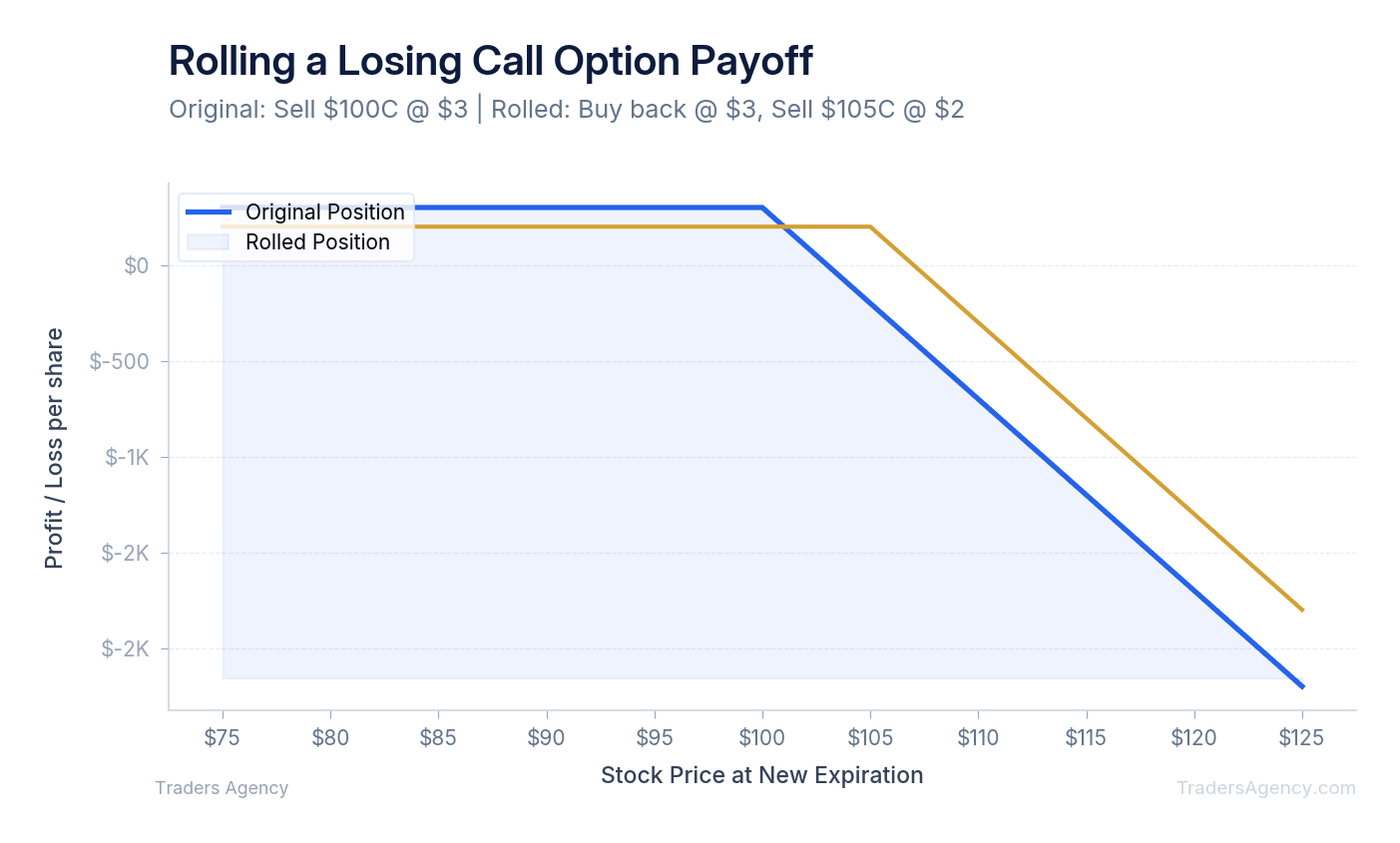
How Do You Calculate the Net Cost of Rolling an Options Position?
Many newer traders ask us: does rolling options cost money? The short answer is yes, because you always pay transaction fees and cross the bid-ask spread twice. However, the net capital outlay depends on whether you roll for a debit or a credit.
When you roll for a net debit, you're paying money out of your account to adjust the trade. This increases your maximum potential loss on the position. When you roll for a net credit, you're collecting premium. We prefer to roll short positions for a net credit whenever possible. Collecting a credit reduces your overall risk and lowers your break-even point.
To calculate your true break-even point, you must combine the realized loss from the closed leg with the premium collected on the new leg. Here's an example:
| Trade Leg | Action | Premium |
|---|---|---|
| Original Put Sold | Collected | +$1.00 |
| Buy Back Original Put | Paid | -$3.00 |
| New Put Sold (rolled) | Collected | +$2.50 |
| Total Net Credit | $0.50 |
You must also account for slippage. Options with wide bid-ask spreads will eat into your potential credit. We recommend using limit orders for all rolling transactions to ensure you get the exact price you need to make the math work.
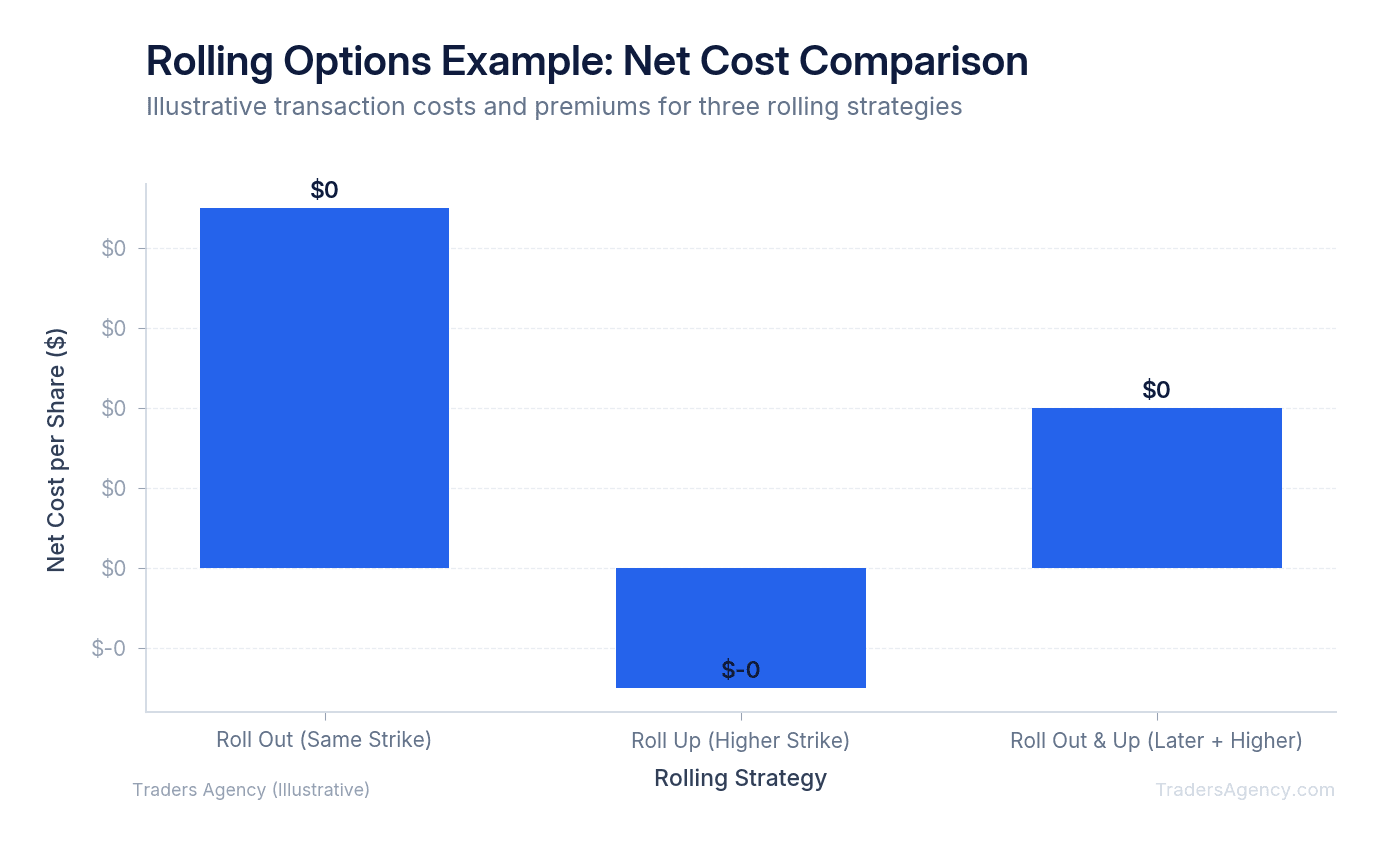
Watch Out: Rolling for a net debit repeatedly can compound your losses. If you've rolled a position two or more times and you're still paying debits, it's time to reassess whether the trade thesis is still valid. Don't throw good money after bad.
Want expert trading insights delivered daily?
Join thousands of traders who rely on Traders Agency for market analysis and trade ideas.
Join Traders AgencyGreeks Considerations When Rolling: Delta, Theta, and Vega
Professional traders don't just look at strike prices. They analyze how the options Greeks shift during a roll. Understanding these metrics provides a mathematical framework for your adjustments.
1. Managing Delta Exposure
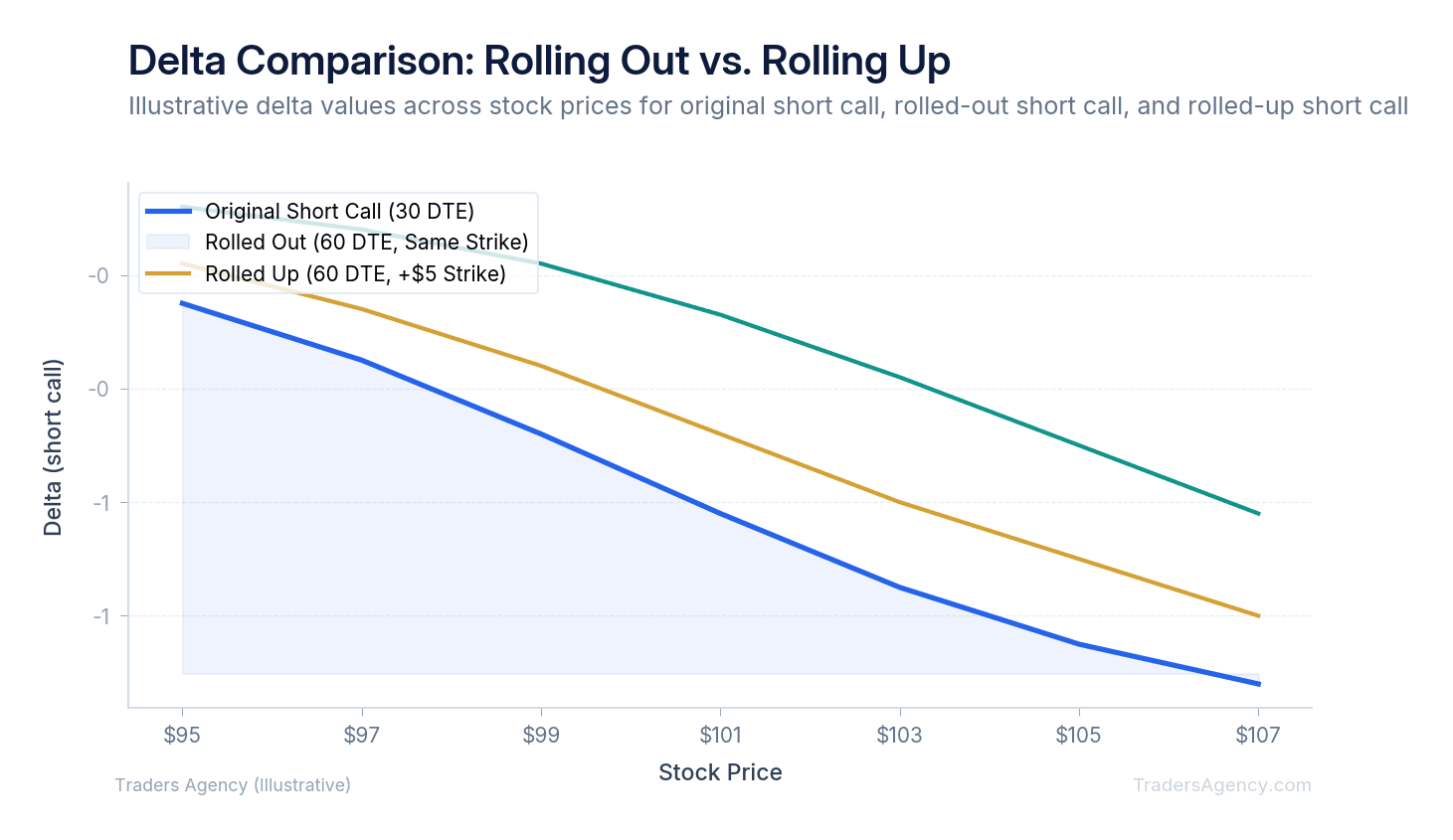
Delta measures your directional risk. When a short call goes deep in the money, its delta approaches -1.00. This means the option is moving penny-for-penny against you as the stock rises. Rolling out and up reduces your negative delta, flattening your directional risk. We look to reset our short options to a delta between 0.16 and 0.30 during a roll.
2. Optimizing Theta Decay
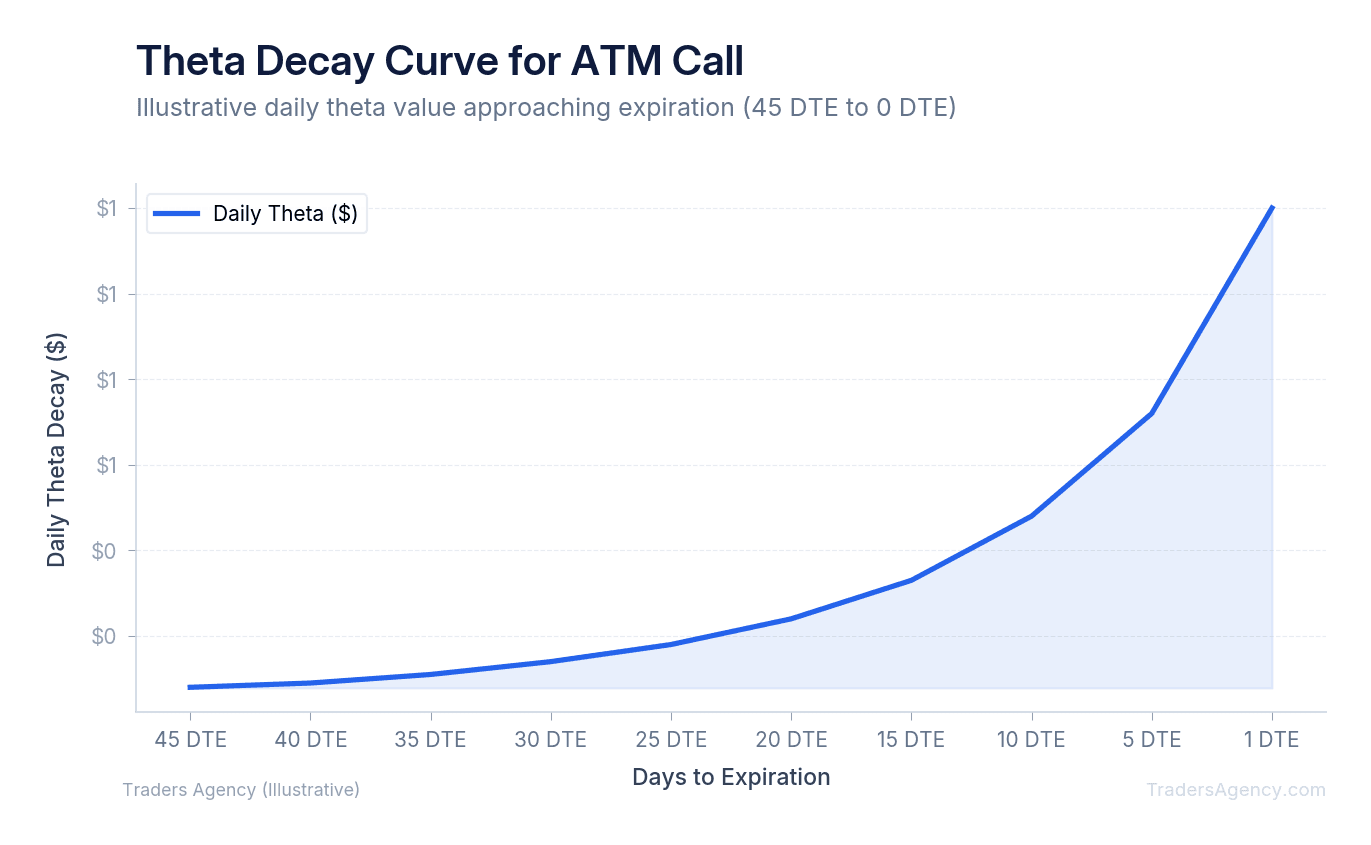
Theta represents time decay. Options lose value faster as expiration approaches, particularly in the last 21 days. When you roll out to a 45-day expiration cycle, you position yourself at the optimal point of the theta decay curve. You want time decay working for you, not against you.
3. Exploiting Vega Shifts
Vega measures sensitivity to implied volatility. If you roll during a high volatility environment, you collect richer premiums. Selling premium when implied volatility rank (IVR) is above 50 provides a statistical edge. We always check the IVR before deciding whether to roll or close. The Cboe Options Exchange publishes volatility data that can help you assess current market conditions.
4. Avoiding Gamma Risk
Gamma measures the rate of change in your delta. As expiration approaches, gamma risk explodes. A small move in the stock price can cause massive swings in your option's value. We teach our members to roll untested positions at 21 days to expiration specifically to avoid this late-stage gamma risk.
Key Concept: Our rolling framework targets these Greeks parameters: roll to a delta between 0.16 and 0.30, select a new expiration at 45 DTE for optimal theta, and only roll when IVR is above 50 to maximize premium collected.
When Should You Roll an Options Position Instead of Closing It?
Knowing when to accept a loss is an essential skill. Rolling a losing call option makes sense if your core thesis remains intact but the timing was off. It does not make sense if the underlying company just announced a massive fundamental change.
We teach our members to follow a strict checklist before rolling:
- Can you roll the position for a net credit?
- Does the new expiration date align with your market outlook?
- Are you avoiding major earnings announcements in the new cycle?
- Is your total capital allocation still within your strict risk limits?
If you cannot answer yes to all of these questions, close the trade. Taking a defined loss is often mathematically superior to locking up margin for another 60 days on a dead thesis. Hope is not a trading strategy.
Is Rolling Options a Good Strategy?
Yes, rolling options is a good strategy when you need more time for a thesis to play out or want to defend a challenged position. However, it's not a magic fix for bad trades. The best rolling options strategy requires a mathematical edge and strict risk management rules.
We frequently see traders roll positions endlessly just to avoid booking a red number in their account. This ties up buying power and exposes you to sequence of returns risk. You should only roll if the new position is a trade you would willingly open from scratch today.
If you find yourself rolling the same position three or four times, you're likely fighting the market trend. We prefer to take the loss, clear our mental capital, and find a better setup elsewhere.
Tax Implications and Day Trading Rules
Advanced traders must consider the regulatory environment before executing complex adjustments. The rolling options tax implications can catch you off guard if you're not careful, especially near the end of the calendar year.
When you close the first leg of a roll at a loss and open a nearly identical position, you might trigger the IRS wash-sale rule. If you sell an option at a loss and buy a "substantially identical" option within 30 days, you cannot claim the loss immediately. Instead, the loss is added to the cost basis of the new position. This becomes problematic in December if you're trying to harvest tax losses but roll the position into January.
Watch Out: If you open a position and roll it on the exact same trading day, the closing leg counts toward your pattern day trader (PDT) limit. The PDT rule applies to accounts with less than $25,000 in equity. Hold the original position overnight and roll the next day to avoid triggering a day trade penalty.
A Complete Rolling Options Example
Let's walk through a concrete rolling options example using a covered call. This will show you exactly how the math works in a live market environment. Assume you own 100 shares of XYZ stock trading at $145.
- Step 1: The Original Setup. You sell one XYZ $150 call expiring in 15 days, collecting $1.50 in premium ($150 total). Your maximum gain is achieved if XYZ closes at or above $150 at expiration. Your shares would be called away, and you'd keep the premium plus the capital appreciation from $145 to $150.
- Step 2: The Market Moves Against You. XYZ announces a massive new product line and the stock surges to $155. Your $150 call is now $5.00 in the money. The option is trading for $5.50. If you do nothing, your shares will be called away at $150, leaving $500 of additional upside on the table.
- Step 3: Executing the Roll. You decide to roll out and up. You buy back your $150 call for $5.50, realizing a $4.00 loss on that specific leg. Simultaneously, you sell a new XYZ $160 call expiring in 45 days for $6.00. You execute this as a single spread order with your broker.
- Step 4: The Outcome. Because you collected $6.00 for the new call and paid $5.50 to close the old one, you executed this roll for a $0.50 net credit. You successfully moved your strike price up by $10, giving your shares room to appreciate to $160. You also put an additional $50 of premium in your pocket.
| Parameter | Original Position | Rolled Position |
|---|---|---|
| Strike Price | $150 | $160 |
| Days to Expiration | 15 DTE | 45 DTE |
| Premium Collected | $1.50 | $6.00 |
| Cost to Close | N/A | $5.50 (to close original) |
| Net Credit on Roll | $0.50 | |
| Total Campaign Credit | $1.50 | $2.00 |
If XYZ stays below $160 at the new expiration, you keep the shares and all the premium collected. This is how professional traders manage risk. They don't panic when a position goes against them. They use the mechanics of time and volatility to restructure the trade in their favor.
Want expert trading insights delivered daily?
Join thousands of traders who rely on Traders Agency for market analysis and trade ideas.
Join Traders AgencyKey Takeaways
- A roll is a simultaneous two-legged trade: you close the existing contract and open a new one on the same underlying, realizing a gain or loss on the first leg at execution.
- Rolling out and up can increase your strike price (from $150 to $160 in the example) while collecting net additional premium, turning a $1.50 total campaign credit into $2.00 after paying $5.50 to close the original position.
- Treat every roll as a new trade decision, not a rescue. The Greeks reset with the new expiration and strike, so delta, theta, and vega exposure all change materially and must be re-evaluated.
- The net credit or debit on a roll is what determines whether the adjustment is worth making. In the example, closing for $5.50 and reopening for $6.00 produces only a $0.50 net credit, which must justify the added time and risk.
- Rolling buys time for a trade thesis to play out, but it also extends your exposure. Knowing when to roll versus when to close outright is a distinct decision that depends on whether the original thesis still holds.
DISCLAIMER: Traders Agency does not offer financial advice. The information provided is for educational purposes only and should not be considered financial advice. Traders Agency is not responsible for any financial losses or consequences resulting from the use of the information provided. Trading carries inherent risks and may not be suitable for all individuals. You are advised to conduct your own research and seek personalized advice before making any investment decisions, recognizing the potential risks and rewards involved.
See more from Traders Agency on Google
Make us a preferred source and our market analysis will appear more prominently in your Google Search, Top Stories, and AI results.
Add to Preferred Sources