
Event-driven options strategies are specialized trading techniques designed to capitalize on sharp price movements or volatility changes surrounding scheduled news events. You've probably seen this happen before: a stock trades flat for weeks, only to gap up 10% the morning after an earnings call. Our team will teach you how to structure trades around these specific, predictable calendar dates. By the end of this guide, you'll know how to calculate expected moves, select the right options strategy, and manage the unique risks of trading binary events. We'll walk you through the exact mechanics of pricing these setups so you can stop guessing and start trading based on hard data.
What Are Event-Driven Options Strategies?
Bottom Line: Trading around binary events requires precise position sizing and a clear understanding of how implied volatility behaves before and after announcements. The strategies covered here are not about predicting outcomes but about structuring trades so the mechanics of the setup, not a directional guess, do the work. The risk rules exist because even a well-structured trade can hit maximum loss at the opening bell if the move exceeds your strikes.
Event-driven options strategies are structured trades placed around scheduled announcements like earnings reports or economic data releases. These strategies aim to profit from either the resulting price expansion or the sudden collapse in implied volatility. Traders use them to isolate specific, time-bound market reactions rather than holding long-term positions.
We often compare this approach to setting a trap. You know exactly when the market-moving news will arrive, so you place your setup right before the announcement. You don't need to guess if the market will move over the next six months. You only care about the reaction on one specific day.
Many institutional firms build entire portfolios around these dates. A classic event-driven hedge fund approach involves buying volatility ahead of major corporate announcements and selling it immediately after the news breaks. We prefer to adapt these professional concepts for retail traders using defined-risk options spreads.
Key Concept: Event-driven options strategies target scheduled announcements with known dates and times. You're not predicting long-term direction. You're structuring a trade around a single, specific market reaction.
What Is FOMC in a Trading Strategy?
In a trading strategy, FOMC refers to the Federal Open Market Committee meetings where the central bank announces interest rate decisions. Options traders target FOMC days because these announcements reliably generate massive, immediate price swings across the entire stock market, creating ideal conditions for volatility-based trades.
When we teach systematic event-driven strategies, we focus heavily on the macroeconomic calendar. The FOMC rate decision is the single most important scheduled market mover. When the Federal Reserve chairman speaks, the S&P 500 (SPX) can easily swing 1% to 2% in a matter of minutes. You can find official meeting schedules and statements directly on the Federal Reserve website.
Other major macro events include the Consumer Price Index (CPI) releases and monthly jobs reports. For individual stocks, quarterly earnings reports serve as the primary binary events. We teach our members to treat these dates differently than normal trading days. Standard technical analysis often fails during these announcements because the new fundamental data instantly overrides historical chart patterns.
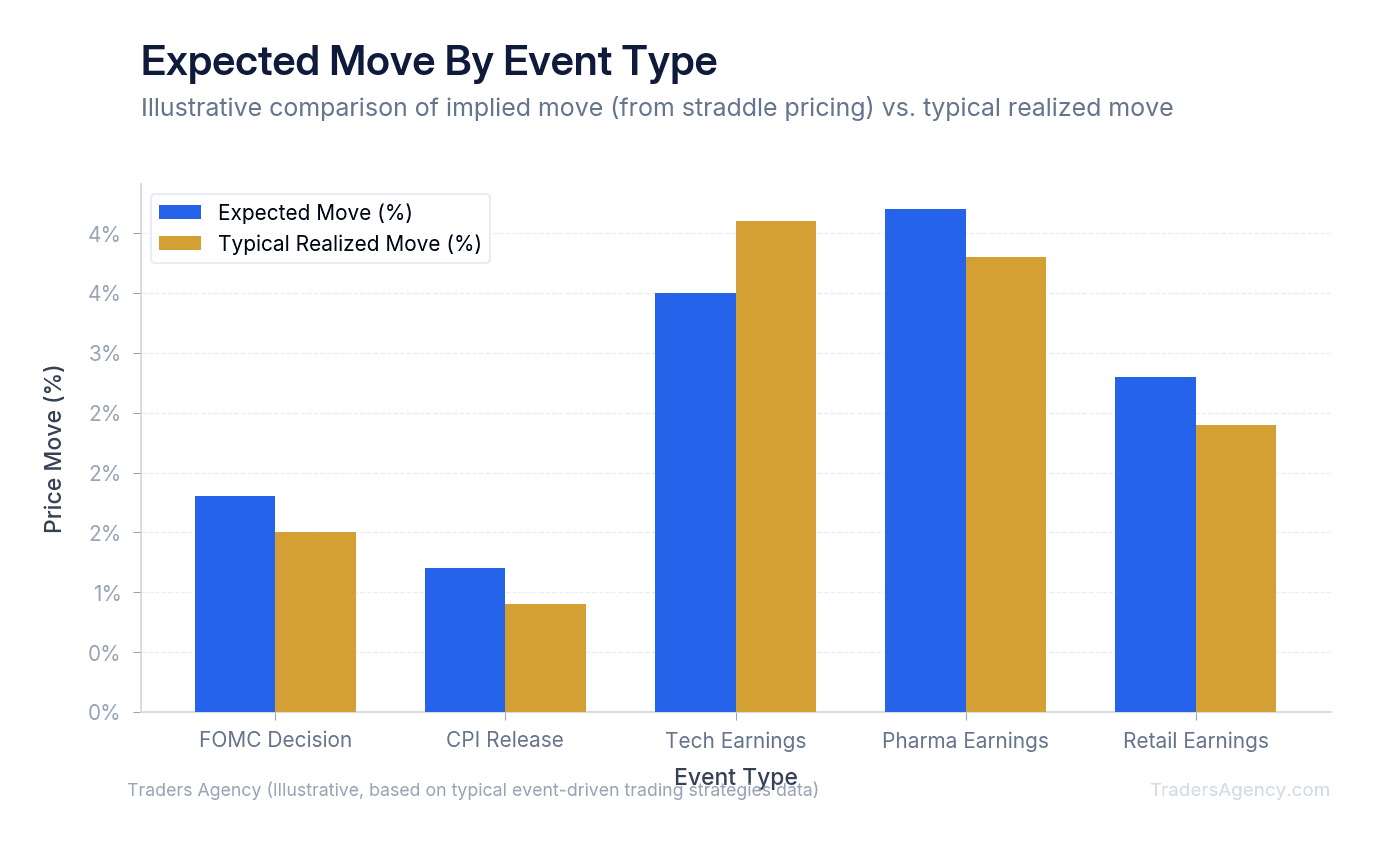
How Do You Calculate the Expected Move Before an Event?
You calculate the expected move by adding the price of the at-the-money call and the at-the-money put for the expiration date closest to the event. This combined premium tells you exactly how much the options market expects the underlying stock to move up or down.
We never guess how far a stock might move. Instead, we let the options market tell us. You can find this data on any standard brokerage platform or by referencing educational materials from the Cboe (Chicago Board Options Exchange).
Here's what we teach our members about pricing the move. If Apple (AAPL) is trading at $150 the day before earnings, you look at the options expiring that same week.
- Identify the At-The-Money Options: Find the call and put options with strike prices closest to the current stock price. In this case, you look at the $150 call and the $150 put.
- Add the Premiums Together: Assume the $150 call costs $3.00 and the $150 put costs $3.00. The total cost of this straddle is $6.00.
- Calculate the Percentage: Divide that $6.00 by the $150 stock price. The options market is pricing in a 4% expected move for this specific earnings event. This calculation forms the foundation of all binary event trading.
When Should You Use an Iron Condor vs. a Long Straddle for Events?
When evaluating the best event-driven options strategies around FOMC announcements, you generally have two choices. You can bet on a massive surprise, or you can bet that the market has overpriced the fear.
1. The Long Straddle (Betting on the Breakout)
A long straddle involves buying both an at-the-money call and an at-the-money put. You want the stock to explode in either direction, breaking far past the expected move.
| Parameter | Value |
|---|---|
| Setup | Buy 1 $150 call for $3.00 + Buy 1 $150 put for $3.00 |
| Total Debit | $6.00 ($600 per contract) |
| Upside Breakeven | $156 |
| Downside Breakeven | $144 |
| Scenario | Stock Price at Expiration | Profit / Loss |
|---|---|---|
| Best Case (Big Move Up) | $165 | +$900 (call worth $15.00 minus $6.00 cost) |
| Breakeven | $156 or $144 | $0 |
| Worst Case (No Move) | $150 | -$600 (max loss) |
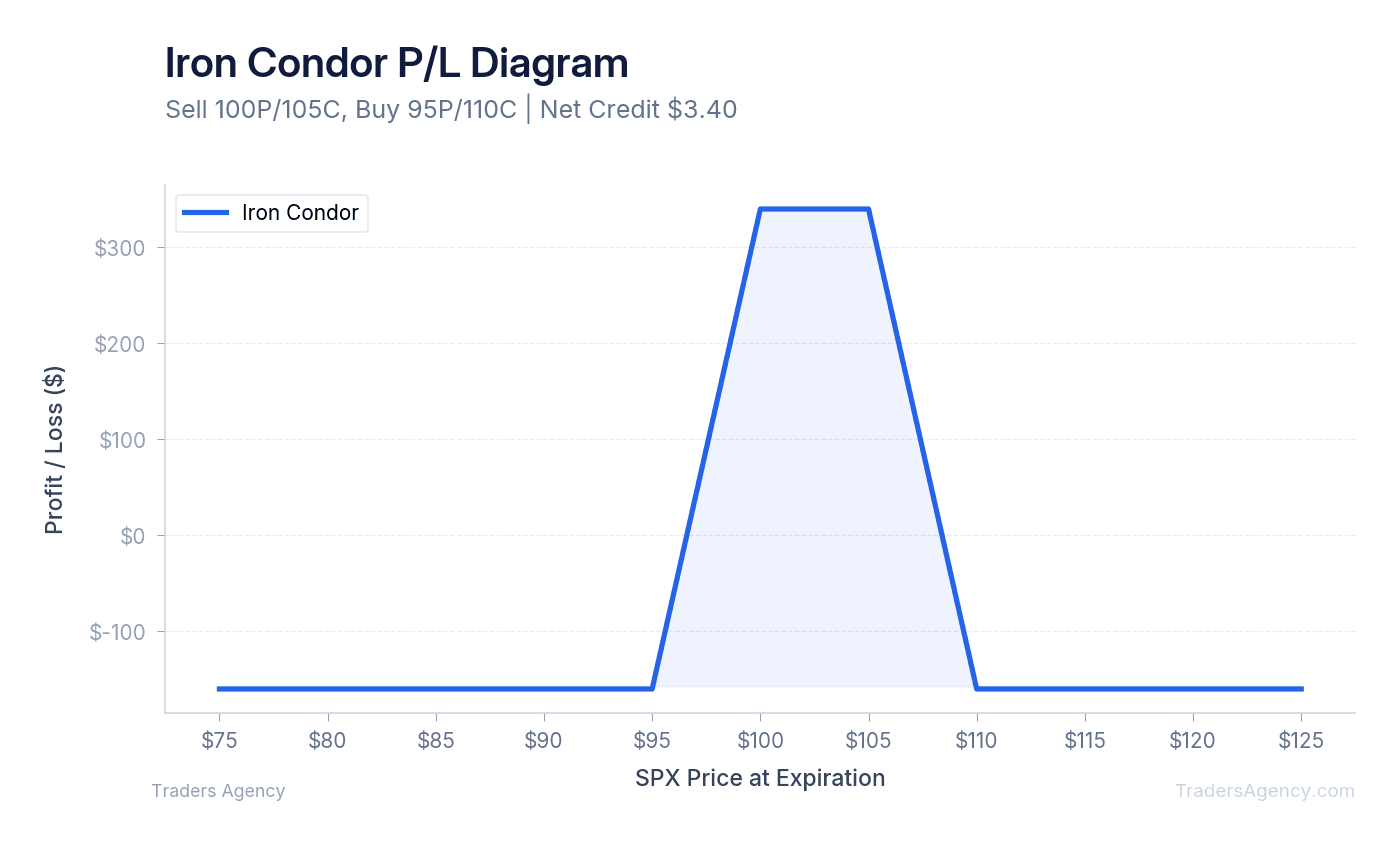
2. The Iron Condor (Betting on the Range)
An iron condor involves selling options outside the expected move to collect premium. You want the stock to stay relatively flat and remain contained within the expected range.
| Parameter | Value |
|---|---|
| Setup (Call Side) | Sell $160 call, Buy $165 call |
| Setup (Put Side) | Sell $140 put, Buy $135 put |
| Total Credit | $1.50 ($150 per contract) |
| Upside Breakeven | $161.50 |
| Downside Breakeven | $138.50 |
| Scenario | Stock Price at Expiration | Profit / Loss |
|---|---|---|
| Best Case (Range-Bound) | Between $140 and $160 | +$150 (keep full credit) |
| Breakeven | $138.50 or $161.50 | $0 |
| Worst Case (Big Move) | $130 or lower | -$350 ($5.00 spread width minus $1.50 credit) |
Want expert trading insights delivered daily?
Join thousands of traders who rely on Traders Agency for market analysis and trade ideas.
Join Traders AgencyHow Do Vega Crush and Theta Decay Affect Options After an Announcement?
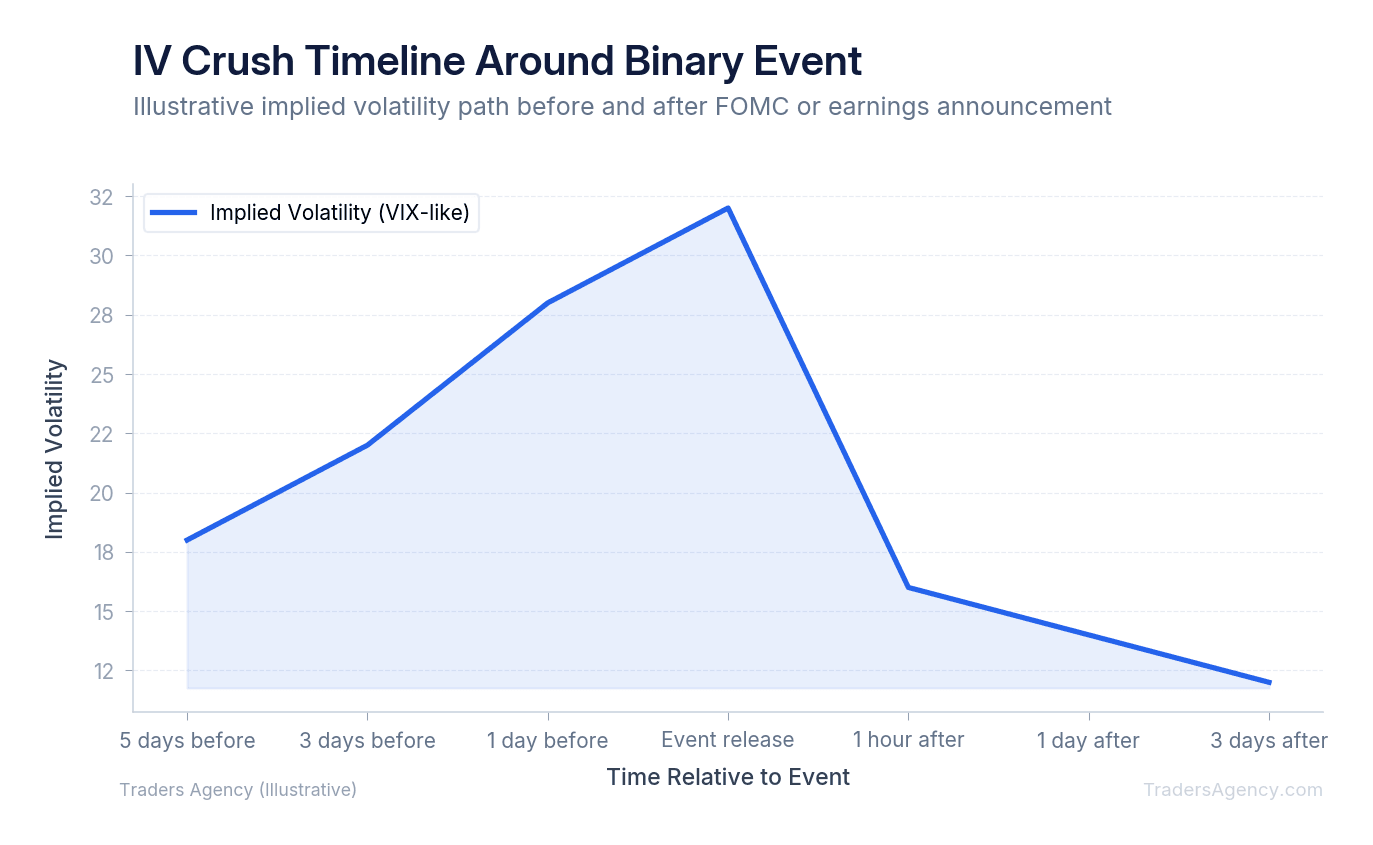
Vega crush and theta decay drastically reduce option premiums immediately following a binary event. Once the news is released, the uncertainty disappears, causing implied volatility to plummet and time value to evaporate. This rapid deflation hurts option buyers but heavily rewards option sellers.
You cannot trade event-driven options strategies without understanding the Greeks. The options market pumps up premiums before a major announcement because uncertainty equals risk. This inflation is known as implied volatility expansion.
The moment the Federal Reserve releases its statement, that uncertainty vanishes. The implied volatility drops instantly. We call this phenomenon vega crush. If you bought a long straddle, vega crush will actively work against you. Even if the stock moves in your direction, the collapsing volatility can drain the value of your contracts.
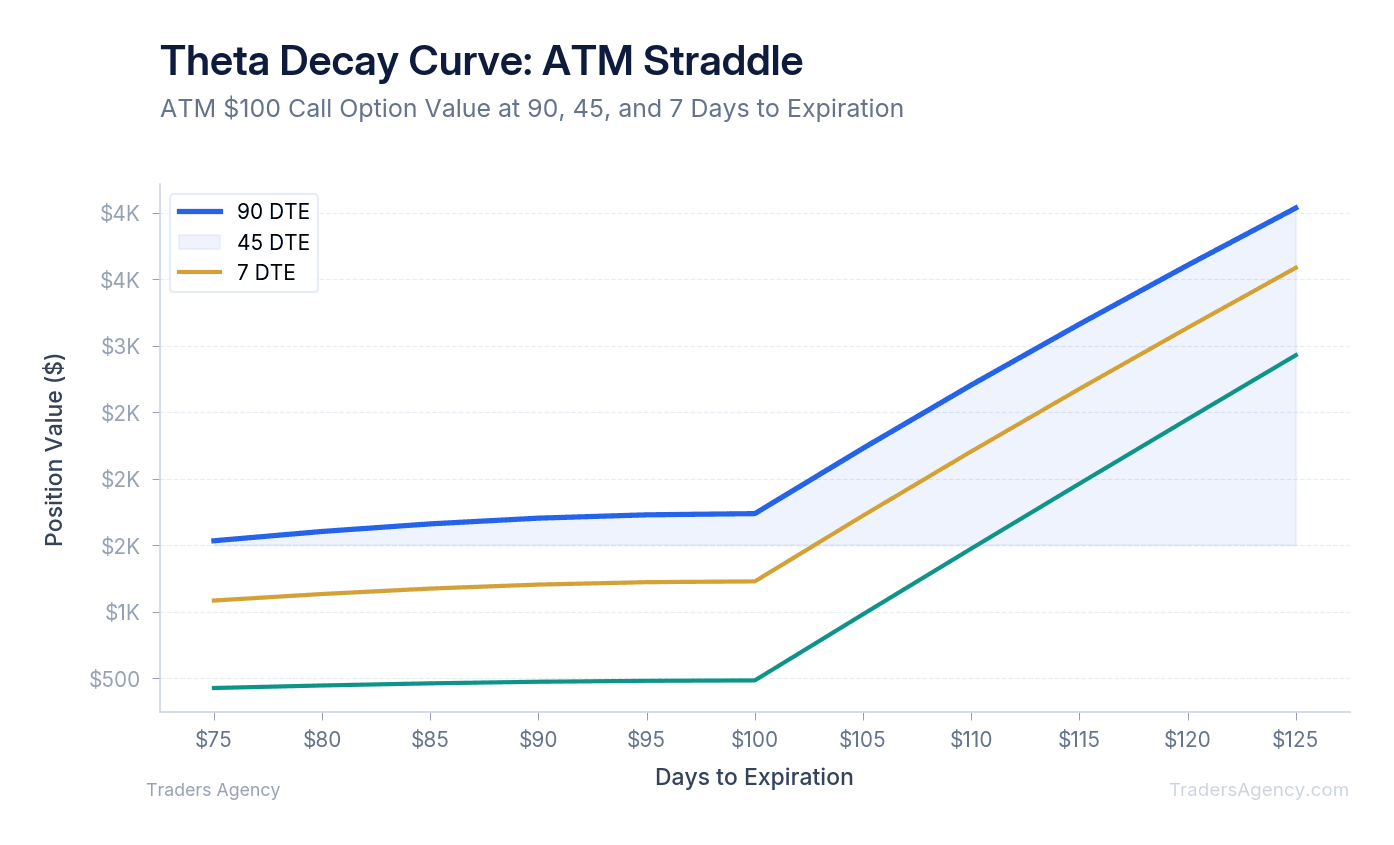
You also face aggressive theta decay. Options lose value as expiration approaches. When you buy short-term options for an earnings play, theta decay accelerates rapidly in the final 48 hours.
To combat these forces, our team prefers selling premium via iron condors when implied volatility is exceptionally high. By selling the options, you actually want vega crush to happen. You want the premiums to deflate so you can buy the contracts back for pennies on the dollar.
Watch Out: Vega crush can erase your profits even when the stock moves in your favor. If you buy a long straddle and the stock moves only slightly past your breakeven, the collapsing implied volatility may still leave you with a loss. Always factor in the post-event volatility drop before entering a long premium position.
How Do You Build a Macro Event Calendar for Options Trading?
Building a macro event calendar requires tracking exact dates and times for FOMC meetings, CPI data releases, and major corporate earnings. A structured calendar allows you to allocate capital efficiently and close existing positions before unexpected volatility disrupts your standard technical trades.
Successful event-driven trading strategies require meticulous scheduling. You should never be surprised by a scheduled news release. We recommend mapping out your trades at the start of every month.
Here are the key events you must track:
- FOMC Rate Decisions: Usually occur eight times a year on Wednesday afternoons at 2:00 PM Eastern.
- CPI Data: Released monthly, usually around the 10th to 13th, at 8:30 AM Eastern before the market opens.
- Non-Farm Payrolls (NFP): Released the first Friday of every month at 8:30 AM Eastern.
- Mega-Cap Earnings: Focus on companies like Apple, Microsoft, and Nvidia, as their results can move the entire market.
Earnings season peaks four times a year. We pay special attention to bank week, which kicks off the season, followed by mega-cap tech week. During these periods, the sheer volume of reports can create secondary volatility across the broader market.
If you're holding a standard swing trade based on a chart pattern, we often suggest closing it before these calendar events hit. The resulting volatility can easily trigger your stop-loss before the stock resumes its normal trend.
How Do You Manage the Trade After the Announcement?
You manage the trade after the announcement by closing the position immediately to lock in profits or cut losses. Holding an event-driven trade past the initial market reaction exposes you to unnecessary directional risk and rapid time decay, defeating the purpose of the strategy.
We teach our members to execute their exit plan within the first hour of the market opening after an earnings release. For macroeconomic data like CPI, the reaction happens instantly. You must be ready to take action at the opening bell.
- If you sold an iron condor and the stock stayed within your expected range: Buy the spreads back immediately. Do not hold the contracts until expiration just to squeeze out the last few pennies of premium. The risk of a late-day price reversal is too high.
- If you bought a long straddle and the stock exploded past your breakeven point: Sell the profitable leg right away. Some traders try to hold the winning option hoping for a larger trend to develop. We prefer to take the guaranteed profit and move on to the next setup.
- If the trade went against you: Close the position and accept the loss. Do not add to a losing event-driven trade or "average down." The event has passed, and the edge is gone.
Key Concept: Event-driven trades have a built-in expiration on their edge. Once the news is out and the market reacts, your informational advantage disappears. Close the trade, book the result, and move on.
When Should You Avoid Event-Driven Options Trades?
You should avoid event-driven options trades when the expected move is too small to justify the risk, or when implied volatility is historically low before an announcement. If the options premiums don't offer enough potential reward, it's better to skip the trade entirely.
We see traders force setups all the time. You don't have to trade every single earnings report or CPI release. Knowing when to sit on your hands is a required skill.
Avoid placing these trades if the stock has poor liquidity. If the bid-ask spread on the options chain is wider than $0.20, you'll lose too much money just entering and exiting the position. Always stick to highly liquid tickers like the SPY ETF or major tech stocks.
Our position sizing rules for binary events are strict:
- Risk no more than 1% to 2% of your total account on a single binary event.
- Cap your total portfolio exposure to binary events at 5%.
- On a $10,000 account, you should never have more than $500 at risk across all event-driven trades combined.
Risk Warning: These trades are inherently unpredictable. A bad earnings report can gap a stock past your iron condor strikes instantly, resulting in a maximum loss at the opening bell. Never allocate capital you cannot afford to lose in a single morning.
Want expert trading insights delivered daily?
Join thousands of traders who rely on Traders Agency for market analysis and trade ideas.
Join Traders AgencyKey Takeaways
- Event-driven options strategies target specific calendar dates like FOMC meetings, CPI releases, and earnings calls rather than holding long-term directional positions.
- Traders should risk no more than 1% to 2% of total account value on a single binary event, with total portfolio exposure to all event-driven trades capped at 5%.
- On a $10,000 account, the maximum combined risk across all active event-driven trades should never exceed $500.
- Two core strategy types apply here: iron condors profit from volatility collapse after the event, while long straddles profit from a large directional move in either direction.
- Vega crush and theta decay work against buyers after the announcement, meaning the timing of entry and exit relative to the event date directly affects profitability.
DISCLAIMER: Traders Agency does not offer financial advice. The information provided is for educational purposes only and should not be considered financial advice. Traders Agency is not responsible for any financial losses or consequences resulting from the use of the information provided. Trading carries inherent risks and may not be suitable for all individuals. You are advised to conduct your own research and seek personalized advice before making any investment decisions, recognizing the potential risks and rewards involved.
See more from Traders Agency on Google
Make us a preferred source and our market analysis will appear more prominently in your Google Search, Top Stories, and AI results.
Add to Preferred Sources