
You've probably seen a stock gap up 20% in a single session with zero fundamental news behind it. A gamma squeeze is a rapid, self-reinforcing upward price movement driven by market makers buying underlying shares to hedge their short call option exposure. Understanding gamma squeeze mechanics is essential for advanced options traders who want to capitalize on these explosive volatility events, and our team is going to walk you through exactly how they work.
We'll break down the institutional dealer positioning that causes these market shocks. Our focus is on the mathematical realities of the options chain rather than internet hype. By the end of this guide, you'll know exactly how to read dealer positioning, spot these setups in real time, and manage the extreme risks involved.
What Is a Gamma Squeeze and How Does It Work?
Bottom Line: A gamma squeeze is not a random volatility event. It is a predictable mechanical process driven by dealer hedging obligations, and traders who understand the five stages and monitor positioning data can identify setups before the price move becomes obvious. The edge is in reading the options chain early and sizing positions to survive a total loss of premium if the squeeze fails to materialize.
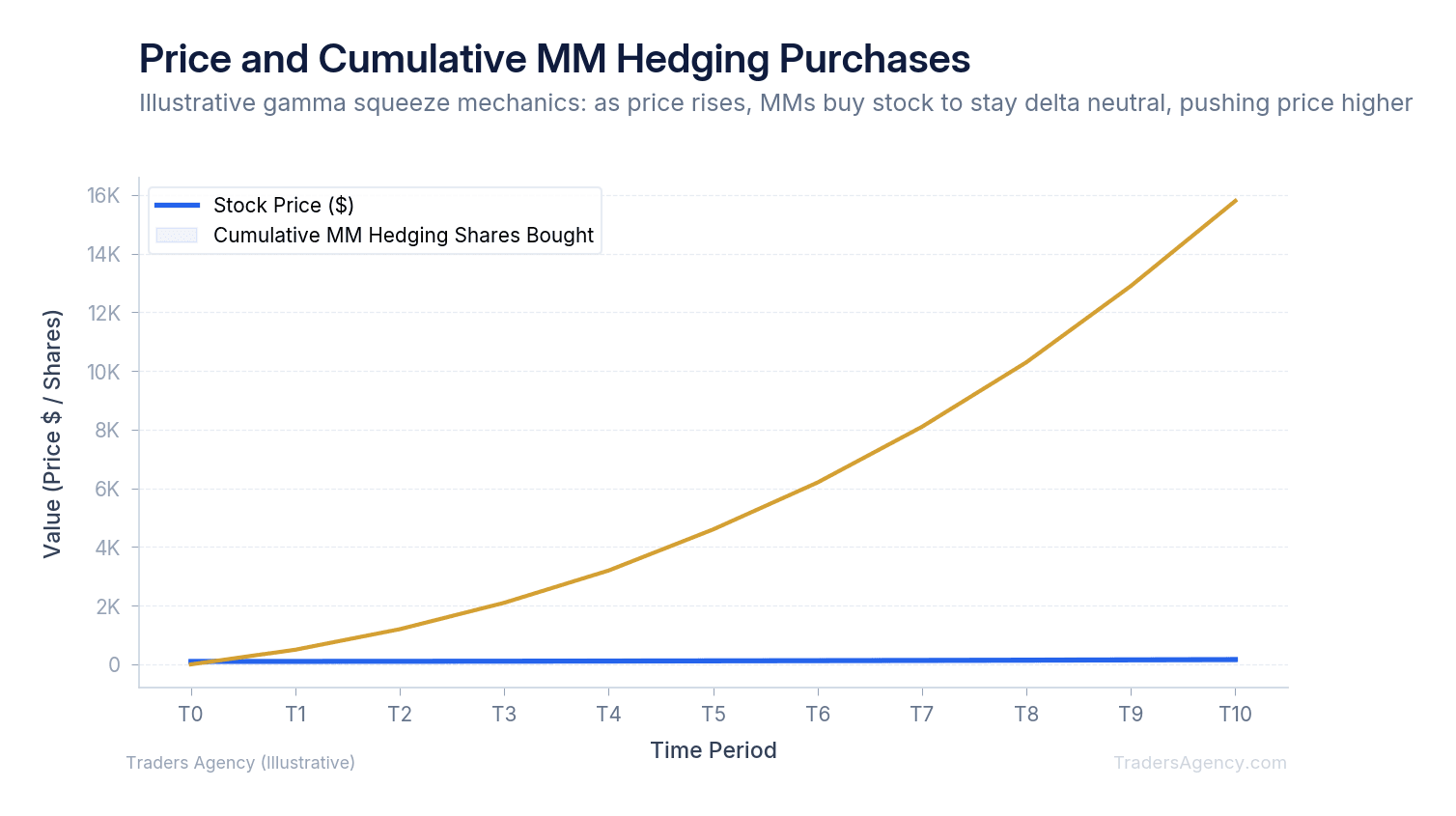
A gamma squeeze works through a forced buying loop created by options market makers. When retail or institutional traders buy massive amounts of out-of-the-money call options, dealers who sell those calls must buy the underlying stock to remain delta-neutral. As the stock price rises toward the strike, the dealer's gamma exposure forces increasingly larger delta adjustments, requiring them to buy even more shares.
This creates an intense upward price shock. Market makers are required to manage their risk dynamically to maintain market liquidity. They do not take directional bets against traders. Instead, they hedge their exposure by trading the underlying asset.
Key Concept: When a trader buys a call option, the market maker takes the other side of the trade. The dealer is now short a call option. To prevent losses if the stock rises, the dealer buys shares of the underlying stock so that profits from the shares offset losses from the short call. This is called delta hedging.
How Does the Market Maker Delta Hedging Feedback Loop Work?
To understand gamma squeeze mechanics, you must understand the relationship between Delta and Gamma. Delta measures how much an option's price will change for a $1 move in the underlying stock. Gamma measures the rate of change in Delta.
Here's a concrete example that shows how the feedback loop builds:
| Stage | Stock Price | Delta per Contract | Shares Dealer Must Hold | Additional Shares Purchased |
|---|---|---|---|---|
| Initial hedge | $130 | 0.15 | 15 shares | 15 shares |
| After call buying pressure | $140 | 0.45 | 45 shares | 30 shares |
| Approaching strike | $148 | 0.65 | 65 shares | 20 shares |
| Deep in the money | $160 | 0.90+ | 90+ shares | 25+ shares |
Consider a scenario where you buy a $150 strike call on a stock currently trading at $130. The initial Delta might be 0.15, so the dealer buys 15 shares per contract to hedge. Heavy call buying pushes the stock up to $140. Because the stock is closer to your strike price, Gamma causes your Delta to expand rapidly to 0.45. The dealer must now hold 45 shares per contract, forcing them to buy 30 additional shares at the market price.
When thousands of traders buy millions of contracts, this forced dealer buying becomes a massive source of market demand. The dealer buying pushes the stock price higher, which increases Delta further, which forces the dealer to buy even more shares. This is the mechanical feedback loop that defines the squeeze.
What Role Do 0DTE Options Play in a Gamma Squeeze?
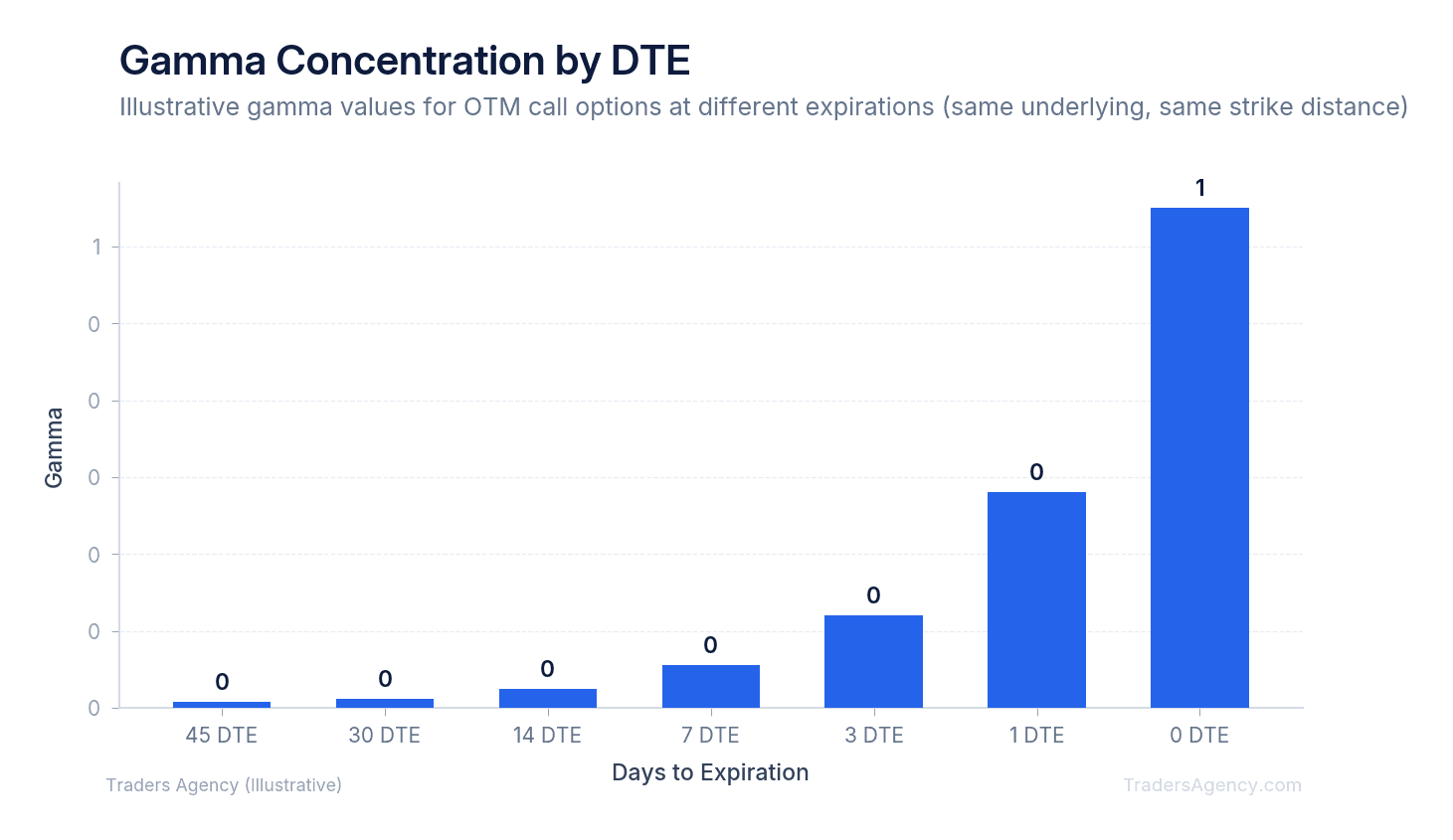
Zero-days-to-expiration (0DTE) options have completely altered the speed and intensity of these events. Gamma is highest when options are close to the money and close to expiration.
For a contract expiring in 30 days, Gamma is relatively flat. The dealer has time to adjust their hedges slowly. For a 0DTE contract, Gamma is a steep cliff. A 0DTE option moving from out-of-the-money to in-the-money experiences a massive and instantaneous Gamma spike.
Dealers have minutes, not days, to adjust their hedges. When traders flood into 0DTE calls, market makers are forced to execute aggressive market orders for the underlying stock. This creates violent intraday price spikes that can trigger trading halts.
Watch Out: 0DTE options amplify gamma squeeze mechanics in both directions. The same explosive Gamma that drives the rally also accelerates the collapse. These contracts can lose 100% of their value in minutes once momentum reverses.
The Five Stages of a Gamma Squeeze
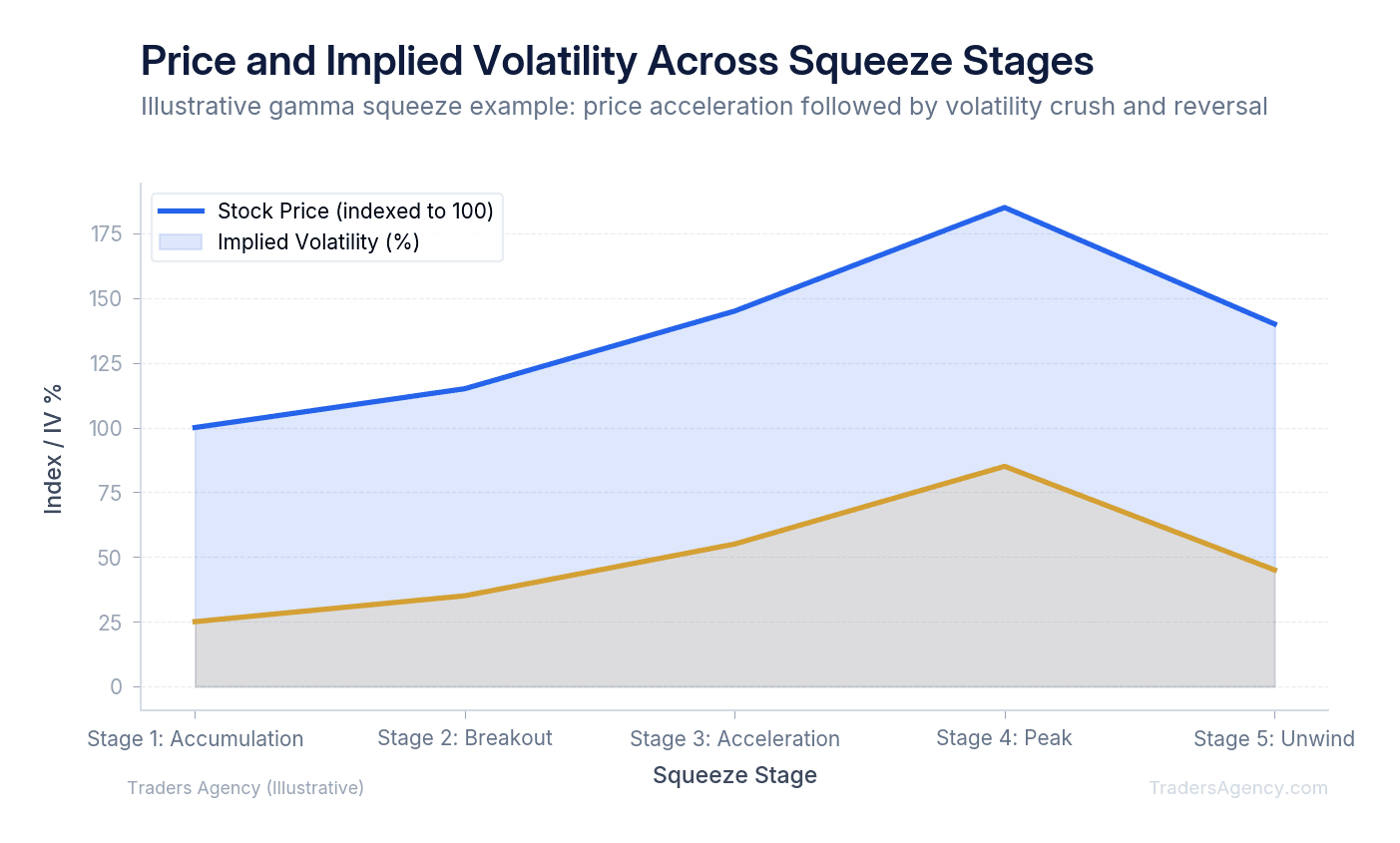
We teach our members to view these events as a predictable sequence. Here's a concrete gamma squeeze example using a hypothetical ticker, XYZ, currently trading at $50.
- The Accumulation Phase: Traders start buying the $60 strike calls expiring this Friday. The volume is highly unusual. You might see 50,000 contracts traded on a strike that previously had an open interest of only 2,000 contracts.
- The Initial Dealer Hedge: Market makers sell these calls and buy a small amount of XYZ stock to cover the initial 0.10 Delta. This steady buying pressure causes the stock to drift up to $52. Implied volatility (IV) begins to creep higher.
- The Acceleration Phase: Momentum builds rapidly. Retail traders notice the unusual options activity and pile in. The stock hits $56. Dealer Gamma expands as the stock approaches the strike. Market makers are now forced to buy millions of shares at the market price, completely overwhelming all natural sellers.
- The Climax: The stock breaches the $60 strike and continues higher. Delta approaches 1.00 as the options move deep in the money. Dealers are now nearly fully hedged, holding close to 100 shares for every single contract they sold. Implied volatility reaches extreme levels, making options prohibitively expensive. The stock might peak at $65 in a matter of hours.
- The Collapse: The buying pressure exhausts itself. Traders begin taking profits by selling their calls back to the market makers. This triggers the unwind phase, which is often faster and more violent than the rally.
Want expert trading insights delivered daily?
Join thousands of traders who rely on Traders Agency for market analysis and trade ideas.
Join Traders AgencyHow Does a Gamma Squeeze End?
A gamma squeeze ends when the underlying call options expire, when traders sell their contracts to take profits, or when the stock price falls enough to reduce dealer gamma exposure. Once the forced buying stops, market makers immediately sell their hedged shares, causing the stock price to collapse rapidly.
When traders sell their calls to close their positions, the dealer's short call exposure vanishes instantly. The dealer no longer needs the 100 shares they bought to hedge a deep in-the-money call. They immediately sell those shares on the open market to free up capital.
This creates a massive supply imbalance. The stock price drops, which decreases the Delta on the remaining out-of-the-money calls. Dealers sell even more shares to un-hedge those positions. This downward feedback loop causes the stock to crash back to its pre-squeeze levels.
What Is the Difference Between a Gamma Squeeze and a Short Squeeze?
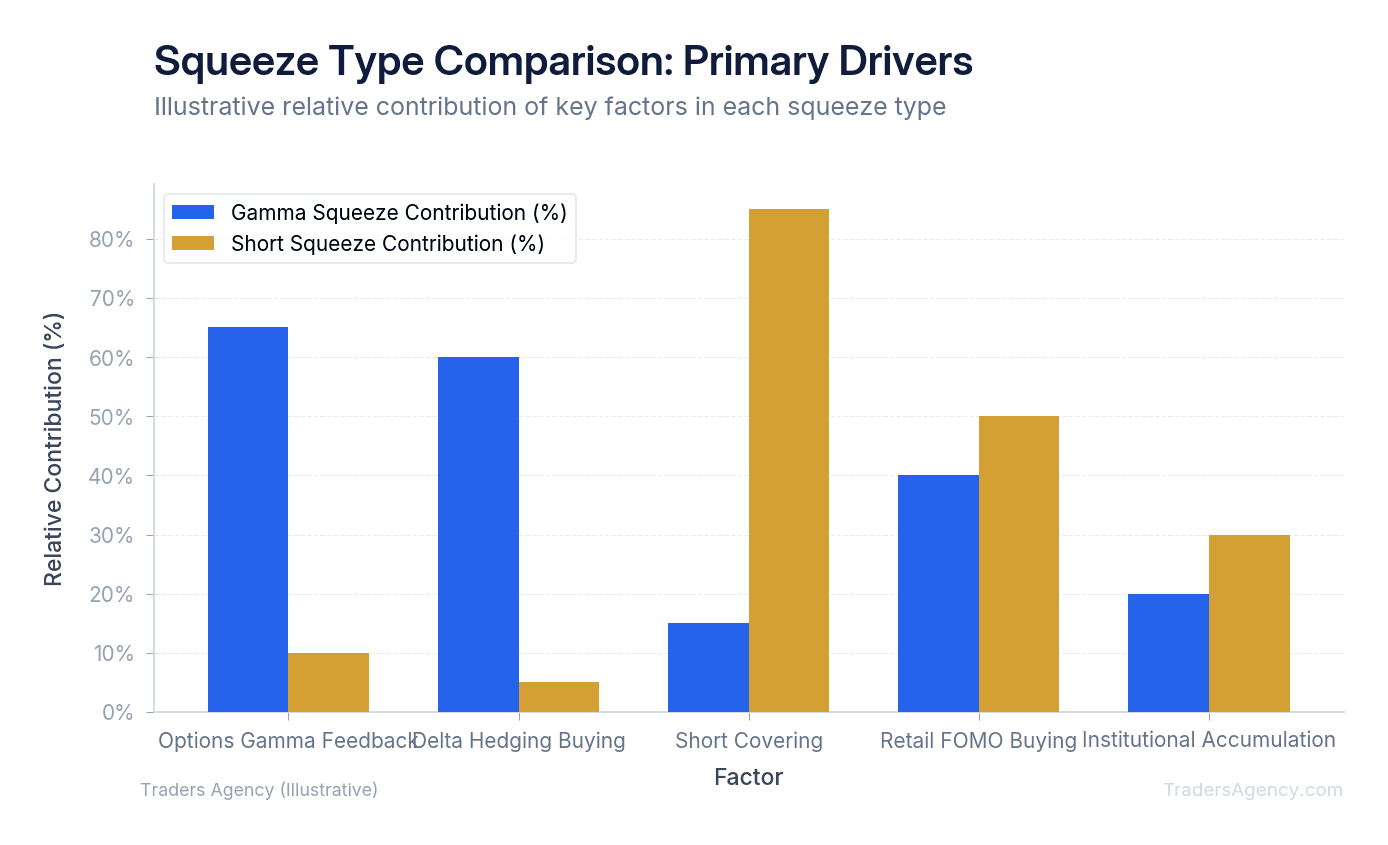
The difference between a gamma squeeze and a short squeeze lies in the participants and the instruments used. A short squeeze forces bearish stock short-sellers to buy shares to cover losing equity positions. A gamma squeeze forces neutral options market makers to buy shares to hedge their short call option exposure.
| Factor | Gamma Squeeze | Short Squeeze |
|---|---|---|
| Primary Driver | Options delta hedging by market makers | Short sellers covering losing positions |
| Key Metric | Call open interest and GEX | Short interest (>20% of float) |
| Instrument | Options chain | Equity shares |
| Can Occur With Zero Short Interest? | Yes | No |
| Speed of Unwind | Extremely fast (hours) | Fast (days to weeks) |
A short squeeze relies on high short interest in the underlying equity. You look for stocks where more than 20% of the float is sold short. When the stock rises, these short sellers face margin calls and must buy shares to exit their positions.
A gamma squeeze relies entirely on the options market. It requires massive call option volume and high open interest concentrated at specific strike prices. A stock with zero short interest can still experience a massive gamma event.
Traders also frequently ask us about a delta squeeze vs gamma squeeze. A delta squeeze is a broad term for directional hedging by dealers over a longer timeframe. Gamma specifically refers to the explosive rate of change in that hedging requirement as expiration approaches. Gamma is the mathematical engine that makes the squeeze violent.
What Indicators Signal a Gamma Squeeze in Real Time?
You need specific quantitative data to identify these setups before they peak. Buying calls after a stock has already jumped 30% is a recipe for severe losses. Our team monitors the options chain for three specific conditions.
1. Call Skew and Volume Anomalies
Look for call option volume that is at least 300% higher than the 30-day average. The volume must heavily outweigh the existing open interest at out-of-the-money strikes. If a strike has an open interest of 5,000 but trades 40,000 contracts in a single morning, dealers are taking on massive new short exposure.
2. Negative Dealer Gamma Exposure (GEX)
A reliable gamma squeeze indicator is a high concentration of negative dealer gamma. When dealers are net short options, they must buy the underlying as it rises. We track strikes where open interest exceeds 10,000 contracts expiring within the current week. The closer the stock price gets to this massive wall of open interest, the higher the probability of a squeeze.
3. Implied Volatility Expansion
Normally, implied volatility drops as a stock rises. This is a standard market dynamic. However, if a stock is up 10% and call implied volatility is also rising sharply, dealers are pricing in extreme tail risk. This simultaneous rise in price and IV is the ultimate confirmation of a squeeze in progress.
You can monitor options flow data and gamma exposure levels through resources provided by the Cboe Options Exchange, which publishes volume and open interest data for listed options.
Key Concept: The strongest gamma squeeze signal is when a stock price rises AND implied volatility rises simultaneously. Under normal conditions, IV falls as price increases. When both move up together, forced dealer hedging is actively driving the move.
Risk Management: Trading the Gamma Squeeze
Trading these events requires strict discipline. The collapse is always faster than the rally. The IV crush that follows the peak will destroy the value of long call options, even if the stock price stays relatively flat. Here's what we teach our members about managing risk in these high-volatility environments.
- Define Your Maximum Loss: Never risk more than 1% to 2% of your total account equity on a single squeeze play. If you are buying calls, your premium paid is your maximum risk. Assume that money is entirely gone the moment you execute the trade.
- Use Debit Spreads Instead of Naked Calls: Because implied volatility is artificially high during a squeeze, buying naked calls is extremely expensive. We prefer to use bull call debit spreads. By buying a lower strike call and selling a higher strike call, you offset the high cost of IV. Your maximum profit is capped, but your probability of profit increases significantly.
- Scale Out on the Way Up: Do not wait for the absolute top. If your $1.50 premium calls hit $4.50, sell half your position to lock in a 200% gain. Let the remainder run with a trailing stop. The exact top is impossible to predict, and the reversal will happen in seconds.
- Avoid Shorting the Peak: Many advanced traders try to short the stock when they think the squeeze is over. This exposes you to theoretically unlimited risk. If the squeeze continues, you will face margin calls and forced liquidation. Instead of shorting the stock directly, we prefer to buy put debit spreads after the momentum breaks and the stock falls below its short-term moving averages.
Risk Warning: Gamma squeezes are among the most dangerous trading environments in the market. The same mechanics that produce 200%+ gains in hours can produce 100% losses just as quickly. Never chase a squeeze that's already in the climax phase, and always size your position assuming total loss of premium.
Understanding these mechanics gives you a distinct advantage over retail traders who are simply chasing green candles. By tracking dealer positioning, monitoring option volume anomalies, and executing strict risk management, you can trade these extreme volatility events with a professional edge.
Want expert trading insights delivered daily?
Join thousands of traders who rely on Traders Agency for market analysis and trade ideas.
Join Traders AgencyKey Takeaways
- Market makers are forced buyers, not directional speculators. When dealers sell call options, they must buy underlying shares to stay delta-neutral, and that buying accelerates as the stock price approaches the strike price.
- Gamma exposure compounds as price rises. The closer a call option gets to its strike, the larger the delta adjustment required per dollar move, which is why squeeze velocity increases rather than plateaus.
- 0DTE options amplify gamma squeeze mechanics because their gamma is at maximum sensitivity on expiration day, meaning even small price moves force outsized hedging activity from dealers.
- Never enter a position during the climax phase. The same mechanics that produce 200%+ gains in hours can produce 100% losses just as quickly, and late entries absorb the full unwind.
- Spotting a squeeze early requires tracking option volume anomalies and dealer positioning, not price action alone. By the time the candles are green and visible, the setup is often already exhausted.
DISCLAIMER: Traders Agency does not offer financial advice. The information provided is for educational purposes only and should not be considered financial advice. Traders Agency is not responsible for any financial losses or consequences resulting from the use of the information provided. Trading carries inherent risks and may not be suitable for all individuals. You are advised to conduct your own research and seek personalized advice before making any investment decisions, recognizing the potential risks and rewards involved.
See more from Traders Agency on Google
Make us a preferred source and our market analysis will appear more prominently in your Google Search, Top Stories, and AI results.
Add to Preferred Sources