
Trading commodities futures starts with one core idea: a futures contract is a standardized, exchange-traded agreement to buy or sell a set quantity of a commodity like gold, crude oil, or natural gas at a fixed price on a future date. These contracts are leveraged, meaning you control a large notional position with a fraction of its value in margin. For experienced traders, the real skill isn't opening the position. It's managing roll risk, margin efficiency, and contract selection across expirations.
This guide isn't a beginner primer. We're assuming you already understand bid-ask spreads, basic order types, and why leverage cuts both ways. What we want to focus on here is the layer most retail traders skip: how contango and backwardation affect your returns, how micro and mini contracts change your position sizing math, and how professional desks actually structure exposure to metals, energy, and agricultural markets.
By the end of this article, you'll know how to size a position using real margin numbers, roll a contract without bleeding unnecessary cost, and apply the same risk framework institutional trading desks use when they hold commodity futures for weeks instead of days.
What Is Contango and Backwardation in Futures Trading?
Bottom Line: Trading commodities futures profitably comes down to managing roll timing, margin, and position sizing rather than just picking direction. Traders who treat contango, backwardation, and correlation risk as part of their structure, the way institutional desks do, avoid the cost bleed that catches most retail traders off guard.
Contango occurs when futures prices for later-dated contracts are higher than the current spot price, while backwardation is the opposite: later contracts trade below spot. This spread between contract months determines whether rolling a position forward costs you money or pays you, which directly affects long-term return on leveraged commodity trades.
Think of contango as the market pricing in storage costs, insurance, and financing. Crude oil and natural gas frequently sit in contango because storing physical barrels or cubic feet isn't free. Gold tends to trade in a mild, persistent contango almost all the time, driven mainly by financing costs rather than storage, which keeps the spread small and predictable.
Backwardation shows up when near-term supply is tight relative to demand. During acute shortages, traders will pay a premium for immediate delivery over a contract three months out. Roll yield is the return, positive or negative, you capture or lose each time you close an expiring contract and open the next one.
- In contango, rolling long positions forward typically costs money because you're selling cheap and buying expensive.
- In backwardation, rolling long positions forward typically earns money because you're selling expensive and buying cheap.
- The size of this spread compounds over months for traders holding leveraged commodity exposure through multiple expirations.
This is one of the biggest gaps we see in how retail traders approach futures: a lot of attention goes to direction, almost none goes to the structural drag or tailwind built into the curve itself.
Key Concept: Roll yield is the hidden return built into every futures position. Learn to read it, because it can quietly add to or subtract from your results regardless of whether you call the price move correctly.
How Do Margin Requirements Work for Commodity Futures?
Margin in futures trading is a performance bond, not a down payment. Exchanges set initial margin and maintenance margin levels based on the contract's volatility, and your broker can require more.
Unlike stock margin, futures margin isn't borrowing money to buy an asset. It's collateral posted against potential losses on a contract you don't own outright. The CME Group, which lists most major commodity futures, publishes margin requirements that move with volatility, sometimes shifting intraday during fast markets.
A standard crude oil futures (CL) contract represents 1,000 barrels. At $75 per barrel, that's $75,000 of notional exposure controlled with roughly $5,000 to $7,000 in margin, depending on the exchange's current requirement. That leverage ratio is exactly why position sizing discipline matters more in futures than almost any other instrument.
Micro and Mini Futures Contracts for Smaller Accounts
Micro futures contracts (like Micro Gold, Micro WTI Crude, or Micro Bitcoin futures) are typically sized at around 1/10th the notional value of the standard contract, and in some cases smaller, letting traders scale exposure without taking on full-size risk.
This matters directly for anyone building a smaller account. A standard gold futures contract (GC) controls 100 troy ounces. At $2,400 per ounce, that's $240,000 of notional exposure, which most individual accounts simply shouldn't carry on one position. Micro Gold futures (MGC) control 10 ounces, bringing notional exposure down to roughly $24,000, a far more workable size for building a diversified book across metals, energy, and agriculture.
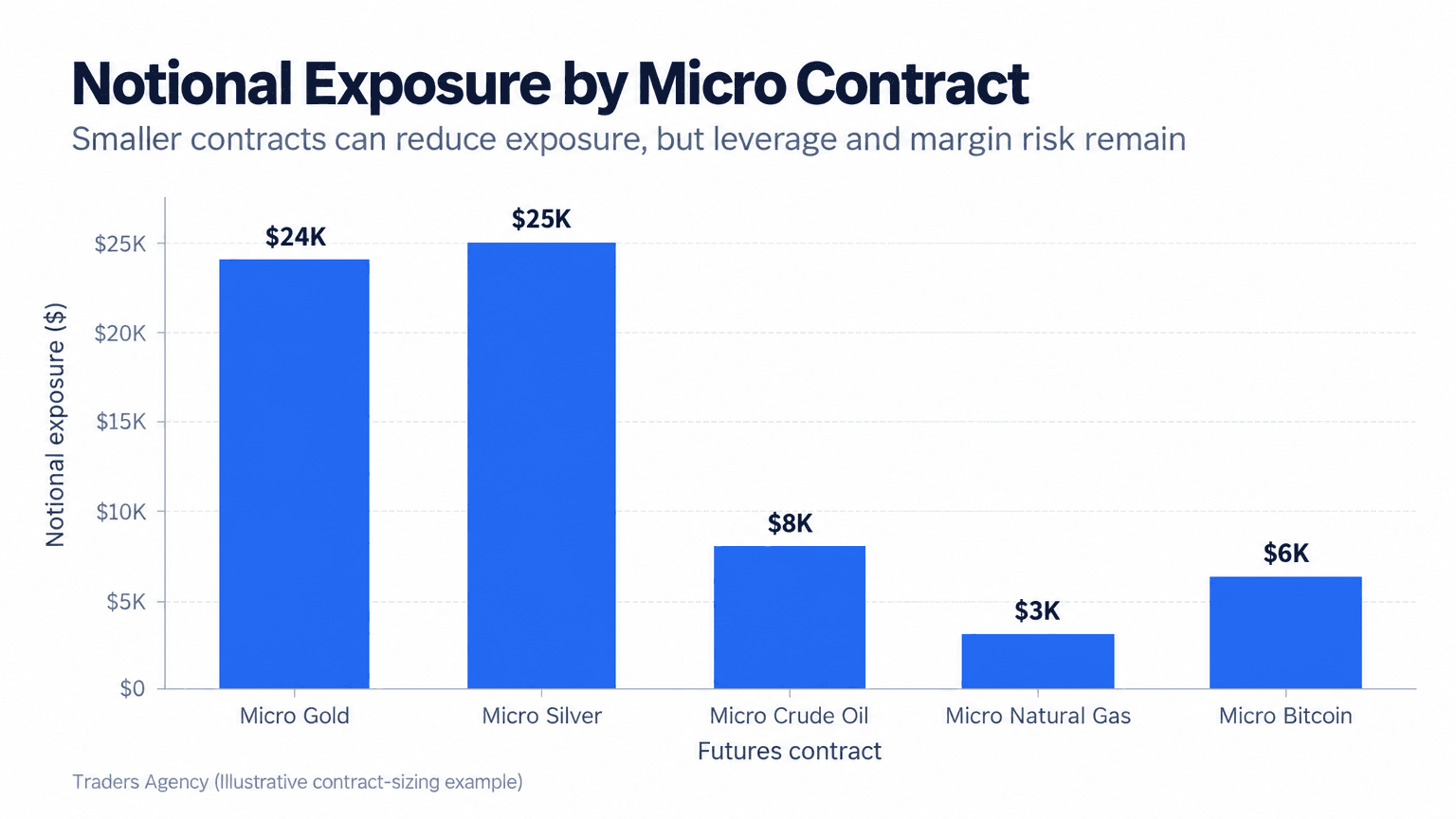
Mini and micro contracts also let advanced traders build spread positions, long one commodity and short a correlated one, at a notional scale that keeps margin usage reasonable across multiple legs at once.
Do I Need $25,000 to Trade Futures?
No. The $25,000 minimum is a Pattern Day Trader rule that applies to margin accounts trading stocks and options, not futures. Futures accounts are regulated differently, and many brokers allow futures trading with account minimums well under that threshold.
That said, is $100 enough to trade futures? Technically, no, not for a standard contract. A single standard crude oil contract alone requires several thousand dollars in margin. Even a micro contract, while far cheaper, usually needs several hundred dollars of margin plus a buffer for drawdown before we'd consider the account properly funded.
Key Concept: The $25,000 Pattern Day Trader rule has nothing to do with futures accounts. It's a stocks-and-options rule. Don't let that number stop you from exploring futures with a modest account.
For traders working with a modest account, our approach is simple: start with micro contracts, keep margin usage well under 50% of available capital, and treat the first several trades as a test of your execution discipline rather than a profit target. A good example of this is trading one Micro Crude Oil contract (MCL), which controls 100 barrels instead of 1,000, cutting both exposure and margin requirement to roughly one-tenth of the standard contract.
Want expert trading insights delivered daily?
Join thousands of traders who rely on Traders Agency for market analysis and trade ideas.
Join Traders AgencyHow Do You Trade Commodities Futures Step-by-Step?
Here's how we teach this process, using a realistic, advanced-level example built around Micro Crude Oil (MCL).
- Step 1: Define the Thesis and Timeframe. Suppose crude oil is trading at $75.00 per barrel, and your analysis points to a short-term supply disruption pushing prices higher over the next three weeks. You decide to go long rather than trade the spot market, because futures let you control size precisely and manage expiration risk on your own terms.
- Step 2: Select the Contract and Size the Position. You choose the Micro WTI Crude Oil contract (MCL), controlling 100 barrels. At $75.00, notional exposure is $7,500, with an initial margin requirement of roughly $500 to $700 depending on current exchange settings.
- Step 3: Set Entry, Stop, and Target. Define your levels before you place the order, not after.
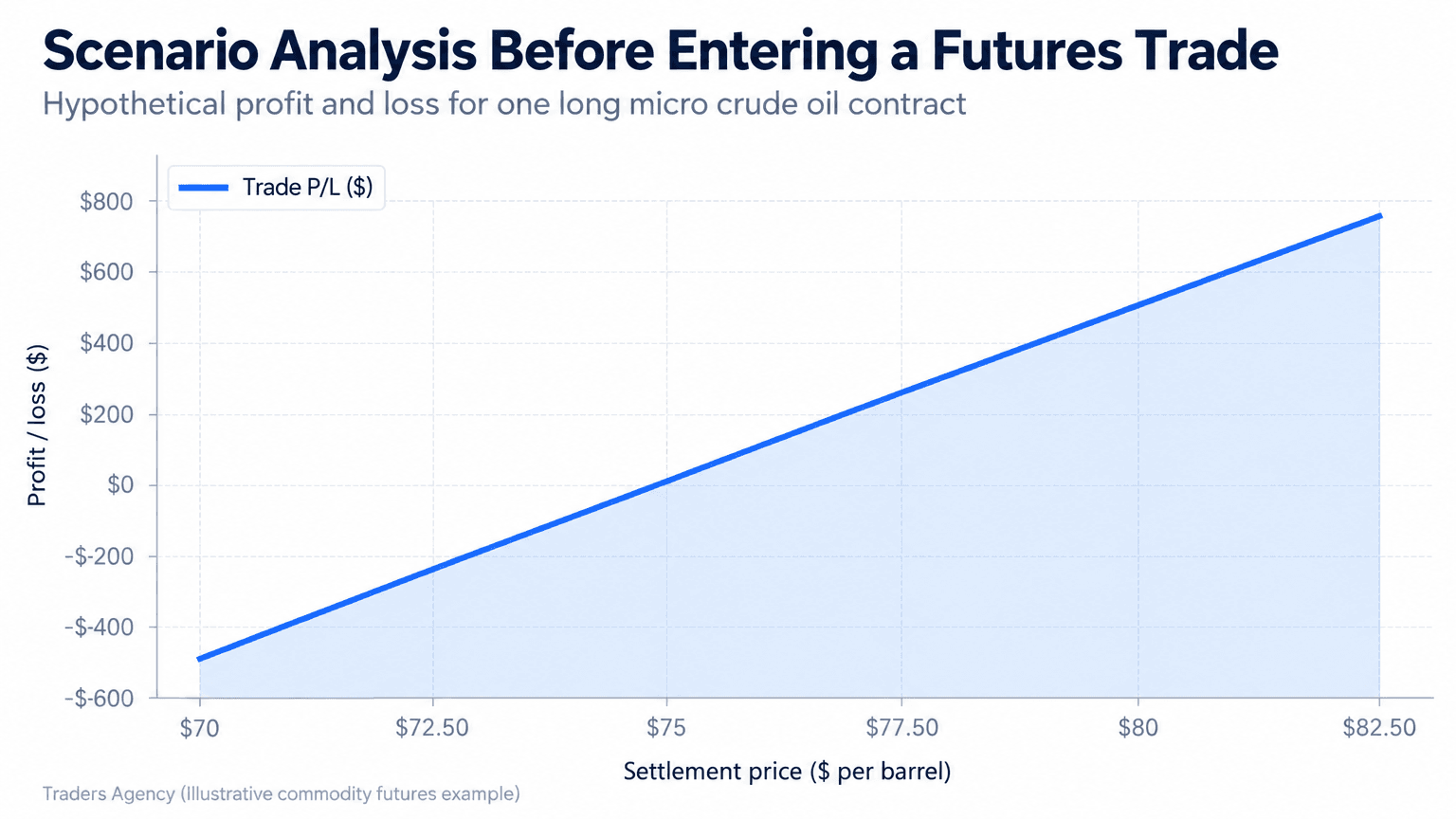
- Step 4: Execute and Monitor. Once filled, you're long one MCL contract. Each $0.01 move equals $1.00 of profit or loss per contract, so a $1.50 stop represents $150 of defined risk on this single position.
- Step 5: Plan the Outcome Before Expiration. Know what you'll do in each scenario, best case, worst case, and the choppy middle ground, before the market forces your hand.
| Parameter | Value |
|---|---|
| Contract | Micro WTI Crude Oil (MCL), 100 barrels |
| Entry | $75.00 |
| Notional Exposure | $7,500 |
| Initial Margin | $500 to $700 |
| Stop-Loss | $73.50 ($150 risk per contract) |
| Target | $78.00 ($300 potential gain per contract) |
| Risk-Reward Ratio | 1:2 |
| Scenario | Price Outcome | Result |
|---|---|---|
| Best Case | Hits $78.00 before expiration | +$300 gain (roughly 43% to 60% of posted margin) |
| Worst Case | Falls to $73.50, stop triggers | -$150 loss, fully defined in advance |
| Most Likely | Chops between $74.00 and $76.50 | Actively managed: trim or extend the stop as expiration approaches |
How Do You Roll Over Futures Contracts Before Expiration?
Rolling a futures contract means closing your position in the expiring month and simultaneously opening an equivalent position in a later-dated contract, avoiding physical delivery and keeping your market exposure continuous.
Most retail commodity traders never intend to take delivery of 1,000 barrels of oil or 5,000 bushels of corn, so rolling happens before the contract's first notice date or last trading day. The mechanics are simple on the surface: sell the near contract, buy the next one out. The cost or benefit of doing this depends entirely on whether the market is in contango or backwardation at the time of the roll.
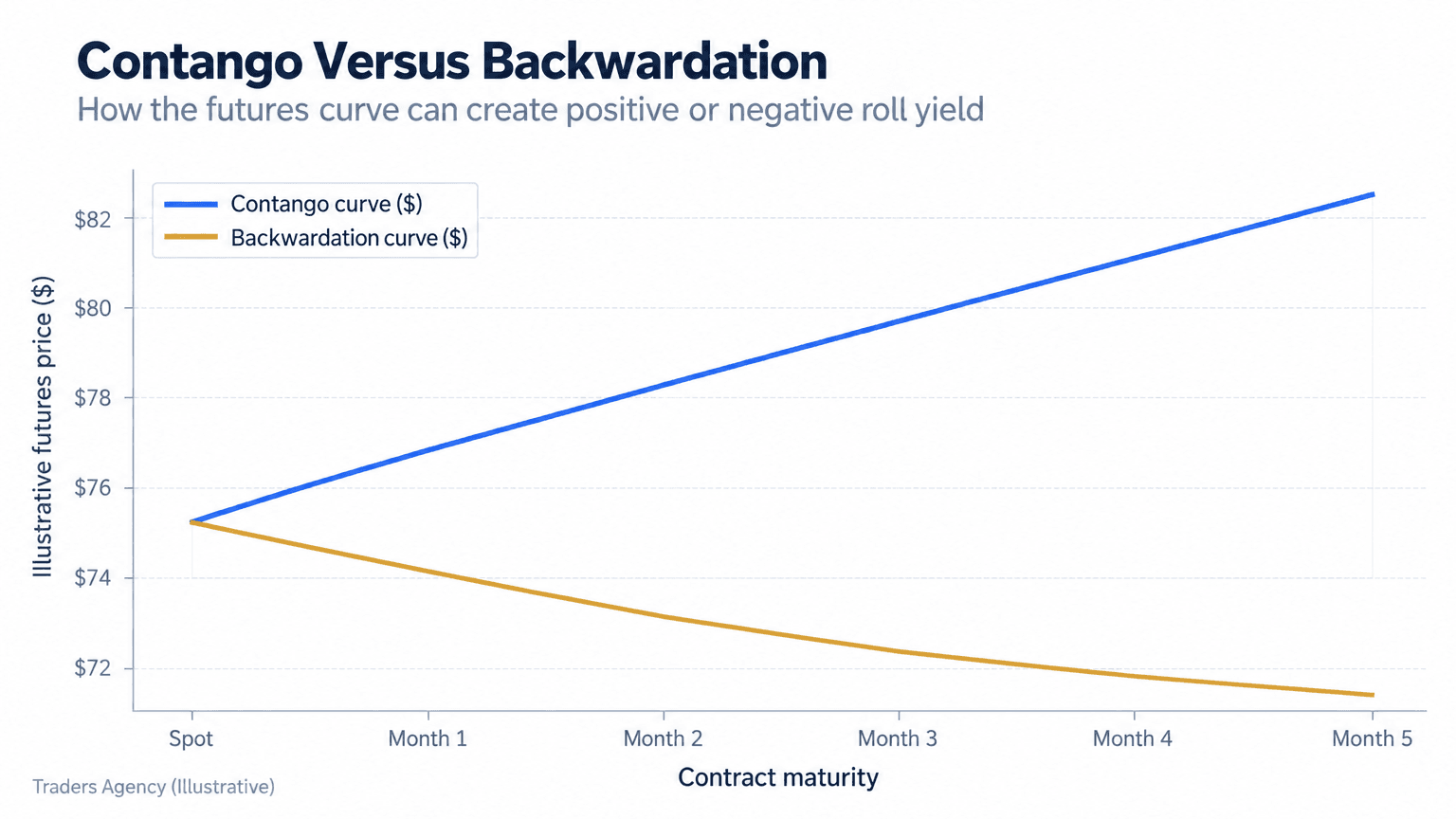
We teach our members to watch the spread between the front month and the next month closely in the days leading up to expiration. A widening contango spread signals rising roll cost for long positions, which may justify reducing size or shifting into a different commodity entirely until the curve normalizes.
Advanced Risk Management Techniques for Futures Traders
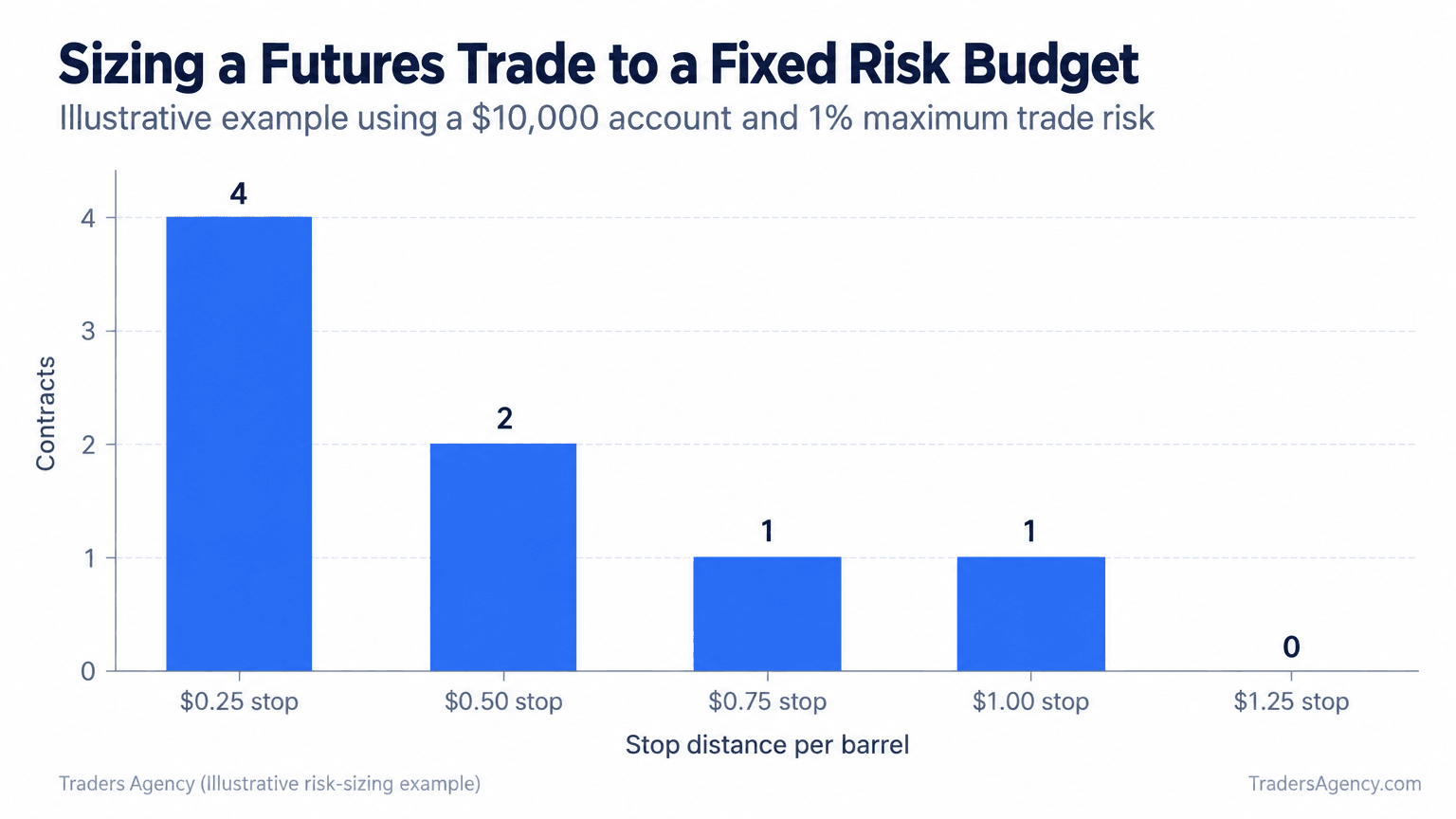
Risk management in futures trading means capping the dollar loss on any single position before entry, sizing contracts to match that cap, and accounting for leverage so a small price move can't erase a disproportionate share of account equity.
The math is straightforward but frequently ignored. If your maximum acceptable loss per trade is $100, and your stop distance on Micro Crude Oil is $0.50 (equal to $50 per contract), you can size up to two contracts. If your stop widens to $2.00 ($200 per contract), that same $100 risk cap only supports half a contract, meaning you either tighten your stop, accept smaller size, or skip the trade.
A few rules we teach our members for managing leveraged commodity exposure:
- Never risk more than 1% to 2% of account equity on a single futures position, measured by the distance to your stop rather than by the margin posted.
- Account for overnight gaps separately from intraday stops, since futures markets can open sharply away from your stop level.
- Track correlated positions together. Long crude oil and long natural gas aren't fully independent risks; a broad energy selloff can hit both simultaneously.
- Reassess margin cushion weekly, since exchange-set margin requirements can increase during volatile stretches, reducing your effective buying power without warning.
Watch Out: Margin requirements can shift intraday during fast markets. A cushion that looks comfortable on Monday can shrink fast by Thursday if volatility spikes, so never run your account right up against the margin line.
What Strategies Do Institutions Use to Trade Gold, Silver, and Oil Futures?
Professional desks rarely trade commodity futures as standalone directional bets. They use them as a hedging and spread instrument, pairing futures positions against physical inventory, ETF holdings, or correlated equities.
A common institutional structure is the calendar spread: simultaneously long the near-month contract and short a further-out contract (or vice versa) to isolate the roll yield itself rather than outright price direction. This is a direct application of the contango and backwardation mechanics we covered earlier, turned into its own tradable position.
Another professional approach treats gold and silver futures as a portfolio hedge against equity drawdowns, since precious metals have historically shown low or negative correlation to stocks during risk-off periods. Oil futures, by contrast, often move with broader economic growth expectations and can correlate positively with cyclical equity sectors, which changes how a desk weights them in a diversified book.
For traders scaling up from the basics, the shift to this institutional mindset usually means spending less time predicting direction and more time structuring exposure: how much correlation risk you're carrying, what the roll curve is doing, and how a single commodity position interacts with everything else in the account.
Our education team publishes new strategy guides and market analysis every week, built around the same real-number, real-risk approach we used in this guide.
Want expert trading insights delivered daily?
Join thousands of traders who rely on Traders Agency for market analysis and trade ideas.
Join Traders AgencyDISCLAIMER: Traders Agency does not offer financial advice. The information provided is for educational purposes only and should not be considered financial advice. Traders Agency is not responsible for any financial losses or consequences resulting from the use of the information provided. Trading carries inherent risks and may not be suitable for all individuals. You are advised to conduct your own research and seek personalized advice before making any investment decisions, recognizing the potential risks and rewards involved.
See more from Traders Agency on Google
Make us a preferred source and our market analysis will appear more prominently in your Google Search, Top Stories, and AI results.
Add to Preferred Sources