
Debit spreads vs credit spreads comes down to one simple question: are you paying money to open the trade, or getting paid to open it? A debit spread means you pay a net premium upfront because you're buying an option that costs more than the one you sell. A credit spread means you collect a net premium upfront because you're selling an option that costs more than the one you buy.
That single difference, who pays and who collects, shapes almost everything else about how these trades behave. It affects your max loss, your max gain, how time decay works for or against you, and which market conditions actually favor the trade. By the end of this article, you'll know how to build both types of spreads, read a basic debit spreads vs credit spreads chart, and decide which one fits your outlook and the current volatility environment.
We'll walk through real numbers, actual strikes, and specific breakeven points so you can see exactly how each trade plays out. No vague theory, just the mechanics you need to start applying this.
What Is a Debit Spread?
Bottom Line: The choice between debit and credit spreads hinges on implied volatility, not just market direction. When options are cheap, debit spreads offer better value; when options are expensive, credit spreads let you collect inflated premium, so checking IV rank before entering a trade should become a standard step in the decision.
A debit spread is an options strategy where you buy one option and sell another option of the same type and expiration, but at a different strike price, resulting in a net cost to open the trade.
You pay money upfront, which becomes your maximum possible loss. The option you buy is more expensive than the option you sell because it's closer to the current stock price, so it carries more value. The trade profits if the stock moves in the direction you expect, and the sold option caps how much you can make while also lowering your upfront cost.
There are two common versions:
- Call debit spread: Buy a lower strike call, sell a higher strike call. This is a bullish trade.
- Put debit spread: Buy a higher strike put, sell a lower strike put. This is a bearish trade.
A Simple Example of a Debit Spread
Let's say a stock is trading at $100. You buy a $100 call for $6.00 and sell a $110 call for $2.00, both expiring in 30 days. Your net cost, or debit, is $4.00 per share, or $400 total since one contract covers 100 shares.
| Parameter | Value |
|---|---|
| Stock Price | $100 |
| Long Call | $100 strike, $6.00 premium |
| Short Call | $110 strike, $2.00 premium |
| Net Debit | $400 total |
| Max Loss | $400 (stock at or below $100 at expiration) |
| Max Gain | $600 ($10 width minus $4 debit) |
| Breakeven | $104 |
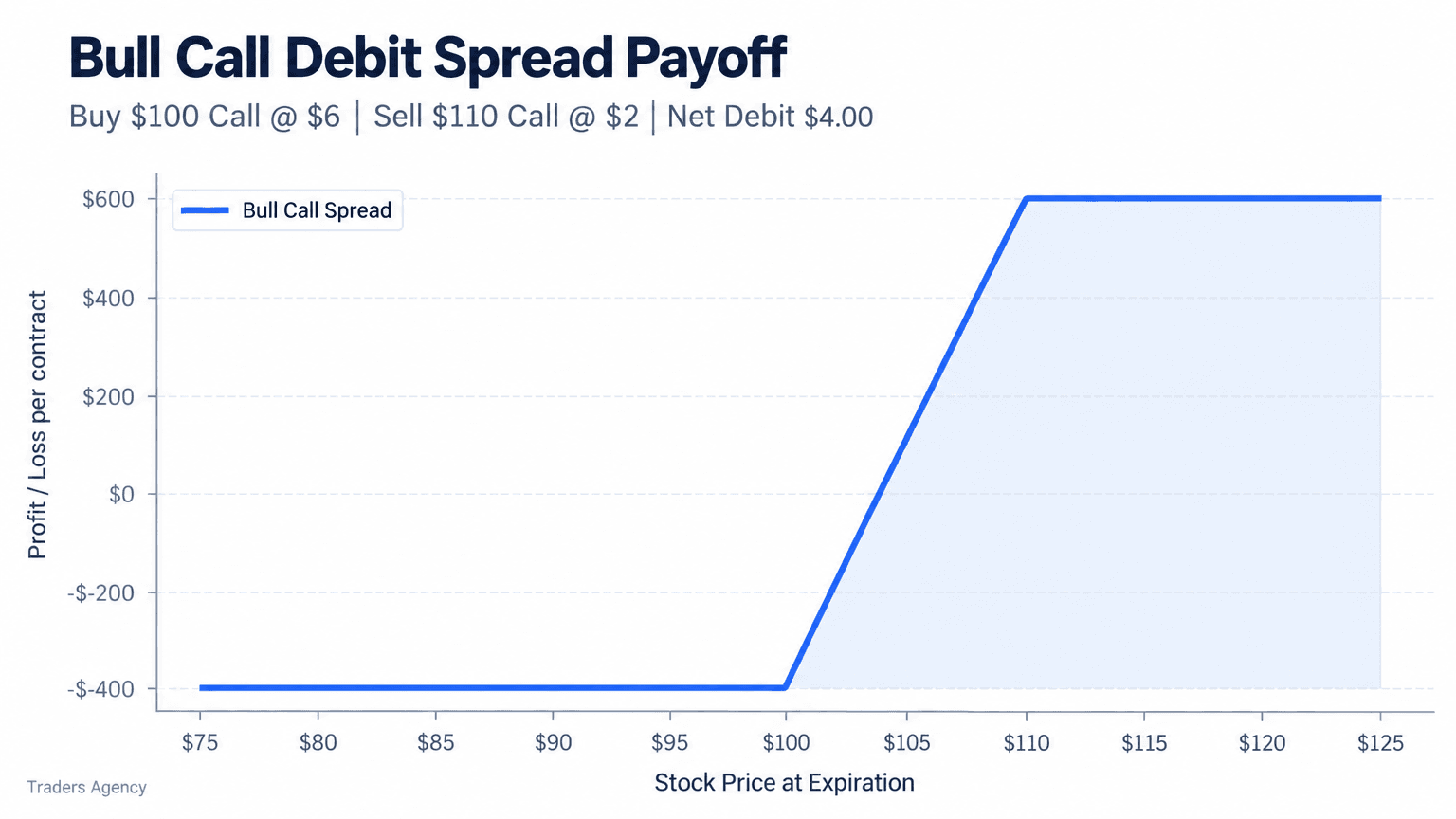
This structure is why people compare call debit spreads vs credit spreads so often. A call debit spread and a bearish call credit spread can sometimes look similar on the surface, but the direction of cash flow and the risk profile are opposites.
What Is a Credit Spread?
A credit spread is an options strategy where you sell one option and buy another option of the same type and expiration at a different strike, resulting in a net premium collected when you open the trade.
Here, you're the net seller. The option you sell is more expensive (closer to the stock price) than the option you buy, so you pocket the difference immediately. That credit is your maximum possible gain, and the trade profits most if the options simply expire worthless.
The two common versions:
- Put credit spread: Sell a higher strike put, buy a lower strike put. This is a bullish trade.
- Call credit spread: Sell a lower strike call, buy a higher strike call. This is a bearish trade.
A Credit Spread vs Debit Spread Example
Using the same $100 stock, imagine you instead sell a $95 put for $3.00 and buy a $90 put for $1.00, both expiring in 30 days. You collect a net credit of $2.00 per share, or $200 total.
| Parameter | Value |
|---|---|
| Stock Price | $100 |
| Short Put | $95 strike, $3.00 premium |
| Long Put | $90 strike, $1.00 premium |
| Net Credit | $200 total |
| Max Gain | $200 (stock stays above $95 at expiration) |
| Max Loss | $300 ($5 width minus $2 credit) |
| Breakeven | $93 |
Notice the asymmetry here compared to the debit spread. With credit spread options, you're risking more than you can make, but you have a higher probability of success because the stock just needs to stay above $95, not rally past a breakeven point.
Key Concept: In a debit spread, you risk a fixed amount to chase a larger payout. In a credit spread, you collect a fixed amount upfront but risk more if the trade goes against you. The tradeoff is reward size versus probability of winning.
What Are the Key Differences Between Debit Spreads and Credit Spreads?
The core difference is cash flow direction, but that single factor cascades into very different risk and reward profiles.
| Feature | Debit Spread | Credit Spread |
|---|---|---|
| Cash flow at open | You pay | You receive |
| Max loss | The debit paid | Width minus credit |
| Max gain | Width minus debit | The credit received |
| Time decay | Works against you | Works for you |
| Best IV environment | Lower implied volatility | Higher implied volatility |
This "which one is better" debate shows up constantly among traders comparing debit spreads vs credit spreads. The honest answer is that neither is universally better. They're tools for different conditions, and we'll get into exactly how to pick between them below.
Want expert trading insights delivered daily?
Join thousands of traders who rely on Traders Agency for market analysis and trade ideas.
Join Traders AgencyAre Debit Spreads Better Than Credit Spreads?
Neither is inherently better. Debit spreads tend to work better in lower implied volatility environments and when you expect a strong directional move, while credit spreads tend to work better in higher implied volatility environments when you expect the stock to stay range bound or move only moderately.
The "which is better" question depends entirely on context: what's implied volatility doing, what's your outlook, and how much risk can you tolerate. Asking which structure is better without specifying market conditions is asking an incomplete question.
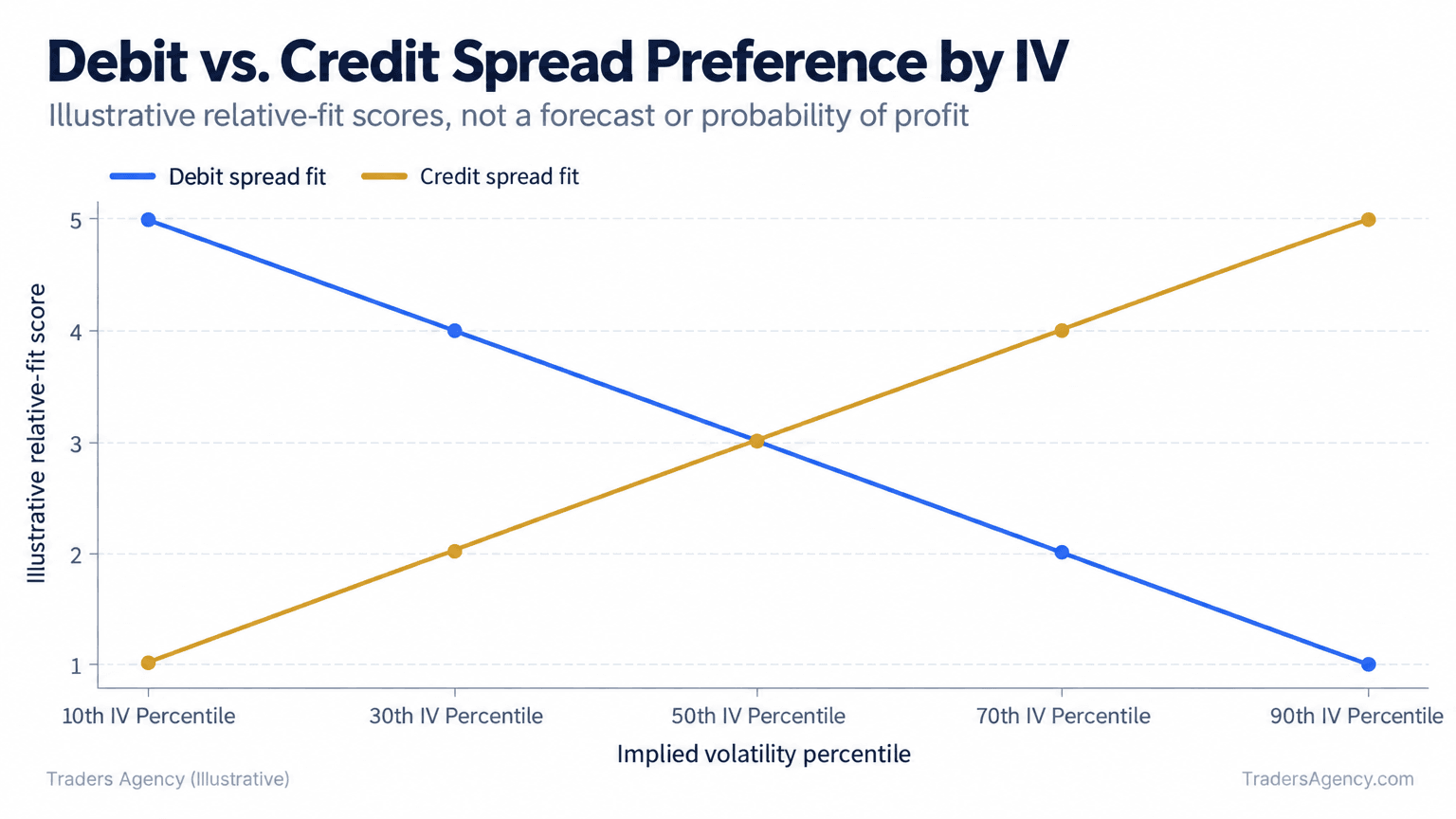
When implied volatility (IV) is low, options are relatively cheap. Buying a debit spread means you're paying less for the long leg, and you benefit if volatility expands along with price movement. When IV is high, options are expensive, which favors selling. A credit spread lets you collect that inflated premium, and you profit as IV contracts back toward normal levels, a process often called volatility crush. You can check real-time IV levels and option chain data directly through the CBOE.
When Should You Use a Debit Spread vs a Credit Spread?
Use a debit spread when you expect a clear directional move and implied volatility is on the lower side, since you want to buy options while they're cheap. Use a credit spread when you expect the stock to stay within a range or move only slightly in your favor, and implied volatility is elevated, since you want to sell expensive premium.
Here's the checklist we use with our members:
- Check IV rank or IV percentile. High readings favor credit spreads; low readings favor debit spreads.
- Define your directional conviction. Strong conviction on a big move favors debit spreads since the payout ratio is higher.
- Consider your timeline. Credit spreads benefit from time passing; debit spreads need the move to happen before time runs out.
- Look at the width and probability. Credit spreads often have a higher probability of a small win; debit spreads often have a lower probability of a larger win.
A call debit spread vs put credit spread comparison is a great example of this decision in action. Both can express a bullish view, but the call debit spread wants a move to happen, while the put credit spread just wants the stock to avoid dropping.
How Do Greeks Affect Debit and Credit Spreads?
Delta, theta, and vega behave differently depending on whether you're in a debit or credit spread, even when both trades reflect the same bullish or bearish opinion. Understanding this helps explain why one structure might suit your outlook better than the other.
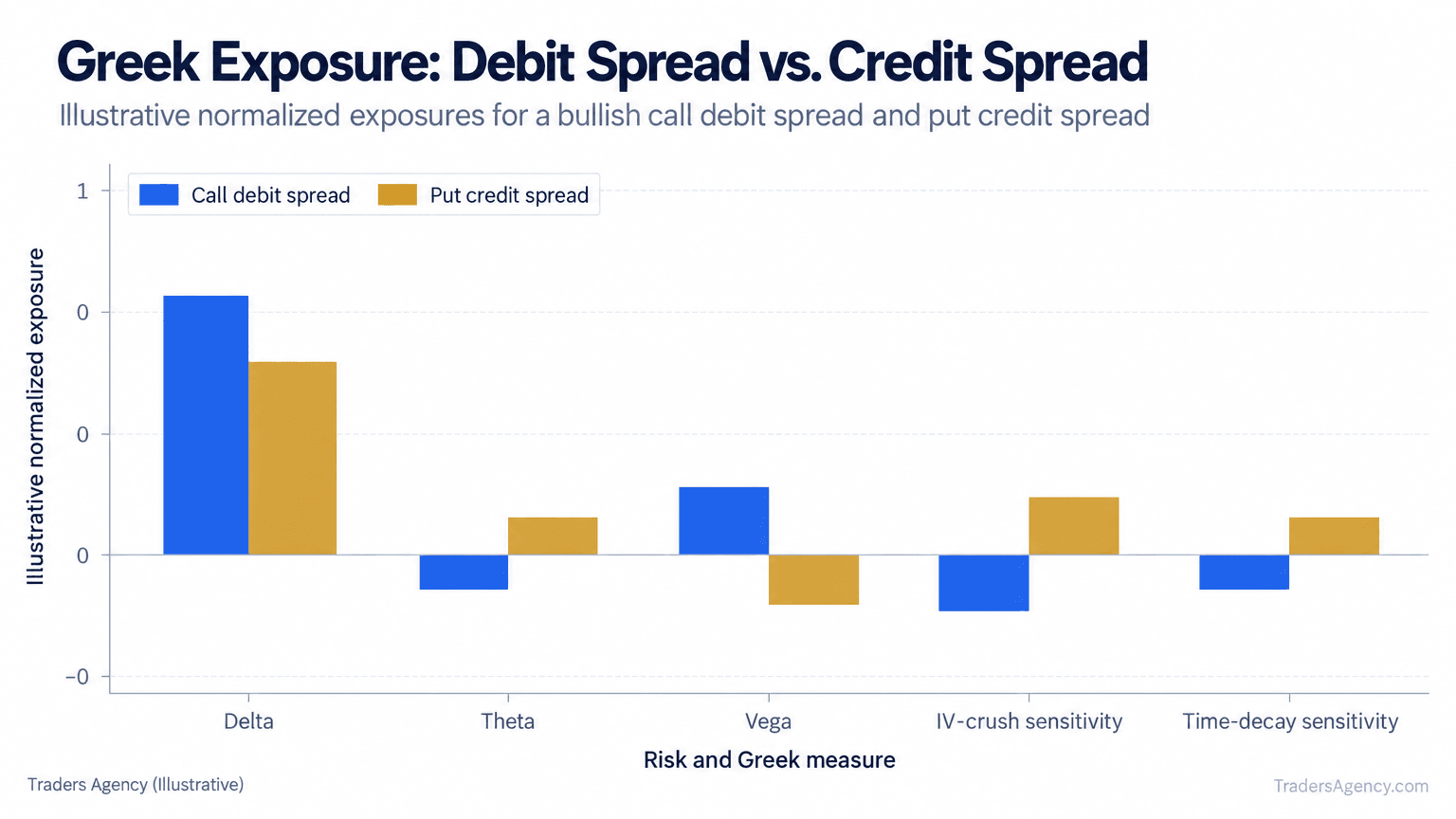
Theta, which measures how much value an option loses each day from time passing, generally works against a debit spread and for a credit spread. Since you own the more expensive option in a debit spread, decay erodes your position daily. In a credit spread, that same decay works in your favor because you want the options to lose value and expire worthless.
Vega, which measures sensitivity to changes in implied volatility, tends to help debit spreads when volatility rises and help credit spreads when volatility falls. This is why matching the spread type to the current IV environment matters so much.
Delta, which measures directional exposure, points the same way for both strategies if you're expressing the same bullish or bearish view, but the magnitude and shape of that exposure differ between the two structures.
What Are the Risks of Credit and Debit Spreads?
The biggest risk with a debit spread is simple: if the stock doesn't move far enough by expiration, you lose the entire amount you paid. There's no partial credit for being "close."
For credit spreads, the main risks are different:
- Max loss can exceed max gain, sometimes significantly, depending on strike width.
- Early assignment risk exists on the short leg, particularly on short calls around dividend dates and on any short option that goes deep in the money.
- Pin risk near expiration can create uncertainty about whether your short option will be exercised.
Both strategies share one major benefit over selling naked options: your max loss is defined and capped the moment you open the trade. That's the main reason we teach spreads to newer options traders rather than single leg positions.
Watch Out: A defined max loss is not the same as a small max loss. Always size your position so that even a full loss on the spread stays within your risk limits for the account.
Risk Management Basics We Recommend
- Never risk more than 1-3% of your account on a single spread.
- Know your max loss before entering, not after.
- Set a mental or hard stop if the trade moves against you early, even though max loss is defined.
- Watch IV going into earnings or major news, since it can swing in your favor or against you fast.
How Do You Choose the Right Spread for Your Strategy?
If you're still deciding between a call debit spread vs credit spread setup, start by asking what the stock is likely to do and why, not which structure sounds more appealing. The chart-based side-by-side of debit spreads vs credit spreads earlier in this article is a useful reference point when implied volatility conditions shift.
A simple rule we give our members: when options feel "cheap," lean toward debit spreads. When options feel "expensive," lean toward credit spreads. Over time, checking IV rank before every trade will make this decision almost automatic.
Want expert trading insights delivered daily?
Join thousands of traders who rely on Traders Agency for market analysis and trade ideas.
Join Traders AgencyDISCLAIMER: Traders Agency does not offer financial advice. The information provided is for educational purposes only and should not be considered financial advice. Traders Agency is not responsible for any financial losses or consequences resulting from the use of the information provided. Trading carries inherent risks and may not be suitable for all individuals. You are advised to conduct your own research and seek personalized advice before making any investment decisions, recognizing the potential risks and rewards involved.
See more from Traders Agency on Google
Make us a preferred source and our market analysis will appear more prominently in your Google Search, Top Stories, and AI results.
Add to Preferred Sources