
You've probably wondered whether you can learn to trade before risking real money on an actual position. That's exactly what a paper trading simulator is built for: a tool built into most trading platforms that lets you place stock, options, or futures trades with simulated money so you can test strategies and learn how order entry actually works, all without any financial exposure. In this guide, we'll show you how to set up a free paper trading simulator account, how the four most popular platforms (Thinkorswim paperMoney, TradingView, Webull, and IBKR) differ from each other, and how to tell when you're ready to graduate from practice money to your own capital. We'll also walk through the mistakes we see most often from traders who skip the fundamentals and jump straight into live markets.
What Is a Paper Trading Simulator?
Bottom Line: A paper trading simulator is useful for learning order entry and platform mechanics, but it can't tell you whether you're ready to trade profitably with real money since simulated fills and results lack the emotional and financial pressure of live markets. Choose a simulator that matches the platform and data quality you'll actually trade with, since that's what determines how well practice translates to live performance.
A paper trading simulator is a feature built into most major brokerage platforms that gives you a fake account balance, usually somewhere between $10,000 and $1,000,000, so you can place trades exactly as you would with real money.
The term "paper trading" comes from the days before computers, when traders would literally write their trades down on paper to track hypothetical performance. Today the process is digital, but the goal is the same: practice stock trading with fake money in an environment that mirrors the real market as closely as possible.
Here's why this matters. A simulator lets you make your early, expensive mistakes (overtrading, ignoring stop losses, sizing positions too large) without losing any actual capital.
Key Concept: A paper trading account is like a flight simulator for traders. You wouldn't want someone's first landing attempt to be with real passengers on board, and the same logic applies to your first trades with real money.
How Do You Set Up a Paper Trading Account?
Setting up a free trading simulator account typically takes under 15 minutes on any of the major platforms. The process is nearly identical across brokers, so once you've done it once, you can repeat it anywhere.
Step-by-Step Setup Process
- Choose a platform. Thinkorswim, TradingView, Webull, and IBKR all offer paper trading, and requirements vary: some let you start without funding a live account, while others ask you to register or log in first.
- Create a free account. You'll provide an email, set a password, and in some cases verify your identity, though a few browser-based tools advertise a no login option for quick testing.
- Select "paper trading" or "simulated trading" mode. This is usually a toggle switch near your account balance.
- Set your starting balance. Most platforms default to a round number like $100,000, but we recommend adjusting this to match a realistic amount you'd actually trade with.
- Link a watchlist. Add the tickers you actually plan to trade so your practice sessions reflect your real strategy.
- Place your first simulated trade. Enter an order exactly as you would with real money: ticker, order type, quantity, and price.
A common troubleshooting issue we hear about: if your simulated balance resets unexpectedly, check whether your platform periodically refreshes paper accounts, which several simulators do on a set schedule. This is normal and not a bug.
Thinkorswim paperMoney or TradingView: Which Paper Trading Platform Is Better?
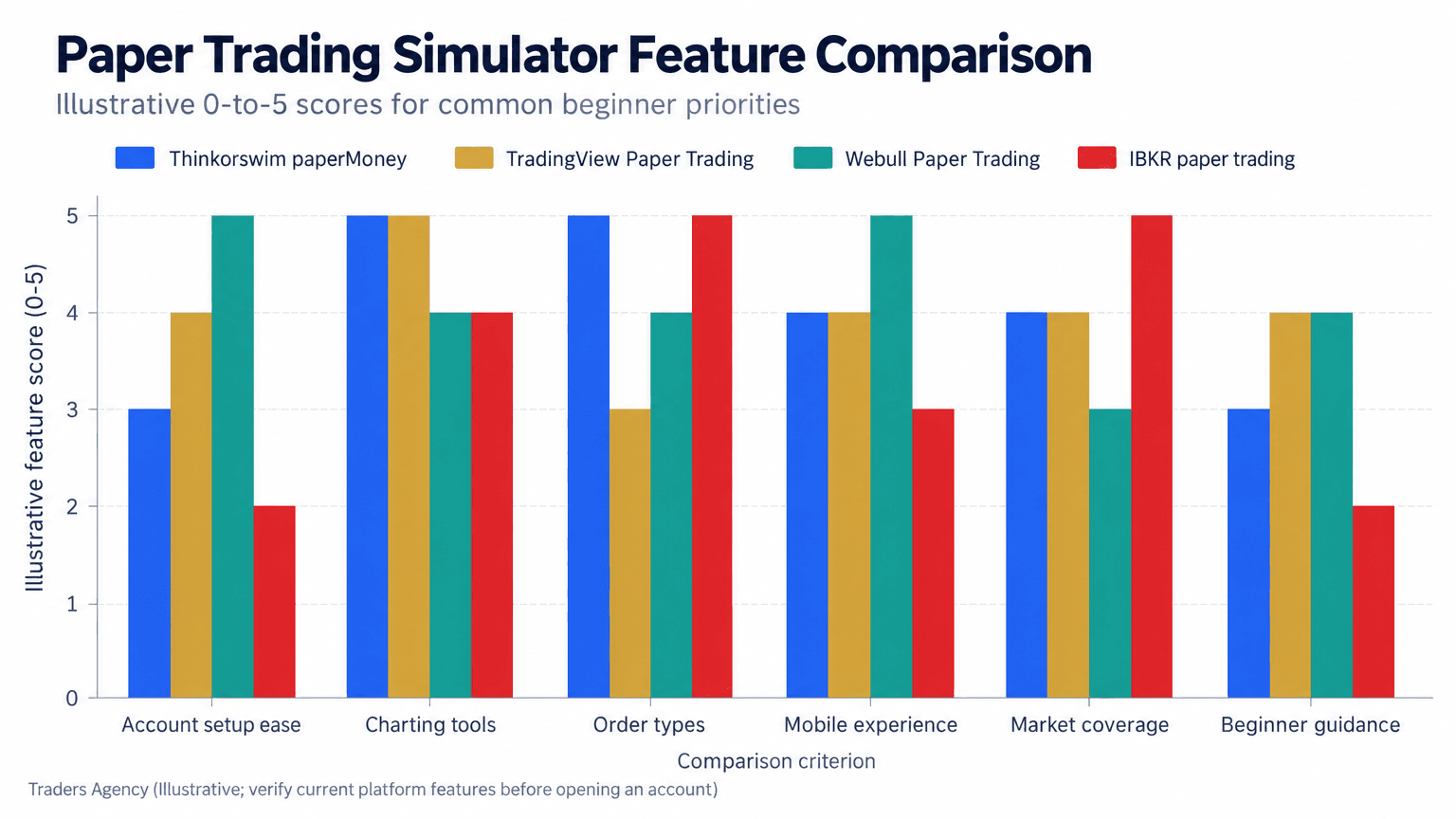
Thinkorswim's paperMoney tool is widely considered one of the most complete simulators available, largely because it mirrors the full live Thinkorswim platform, including options chains, futures, and advanced order types.
TradingView's paper trading is built around its popular charting interface, which makes it a strong choice if you already know TradingView from technical analysis work. The tradeoff is that its simulator has historically focused more on stocks, with fewer order complexities than Thinkorswim.
| Platform | Strengths | Best For |
|---|---|---|
| Thinkorswim paperMoney | Full options and futures support, realistic margin simulation, resets periodically | Options traders practicing multi-leg strategies |
| TradingView | Charting tools built directly into the order ticket, simpler order types, broader crypto and forex coverage | Chart-focused traders testing entries against technical setups |
Webull or IBKR: Which Paper Trading Account Should You Use?
Webull's paper trading account is often praised for being approachable, with a clean mobile interface that makes it a popular choice among newer traders looking for a day trading simulator without complicated settings.
IBKR's (Interactive Brokers) paper trading account, by contrast, is aimed at more active and international traders. It supports a wider range of global markets and order types, but the interface has a steeper learning curve for beginners.
| Platform | Design | Best For |
|---|---|---|
| Webull | Simple, mobile-first, good for US stocks and basic options, free account setup | Newer traders who want an easy entry point |
| IBKR | Global market access, advanced order routing | Traders who already understand complex order types |
Watch Out: Both Webull and IBKR can show order fills that are slightly more forgiving than what you'd experience in live markets, especially on thinly traded stocks. Don't assume your paper fills will match your live fills exactly.
Why Does Data Quality Affect Paper Trading Practice?
Not every free paper trading account uses real-time data, and this difference can quietly distort your results.
Some platforms use delayed data, often by 15 minutes, which means the price you see on screen isn't the price you'd actually get in a live trade. For long-term investors, a 15-minute delay barely matters. For anyone practicing day trading or scalping strategies, it can make your simulated results look far better, or far worse, than what would happen in real time.
Thinkorswim and TradingView can provide real-time or near real-time data for paper trading, depending on your account status and any exchange data subscriptions tied to your login. Free, no-login simulators are more likely to run on delayed feeds.
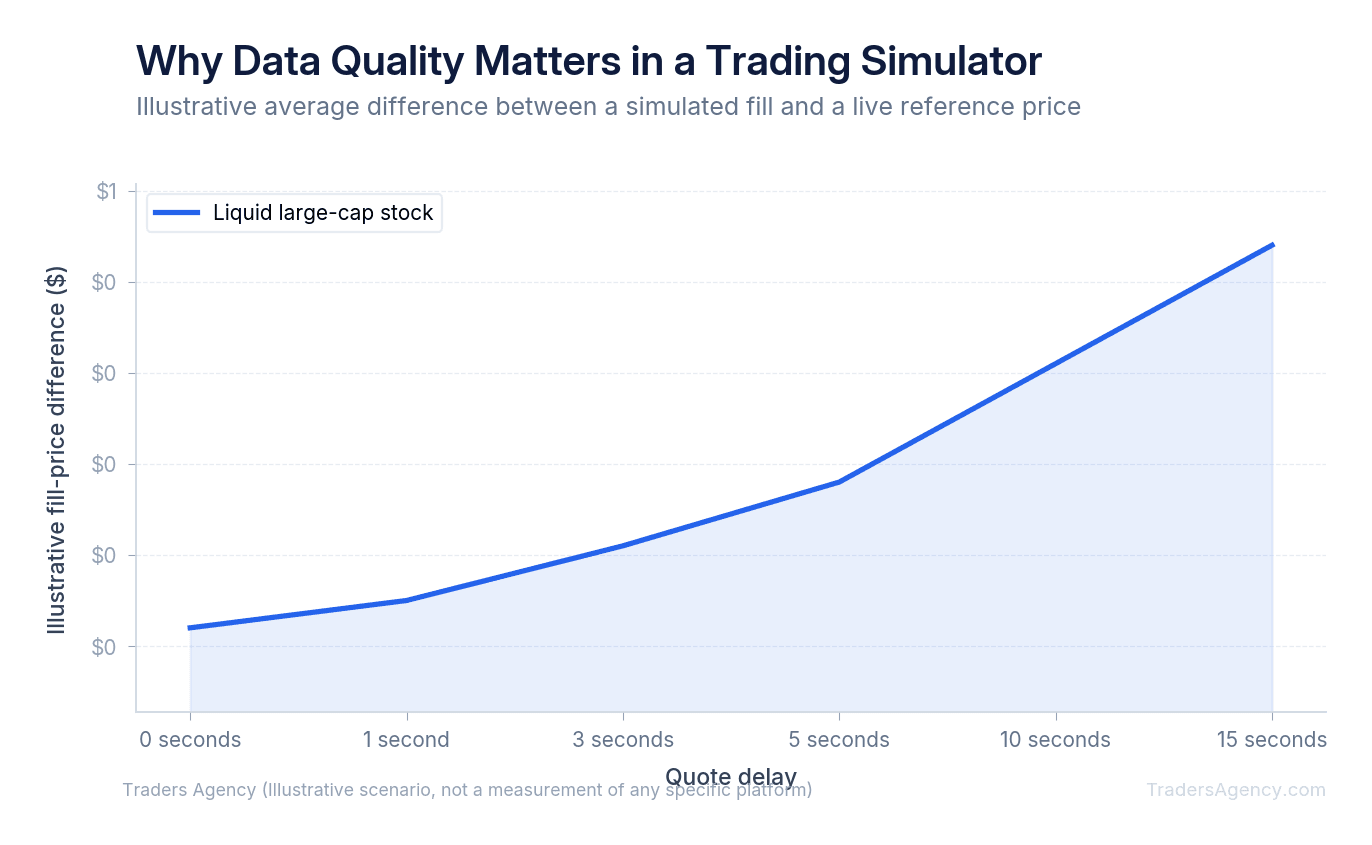
If you're testing a strategy that depends on fast execution, confirm your simulator's data speed before trusting your results. A strategy that looks profitable on delayed data can fall apart the moment real-time price action enters the picture.
Want expert trading insights delivered daily?
Join thousands of traders who rely on Traders Agency for market analysis and trade ideas.
Join Traders AgencyWhy Paper Trade Before Using Real Money?
Paper trading exists to help you build habits and test ideas before your decisions carry financial consequences. Practicing with simulated money gives you repetition without risk, which is how most skills get learned in any field.
Trading involves decisions made under pressure, and that pressure doesn't show up the same way in a simulator as it does with real money on the line. Even so, a simulated account is still valuable for learning platform mechanics: how to enter orders correctly, how stop losses behave, and how your chosen strategy performs across different market conditions.
Investor education resources such as the SEC's Investor.gov stress understanding how orders, costs, and risk work before you commit real capital, and a simulated account is one practical way to build that understanding.
Common Paper Trading Mistakes to Avoid
We see the same handful of mistakes repeated across new traders using a paper trading simulator. Avoid these if you want your practice to actually translate into real skill.
- Using an unrealistic starting balance. If you'll actually trade with $5,000, don't practice with a $500,000 simulated account. Position sizing habits won't transfer.
- Ignoring commissions and slippage. Some simulators don't account for these costs, making your paper results look better than live trading will.
- Overtrading because losses don't feel real. Without real financial risk, it's easy to click into dozens of trades a day that you'd never actually place with your own money.
- Skipping stop losses. If you don't practice using them in the simulator, you won't use them consistently with real capital either.
- Trading on delayed data without realizing it. This can make fast strategies look more effective than they actually are.
- Never tracking results. Treat your paper account like a real portfolio: keep a trade log, note your reasoning, and review it weekly.
Watch Out: If your paper trading results only look good because you're skipping stops, ignoring fees, or trading on delayed quotes, those results won't hold up once real money is on the line.
When Should You Switch to Real Money?
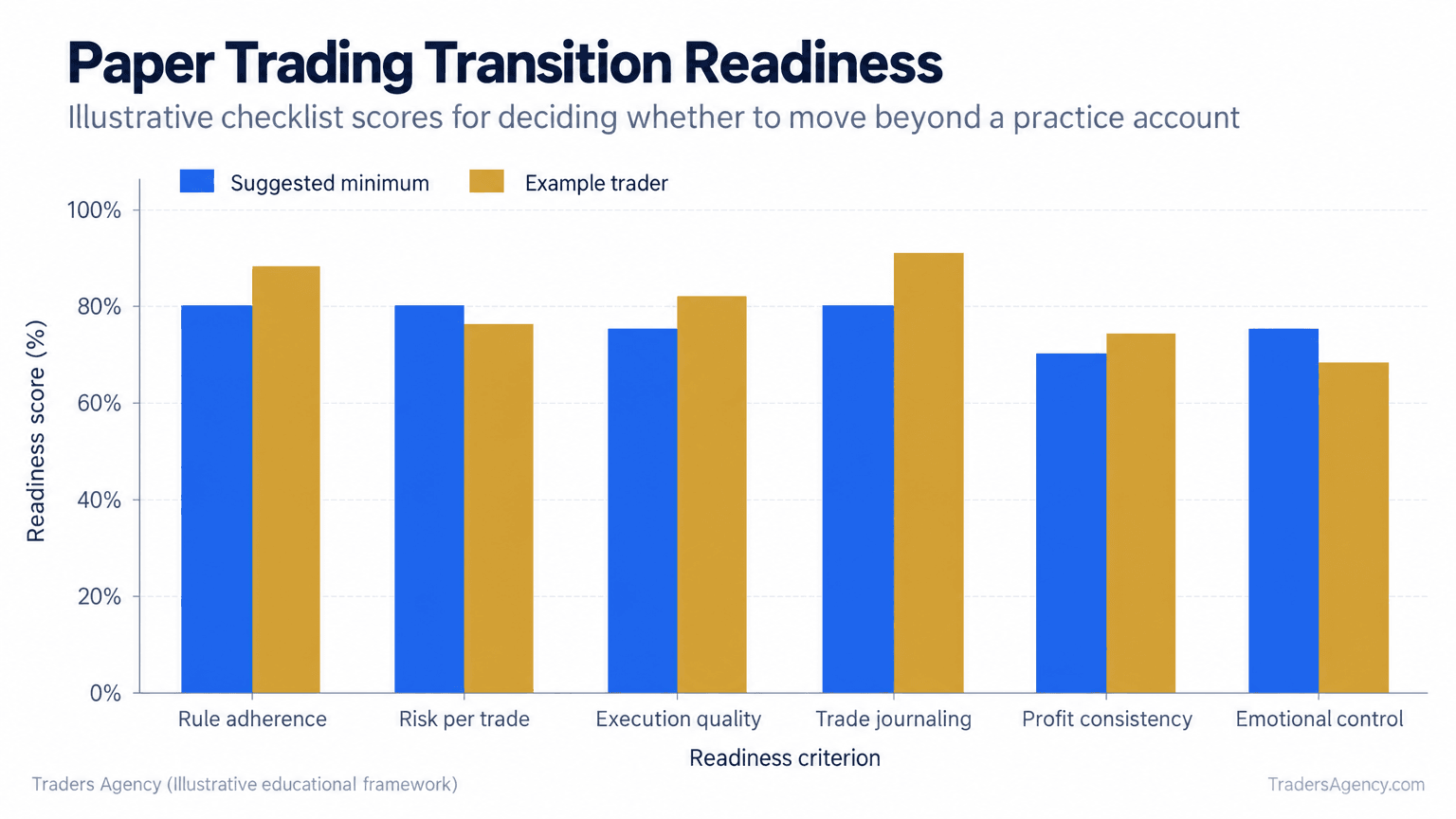
There's no single number of trades that makes someone ready to go live, but there are clear signs worth watching for. Consistency matters more than any specific win rate.
Before moving to real capital, most traders we work with can answer yes to the following:
- Have you followed your trading plan on at least 20 consecutive trades, not just when it was convenient?
- Can you explain your risk management rules (position size, stop loss placement) without hesitating?
- Have you reviewed your paper trading log and identified patterns in your wins and losses?
- Are you emotionally steady after a losing trade, or does it make you want to immediately "revenge trade"?
- Have you accounted for commissions, taxes, and slippage in your expected results?
If you're still answering "no" to several of these, that's a sign to keep practicing rather than rush the transition.
Is Paper Trading Illegal?
No, paper trading is not illegal. It's a legal, standard educational practice offered by brokerages such as Schwab's Thinkorswim, Webull, and Interactive Brokers, as well as charting platforms like TradingView.
Because no real money changes hands, there's no securities transaction actually taking place, which is why a practice account doesn't work the same way as a live, funded brokerage account. Brokerages offer simulators because practice accounts help new customers learn platform mechanics before they trade with real capital.
That said, questions about whether you can make a specific dollar amount per day trading apply only to live markets with real capital at risk. A paper account will never answer those questions accurately, since simulated results don't carry the emotional or financial pressure of real trading, and some platforms show more forgiving fills than you'd get in a live market.
Want expert trading insights delivered daily?
Join thousands of traders who rely on Traders Agency for market analysis and trade ideas.
Join Traders AgencyDISCLAIMER: Traders Agency does not offer financial advice. The information provided is for educational purposes only and should not be considered financial advice. Traders Agency is not responsible for any financial losses or consequences resulting from the use of the information provided. Trading carries inherent risks and may not be suitable for all individuals. You are advised to conduct your own research and seek personalized advice before making any investment decisions, recognizing the potential risks and rewards involved.
See more from Traders Agency on Google
Make us a preferred source and our market analysis will appear more prominently in your Google Search, Top Stories, and AI results.
Add to Preferred Sources