
Choosing between a spot Bitcoin ETF and a futures-based Bitcoin ETF is the first real decision every crypto-curious trader has to make, and it's a decision that quietly shapes your costs, your tax bill, and your long-term returns. In this guide, we'll show you exactly how each structure works, what it costs, and how to pick the one that actually fits your trading style.
You've probably seen IBIT, FBTC, and BITO mentioned in the same breath, as if they're interchangeable. They're not. One owns the actual asset. The other owns a bet on the asset. We built this guide for traders who are comfortable buying stocks but new to crypto ETFs, and we'll walk through real numbers rather than just theory.
What Is a Bitcoin Spot ETF?
Bottom Line: Spot Bitcoin ETFs hold actual BTC and suit traders who want clean, long-term exposure without derivative decay, while futures ETFs like BITO suit shorter, tactical trades but face contango drag that erodes returns over time. The right choice depends on your time horizon and tax tolerance, so check the expense ratio and tax form before committing.
A Bitcoin spot ETF is a fund that buys and holds actual Bitcoin on behalf of its shareholders. When you buy a share, you're indirectly owning a slice of real BTC sitting in custody, not a derivative or a promise tied to a future date.
This matters because it removes a layer of complexity. Spot trading simply means buying or selling an asset for immediate ownership and delivery, instead of agreeing to a price for some future date. Spot ETFs apply that same logic at the fund level: the issuer buys real Bitcoin, stores it with a custodian, then issues shares that track its value.
Funds like IBIT (iShares Bitcoin Trust) and FBTC (Fidelity Wise Origin Bitcoin Fund) are the two most recognized spot products. They launched in January 2024 after years of regulatory pushback, and they trade on regular stock exchanges just like any equity ETF.
Key Concept: A spot Bitcoin ETF's share price should track Bitcoin's actual market price almost one-to-one, minus a small management fee.
What Are Crypto Futures ETFs?
A crypto futures ETF doesn't hold Bitcoin directly. Instead, it holds futures contracts, agreements to buy or sell Bitcoin at a set price on a future date, typically traded on the CME (Chicago Mercantile Exchange).
BITO (ProShares Bitcoin Strategy ETF) was the first Bitcoin futures ETF, launching in October 2021, more than two years before spot ETFs were approved. For a while, futures ETFs were the only legal way to get Bitcoin exposure inside a regular brokerage account.
Because futures contracts expire, the fund has to constantly sell expiring contracts and buy new ones. This process, called rolling, introduces a cost that spot ETFs simply don't have.
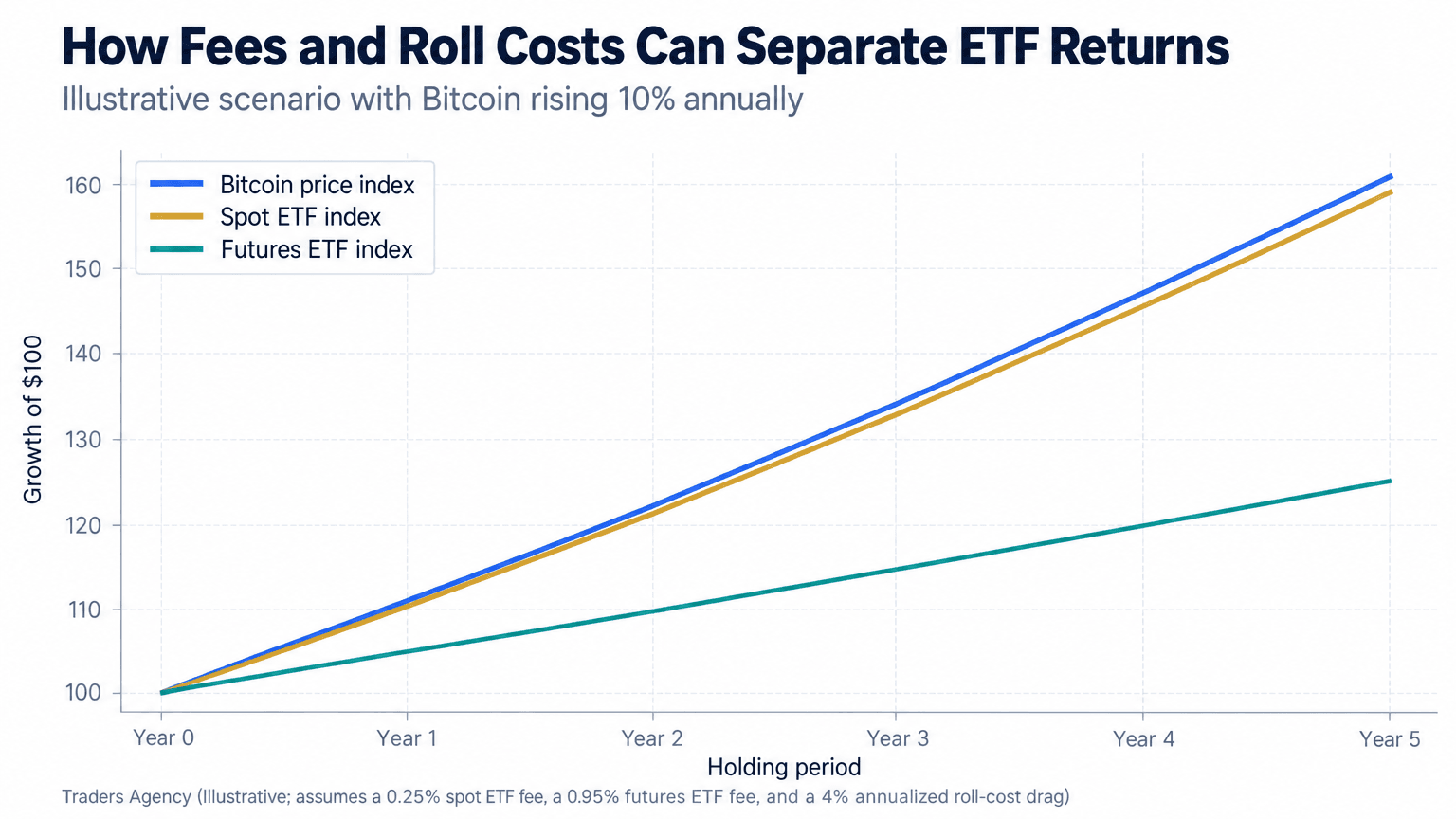
Look at the gap in that chart. Both lines represent "owning Bitcoin exposure," but the futures line lags far behind because of fees and rolling costs eating into returns year after year.
What Is Contango and Why Does It Hurt Futures ETFs?
Contango happens when futures contracts trade at a higher price than the current spot price of the asset. It's common in Bitcoin futures markets, and it creates a steady drag on futures ETF returns.
Here's a simple example. Say Bitcoin's current price is $60,000. A futures contract expiring next month might trade at $60,600, one expiring in two months at $61,800, and one in three months at $63,600. Each contract is priced higher than the last.
| Contract | Price | Premium to Spot |
|---|---|---|
| Bitcoin Spot Price | $60,000 | - |
| 1-Month Futures | $60,600 | +1.0% |
| 2-Month Futures | $61,800 | +3.0% |
| 3-Month Futures | $63,600 | +6.0% |
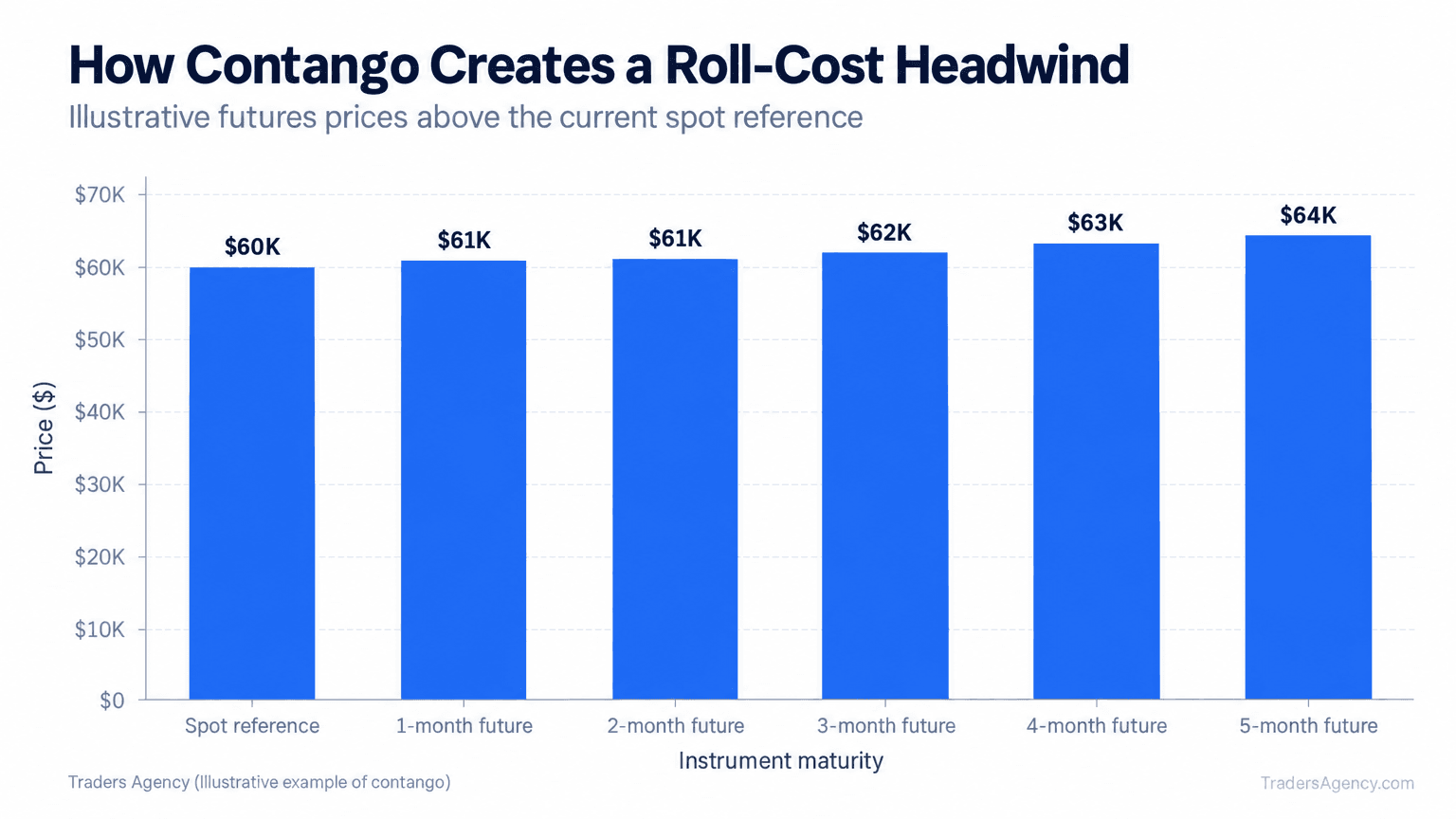
When the fund's near-month contract approaches expiration, it has to sell it and buy the next one, which is priced higher. That means the fund is systematically selling low and buying high, even if Bitcoin's actual price hasn't moved at all. Over a year, this roll cost can add up to several percentage points of lost return.
Want expert trading insights delivered daily?
Join thousands of traders who rely on Traders Agency for market analysis and trade ideas.
Join Traders AgencyWhich Is Better, Spot or Futures?
For most long-term holders, we teach that a spot Bitcoin ETF is the stronger choice because it avoids contango drag and typically carries a lower fee. Futures ETFs make more sense for short-term traders who want exposure inside account structures where spot products aren't available.
This really comes down to time horizon. If you're planning to hold for months or years, the roll costs in a futures ETF compound against you the entire time. If you're trading a two-week move around a Federal Reserve announcement or an ETF inflow report, that drag barely has time to matter.
When traders ask us whether IBIT or FBTC is the better pick, our answer is simple: both are spot ETFs holding actual Bitcoin, so the comparison comes down to fees and trading volume rather than structure. Both have charged competitive expense ratios in the same range since launch, and both trade with tight bid-ask spreads due to high daily volume. The better pick often depends on which brokerage already offers lower trading costs for that specific fund, since Fidelity clients, for example, may face lower commission costs on FBTC.
Why Trade Futures Instead of ETFs?
Some traders skip ETFs entirely and trade Bitcoin futures contracts directly through a futures broker. The main reasons are leverage, extended trading hours, and the ability to short the market more directly without some of the complexities retail investors run into with inverse ETFs.
Direct futures trading also avoids ETF-specific management fees. But it introduces margin requirements, daily mark-to-market settlement, and contract expiration dates that an ETF investor never has to think about. We see this path as built for active traders, not buy-and-hold investors.
How Do Costs, Taxes, and Pattern-Day Trading Rules Differ Between Spot and Futures Bitcoin ETFs?
Fee Comparison
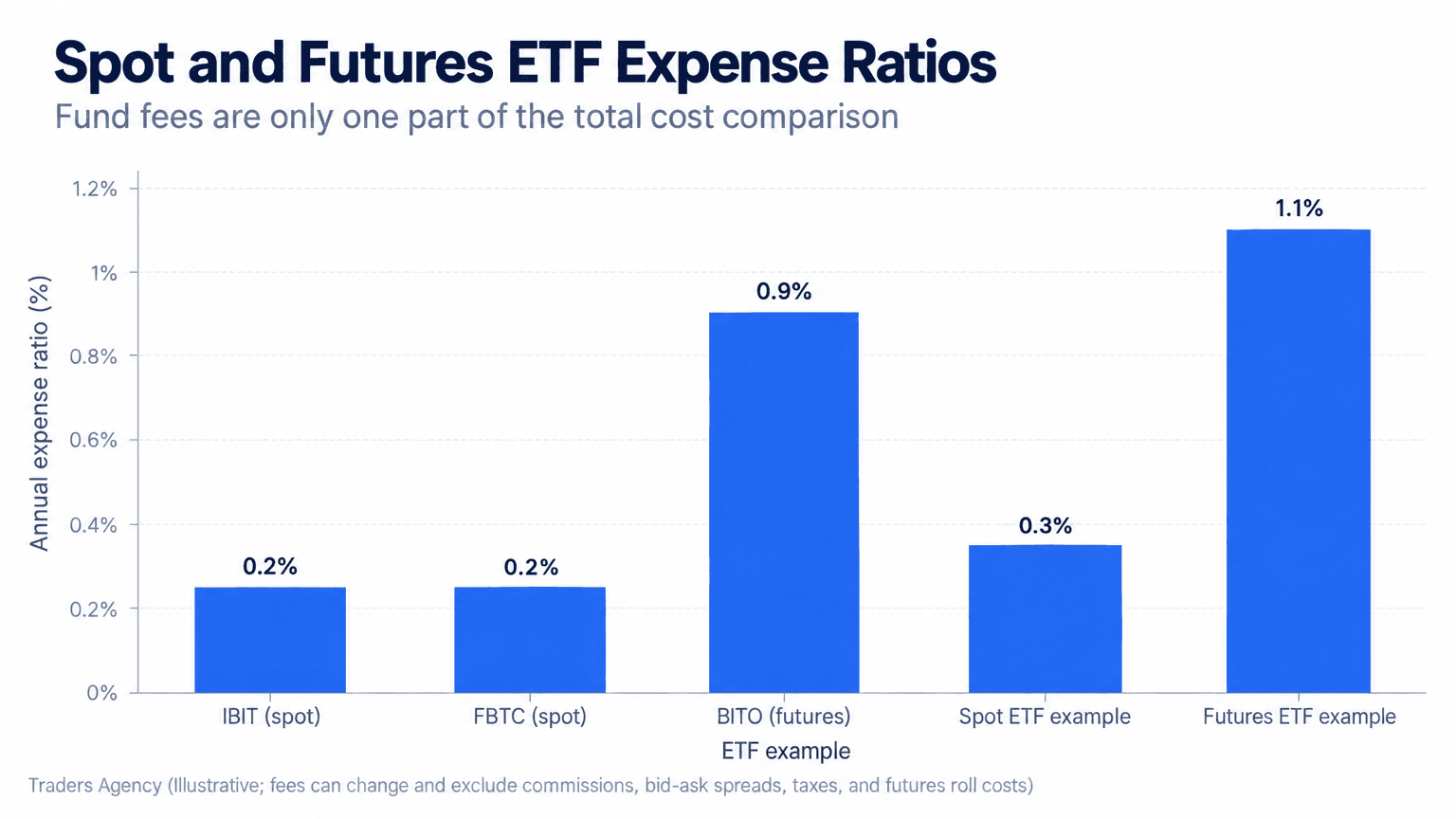
Notice that futures ETFs like BITO charge roughly four times the management fee of spot ETFs. That gap alone, before you even factor in contango, puts futures products at a disadvantage for long-term holders.
Tax Treatment Differs Significantly
This is the part most beginner guides skip, and it matters more than people realize.
- Spot Bitcoin ETFs are generally taxed like other securities: long-term capital gains rates apply if held over a year, short-term rates if held less.
- Futures-based ETFs often use contracts subject to Section 1256 tax treatment, which can apply a blended rate (commonly a 60/40 split between long-term and short-term rates) regardless of how long you actually held the position.
- Some futures ETFs issue a K-1 tax form instead of a standard 1099, which adds complexity at filing time.
Pattern Day Trading Rules
Because both spot and futures Bitcoin ETFs trade on regular exchanges as shares, they're subject to the same Pattern Day Trader (PDT) rule from FINRA that applies to stocks: if you make four or more day trades within five business days in a margin account under $25,000, your broker can restrict your trading. This applies equally whether you're trading IBIT or BITO, so it's not a factor in choosing between them, but it's worth knowing before you start actively trading either one.
Which Approach Is Right for You?
Choose a Spot ETF If You:
- Plan to hold your position for six months or longer
- Want your returns to track Bitcoin's actual price as closely as possible
- Prefer simpler tax reporting through a standard 1099
- Are building a long-term portfolio allocation alongside stocks and bonds
Choose a Futures ETF or Direct Futures If You:
- Are making short-term, tactical trades around news events
- Want the higher leverage available through direct futures contracts, beyond the margin a broker allows on ETF shares
- Already have a futures trading account and want to add crypto exposure without opening a new brokerage relationship
Watch Out: Don't assume all Bitcoin ETFs are the same just because they have "Bitcoin" in the name. Checking a fund's prospectus for "spot" versus "futures" language is non-negotiable. Don't hold a futures-based ETF for years without accounting for contango drag, and don't oversize a Bitcoin allocation. Most diversified portfolios treat crypto as a small satellite position, often in the low single digits as a percentage of total assets, because Bitcoin's volatility is much higher than broad equity indexes.
Portfolio Fit and Correlation
Bitcoin has historically shown periods of both low and high correlation with equities, shifting depending on macro conditions like interest rate policy and risk appetite. That inconsistency is exactly why we recommend a small, defined allocation rather than treating Bitcoin as a stock substitute. Reviewing a spot-versus-futures chart over multiple years is a useful exercise before committing capital, since it shows how much the two structures can diverge even when the underlying asset moves in the same direction.
Takeaway: Choosing Between Bitcoin ETF Spot vs Futures
The spot-versus-futures decision really comes down to time horizon and tax tolerance. Spot ETFs like IBIT and FBTC suit investors who want clean, long-term exposure to actual Bitcoin. Futures ETFs like BITO suit traders making shorter, tactical bets where contango has less time to erode returns.
Whichever structure you pick, we encourage you to read the fund's prospectus filed with the SEC, compare expense ratios, and understand the tax form you'll receive before tax season arrives.
Want expert trading insights delivered daily?
Join thousands of traders who rely on Traders Agency for market analysis and trade ideas.
Join Traders AgencyDISCLAIMER: Traders Agency does not offer financial advice. The information provided is for educational purposes only and should not be considered financial advice. Traders Agency is not responsible for any financial losses or consequences resulting from the use of the information provided. Trading carries inherent risks and may not be suitable for all individuals. You are advised to conduct your own research and seek personalized advice before making any investment decisions, recognizing the potential risks and rewards involved.
See more from Traders Agency on Google
Make us a preferred source and our market analysis will appear more prominently in your Google Search, Top Stories, and AI results.
Add to Preferred Sources