
You have probably seen this happen on your trading screens. A relatively unknown stock suddenly spikes 200% in a single afternoon on massive volume. What you are witnessing is retail traders moving markets. When individual investors coordinate their buying power through options contracts and social media, they create overwhelming demand that forces institutional players to adjust their positions. In this guide, our education team will show you exactly how this process works, how to spot these moves in real time, and how to trade alongside them while protecting your capital from sudden reversals.
How Do Retail Traders Actually Move Markets?
Bottom Line: Retail traders can and do move markets, but the mechanics that create a 200% single-afternoon spike are the same ones that wipe out the majority of participants who enter too late or exit too slowly. The traders who survive these moves treat them as data-driven setups, not social media events. Understanding gamma exposure, options flow, and coordinated order flow is what separates the 3% who profit from the crowd that funds their gains.
Many newer traders ask why retail traders move markets today more than they did a decade ago. The answer comes down to accessibility and aggregate order flow. When millions of individual traders use zero-commission brokers to buy the same stock simultaneously, their combined capital rivals major hedge funds.
This collective buying power creates a massive influx of orders. Retail traders often coordinate their ideas on social platforms, and when you see discussions about a particular ticker gaining traction across trading forums, that is usually the starting point for coordinated volume. This aggregate order flow forces brokers and clearinghouses to process millions of shares in minutes.
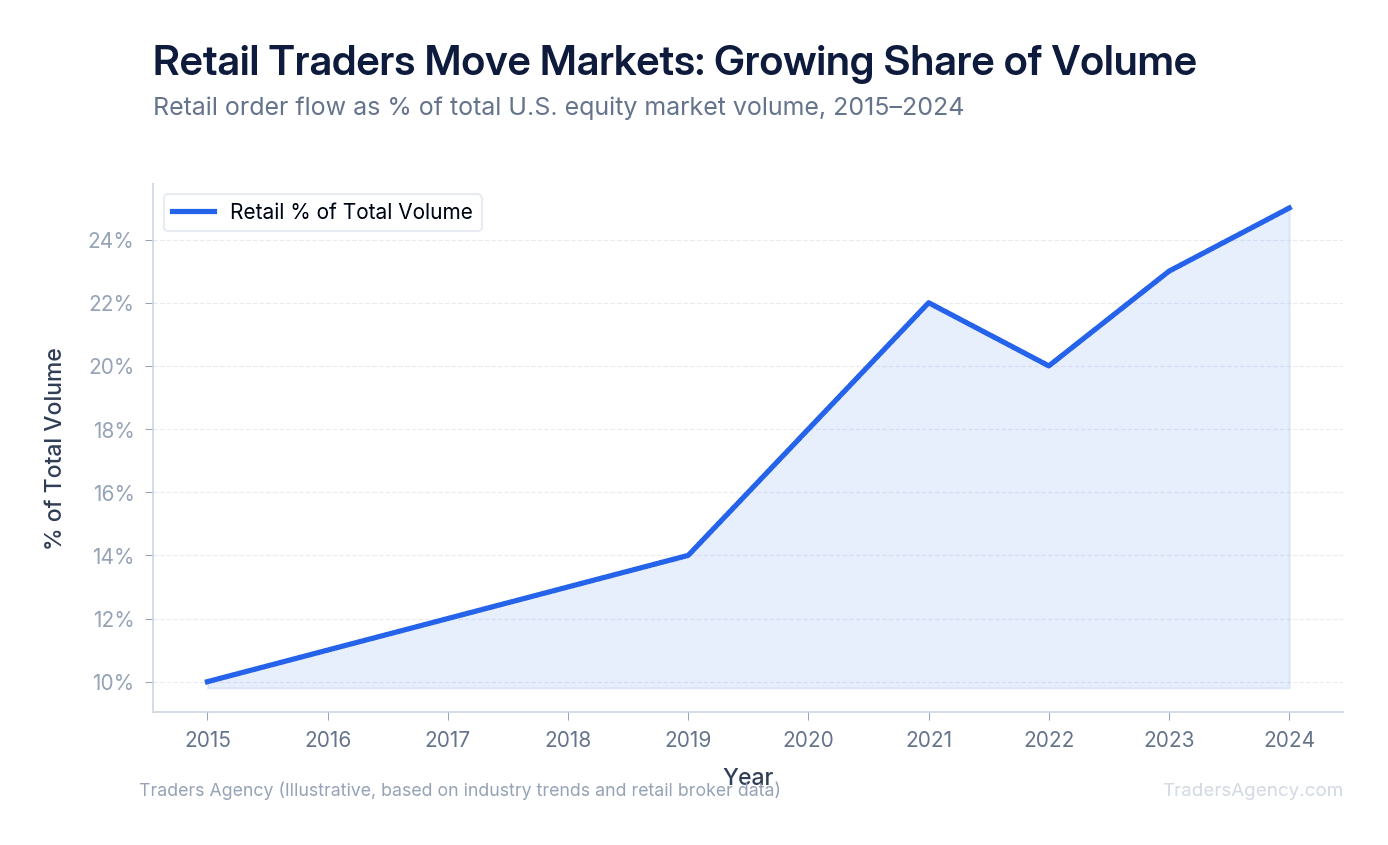
We teach our members to watch for payment for order flow data. Market makers pay retail brokers for the right to execute these trades. When a retail trader clicks buy, that order does not go straight to the exchange. It goes to a wholesale market maker. Because retail traders move markets through sheer volume, these wholesalers must rapidly adjust their own inventory.
If they cannot find enough sellers to match the retail buyers, they must raise the bid price. This micro-structural imbalance is what causes the price to jump so quickly. When retail volume spikes, market makers must take the other side of those trades to provide liquidity. If retail is heavily buying, market makers are initially selling, which leaves those institutions short the stock. They must then buy shares on the open market to balance their books.
Key Concept: When retail order flow overwhelms available liquidity, market makers are forced to raise bid prices and buy shares on the open market to rebalance their inventory. This micro-structural imbalance is the engine behind rapid price spikes.
How Does Gamma Exposure Amplify Retail Options Activity?
Gamma exposure amplifies retail options activity by forcing market makers to buy the underlying stock as option prices rise. When retail traders buy massive amounts of short-dated call options, market makers who sold those calls must hedge their risk by purchasing shares of the stock itself.
This creates a feedback loop. Retail traders buy out-of-the-money call options, which are cheap but highly sensitive to price changes. Retail options volume has surged in recent years, and as the stock price creeps up, the gamma (the rate of change of the option's delta) increases.
The expiration date of these options plays a massive role. Retail traders prefer options that expire on the same day or the same week, known as zero days to expiration (0DTE). Because these contracts expire so soon, the market maker has no time to wait out the volatility. They must hedge immediately. This urgency accelerates the buying pressure.
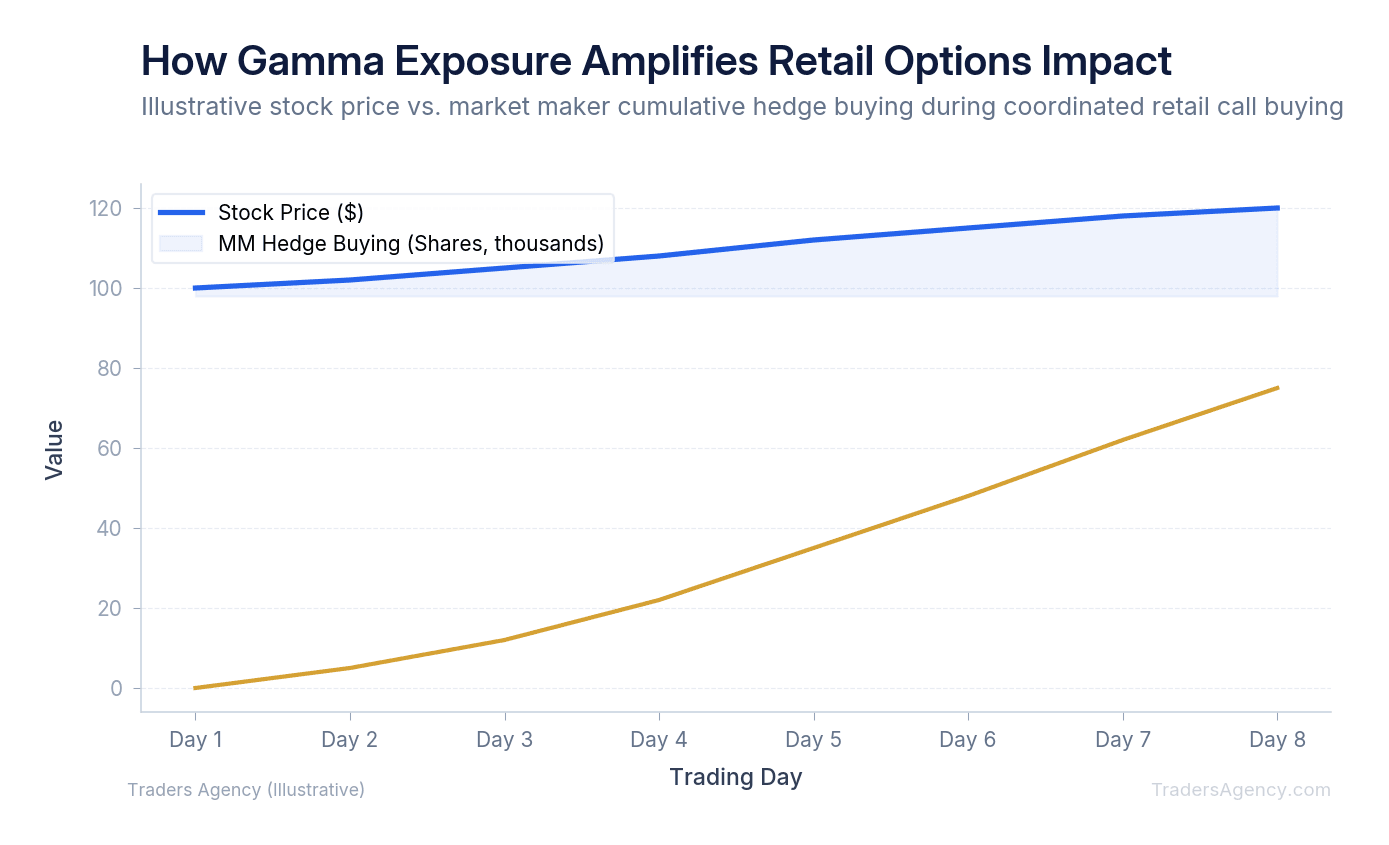
To stay delta-neutral, the market maker must buy more shares. This forced buying pushes the stock price even higher. The higher the stock goes, the more shares the market maker must buy.
Our team looks for setups where the open interest on call options vastly outweighs put options. If a stock is trading at $20 and there is massive volume on the $25 strike calls expiring this Friday, we know market makers will need to buy significantly more shares as the price approaches $25. This hedging mechanic is the true engine behind retail-driven momentum. You can track options activity and open interest data through the Cboe Options Exchange.
Do Retail Traders Actually Move the Market?
Yes, retail traders absolutely move the market, particularly in small-cap stocks and heavily shorted companies. When individual investors concentrate their capital into a single ticker with low liquidity or high short interest, their buying pressure can trigger massive short squeezes and volatility halts.
In large-cap stocks like Apple (AAPL) or Microsoft (MSFT), retail impact is minimal. But in stocks with a small float (the number of shares available to trade), retail volume can dictate the entire price action.
We saw the ultimate example of this during the coordinated retail buying events of 2021. During those historical events, coordinated retail buying forced institutional short sellers to cover their positions at massive losses.
When a stock has a short interest above 20%, it becomes a prime target. Retail traders buy the stock, driving the price up. Short sellers are forced to buy shares to close their losing positions. This creates double the buying pressure.
The aftermath of these events is always the same. Once the buying pressure exhausts itself, the stock price collapses. The institutions that were squeezed out eventually find new entry points to short the stock again. This is why we tell our members never to view these trades as long-term investments.
Watch Out: Retail-driven squeezes always end. Once buying pressure fades, these stocks collapse rapidly. Never treat a momentum squeeze as a long-term investment. Have your exit plan before you enter.
Want expert trading insights delivered daily?
Join thousands of traders who rely on Traders Agency for market analysis and trade ideas.
Join Traders AgencyHow Do You Identify and Trade a Retail-Driven Move in Real Time?
We prefer to trade these setups systematically. You cannot just buy a stock because it is trending on social media. You need a structured approach to enter and exit safely. Here is the step-by-step process our team uses to trade retail-driven momentum.
Step 1: Spotting the Setup
First, you need to identify the right conditions before the massive spike happens. We look for three specific criteria:
- High Short Interest: The stock must have at least 15% to 20% of its float sold short.
- Unusual Options Volume: Call option volume should be at least 300% higher than the 30-day average.
- Social Velocity: Mentions of the ticker symbol are rapidly increasing across trading forums.
Step 2: Executing the Trade
Here is a concrete example. Suppose Ticker XYZ is trading at $10. It has a 25% short interest and you notice unusual volume on the $12 call options expiring this week.
We do not buy the stock blindly. We wait for a technical breakout above a key resistance level, such as $10.50. Once XYZ crosses $10.50 on high volume, we enter the trade. We might buy the stock directly, or we might buy the $11 strike calls for a $0.50 premium ($50 per contract).
| Parameter | Value |
|---|---|
| Stock | XYZ at $10.00 |
| Short Interest | 25% of float |
| Entry Trigger | Breakout above $10.50 |
| Options Position | $11 strike calls at $0.50 premium |
| Account Size | $20,000 |
| Max Allocation | $600 (12 contracts) |
| Stop Loss (shares) | $10.25 |
If your total account size is $20,000, you should allocate no more than $600 to this specific options trade. This means you could buy exactly 12 contracts at the $0.50 premium. By strictly limiting your size, you remove the emotional panic that causes traders to make bad decisions during wild price swings.
Step 3: Managing the Outcome
- If the squeeze materializes: XYZ might spike to $15. Your $11 calls would now be worth at least $4.00 ($400 per contract), giving you a significant gain.
- Scale out of your position: If you bought 12 call options and they double in value, sell 6 of them. You have now recovered your initial investment. Let the remaining 6 contracts run risk-free.
- If momentum fails: XYZ drops back to $9. Your maximum loss on the options is capped at the $50 you paid per contract. If you bought shares, your strict stop loss at $10.25 limits the damage.
| Scenario | Stock Price | Option Value (per contract) | Result on 12 Contracts |
|---|---|---|---|
| Best Case (squeeze) | $15.00 | $4.00+ | +$4,200+ profit |
| Partial Win (scale out) | $12.00 | $1.00 | +$600 profit |
| Worst Case (failure) | $9.00 | $0.00 | -$600 max loss |
What Is the 3-5-7 Rule in Trading?
The 3-5-7 rule is a risk management framework that dictates you should risk no more than 3% of your capital on a single trade, aim for a 5% portfolio gain per month, and cut your losses if your total account draws down by 7%.
This rule is especially useful when trading highly volatile retail-driven stocks. Because these assets can gap down overnight, you must protect your account. The SEC's investor education resources consistently warn retail investors about the dangers of concentrated positions.
Key Concept: The 3-5-7 Rule
3% = Maximum risk on any single trade.
5% = Target monthly portfolio return.
7% = Maximum total account drawdown before you stop trading and reassess.
If you have a $10,000 account, the 3% rule means you should never risk more than $300 on a single momentum trade. If you buy options, your total position size should not exceed $300. If you buy shares, your stop loss should trigger before you lose $300.
When Should You Trade Alongside Retail Flow?
You should trade alongside retail flow only when you have a clear technical entry, defined risk parameters, and the stock has not already gone parabolic. The best time to enter is during the initial volume expansion, not after the stock has already rallied 100% in a single day.
Market conditions matter. Retail momentum strategies work best in bullish or speculative market environments. When the broader market is in a downtrend, these squeezes tend to fail quickly.
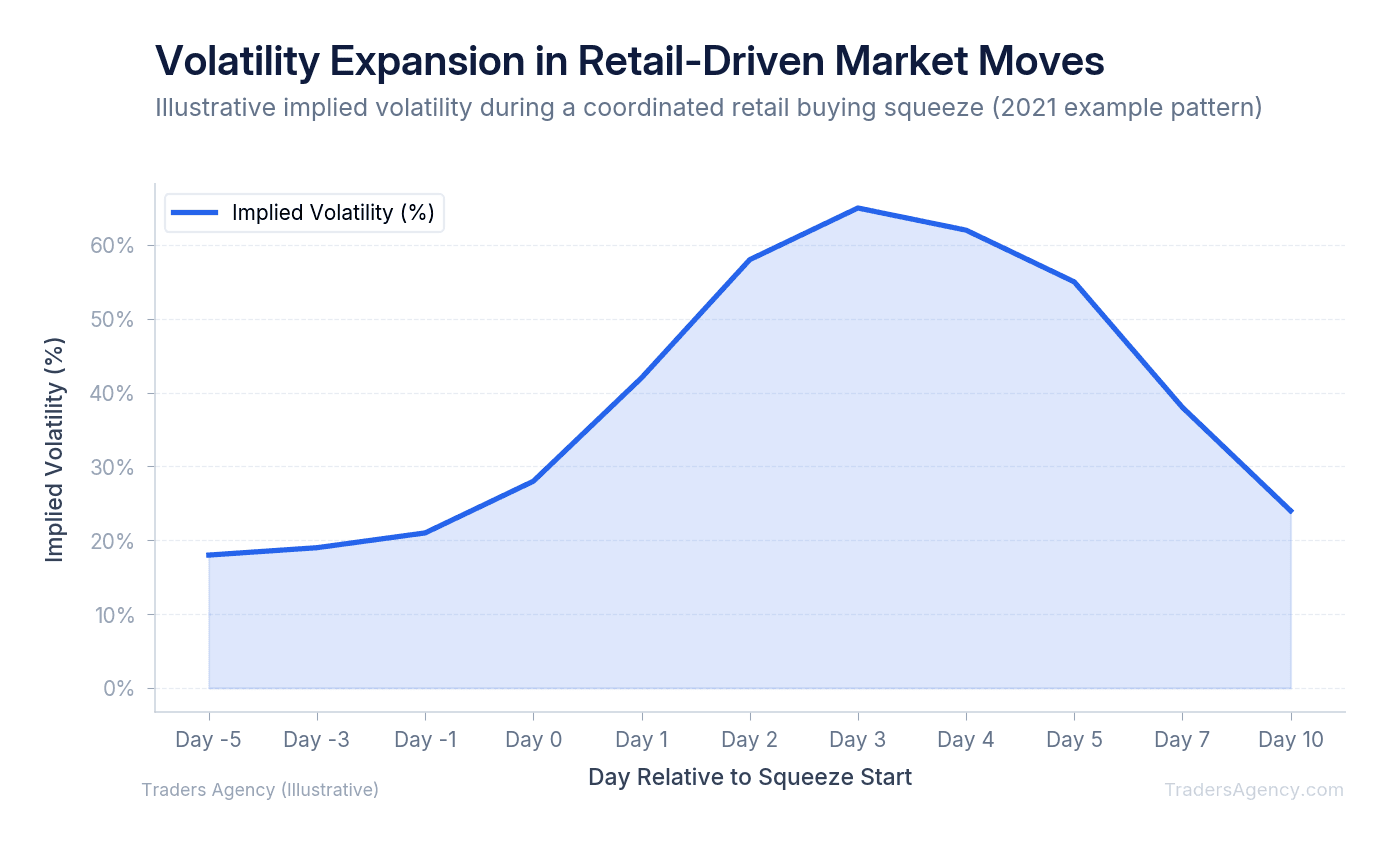
We teach our members to avoid trading these setups during earnings week. The implied volatility is already too high, making options prohibitively expensive. If you buy calls when implied volatility is at 150%, you will likely lose money even if the stock goes up, due to a phenomenon called volatility crush.
Common Mistakes to Avoid
- Chasing gap-ups: Never buy a stock that opens 50% higher than its previous close.
- Ignoring the exit: Always take partial profits on the way up. Sell half your position when you are up 100%.
- Holding overnight: Retail momentum can vanish instantly. We prefer to close these trades before the closing bell.
Is It True That 97% of Day Traders Lose Money?
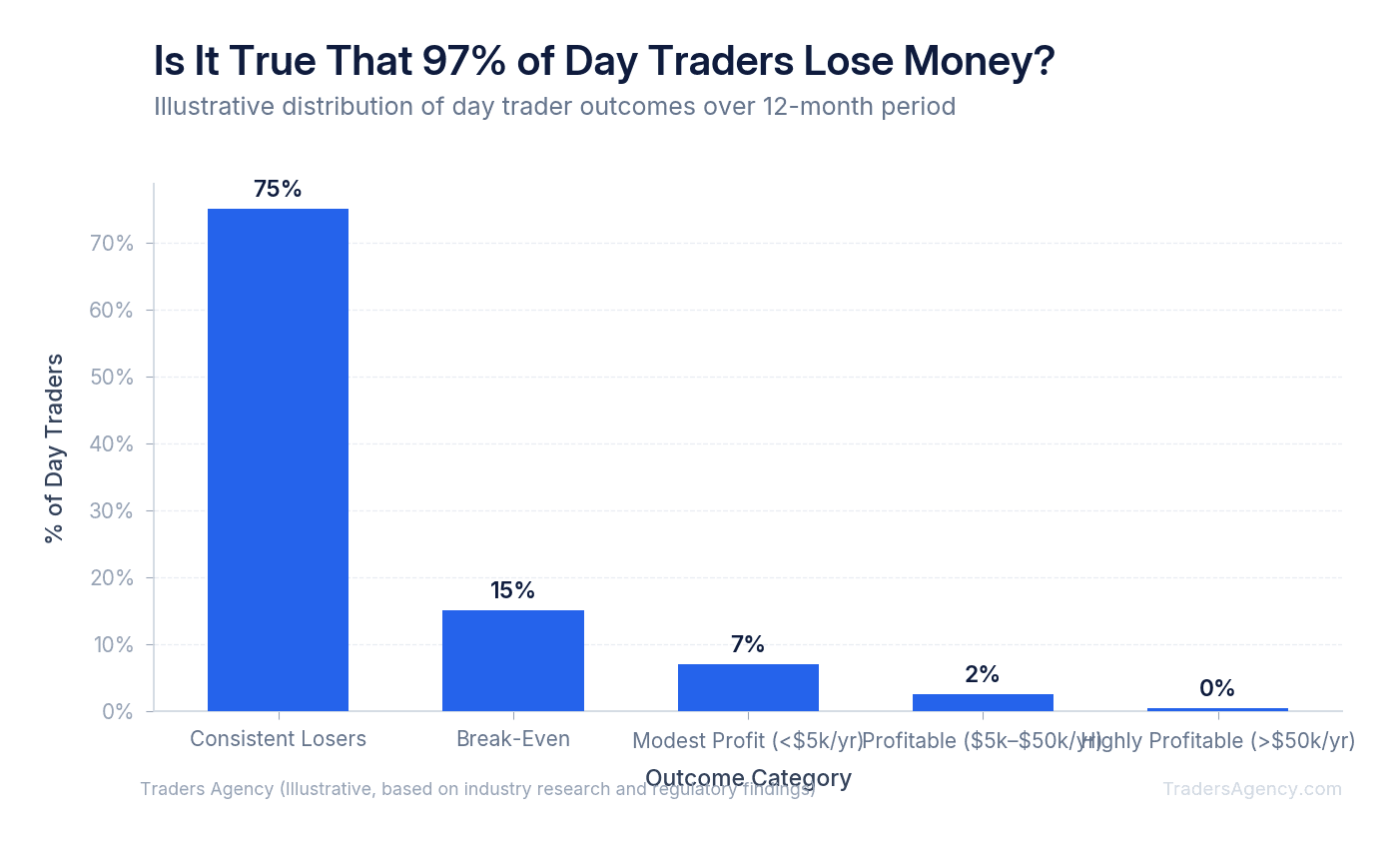
Yes, it is true that 97% of day traders lose money over the long term, primarily because they lack strict risk management and chase volatile momentum stocks without a tested strategy. Only a small fraction of traders achieve consistent profitability.
Many beginners see retail traders moving markets and think it is easy money. They buy at the absolute top of a squeeze, right before the institutional short sellers reload their positions. When the stock crashes from $30 back to $10, the retail trader is left holding the bag.
To be in the successful 3%, you must treat trading like a business. You need a mechanical approach. Do not rely on hope or social media hype. Use the data, track the options flow, and always protect your downside.
Risk Warning: The overwhelming majority of day traders lose money. Retail-driven momentum trades are extremely high risk. Never allocate more than you can afford to lose, always use defined-risk strategies, and never chase a stock that has already made its move.
Want expert trading insights delivered daily?
Join thousands of traders who rely on Traders Agency for market analysis and trade ideas.
Join Traders AgencyKey Takeaways
- Retail traders now generate enough aggregate order flow to rival major hedge funds when millions of individuals buy the same stock simultaneously through zero-commission brokers.
- Social media forums are the starting point for coordinated volume: when a ticker gains traction across trading communities, that discussion typically precedes the price move.
- Only roughly 3% of retail momentum traders come out ahead. The majority are left holding positions after the stock collapses, often from $30 back to $10 or lower.
- Tracking unusual options activity and options chain data gives traders an early signal of retail-driven momentum before the price spike becomes obvious on a chart.
- Defined-risk strategies are non-negotiable in retail-driven trades. Never chase a stock that has already made its move, and never allocate more than you can afford to lose entirely.
DISCLAIMER: Traders Agency does not offer financial advice. The information provided is for educational purposes only and should not be considered financial advice. Traders Agency is not responsible for any financial losses or consequences resulting from the use of the information provided. Trading carries inherent risks and may not be suitable for all individuals. You are advised to conduct your own research and seek personalized advice before making any investment decisions, recognizing the potential risks and rewards involved.
See more from Traders Agency on Google
Make us a preferred source and our market analysis will appear more prominently in your Google Search, Top Stories, and AI results.
Add to Preferred Sources