
What is the relationship between central bank policy and your portfolio? Understanding exactly how interest rates affect stock prices is a foundational skill for any fundamental investor. We consider it one of the most important concepts you can master early in your trading education.
Interest rates affect stock prices by changing the cost of borrowing for companies and altering the mathematical discount rate investors use to value future corporate earnings. When rates go up, future profits are worth less today. This tends to push stock valuations lower, though the effect varies by sector and stock type.
In this guide, our education team will show you the exact mechanics behind this relationship. We'll walk you through the math, explain why certain stocks get hit harder than others, and show you how to position your portfolio. By the end, you'll know how to read a rate announcement and anticipate the market reaction.
What Is the Discount Rate and How Does It Drive Stock Valuations?
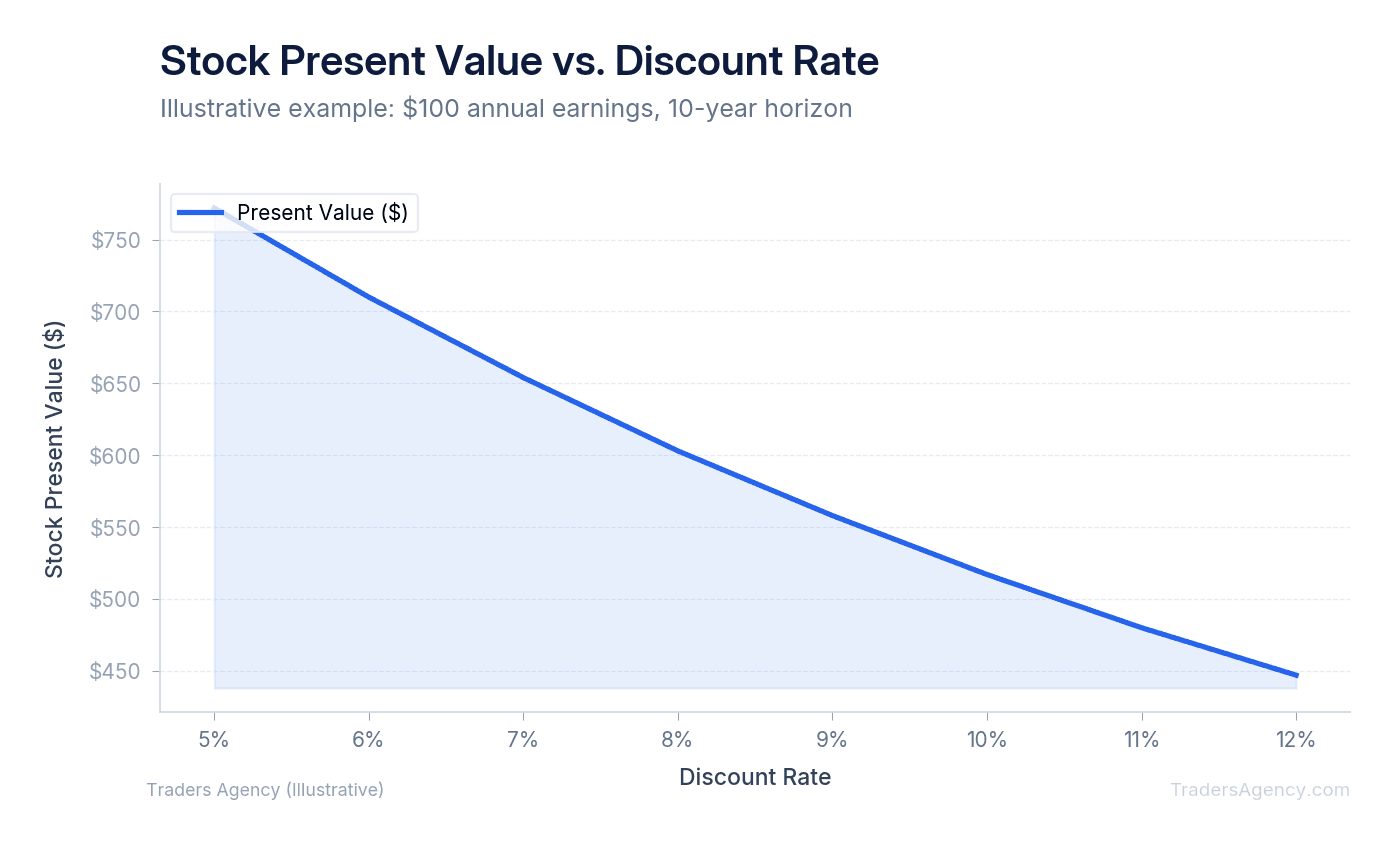
The discount rate is the interest percentage investors use to calculate the present value of a company's future cash flows. When the Federal Reserve raises interest rates, the discount rate increases. A higher discount rate mathematically reduces the present value of future earnings, causing stock valuations to fall.
To understand this, we teach our members a concept called Discounted Cash Flow (DCF). This is the standard valuation model used by professional analysts, and it's the backbone of how Wall Street prices stocks.
Key Concept: A dollar earned tomorrow is worth less than a dollar earned today. The discount rate quantifies exactly how much less, and it moves in lockstep with interest rates.
If you can earn a guaranteed 5% yield in a savings account, a company must offer you a return higher than 5% to justify the risk of buying its stock. That baseline guaranteed yield is known as the risk-free rate. As the risk-free rate rises, investors demand a higher return from stocks.
Consider a concrete example. Imagine a company is guaranteed to pay you $100 in exactly one year. If your discount rate is 2%, that $100 future payment is worth about $98.04 today. But if interest rates spike and your discount rate becomes 5%, that same $100 future payment is now only worth $95.24 today.
The company did not lose any money. Its business operations did not change at all. The stock price dropped purely because the mathematical value of its future money declined.
Why Do Growth Stocks Fall Harder Than Value Stocks When Rates Rise?
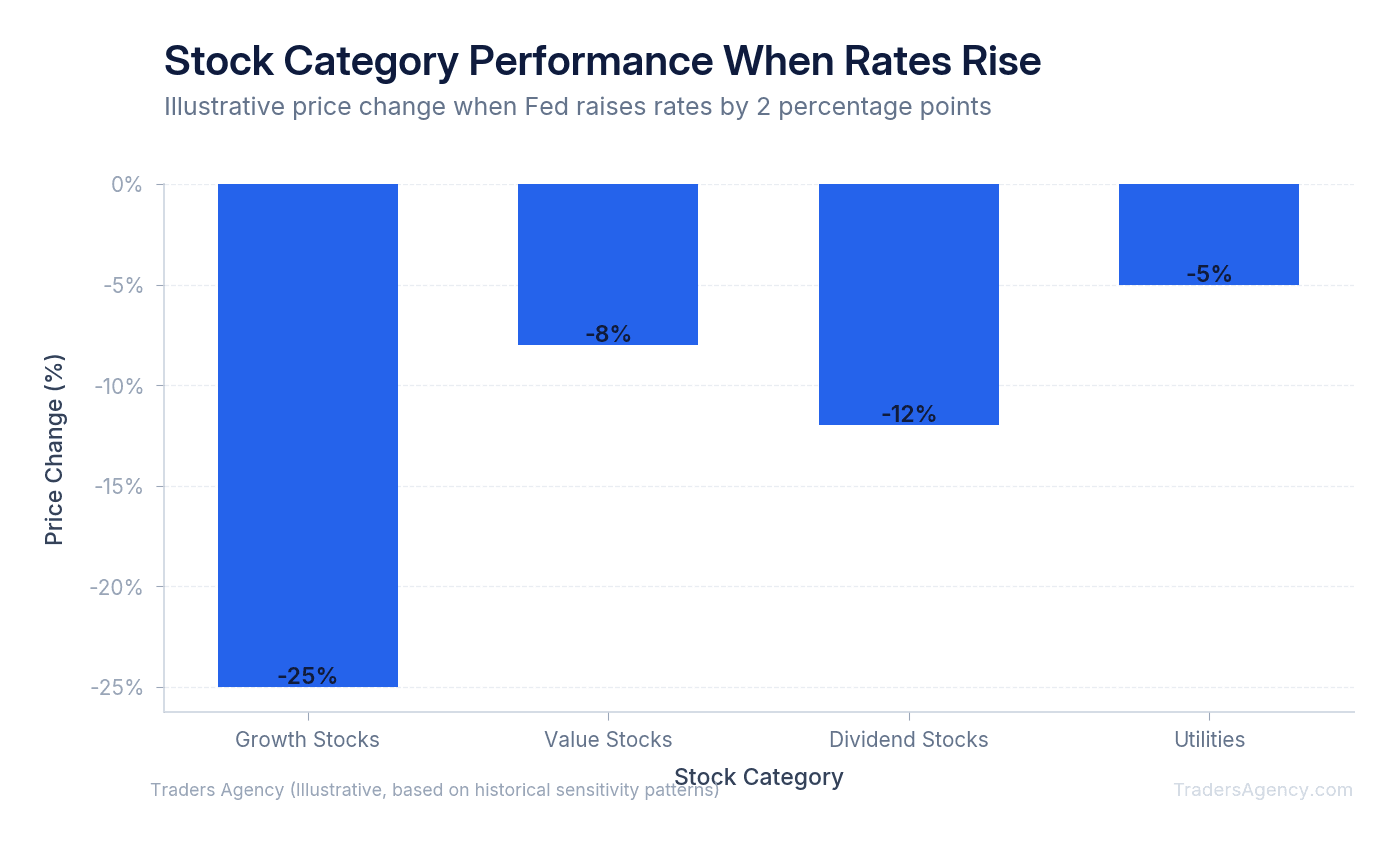
Growth stocks fall harder than value stocks during rate hikes because their valuations rely heavily on earnings expected many years in the future. Value stocks generate significant cash flow today, making them less sensitive to changes in the discount rate over long time horizons.
We like to compare this dynamic to a concept from the bond market called duration. Duration measures how sensitive an asset is to interest rate changes. The further into the future an asset's cash flows occur, the higher its duration. High duration means high sensitivity to rate fluctuations.
Growth Stocks: High Duration, High Risk
Growth stocks are typically technology or biotech companies. They might not make much profit right now. Investors buy them for the massive earnings they expect five or ten years down the road. Because those profits are so far in the future, a higher discount rate heavily penalizes their present value.
Value Stocks: Low Duration, More Stability
Value stocks are usually established companies in mature industries. Think of banks, industrial manufacturers, or consumer goods companies. They are generating strong profits and paying dividends right now. Their cash flows are immediate.
When you see financial headlines asking how interest rates affect stock prices, the answer depends heavily on the type of stock. A 1% increase in rates might cause a value stock to drop 5%. Meanwhile, a high-growth tech stock could plunge 20% on the exact same news.
| Stock Type | Cash Flow Timing | Rate Sensitivity (Duration) | Typical Decline on 1% Rate Hike |
|---|---|---|---|
| Growth Stocks | 5-10+ years out | High | 15-25% |
| Value Stocks | Immediate / near-term | Low | 3-8% |
How Does the Fed Funds Rate Flow Through to Your Stock Portfolio?
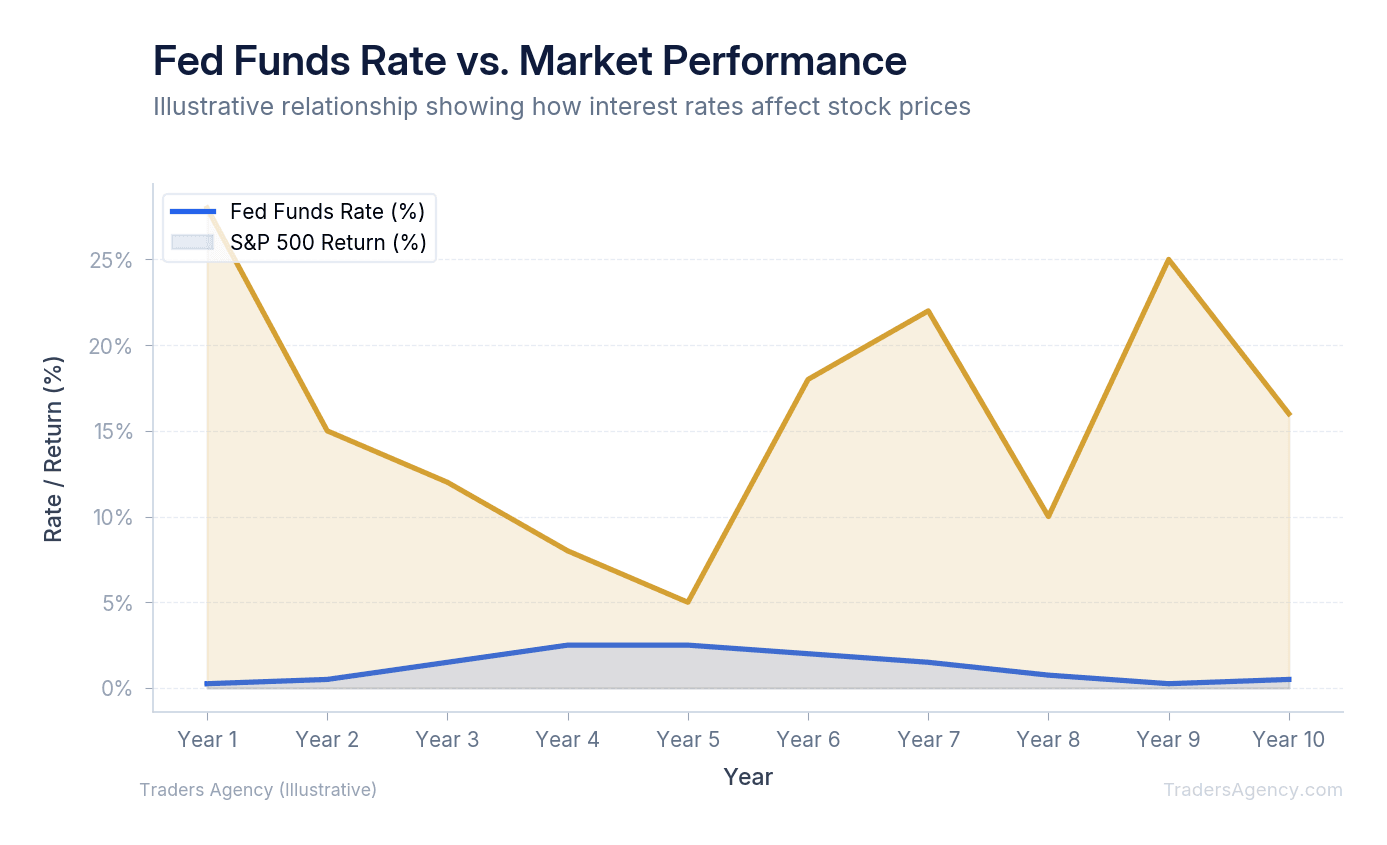
The Fed funds rate dictates what banks charge each other for overnight loans. This baseline rate directly influences commercial lending rates, corporate bond yields, and consumer credit. As borrowing becomes more expensive, corporate profit margins shrink and consumer spending slows, which ultimately drives stock prices lower.
The Federal Reserve does not directly set mortgage rates or corporate loan rates. They only set the target federal funds rate. However, this single lever influences the entire economy. Here is the step-by-step transmission mechanism we track:
- The Cost of Capital Increases. When the Fed raises rates, banks immediately raise their prime rate. This is the baseline rate used for corporate loans. If a company needs to borrow money to build a new factory or hire more workers, the interest expense on that debt is suddenly much higher.
- Corporate Profit Margins Compress. Higher interest expenses eat directly into a company's net income. If a business was paying 4% interest on $10 million in debt, their annual interest expense was $400,000. If their rate resets to 7%, that expense jumps to $700,000. That is $300,000 wiped straight off their bottom line without a single change in sales.
- Consumer Spending Slows. Higher rates also hit consumers directly. Credit card rates spike. Auto loans become more expensive. Mortgage rates climb. When consumers spend more of their monthly income servicing debt, they have less disposable income to buy products from the companies in your portfolio.
Watch Out: When you combine lower corporate profits with slower consumer spending, the effect on stock valuations compounds. Many beginner investors underestimate how quickly this chain reaction plays out after a rate hike.
How Do Rising Bond Yields Pull Money Away From Stocks?
Bonds and stocks constantly compete for investment capital. When interest rates rise, newly issued bonds offer higher guaranteed yields. This makes risk-free government bonds more attractive to investors, causing them to pull money out of the risky stock market and reallocate it into the bond market.
This dynamic is known as asset allocation. Institutional investors manage trillions of dollars. They are constantly weighing the risk and reward of equities against fixed-income assets.
Consider the 10-Year Treasury Yield, which is the benchmark for global borrowing. If the 10-Year Treasury is paying a 1% yield, institutional investors are forced to buy stocks to generate meaningful returns for their clients. They will accept the higher risk of the stock market because the bond market offers virtually no reward.
If the Federal Reserve raises rates and the 10-Year Treasury yield jumps to 5%, the math changes completely. A guaranteed 5% return backed by the U.S. government is highly attractive. Portfolio managers will sell billions of dollars worth of stocks to lock in those high risk-free bond yields.
This capital flight drains liquidity from the stock market. When massive institutions hit the sell button to buy bonds, retail investors feel the pain through falling stock prices. We always tell our members to keep one eye on the bond market. The bond market often signals stock market movements weeks in advance.
Want expert trading insights delivered daily?
Join thousands of traders who rely on Traders Agency for market analysis and trade ideas.
Join Traders AgencyWhich Sectors Win and Lose When Interest Rates Go Up?
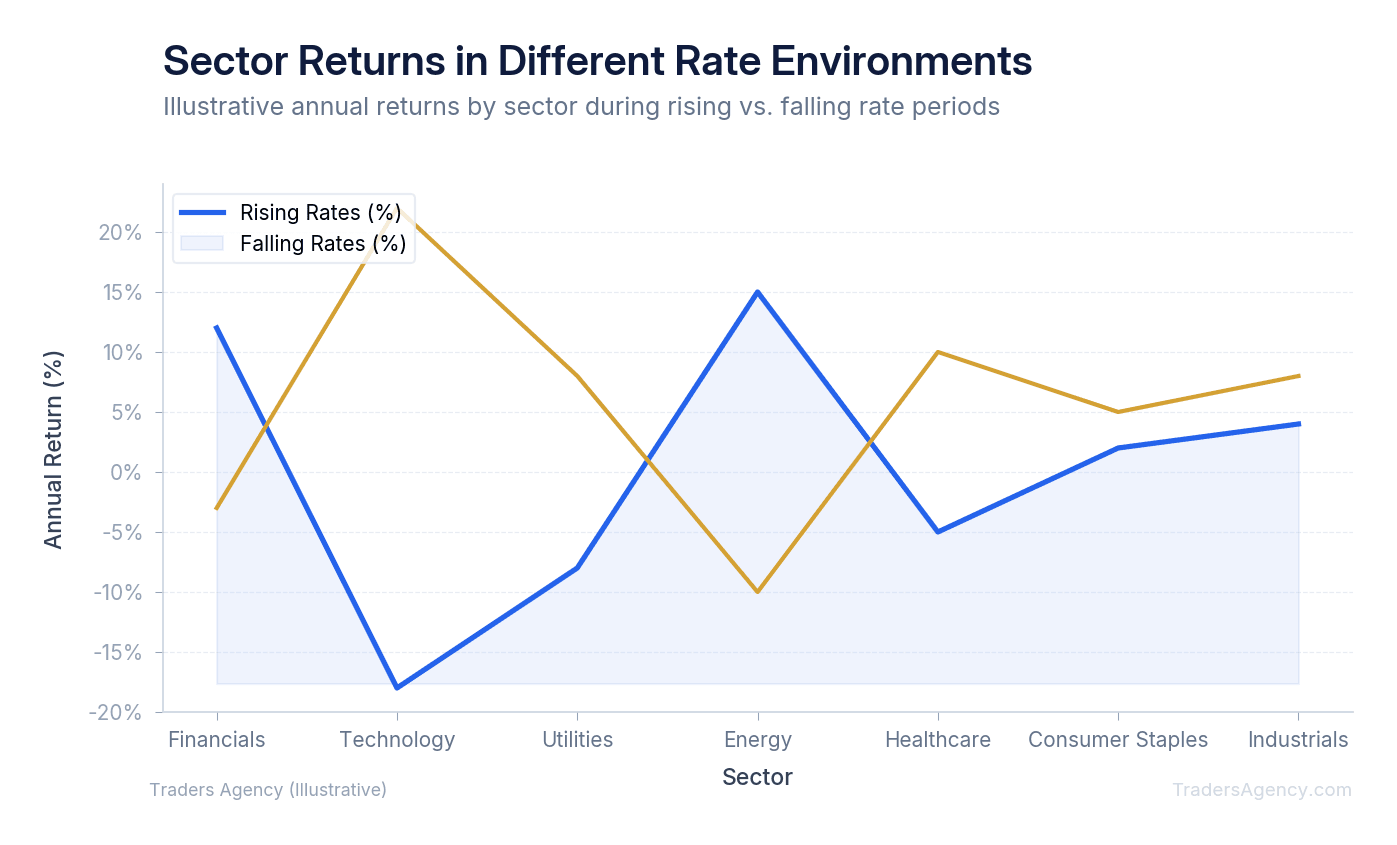
Financial institutions like banks and insurance companies typically win when interest rates rise because they earn wider profit margins on loans. Conversely, utilities, real estate, and technology sectors usually lose because they rely heavily on cheap debt to fund operations and pay dividends.
We teach our members to look at the market in terms of sectors. Not every stock suffers during a rate hike cycle. If you know where to look, you can find opportunities.
The Winners: Financials
Banks make money on the spread between the interest they pay on your savings account and the interest they charge on loans. This is called the Net Interest Margin (NIM). When rates rise, banks usually increase loan rates much faster than they increase savings account yields. This expands their profit margins.
Insurance companies also benefit. They invest customer premiums in safe yield-bearing bonds. Higher rates mean higher returns on those massive bond portfolios.
The Losers: Utilities and Real Estate
Utility stocks and Real Estate Investment Trusts (REITs) are notoriously sensitive to rate hikes. These companies carry massive amounts of debt to build power plants or buy properties. When debt gets more expensive, their profits shrink.
Additionally, investors usually buy utilities and REITs for their dividend yields. If an investor can get a guaranteed 5% from a risk-free Treasury bond, a 4% dividend yield from a risky utility stock no longer looks attractive.
| Sector | Rate Hike Impact | Why |
|---|---|---|
| Financials (Banks) | Positive | Wider net interest margins on loans |
| Insurance | Positive | Higher bond portfolio returns |
| Technology | Negative | High-duration growth valuations compress |
| Utilities | Negative | Heavy debt loads; dividend yield less competitive |
| Real Estate (REITs) | Negative | Higher borrowing costs; dividend yield less competitive |
How Do Interest Rates Affect Stock Prices in a DCF Valuation Model?
We'll walk through a practical example showing you exactly how a professional analyst adjusts a stock valuation when interest rates change. We'll use a simplified valuation model to make the math clear.
- Establish the Baseline Earnings. Imagine you are analyzing a company called Alpha Corp (ticker symbol: ALPH). Alpha Corp generates exactly $5 in Earnings Per Share (EPS) every year. For this simple example, we'll assume their earnings never grow. They just stay flat at $5 forever.
- Apply the Initial Discount Rate. Before the Federal Reserve acts, the standard discount rate in the market is 5%. To find the fair value of Alpha Corp, we divide the earnings by the discount rate: $5.00 / 0.05 = $100.00. At a 5% interest rate environment, Alpha Corp is fairly valued at $100 per share.
- Adjust for the Rate Hike. The Federal Reserve announces an aggressive rate hike. Borrowing costs go up across the board. Investors decide they need a higher return to justify the risk of holding stocks. The new market discount rate jumps to 8%. We run the exact same math with the new rate: $5.00 / 0.08 = $62.50.
- Evaluate the Outcome. Alpha Corp is still making the exact same $5 per share. Their business is completely healthy. Yet, the fair value of the stock just plummeted from $100 to $62.50 per share. This represents a massive 37.5% decline in the stock price, purely based on the interest rate adjustment.
| Parameter | Before Rate Hike | After Rate Hike |
|---|---|---|
| Earnings Per Share (EPS) | $5.00 | $5.00 |
| Discount Rate | 5% | 8% |
| Fair Value Per Share | $100.00 | $62.50 |
| Change in Value | -37.5% | |
Key Concept: You can pick a great company with strong earnings, but if you buy right before a major rate hike, your investment will likely lose value. The math of the discount rate overrides business fundamentals in the short term.
How Should Beginner Investors Respond When the Fed Raises Rates?
Beginner investors should respond to rising rates by reducing exposure to high-valuation growth stocks and shifting capital toward profitable, cash-generating value stocks. You should also maintain strict stop losses, increase your cash reserves, and avoid companies with high levels of floating-rate debt.
Understanding the theory is great, but you need a practical action plan. Here is the exact framework our team recommends when we enter a rising rate environment:
- Audit Your Portfolio for Debt. You need to know how much debt the companies in your portfolio carry. You can find this information on a company's balance sheet, available in their quarterly 10-Q filings via the SEC EDGAR database. Look for companies with low debt-to-equity ratios. If a company has a lot of debt, check if it is fixed-rate or floating-rate. Floating-rate debt becomes more expensive immediately when the Fed hikes rates.
- Focus on Free Cash Flow. In a low-rate environment, investors tolerate companies that burn cash to achieve rapid growth. In a high-rate environment, cash is king. We prefer to screen for companies that generate strong free cash flow. These businesses fund their own operations and do not need to borrow expensive money from banks to survive.
- Adjust Your Position Sizing. Rising rates usually bring market volatility. We teach our members to reduce their standard position sizes during these periods. If you normally risk 2% of your account on a single trade, consider dropping that to 1%. This simple adjustment protects your capital while the market digests the new interest rate reality.
- Be Patient with Entries. When rates are rising, stock valuations are actively compressing. A stock that looks cheap today might look expensive tomorrow if rates go higher. We prefer to wait for clear technical support levels to form before buying. Do not try to catch a falling knife just because a stock is down 20% from its highs.
Watch Out: Companies with large amounts of floating-rate debt are the most vulnerable during rate hike cycles. Always check the debt structure on the balance sheet before holding a position through a Fed announcement.
The Big Picture on Rates and Equities
Interest rates act like gravity on the financial markets. When gravity increases, asset prices get pulled down to earth. While the math can seem intimidating at first, the core concept is straightforward.
Higher rates mean higher borrowing costs and lower present values for future earnings. By understanding how interest rates affect stock prices, you gain a massive advantage over the average retail trader. You'll stop panicking when the market drops on Fed news. Instead, you'll know exactly why it is happening and where to look for the next opportunity.
Our team recommends making interest rate awareness a permanent part of your trading routine. Watch the Fed funds rate, track the 10-Year Treasury yield, and always know where your portfolio sits on the growth-to-value spectrum. These habits will serve you well in any market environment.
Want expert trading insights delivered daily?
Join thousands of traders who rely on Traders Agency for market analysis and trade ideas.
Join Traders AgencyKey Takeaways
- When the Federal Reserve raises interest rates, the discount rate used in DCF models increases, which mathematically reduces the present value of future earnings and pushes stock valuations lower.
- Growth stocks are hit harder than value stocks during rate hikes because more of their value is tied to earnings projected far into the future, making those cash flows more sensitive to discount rate changes.
- Rising rates create direct competition between stocks and bonds: when Treasury yields climb, income-seeking investors have a lower-risk alternative, which reduces demand for equities.
- Tracking the Fed funds rate and the 10-Year Treasury yield together gives investors an early signal for how the market may reprice growth versus value holdings.
- Knowing where your portfolio sits on the growth-to-value spectrum before a rate announcement lets you anticipate sector-level reactions rather than react to them after the fact.
DISCLAIMER: Traders Agency does not offer financial advice. The information provided is for educational purposes only and should not be considered financial advice. Traders Agency is not responsible for any financial losses or consequences resulting from the use of the information provided. Trading carries inherent risks and may not be suitable for all individuals. You are advised to conduct your own research and seek personalized advice before making any investment decisions, recognizing the potential risks and rewards involved.
See more from Traders Agency on Google
Make us a preferred source and our market analysis will appear more prominently in your Google Search, Top Stories, and AI results.
Add to Preferred Sources