China's April 2026 inflation data just landed, and the numbers beat estimates across the board. Our team is watching a major shift in the global macroeconomic picture: China's producer prices hit a three-year high, officially ending the longest deflationary streak in decades. The driver? A massive energy shock from the ongoing Iran war that is now rippling through commodity markets and global supply chains. Traders need to understand what this means right now.
The Big Number: China's producer price index surged 2.8% year-over-year in April, crushing the 1.6% forecast and marking the highest reading since July 2022. The 41-month deflationary streak is officially over.
China Producer Prices Jump to Three-Year High in April 2026
Here is what we know from the National Bureau of Statistics data released Monday. China's producer price index jumped 2.8% from a year ago, the highest reading since July 2022, easily beating the 1.6% forecast. The PPI had previously returned to a 0.5% growth rate in March, officially ending a 41-month streak of declines.
Consumer prices also accelerated. The CPI ticked up 1.2% in April from a year earlier, topping the 0.9% estimate and accelerating from a 1.0% rise in March. Core CPI, which strips out volatile food and energy prices, rose 1.2% in April. Headline CPI in the first quarter reached 0.9% year-over-year, marking the highest level since the first quarter of 2023. ANZ Research forecasts full-year CPI at 1.2%.
This surge effectively ends the longest deflationary streak in decades. Domestic demand remains weak, with retail sales slowing sharply to 1.7% in March. The property sector continues to struggle, with an 11.2% investment drop steepening from a 9.9% decline during the same period last year. However, the factory-gate price explosion alters the entire inflation narrative. Leading Chinese economists argue that a short oil price shock could have a positive long-term impact on the Chinese economy by providing a quick fix for the deflationary inertia that has held back credit-driven demand.
How Did the Iran War Push China's Factory Gate Prices Higher?
The Iran war, which started on February 28, 2026, triggered a massive disruption in the Strait of Hormuz. This blockade throttled energy and raw material flows, creating a supply-side price shock. Brent crude oil prices climbed from an average of $71 per barrel in February before the conflict escalated.
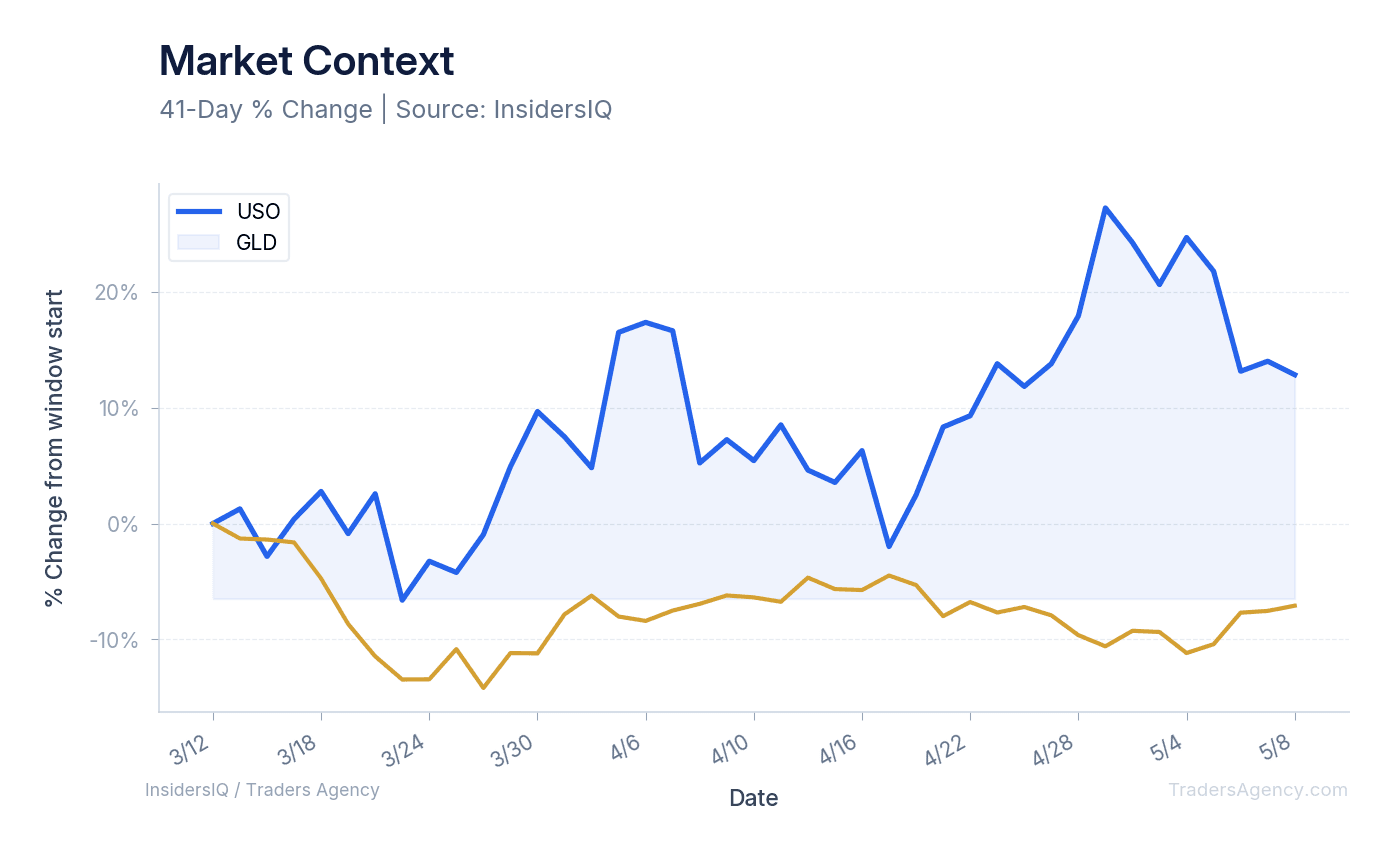
Over the past 60 days, we have seen the USO oil fund surge 12.84%, reflecting the severe stress in global energy markets. The GLD gold fund dropped 7.09% over the same period. The data we are tracking shows transportation fuel costs in China surged 10.0% month-over-month in March alone. By April, retail gasoline prices had surged 19.3% from a year earlier.
China relies heavily on the Strait of Hormuz, with over one-third of its crude oil supply transiting the route each year. The country has insulated itself through strategic energy reserves, diversified foreign energy supplies, domestic energy alternatives, and a higher electric vehicle adoption rate. However, economists warn the buffer has limits as the disruption drags on. The PPI outlook will hinge on oil prices in the near term and Beijing's anti-involution push over the longer term.
Which Sectors Are Most Exposed to China's Producer Price Surge?
The energy shock is creating massive divergence across different industrial sectors. Traders need to monitor the industries facing the most severe input cost inflation: non-ferrous metals mining, oil and gas extraction, and oil and coal processing.
The data reveals extreme price action in specific mining and processing sectors:
- Non-ferrous metals mining prices rose 38.9% from a year earlier.
- Oil and gas extraction prices climbed 28.6% year-over-year.
- Non-ferrous metal smelting and processing logged a 22.4% rise.
- Oil and coal processing prices jumped 14.2%, driven by restocking demand for power-generation coal and rising demand for coal as an alternative energy source.
Beyond commodities, the growing appetite for artificial intelligence computing power is lifting prices for fiber manufacturing and external storage equipment.
On the consumer side, travel spending during the Labour Day holiday, which ended on May 5, pushed consumer sales up 14.3% from a year earlier. This outpaced the 13.7% growth recorded during February's Lunar New Year break. In contrast, tourism prices fell sharply by 12.9% month-over-month in the off-season as the country got back to work in March.
Food prices also fell 1.6% in April, dragged down by cheaper pork and fresh produce. Pork prices saw a -11.5% year-over-year reading as of March. Fresh vegetables dropped 10.1% month-over-month, while fresh food prices fell 3.3%. We expect food prices to bottom out this year, though potential deals between China and the US on soybean purchases could push pig feed prices lower and limit a recovery in pork prices.
Want expert trading insights delivered daily?
Join thousands of traders who rely on Traders Agency for market analysis and trade ideas.
Join Traders AgencyWhat Does Rising China Inflation Mean for Global Commodity Markets?
Rising china inflation april 2026 data means global commodity markets will face sustained pricing pressure as Chinese manufacturers pass elevated energy costs down the supply chain. The combination of high input costs and strong export volume creates a volatile setup for international trade.
Despite the domestic real estate downturn, China's export engine is running hot. Overall export growth accelerated last month, rising 14.1% from a year earlier. This pushed the monthly trade surplus to an impressive $84.8 billion.
Trade Surplus Watch: China is now on track for a third consecutive year of roughly a trillion-dollar surplus. This export strength directly impacts global markets as Chinese manufacturers use their relative strengths to outcompete other global players facing the same energy constraints.
Depressed demand for Chinese goods in foreign markets could eventually undermine China's macroeconomic prospects in 2026, but the current export data remains highly elevated.
What Should Traders Watch After China's April 2026 Inflation Data?
Our analysis points to several immediate events that traders must monitor in the coming days. The geopolitical situation is evolving rapidly, and the broader market sentiment currently sits at a Fear & Greed index of 68. Retail trading chatter remains muted on this specific macroeconomic shift, with WallStreetBets sentiment at 0.03 across 2,748 mentions.
Here are the exact events and data points we are watching:
- The US-China Leaders' Summit: US President Donald Trump will visit Beijing later this week to meet with Chinese President Xi Jinping. China's trade surplus with the US has already widened to $87.7 billion this year. Trade, export controls, Taiwan, and the Middle East conflict will dominate these discussions.
- Strait of Hormuz Negotiations: Beijing hosted Iranian Foreign Minister Abbas Araghchi last week, positioning itself as an active intermediary in efforts to reopen the Strait. Any news regarding the reopening will cause immediate volatility in oil markets and the USO ticker.
- Middle East Investment Risks: The Middle East was the top global destination for Chinese investment in 2025. The ongoing war poses direct threats to these investments, particularly in the technology sector within wealthy Gulf countries.
- Monetary Policy Outlook: The stronger inflation print and robust exports are likely to keep Chinese policymakers on hold until the second half of this year. Barring a sharp deterioration in the economy, the next policy move is more likely to be a cut than a hike.
The Bottom Line
China's April 2026 inflation data confirms that the global energy shock is actively translating into higher factory-gate prices. The 41-month deflationary streak is over, replaced by supply-side reflation that risks further pressuring companies' profit margins. Our team is closely monitoring the upcoming leaders' summit in Beijing and the price action in the USO oil fund as the primary indicators for the next major market move.
Want expert trading insights delivered daily?
Join thousands of traders who rely on Traders Agency for market analysis and trade ideas.
Join Traders AgencyKey Takeaways
- China's PPI surged 2.8% year-over-year in April 2026, crushing the 1.6% forecast and marking the highest reading since July 2022.
- The 41-month deflationary streak in Chinese producer prices is officially over, driven primarily by the energy shock from the ongoing Iran war.
- Consumer prices also beat estimates, with CPI rising 1.2% year-over-year against a 0.9% forecast, and ANZ Research projecting full-year CPI at 1.2%.
- The inflation surge is supply-side in nature, meaning the next likely policy move from Beijing is a rate cut rather than a hike, as demand remains the underlying concern.
- Traders should monitor the USO oil fund and the upcoming Beijing leaders' summit as the two primary signals for the next major market move.
DISCLAIMER: Traders Agency does not offer financial advice. The information provided is for educational purposes only and should not be considered financial advice. Traders Agency is not responsible for any financial losses or consequences resulting from the use of the information provided. Trading carries inherent risks and may not be suitable for all individuals. You are advised to conduct your own research and seek personalized advice before making any investment decisions, recognizing the potential risks and rewards involved.
See more from Traders Agency on Google
Make us a preferred source and our market analysis will appear more prominently in your Google Search, Top Stories, and AI results.
Add to Preferred Sources