A bold Nasdaq 30,000 prediction from Dan Ives of Wedbush Securities is making waves across the technology sector. Our team is watching this development closely as the artificial intelligence rally continues to expand across multiple sectors, and the implications for active traders are significant right now.
The Nasdaq Composite ended Friday at 26,247.08, marking a 12.93% increase so far this year. A solid earnings season has completely erased the investor jitters we saw earlier this year. Market participants are now rushing to price in a massive infrastructure buildout, and Dan Ives' forecast of 30,000 within the next year represents substantial upside from current levels.
The Target: Nasdaq 30,000 within the next year, representing approximately 14.3% upside from the current level of 26,247.08. The thesis rests on a 10-to-1 chip demand-to-supply imbalance that our team views as the primary engine driving this market higher.
We view this forecast as a clear signal that institutional money expects the current momentum to persist. The underlying fundamentals, driven by recent tech earnings, are providing the exact data needed to support these elevated price targets. For active traders, this is the kind of directional conviction that demands attention.
What Is the Foundation of This Nasdaq 30000 Prediction?
This Nasdaq 30,000 prediction relies entirely on a massive supply and demand imbalance in the semiconductor market. As Ives told CNBC's Squawk Box Europe on Monday, "Demand and supply is 10-1 for chips. We are in the early days still of the AI revolution. The haters will hate, and we know that."
The recent tech earnings season provided the hard numbers required to justify these aggressive forecasts. "These earnings have validated the AI bullish thesis," Ives said. When demand outpaces supply by a factor of ten, pricing power shifts entirely to the manufacturers.
Our analysis suggests this 10-to-1 ratio is the primary engine driving the entire market higher. This is not a speculative metric. It is a tangible imbalance that forces hyperscalers to compete aggressively for limited resources. The skeptics will dismiss these valuations, but the raw supply and demand metrics cannot be ignored.
How Will This Affect the Market?
The broader market will likely see continued aggressive buying in technology and semiconductor indices as capital flows into derivative plays. We are already tracking a +19.08% jump in the QQQ over the last 60 days. The XLK technology sector ETF has surged +27.34% during the exact same timeframe.
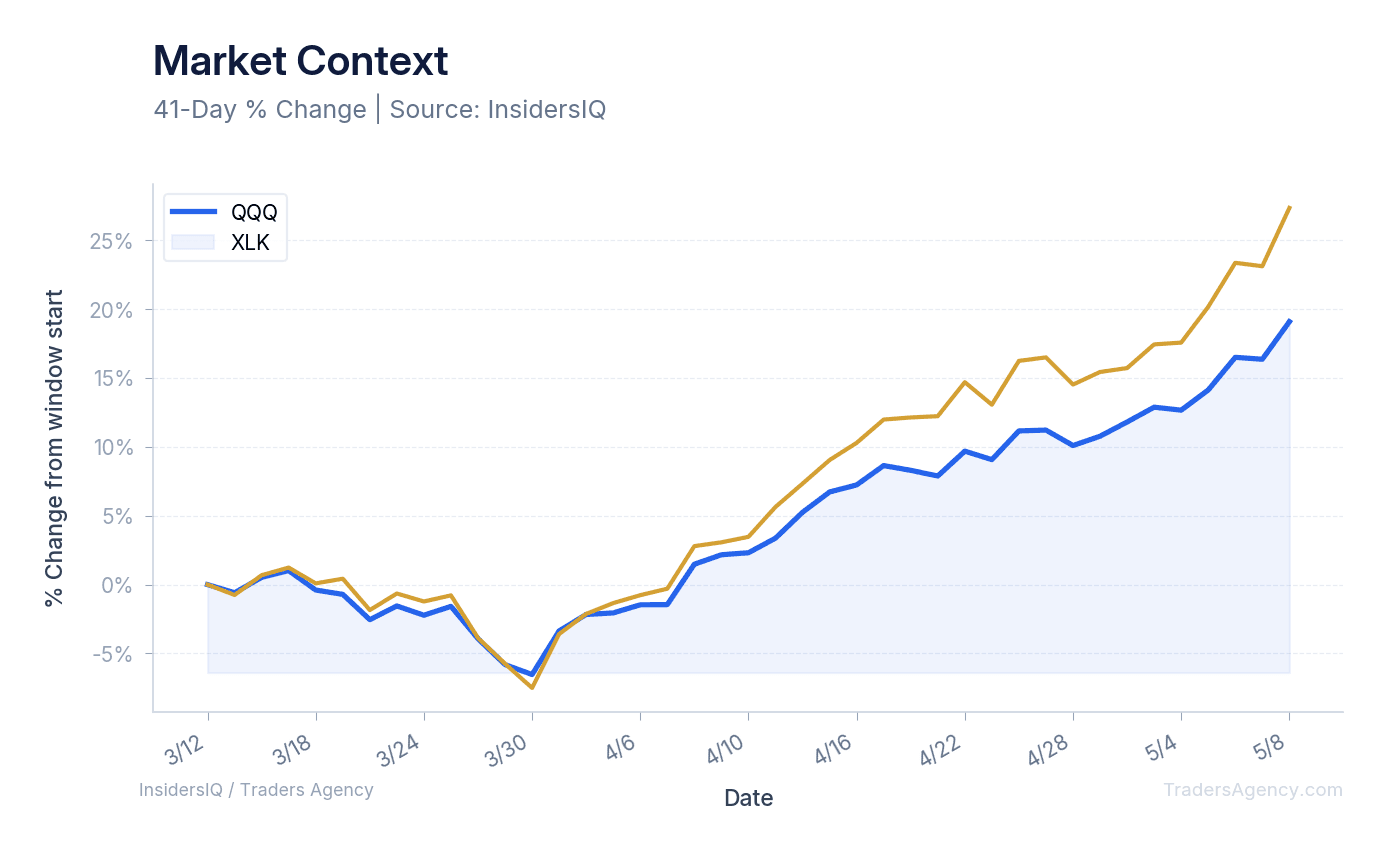
The momentum is highly concentrated but extremely powerful. Over the past month alone, the PHLX Semiconductor Sector Index, comprising the 30 largest U.S.-traded chip companies, has soared 38%. This index serves as a perfect barometer for the underlying hardware demand.
Historic Move: A 38% surge in the PHLX Semiconductor Sector Index over a single month is a historic price action event. Our sentiment trackers confirm aggressive bullish posturing across the trading community, with the Fear & Greed index sitting at 68.
WallStreetBets sentiment registers at 0.03 with 2,748 recent mentions. This data shows retail traders are actively discussing and participating in these explosive moves.
What Is the Memory Super Cycle and Why Does It Matter for This Rally?
Our analysis points to a specific driver for this sustained growth: the memory super-cycle. "It's a memory super-cycle," Ives said, referring to the unprecedented demand for memory chips sparked by a rapid AI infrastructure buildout. Ives is backing the AI rally to continue for another two years.
We are paying close attention to companies like SK Hynix and other memory manufacturers. Ives said he is very bullish on what he is seeing there. You cannot simply buy one type of stock to capture this entire move.
Ives said it is about playing the hyperscalers first, then chips, software, cybersecurity, infrastructure, and power. "You can't just own one subsector, you have to own the derivative plays," Ives said. The memory super-cycle is driving unprecedented demand for hardware, and companies positioned correctly within the supply chain stand to benefit.
Want expert trading insights delivered daily?
Join thousands of traders who rely on Traders Agency for market analysis and trade ideas.
Join Traders AgencyIs the AI Rally a Dot-Com Bubble in Disguise?
Michael Burry of "Big Short" fame warned on Friday that the stock market's fixation on AI is beginning to resemble the final stages of the dot-com bubble. "Stocks are not up or down because of jobs or consumer sentiment," Burry wrote. "They are going straight up because they have been going straight up. On a two letter thesis that everyone thinks they understand." He compared the current environment to "the last months of the 1999-2000 bubble."
Paul Tudor Jones, founder and chief investment officer of Tudor Investment, also told CNBC's "Squawk Box" on Thursday that the AI-fueled bull market still has further to run, but added there could be some "breathtaking" valuation corrections in time.
While the Nasdaq 30,000 prediction highlights the upside, traders must respect these warnings. The bull market likely still has further to run, but the warning of breathtaking corrections means traders cannot simply buy and hold blindly. Risk management will be the defining factor for success in this environment.
Which Sectors Benefit Most from AI Infrastructure Spending?
The greatest benefits will flow into derivative plays beyond just the primary chip manufacturers. Ives laid out the sectors traders must diversify into: software, cybersecurity, infrastructure, and power. These subsectors provide the necessary foundation for hyperscalers to operate and expand their massive data centers.
To capture the full scope of this trend, our team is monitoring several distinct categories. The capital rotation will likely hit these areas in waves as the infrastructure buildout matures.
Here are the primary sectors we are tracking for derivative plays:
- Semiconductor Chips: The foundational layer experiencing the 10-to-1 demand imbalance.
- Software: The applications required to run and manage new computing capabilities.
- Cybersecurity: Essential protection for the massive influx of new data and processing power.
- Infrastructure and Power: The physical facilities and energy grids required to keep data centers online.
As Ives put it, you have to own the derivative plays to survive this market cycle.
What Should Traders Watch Next to Validate the Nasdaq 30,000 Case?
We are keeping a close eye on the mega-cap technology stocks driving this index higher. Several major players have already recorded massive gains, and their next moves will dictate the broader market direction.
1. The Core Mega-Caps
We are tracking Intel, Nvidia, Apple, and Alphabet very closely. All four of these companies have enjoyed double-digit growth recently. The market relies on these specific names to maintain the current index levels. If capital begins to rotate out of these mega-caps, the broader market will immediately feel the impact.
2. The Semiconductor Index
The PHLX Semiconductor Sector Index is our primary barometer for chip strength. After soaring 38% in a single month, we are watching to see if this group of 30 companies can consolidate these gains without a massive pullback. This index serves as the leading indicator for the entire hardware supply chain.
3. Market Sentiment Metrics
With the Fear & Greed index at 68, the market is leaning heavily bullish. We will monitor the WallStreetBets mention count, currently at 2,748, to gauge retail participation levels. Retail exuberance can often signal a near-term top in the market, so we are watching these specific sentiment indicators to time our entries and exits carefully.
Our Bottom Line
The path to Nasdaq 30,000 has been paved by clear earnings strength and massive infrastructure spending. The 10-to-1 demand ratio for chips provides a mathematical foundation for the bullish thesis. However, the warnings of a 1999-2000 style bubble require strict risk management from active traders.
Our team will continue to trade the momentum in the QQQ and XLK while monitoring for the breathtaking corrections predicted by veteran investors. We are positioning for the memory super-cycle, focusing on derivative plays in power, cybersecurity, and software.
The Nasdaq 30,000 prediction is aggressive, but the data shows it is entirely possible if the current capital flows persist. Stay sharp and manage your risk.
Want expert trading insights delivered daily?
Join thousands of traders who rely on Traders Agency for market analysis and trade ideas.
Join Traders AgencyKey Takeaways
- Dan Ives of Wedbush Securities is targeting Nasdaq 30,000 within the next year, representing approximately 14.3% upside from the current level of 26,247.08.
- The Nasdaq Composite has already gained 12.93% year-to-date, with a strong earnings season erasing the early-year volatility that rattled investors.
- The core thesis rests on a 10-to-1 chip demand-to-supply imbalance, which Ives described on CNBC's Squawk Box Europe as the primary driver of the AI infrastructure buildout.
- Veteran investors are flagging a potential 1999-2000 style bubble scenario, making strict risk management a non-negotiable for traders riding this momentum.
- The team is focusing on derivative plays in power, cybersecurity, and software as part of a memory super-cycle positioning strategy, alongside QQQ and XLK exposure.
DISCLAIMER: Traders Agency does not offer financial advice. The information provided is for educational purposes only and should not be considered financial advice. Traders Agency is not responsible for any financial losses or consequences resulting from the use of the information provided. Trading carries inherent risks and may not be suitable for all individuals. You are advised to conduct your own research and seek personalized advice before making any investment decisions, recognizing the potential risks and rewards involved.
See more from Traders Agency on Google
Make us a preferred source and our market analysis will appear more prominently in your Google Search, Top Stories, and AI results.
Add to Preferred Sources