
You've probably seen this happen: a stock reports earnings, implied volatility crashes, and the underlying price pins exactly at a major support or resistance level. If you only bought a naked call or put, the volatility crush wiped out your premium. We're going to walk you through how to construct a trade that actually benefits from this exact scenario: the butterfly spread. Among all butterfly spread options strategies, this defined-risk structure stands out for its capital efficiency and precision. By the end of this guide, you'll understand how to execute this strategy, manage the options Greeks, and optimize your strike selection for maximum probability. Our team recommends mastering these mechanics before deploying real capital.
What Are Butterfly Spread Options and How Do They Work?
Bottom Line: The butterfly spread is a capital-efficient, defined-risk structure built for low-movement, high-precision scenarios, particularly when a stock is expected to pin near a specific price by expiration. Its value depends heavily on strike selection, timing, and liquidity. Traders who understand the Greeks, manage pin risk actively, and avoid illiquid underlyings are better positioned to use this strategy effectively.
Butterfly spread options require opening three different strike prices within the same expiration cycle. You buy one in-the-money option, sell two at-the-money options, and buy one out-of-the-money option. This specific structure creates a low-cost trade with a narrow, highly defined profit zone.
The logic behind this trade relies on the rapid time decay of the two short options you sell at the middle strike. We prefer to use this setup when we expect the underlying asset to remain completely flat or pin at a specific price by expiration.
The two long options act as protective wings. They cap your maximum loss if the stock makes an unexpected, explosive move in either direction.
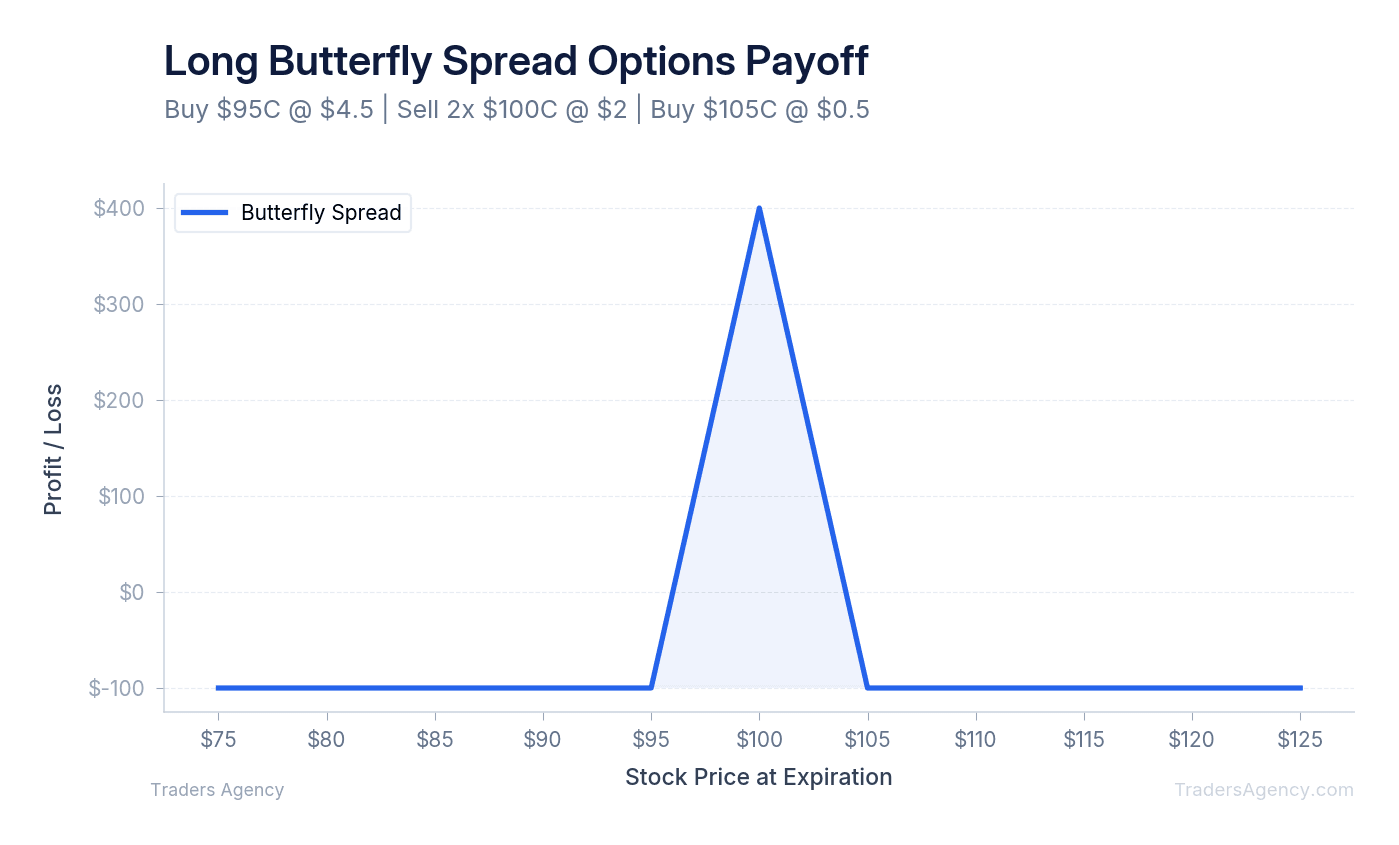
Because you're buying and selling options simultaneously, the premium collected from the short strikes offsets the cost of the long strikes. This makes the trade extremely capital efficient.
Key Concept: A butterfly spread combines three strike prices in a single expiration cycle. You buy the outer "wings" for protection and sell two contracts at the middle strike to collect premium, creating a defined-risk trade with a specific profit target.
Is a Butterfly Spread Profitable?
Yes, a butterfly spread is profitable when the underlying stock price closes exactly at the short middle strike at expiration. Because the initial debit paid is very low, the return on capital can be exceptionally high, often exceeding 300% if the price pins your target perfectly.
However, that absolute maximum profit is difficult to achieve in real-world trading. Professional traders focus on probability-adjusted returns rather than chasing the absolute peak of the profit tent. To increase your probability of profit, you must optimize your strike width.
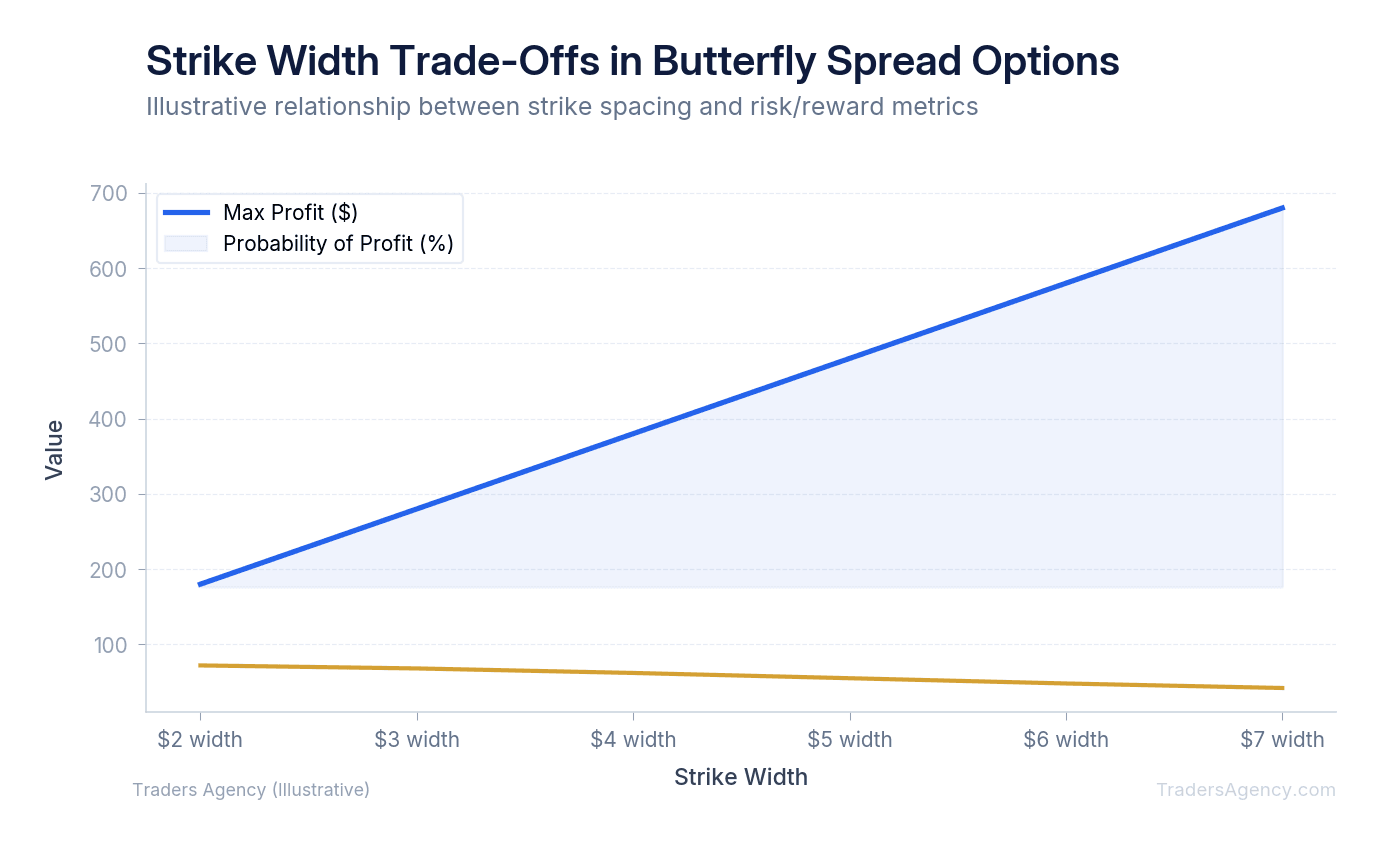
Here's how our team approaches strike width optimization:
- Narrow wings (e.g., $5 wide): This provides a lower upfront cost and higher potential return on capital. The downside is a very low probability of landing inside the tight profit zone.
- Wide wings (e.g., $20 wide): This requires a higher initial cost and offers a lower maximum return. The benefit is a significantly wider breakeven zone that drastically increases your win rate.
- Directional bias: You can shift the entire three-leg structure slightly out-of-the-money. We do this when we expect a moderate drift in one direction before expiration.
How Do You Execute a Butterfly Spread Step by Step?
Let's look at a concrete butterfly spread strategy example using a hypothetical stock, XYZ, currently trading at $150. We expect XYZ to trade exactly at $150 on expiration Friday.
Step 1: The Setup
We'll construct a standard long call butterfly. All options share the same expiration date, which is exactly 14 days away.
| Leg | Action | Strike | Premium |
|---|---|---|---|
| Lower Wing | Buy 1 Call (ITM) | $145 | $6.00 |
| Middle (x2) | Sell 2 Calls (ATM) | $150 | $3.00 each |
| Upper Wing | Buy 1 Call (OTM) | $155 | $1.00 |
Step 2: The Execution and Cost
To find your total cost, calculate the net debit. You pay $7.00 total for the two long wings ($6.00 plus $1.00). You collect $6.00 total for the two short middle strikes ($3.00 multiplied by 2).
Your net cost is $1.00 per share, or $100 total for one standard contract. This $100 is your absolute maximum risk on the trade.
Step 3: The Outcome and Formula
The butterfly spread formula for maximum profit is straightforward: (Distance between strikes minus Net Debit Paid) x 100.
In this case, the strikes are $5 wide. Subtract the $1.00 debit to get $4.00. Your maximum potential profit is $400.
| Scenario | Stock Price at Expiration | Profit / Loss |
|---|---|---|
| Max Profit | $150 (at middle strike) | +$400 |
| Lower Breakeven | $146 | $0 |
| Upper Breakeven | $154 | $0 |
| Max Loss (below $145 or above $155) | Below $145 or above $155 | -$100 |
If XYZ closes anywhere between $146 and $154, you make money. If it closes outside that range, you only lose your initial $100.
Want expert trading insights delivered daily?
Join thousands of traders who rely on Traders Agency for market analysis and trade ideas.
Join Traders AgencyHow Do the Greeks Shape Butterfly Spread Performance?
The options Greeks dictate how a butterfly spread behaves before expiration. This strategy relies heavily on positive Theta, meaning time decay works in your favor. It also carries negative Vega, meaning a drop in implied volatility will directly increase the value of your position.
Advanced traders know that a butterfly spread does not show significant profits early in the trade lifecycle. The two short options at the middle strike hold the most extrinsic value. As expiration approaches, the Theta decay on those two short options accelerates much faster than the decay on your long wings.
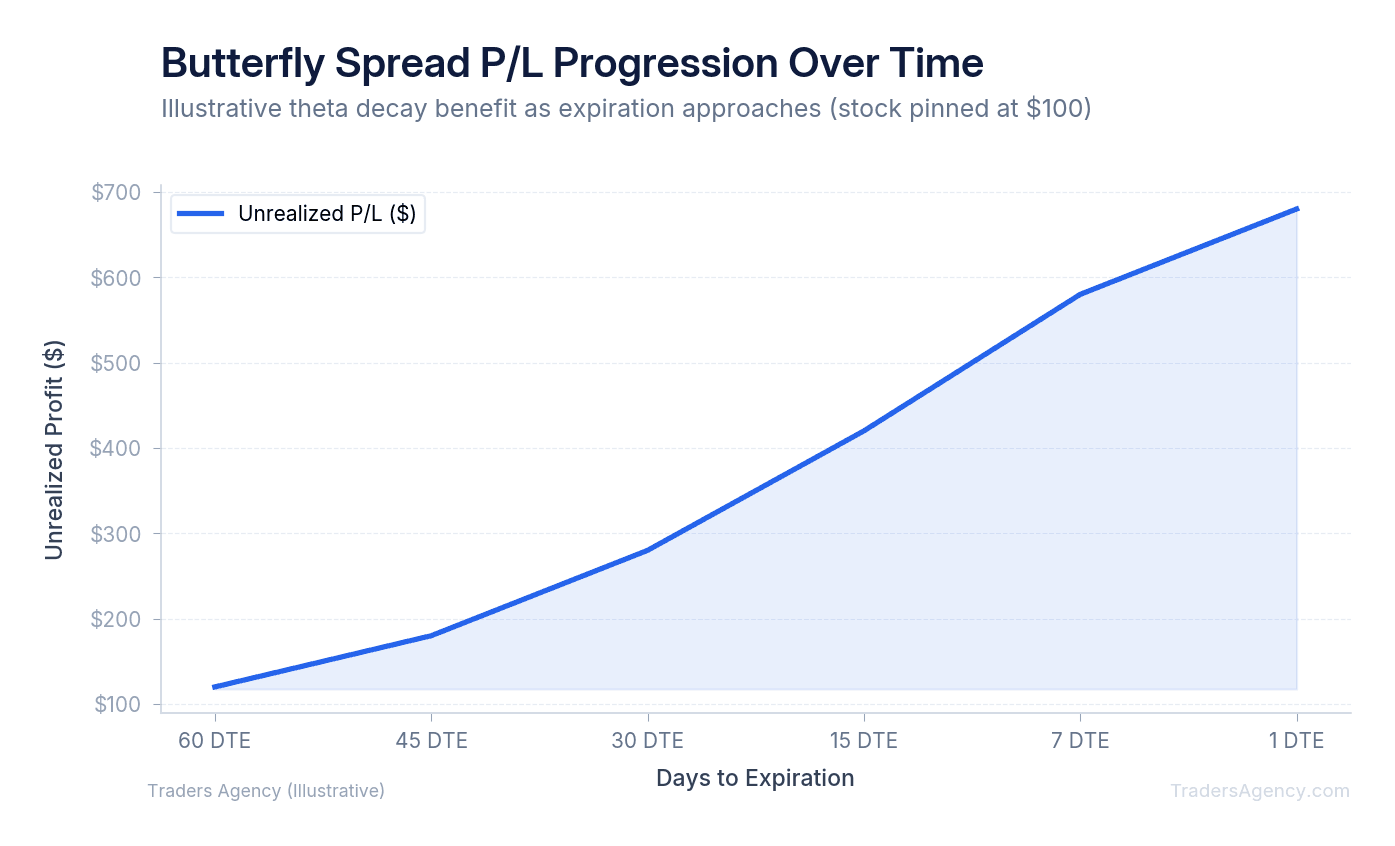
Vega is equally important to monitor. When you sell the two middle strikes, you're effectively shorting volatility. If implied volatility drops, the value of all options in the spread decreases, but the two short middle-strike options lose more value than the long wings, producing a net gain for the position. A volatility crush is exactly what you want when holding a long butterfly. The Cboe provides extensive educational materials on how implied volatility affects multi-leg options structures like this one.
Key Concept: A long butterfly benefits from two forces working together: positive Theta (time decay accelerates on your short strikes) and negative Vega (a drop in implied volatility increases your position's value). This is why the strategy excels in post-earnings or low-volatility environments.
When Is the Right Time to Use a Butterfly Spread?
The ideal market condition for a butterfly spread is a low-volatility consolidation period. You want the underlying asset to remain range-bound and settle precisely at your chosen middle strike price.
We prefer to deploy this strategy when a stock has established a clear, strong support or resistance level. If you see heavy options volume pinning a stock to a specific whole number, that's your target.
Watch Out: Avoid using a standard long butterfly during major macroeconomic announcements or unconfirmed earnings reports. If the stock makes a massive 10% gap in either direction, your trade will immediately hit its maximum loss. Always check the economic calendar before entering.
What Is the Difference Between a Short Butterfly and a Reverse Butterfly Spread?
Sometimes, you want the exact opposite payoff profile. If you expect a massive breakout but aren't sure of the direction, you might consider flipping the structure entirely.
A short butterfly spread involves selling the wings and buying two contracts at the middle strike. You collect a net credit upfront. You profit if the stock makes a large move outside your wing strikes before expiration.
A reverse butterfly spread is functionally identical to a short butterfly, just described from the perspective of the trader initiating the position. Both produce the same payoff profile: you profit when the stock moves significantly away from the middle strike.
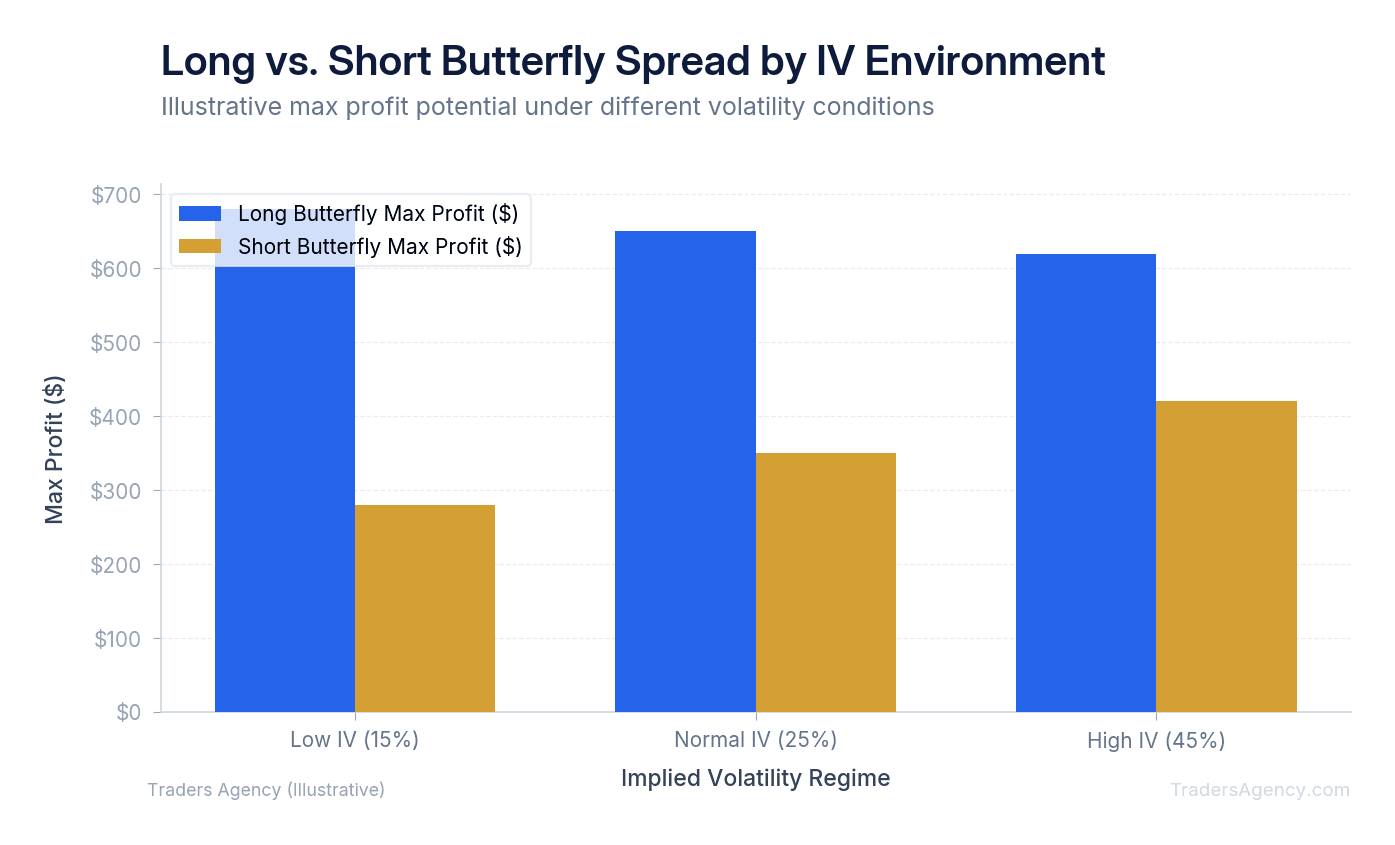
We teach our members to avoid short butterflies in low-volatility environments. If implied volatility is already at the floor, the premiums you collect for selling the wings won't justify the risk. You deploy these short structures when implied volatility is exceptionally high and you expect an immediate, violent price expansion.
Butterfly Spread vs. Short Straddle: Which Is Safer?
A butterfly spread is generally safer than a short straddle because it has strictly defined risk. While a short straddle offers a higher probability of profit and a wider breakeven zone, it exposes the trader to unlimited upside risk and substantial downside risk.
When comparing a butterfly spread vs. short straddle, the choice comes down to your risk tolerance and account size. A short straddle requires selling a naked call and a naked put at the exact same strike. If the stock gaps up 20% overnight, a short straddle can cause catastrophic account losses.
With a butterfly, your long wings act as an absolute stop loss. The maximum you can lose is the initial debit paid. This defined risk allows you to size your positions accurately without fear of a margin call.
Our Risk Management Rules for Butterfly Spreads
- Position Sizing: Never allocate more than 2% to 3% of your total account equity to a single butterfly trade.
- Early Exits: Don't hold until expiration hoping for the absolute maximum gain. We prefer to close the trade when we capture 50% to 60% of the maximum potential profit.
- Pin Risk: If the stock closes exactly at your short strike, you face assignment risk. Always close the trade before the final bell to avoid weekend gap risk on assigned shares.
- Liquidity: Only trade this structure on highly liquid options. A butterfly spread strategy chart might look perfect in theory, but if the bid-ask spread is too wide, you'll lose your edge to slippage.
Watch Out: Pin risk is real. If the underlying closes exactly at your short middle strike on expiration day, you could be assigned on one or both short contracts. This leaves you with an unexpected stock position over the weekend. Our standing rule: close the trade before the final 30 minutes of expiration Friday.
Want expert trading insights delivered daily?
Join thousands of traders who rely on Traders Agency for market analysis and trade ideas.
Join Traders AgencyKey Takeaways
- A butterfly spread requires three strike prices in the same expiration cycle: one in-the-money long, two at-the-money shorts, and one out-of-the-money long.
- The strategy is designed to profit when the underlying asset pins near the middle strike at expiration, making it well-suited for post-earnings environments where implied volatility collapses.
- The two long outer options cap maximum loss if the stock makes an unexpected large move in either direction, giving the trade a fully defined risk profile.
- Pin risk is a real concern: if the underlying closes exactly at the short middle strike on expiration day, assignment on one or both short contracts could leave an unexpected stock position over the weekend. The recommended rule is to close the trade before the final 30 minutes of expiration Friday.
- Liquidity matters as much as structure. A wide bid-ask spread on illiquid options can eliminate the edge the strategy is designed to create, even when the setup looks correct on a chart.
DISCLAIMER: Traders Agency does not offer financial advice. The information provided is for educational purposes only and should not be considered financial advice. Traders Agency is not responsible for any financial losses or consequences resulting from the use of the information provided. Trading carries inherent risks and may not be suitable for all individuals. You are advised to conduct your own research and seek personalized advice before making any investment decisions, recognizing the potential risks and rewards involved.
See more from Traders Agency on Google
Make us a preferred source and our market analysis will appear more prominently in your Google Search, Top Stories, and AI results.
Add to Preferred Sources