
You've probably watched a stock explode 50% in a single afternoon and wondered what exactly caused that violent move. Retail traders often assume every massive rally is a short squeeze. Our team takes a different approach: we look at the options chain to find the real driver. By the end of this guide, we'll teach you exactly how market makers are forced to buy shares during rapid rallies. You'll understand how to track dealer positioning, identify a gamma squeeze indicator, and manage your risk when trading these explosive setups.
What Is a Gamma Squeeze in the Market?
Bottom Line: A gamma squeeze is driven by the mechanical obligation of options market makers to delta hedge their short call exposure, not by short sellers covering positions. Understanding the difference between a gamma squeeze and a short squeeze helps traders identify the real driver behind explosive moves and focus on early identification and directional risk management rather than attempting to trade the hedging mechanics themselves.
A gamma squeeze is a rapid price acceleration caused by options market makers buying the underlying stock to hedge their short call positions. As the stock price rises, the delta of these calls increases, forcing dealers to continuously buy shares to remain neutral.
When retail or institutional traders buy massive amounts of out-of-the-money (OTM) call options, someone has to take the other side of that trade. Market makers step in to sell those calls. This leaves the dealer short gamma.
To protect themselves from unlimited risk, they must delta hedge. If the stock moves higher, the delta of the calls they sold gets closer to 1.00. The dealer must buy more shares of the underlying stock to offset this growing directional exposure.
This forced buying pushes the stock price even higher, which increases the call delta again, forcing even more buying.
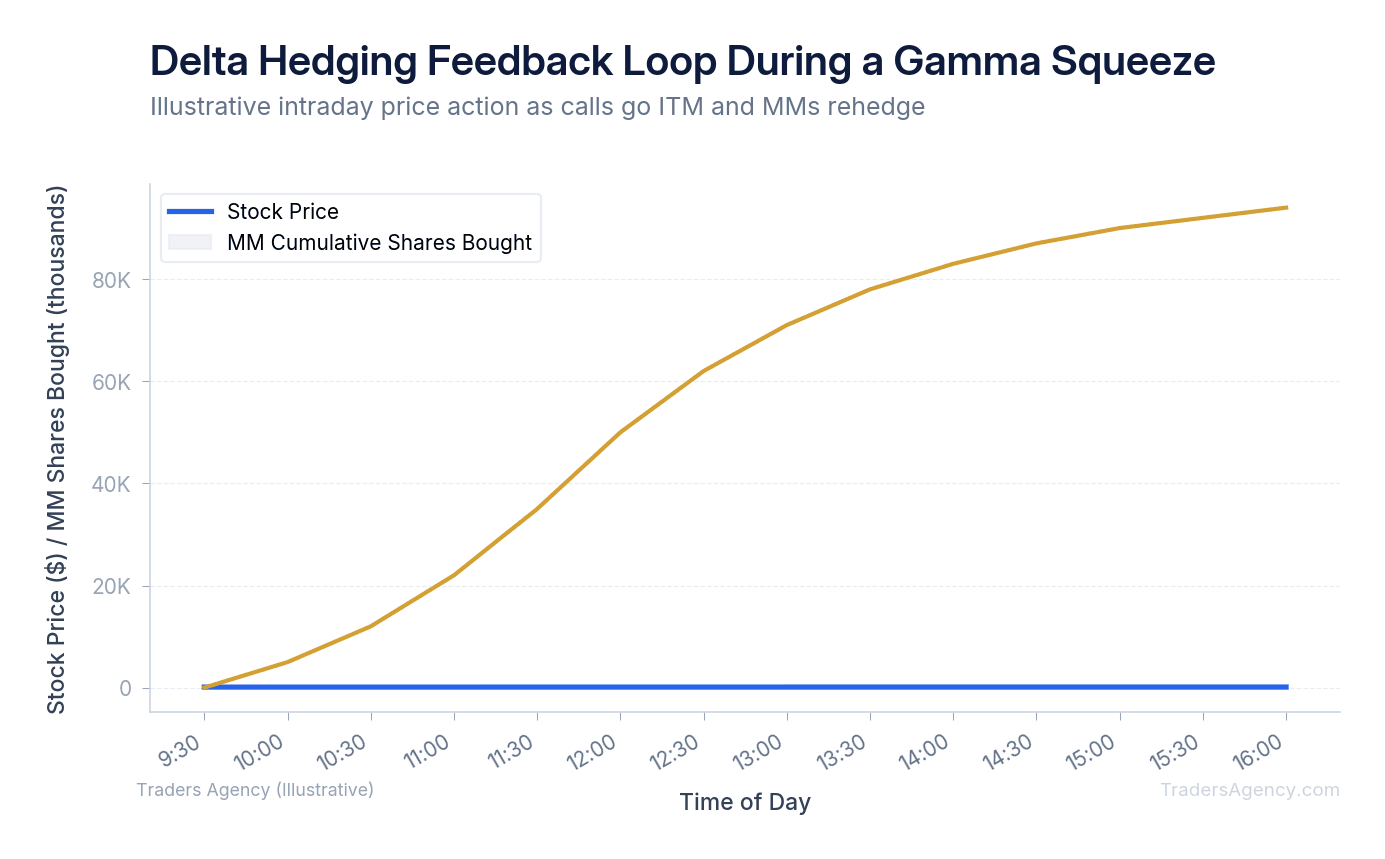
This self-reinforcing cycle creates a violent upward spike. We teach our members to monitor the options chain for heavy call volume at specific strike prices. When dealers are short massive amounts of gamma, the stock becomes highly sensitive to small price movements.
Key Concept: A gamma squeeze occurs when market makers who sold call options are forced to buy increasing amounts of the underlying stock as the price rises, creating a self-reinforcing feedback loop that drives explosive upward moves.
What Is the Difference Between a Gamma Squeeze and a Short Squeeze?
The difference between a gamma squeeze vs short squeeze comes down to the underlying mechanics. A short squeeze is driven by traders buying shares to cover borrowed short positions. A gamma squeeze is driven by market makers buying shares to hedge their short call options exposure.
Many traders confuse these two events. A short squeeze requires a high short interest as a percentage of the available float. When the stock rises, short sellers face margin calls and must buy shares to exit their losing trades.
A gamma squeeze requires massive call option volume, especially short-dated contracts. You don't need high short interest for a gamma squeeze to occur. You only need heavy dealer short gamma positioning.
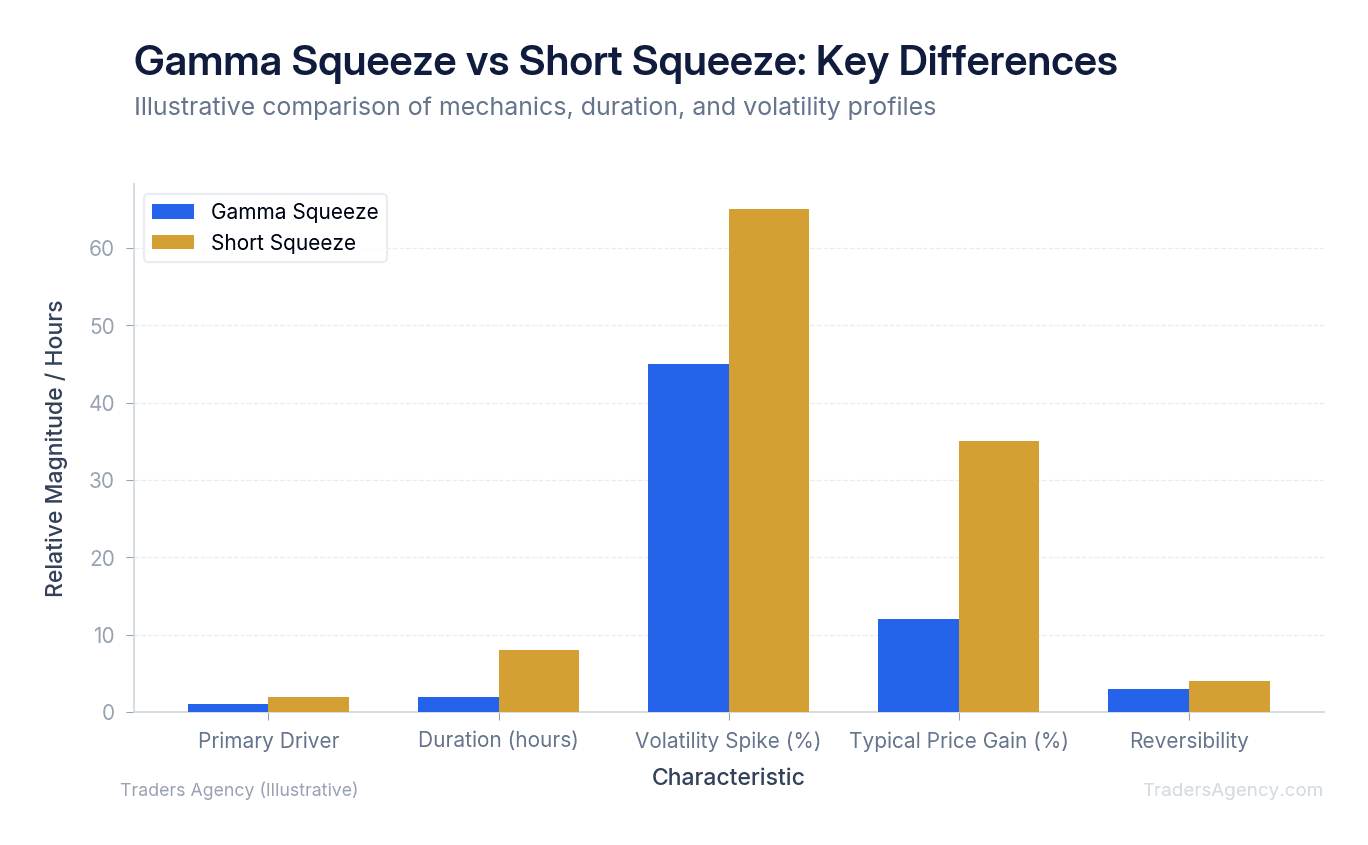
| Factor | Gamma Squeeze | Short Squeeze |
|---|---|---|
| Primary Driver | Market maker delta hedging | Short sellers covering positions |
| Key Data Point | Options chain / gamma exposure | Short interest / days to cover |
| Trigger | Heavy OTM call buying | Rising stock price + margin calls |
| Timeframe | Often intraday (especially 0DTE) | Can last days to weeks |
| Reversal Cause | Options expiration or call selling | Short sellers finish covering |
Sometimes, both happen simultaneously. A gamma squeeze can push the stock price high enough to trigger margin calls for short sellers, creating a dual-engine rally. Understanding the difference allows you to look at the right data points. We recommend checking the options chain for gamma exposure (GEX) rather than relying solely on short interest reports.
How Do Market Makers Trigger a Delta Hedging Feedback Loop?
To understand the mechanics, you need to know how a delta squeeze vs gamma squeeze operates behind the scenes. Delta measures the directional exposure, while gamma measures the rate of change of that delta.
When a dealer sells a call option, they immediately buy a specific number of shares based on the option's delta. If they sell one call contract with a 0.30 delta, they buy 30 shares. If the stock stays flat, their position is perfectly hedged.
The problem arises because gamma accelerates delta. As the stock price moves toward the strike price, gamma forces that 0.30 delta to become 0.50, then 0.80, and eventually 1.00. The dealer must constantly adjust their hedge by buying more shares in real time.
Dealer hedging activity can significantly impact underlying stock liquidity, especially during periods of concentrated options positioning. When liquidity dries up and dealers are forced to buy at market prices, the feedback loop goes into overdrive.
Why Does Gamma Amplification Intensify Near Expiration and With 0DTE Options?
Gamma does not behave linearly. It peaks when an option is exactly at-the-money (ATM) and grows exponentially as the expiration date approaches. This is why zero-days-to-expiration (0DTE) options are so powerful.
Our team closely monitors 0DTE volume because short-dated options carry massive gamma risk for market makers. A 0DTE option sitting just outside the money has a delta near zero. If the stock suddenly rallies and that strike becomes ATM, the delta violently snaps to 0.50.
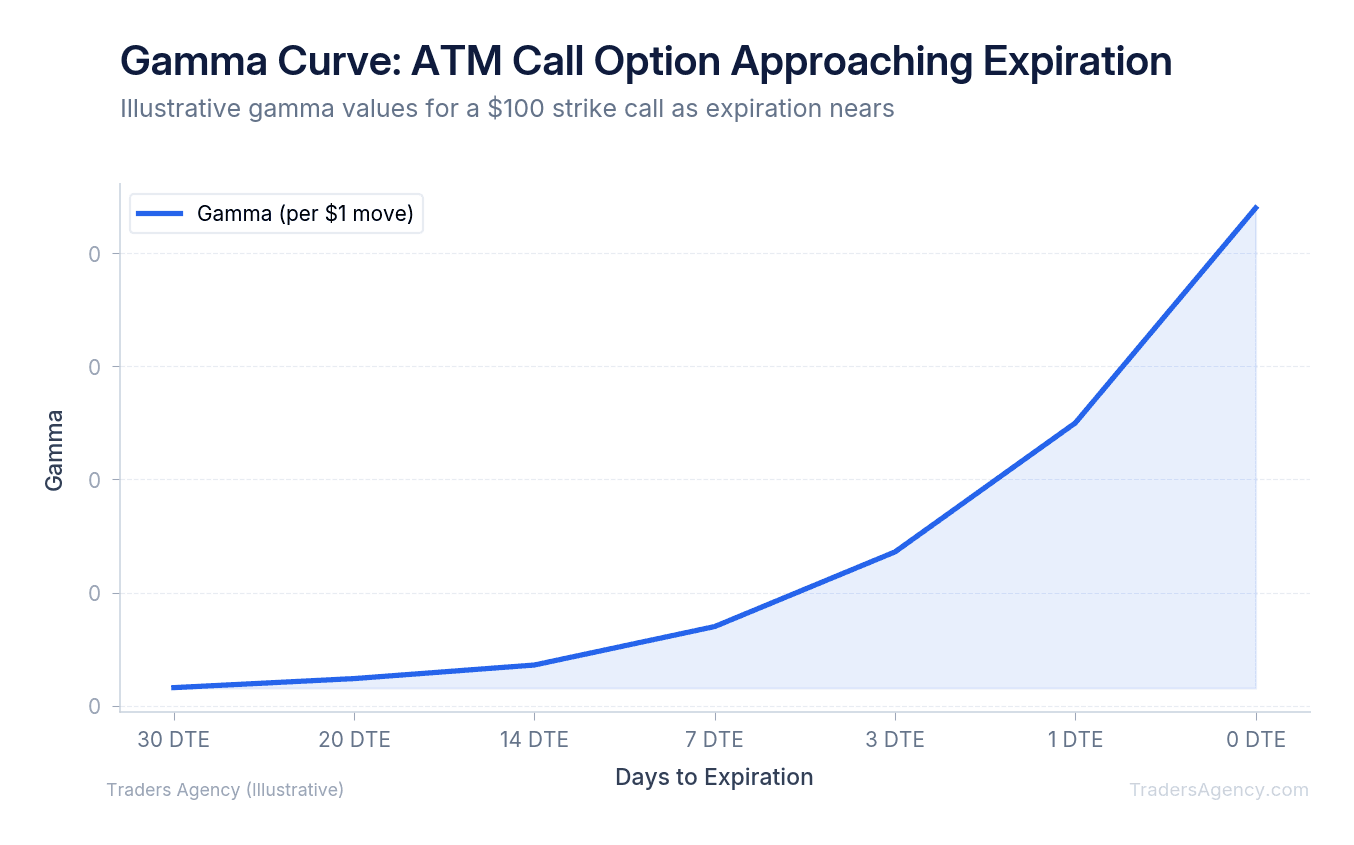
Dealers have almost no time to react. They must instantly buy roughly 50 shares per contract to hedge. This sudden burst of buying pressure creates the intraday spikes we frequently see in highly traded indices.
0DTE volume now makes up a massive portion of daily options trading on the Cboe. The shorter the time to expiration, the more explosive the gamma amplification becomes.
Key Concept: Gamma peaks for at-the-money options and increases exponentially as expiration approaches. This is why 0DTE options create the most violent gamma squeezes: dealers are forced to hedge enormous delta swings in minutes, not days.
Want expert trading insights delivered daily?
Join thousands of traders who rely on Traders Agency for market analysis and trade ideas.
Join Traders AgencyStep-by-Step Gamma Squeeze Example
Let's walk through a concrete gamma squeeze example using specific numbers so you can see exactly how the math forces market makers to act. Assume stock XYZ is trading at $100. A coordinated group of traders suddenly buys 100,000 contracts of the $105 call options expiring today.
- The Initial Setup: Market makers sell the 100,000 contracts. At $100, the $105 call has a delta of 0.10. To hedge, the dealers buy 1 million shares (100,000 contracts x 100 multiplier x 0.10 delta). This initial buying pushes XYZ to $102.
- The Gamma Acceleration: Because the stock is now at $102, the $105 call is closer to the money. Gamma increases the delta from 0.10 to 0.30. The dealers must now hold 3 million shares to stay neutral. They are forced to buy 2 million more shares immediately.
- The Climax: This massive 2-million-share purchase drives XYZ up to $105. The options are now perfectly at-the-money. The delta hits 0.50. The dealers must buy another 2 million shares to reach their required 5-million-share hedge. The stock spikes to $110, pushing the delta to nearly 1.00. The dealers are now holding 10 million shares. The initial option purchase forced market makers to buy 10 million shares in a matter of hours.
| Stage | Stock Price | Call Delta | Shares Dealers Must Hold | New Shares Purchased |
|---|---|---|---|---|
| Initial Setup | $100 | 0.10 | 1,000,000 | 1,000,000 |
| Gamma Acceleration | $102 | 0.30 | 3,000,000 | 2,000,000 |
| At-the-Money | $105 | 0.50 | 5,000,000 | 2,000,000 |
| Deep In-the-Money | $110 | ~1.00 | 10,000,000 | 5,000,000 |
How Does a Gamma Squeeze End?
A gamma squeeze ends when the call options expire, are exercised, or are sold back to the market makers. Once the dealer no longer holds the short call position, they must sell their hedged shares, causing the stock price to collapse rapidly.
This is the most dangerous phase for retail traders. The upward momentum feels unstoppable, but the mechanics dictate a violent reversal. When traders sell their calls to take profits, the dealer buys the calls back. The dealer is no longer short gamma.
They immediately dump the underlying shares they bought to hedge. If 100,000 contracts are sold back, the dealer dumps 10 million shares onto the open market. The stock plummets just as fast as it rose.
We teach our members to watch for a flattening of call volume as a primary gamma squeeze indicator signaling the end of the run.
Watch Out: The reversal phase of a gamma squeeze is where most retail traders get crushed. When dealers begin unwinding their hedges, the selling pressure is just as mechanical and relentless as the buying pressure was on the way up. If you're holding long calls or shares at the top, the drawdown can be catastrophic within minutes.
What Are the Risks of a Gamma Squeeze?
The primary risks of a gamma squeeze include massive slippage, sudden liquidity vacuums, and catastrophic drawdowns when the dealer de-hedging process begins. Traders who buy at the top often face immediate and severe losses.
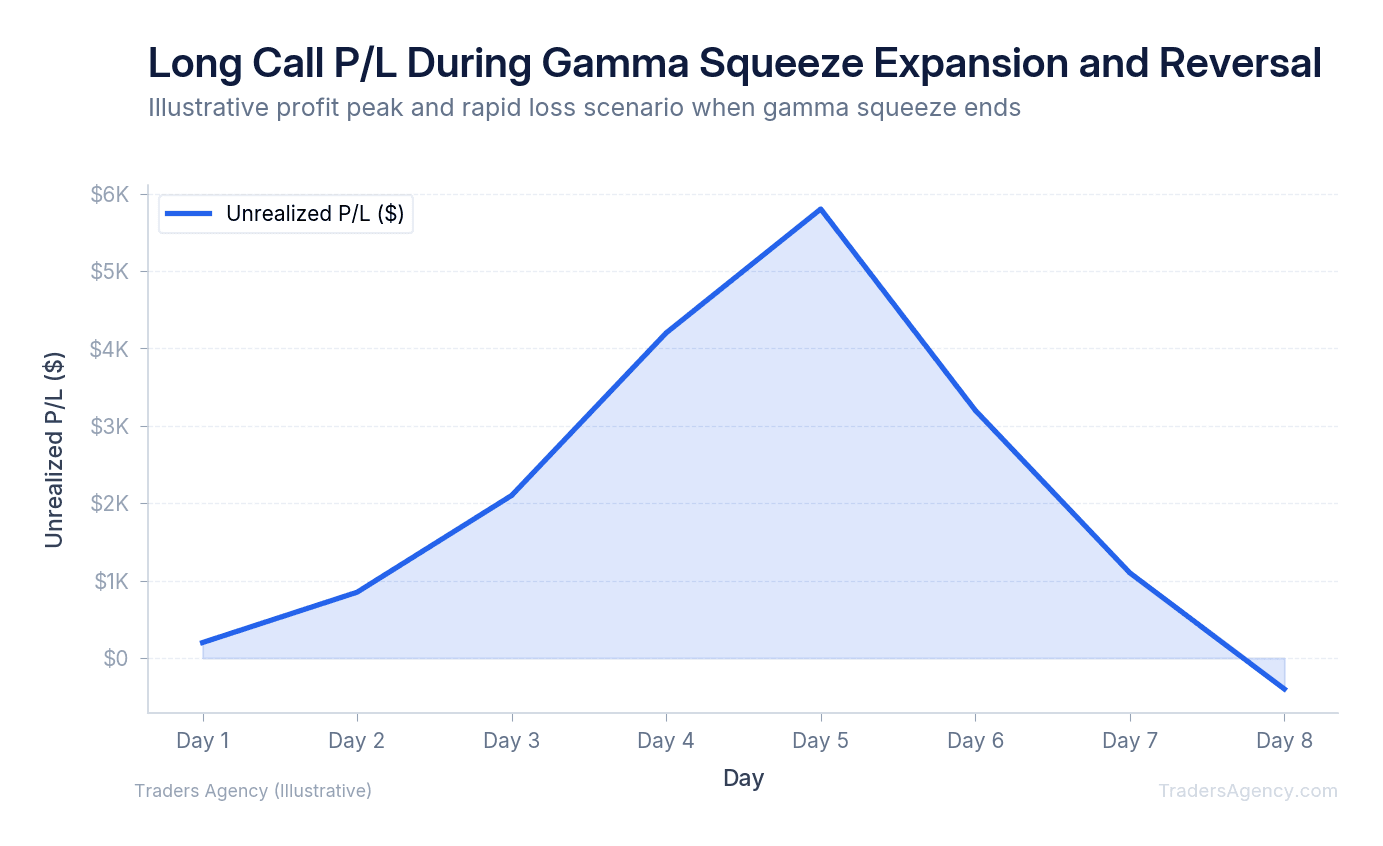
Risk management is mandatory when trading these setups. You must account for implied volatility (IV) crush. If you buy options during the middle of a squeeze, the premiums will be astronomically high. When the stock price stabilizes or drops, IV collapses.
Your options can lose 80% of their value in minutes, even if the stock price only drops slightly. We prefer to use defined-risk spreads if we enter during high-volatility environments.
Our team follows strict rules when trading these volatile events:
- Cap position sizing: Never allocate more than 1% to 2% of your total account capital to a speculative squeeze play.
- Take partial profits: Sell half of your position when the stock experiences its first major vertical spike.
- Avoid chasing: Do not enter a new long position after the stock has already moved multiple standard deviations above its daily average.
- Watch the clock: Be extremely cautious holding 0DTE options into the final hour of trading, as dealers will aggressively unwind hedges.
Is Gamma Scalping Profitable?
Gamma scalping is profitable for institutional traders and market makers who use it to offset the cost of holding long options positions. It involves buying and selling the underlying stock to remain delta-neutral as the stock price fluctuates.
While retail traders look for directional bets during a squeeze, professionals use gamma scalping to profit from the volatility itself. If an institution owns long straddles, they are long gamma. As the stock moves up, their delta becomes positive. They sell shares to lock in profits and return to neutral.
If the stock drops, their delta becomes negative. They buy shares to return to neutral. They are constantly buying low and selling high around their core options position.
This requires advanced automated execution and massive capital. For the average retail trader, attempting to manually gamma scalp during a violent squeeze is incredibly difficult and often results in heavy losses due to bid-ask spreads and execution delays.
Watch Out: Gamma scalping is not a realistic strategy for most retail traders. The speed of execution required, combined with wide bid-ask spreads during volatile events, means manual attempts at gamma scalping typically result in losses rather than profits. Focus on identifying the squeeze early and managing your directional risk instead.
Want expert trading insights delivered daily?
Join thousands of traders who rely on Traders Agency for market analysis and trade ideas.
Join Traders AgencyKey Takeaways
- Market makers who sell OTM call options are left short gamma and must delta hedge by buying shares as the stock rises, which can push the price higher and trigger even more forced buying.
- As a call option's delta approaches 1.00, dealers must continuously add shares to stay neutral, creating a self-reinforcing feedback loop that accelerates price moves.
- Gamma amplification intensifies near expiration, particularly with 0DTE options, because gamma values spike sharply as time value collapses.
- Gamma scalping is not a realistic strategy for most retail traders: the speed of execution required and wide bid-ask spreads during volatile events typically produce losses rather than profits.
- Identifying a gamma squeeze early by tracking dealer positioning and unusual options activity is more practical for retail traders than trying to trade the mechanics directly.
DISCLAIMER: Traders Agency does not offer financial advice. The information provided is for educational purposes only and should not be considered financial advice. Traders Agency is not responsible for any financial losses or consequences resulting from the use of the information provided. Trading carries inherent risks and may not be suitable for all individuals. You are advised to conduct your own research and seek personalized advice before making any investment decisions, recognizing the potential risks and rewards involved.
See more from Traders Agency on Google
Make us a preferred source and our market analysis will appear more prominently in your Google Search, Top Stories, and AI results.
Add to Preferred Sources