

The global computing infrastructure is completely unprepared for what is about to happen.
We are standing at the exact moment a new technology transitions from a niche developer tool into a mandatory enterprise system. The demand driving this supply chain is structural, and it is creating a massive opportunity in agentic AI stocks.
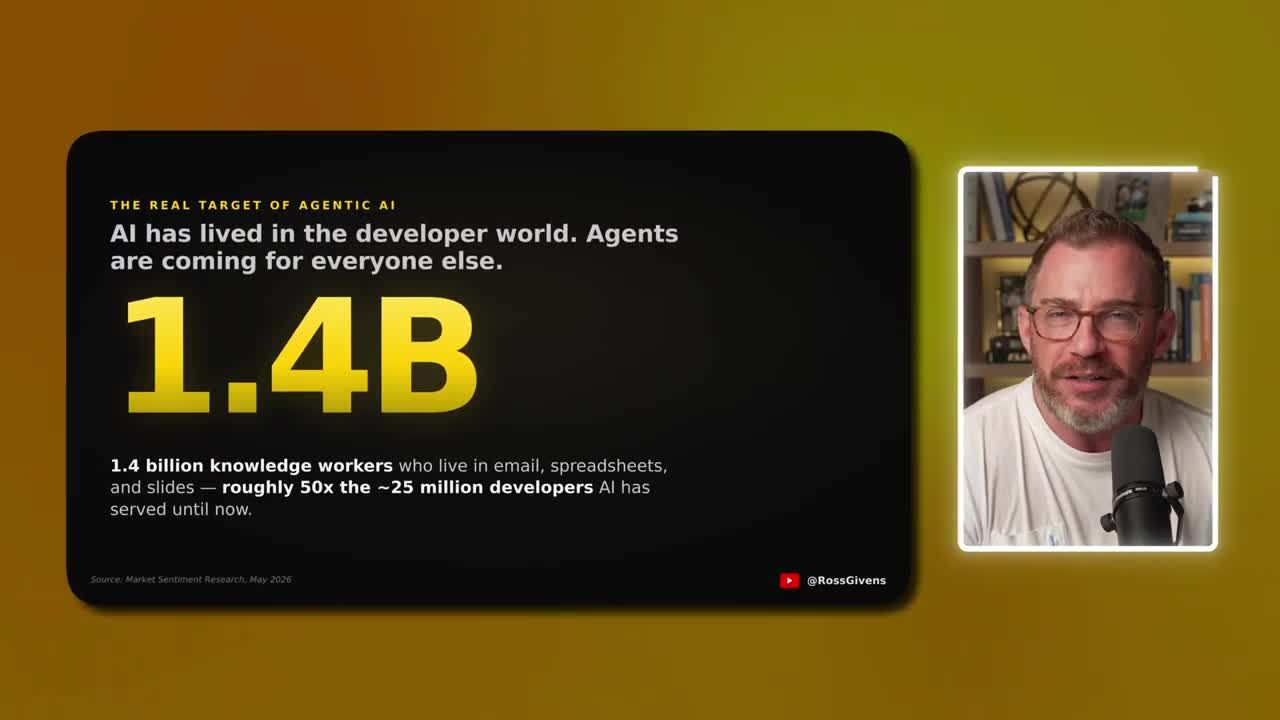
Up until a few months ago, using AI at work meant you were a developer. You were writing code in something like Cursor. That represents maybe 20 to 25 million people on the entire planet.
That reality is gone. AI is about to operate the actual software that over a billion knowledge workers use to do their jobs every single day. This is a major inflection point with real ramifications for the supply chain underneath it. The picks and shovels layer just got a massive promotion.
This article breaks down exactly what this technology will do to global computing demand, and how you can position yourself in the backdoor stocks quietly powering this entire buildout.
What Is Agentic AI?
Bottom Line: The transition from developer-facing AI tools to agentic systems running inside enterprise software for over a billion workers represents a step-change in computing demand, not a continuation of the existing trend. The real opportunity is not in the AI applications themselves but in the infrastructure layer underneath: the memory, storage, and power components that agentic workloads require at scale. With 78% of the world yet to use any AI tool, this buildout is closer to the beginning than the middle.
An autonomous system that runs complex, multi-step workflows for hours, requiring vastly more computing power than standard chatbots.
An AI agent is not a chatbot. When you ask ChatGPT a question, the response is quick. It doesn't use much compute. A chatbot session is short, GPU-heavy, and operates with low context.
An agentic session is the exact opposite. It could run for hours. It constantly does things in the background. It leans heavily on CPUs, memory, and GPUs all at once.
Compute is measured in tokens. We can quantify exactly how much heavier this new workload is.
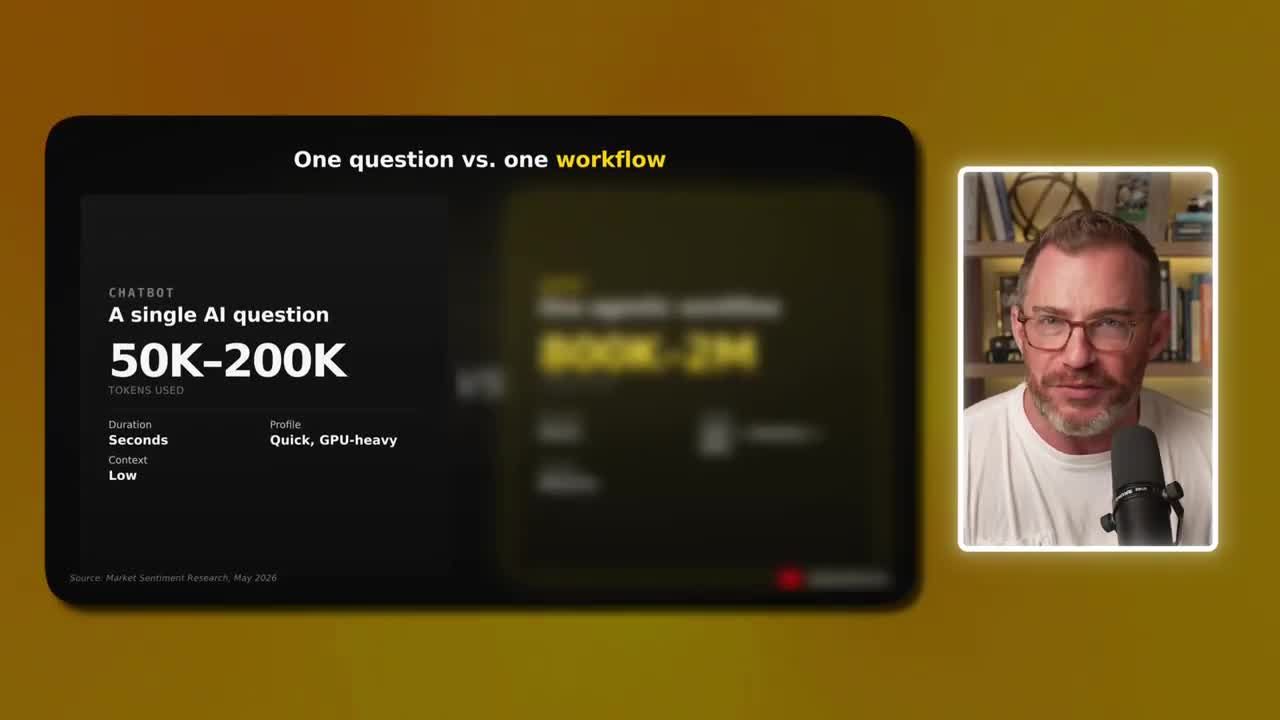
A developer running a focused 30-minute coding session burns between 50,000 and 200,000 tokens. A financial analyst using an agentic system to analyze the nuclear power ecosystem burns between 800,000 and 2 million tokens from a single command.
That single command asks the agent to analyze every publicly traded company in the space, build and reconcile a 200-row file, compare it to industry comps, write a full email summary, and build a 40-slide deck.
Anthropic and Microsoft Move In
Claude is now embedded in Excel, PowerPoint, and Word. This is not a demo.
Last month, Anthropic made a big move. Its Claude model is now living inside of Excel, PowerPoint, and Word. Generally available. No waitlist. Embedded directly into three applications that 1.4 billion office workers open every single morning.
Microsoft is aggressively pushing adoption too. Their Copilot system is around 20 million paying users. They rolled out a new Office bundle on May 1st. Microsoft has already said that over 80% of the Fortune 500 has rolled Copilot out to at least part of their workforce.
The infrastructure to handle this level of enterprise adoption simply does not exist yet.
How Does Agentic AI Change the AI Supply Chain?
The initial AI boom caused every major tech company to aggressively buy GPUs. That's what Nvidia makes. But the architecture required for AI agents is completely different.
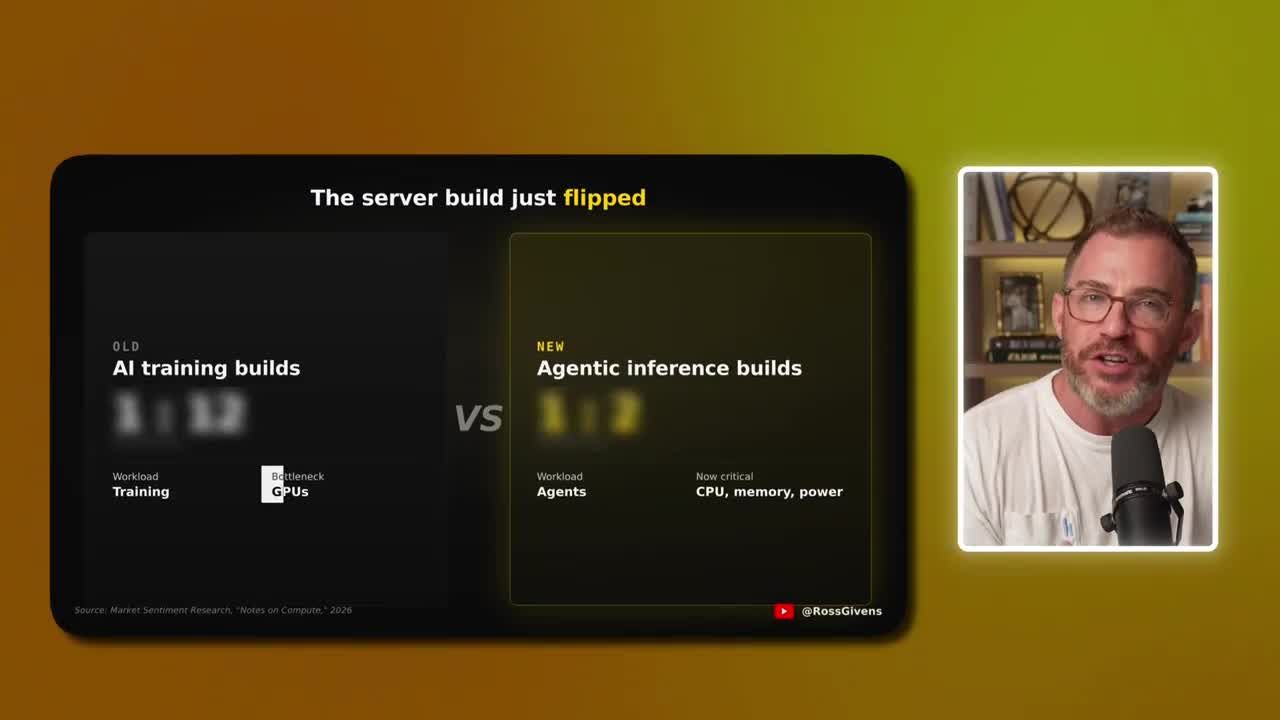
The server CPU to GPU ratio has shifted dramatically. At the peak of the AI boom, the old training builds operated on a 1 to 12 ratio: 12 GPUs for every CPU. In these new agentic builds, that ratio has shifted to 1 to 2.
An entire pile of components that the market stopped paying attention to, CPUs, memory, storage, power chips, all became mission critical at once. That's why stocks like SanDisk and Micron are going vertical right now.
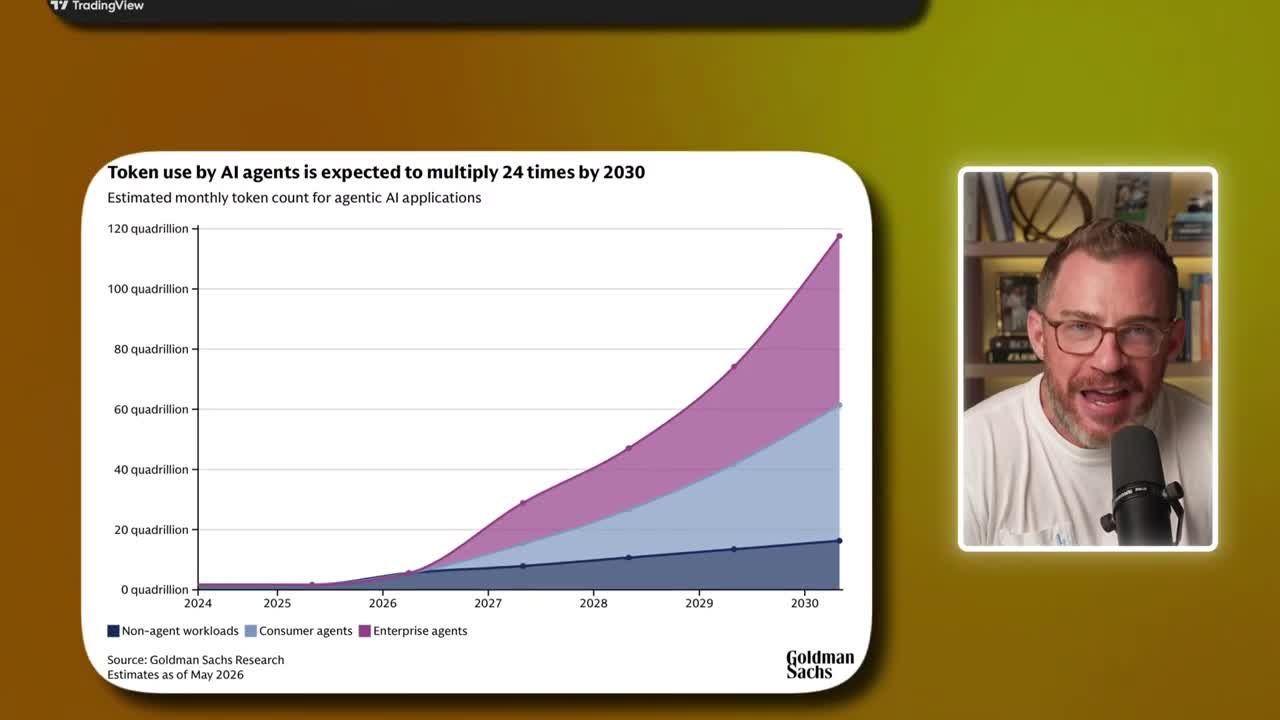
In that same report, Goldman noted that token economics turn positive in the first half of 2026. That is the moment an agent's output is worth more than what it costs to run it. Once that flips, every company on Earth has to deploy agents just to stay competitive.
Right now, agentic AI is still more hobbyist tinkering than full commercial deployment. But the second it pays for itself, adoption goes vertical in a matter of months, not years.
What Does the Nvidia Playbook Teach Us About Agentic AI Stocks?
I was wrong. Here is what that mistake taught me.
Back in 2023, I wrote a piece warning people that Nvidia looked expensive. The stock had tripled in a few months, and the price to sales ratio had doubled. I looked at that valuation and thought it was overpriced.
I was wrong.
While I was staring at multiples, the actual sales were about to explode. Nvidia's revenue went from $61 billion to $130 billion to $216 billion in just three years. Doubling revenue every single year at that scale is something I had never seen before. Every big tech company on Earth was in an arms race to buy GPUs, and Nvidia was the only one selling.

The company is worth $5 trillion now. The stock is up 1,600%. That trade happened, and it is over.
The lesson is simple: do not bet against a structural change. When demand is structural and the moats are the best in the business, rich valuations are often justified.
Get an entire year of live weekly mentoring sessions, my newsletter, indicators, bonus reports, tons more. Click the link and I'll see you in the next live session.
Join my Black Ops Trading ClubWhich Backdoor Stocks Are Quietly Powering the Agentic AI Buildout?
The cleanest way for a US investor to own the picks and shovels underneath this trend.
These companies own the compute, memory, and storage layers of the agentic build. They have already run hard. These are the proven leaders of this wave. But the demand driving them is still early, and we have started seeing some pullbacks thanks to a few dips in the market recently.
1. ARM Holdings (ARM)
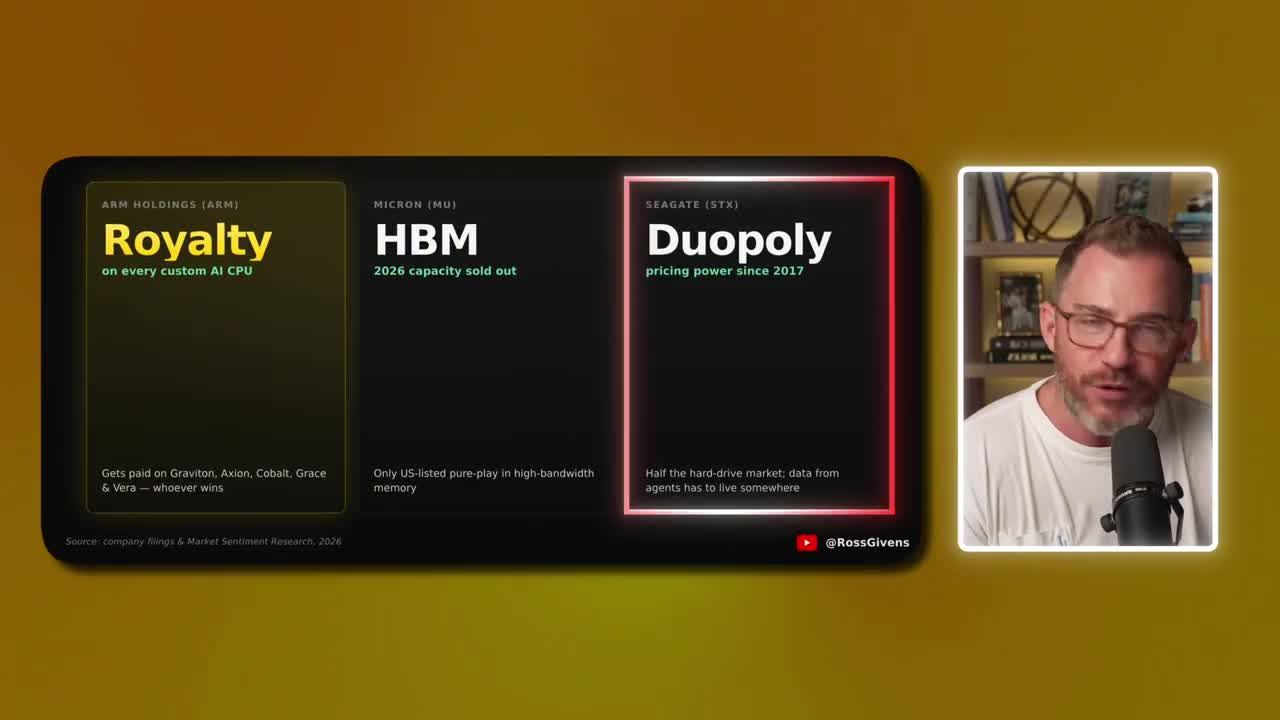
ARM is the toll booth for the entire custom CPU boom. When massive hyperscalers build their own custom AI chips (Amazon's Graviton, Google's Axion, Microsoft, Nvidia, etc.), almost every one of them is built on ARM's architecture.
ARM collects a royalty on each and every chip. They don't care who wins the design war. Amazon, Google, Microsoft. They get paid either way. That is a direct royalty stream on the custom CPU boom, listed right on the NASDAQ.
2. Micron (MU)
Agentic AI agents run for hours and are hungry for memory. That's where all the context lives. Micron is the only US-listed pure play in high bandwidth memory, the stuff that sits right next to the GPU.
The stock has gone parabolic. It just crossed a trillion-dollar valuation. It is extended, but so was Nvidia a couple of years ago, and that one kept going as well.
3. Seagate (STX)
Agents generate mountains more data than chatbots ever did, and all that data has to live somewhere. Seagate is one half of the hard drive duopoly.
For the first time since 2017, Seagate has real pricing power. Their capacity is reportedly sold out through year end. If you want to go deeper into the storage layer, its duopoly partner Western Digital (WDC) and ND, which is the spin-off of SanDisk, are both right there on the NASDAQ as well.
The Deep Cuts: Asian Supply Chain
The names Wall Street is not talking about, because most of them don't trade in the US.
Many of the best stocks in this supply chain trade overseas. Just because it's not a US stock doesn't mean it's not a great opportunity. These are some of the strongest agentic AI stocks in the power management and component layers.
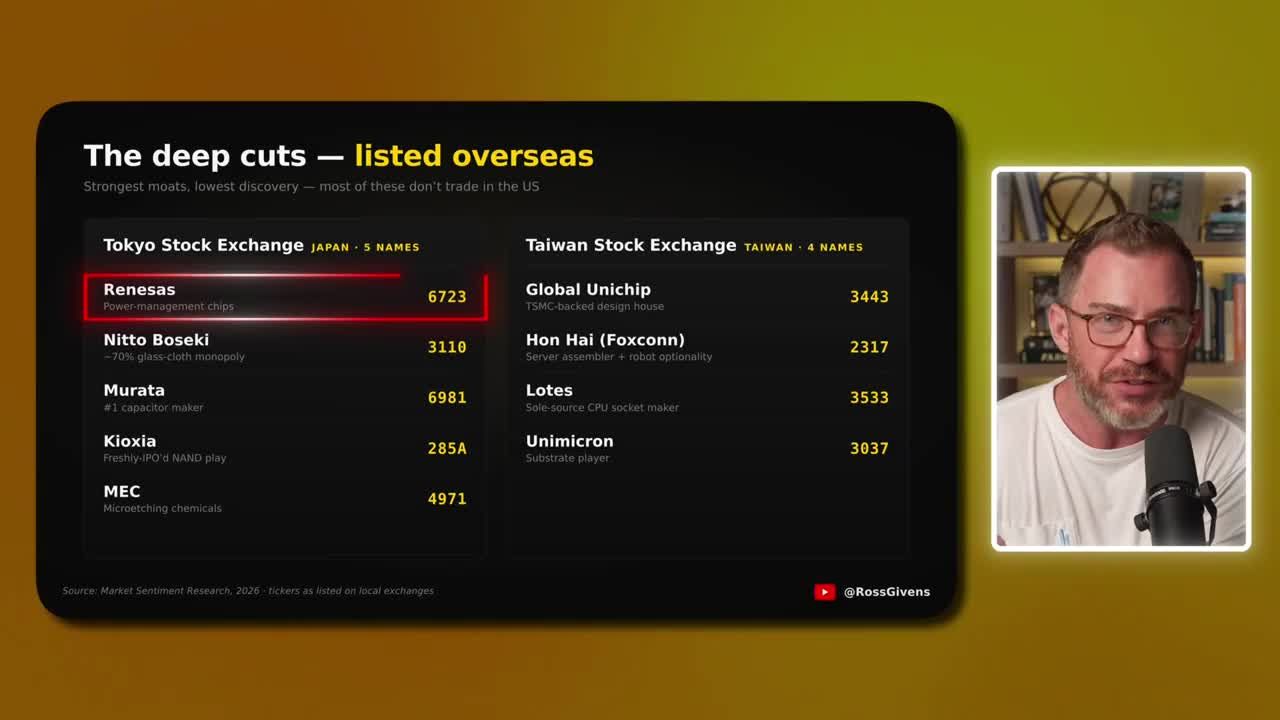
On the Tokyo exchange, you have several dominant players:
- Renis (6723), power management chips
- Nidobasiki (3110), a 70% monopoly in glass cloth
- Marada (6981), the number one capacitor maker in the world
- Kioxia (285A), fresh IPO in the NAND space
- MEC (491), micro etching chemicals
There are also several critical suppliers listed on the Taiwan exchange. These are the companies physically manufacturing the components required for the agentic server builds.
How to Buy These Overseas
If you are trading in a regular individual or joint account, open an account at Interactive Brokers. IBKR gives you direct access to the Tokyo and Taiwan exchanges. You can buy these foreign stocks in US dollars alongside your domestic positions.
Schwab's global account works too, but it covers Japan only, not Taiwan. Fidelity also lets you trade in Japan, but only in non-retirement accounts.
If you want to hold these foreign names in an IRA or a Roth, it gets tricky. Most brokers will not allow direct foreign exchange trading in retirement accounts. The workaround is buying an ADR (American Depository Receipt), basically an IOU for a share of that foreign stock that trades on the US exchange during normal market hours.
You can buy these specific ADRs in a regular brokerage account or IRA using US dollars:
- Renis trades over the counter as RNY
- Marada trades as MRAY
- Foxconn trades as HNHPF
For the foreign companies without a good ADR, stick with the US-listed leaders. ARM, Micron, and Seagate will give you clean exposure to the exact same structural trend without ever leaving the NASDAQ.
Understanding the Risks
You must manage your risk with this basket of stocks. More than half of this supply chain sits in Taiwan and Korea. Any major geopolitical event in Taiwan would hurt these names.
Customer concentration is extremely high. Six customers, names you know like Google, Amazon, and the usuals, account for over 70% of the orders across most of these names. If two of them pause spending, sales take a hit. Doubtful, but possible.
Valuations are also rich. But as we learned with Nvidia a few years ago, rich valuations are often justified when the demand is structural and the moats are the best in the business.
The Next Phase of the AI Trade
The general public and Wall Street are just waking up to the reality of agentic AI stocks. The market spent the last two years obsessing over Nvidia and the initial GPU training buildout. That trade is done. The Nvidia trade is one everyone already made.
The next phase, the agentic AI trade, requires a massive expansion in memory, storage, substrates, sockets, and power chips. We are still ridiculously early in this cycle. The latest estimates show that 78% of humanity has never used a single AI tool. Not once.
Pullbacks in these agentic AI stocks will generally be buying opportunities as this technology scales to 1.4 billion enterprise users. The buildout underneath agentic AI is only just beginning.
Get an entire year of live weekly mentoring sessions, my newsletter, indicators, bonus reports, tons more. Click the link and I'll see you in the next live session.
Key Takeaways
- Agentic AI targets 1.4 billion knowledge workers, roughly 50x the developer audience (20-25 million people) that AI tools have served until now.
- Unlike a standard chatbot session, an agentic AI session runs complex multi-step workflows for hours, requiring dramatically more compute, memory, and storage per user.
- 78% of humanity has never used a single AI tool, meaning the demand curve for agentic AI infrastructure is still in its earliest stages.
- The investment thesis shifts from front-end AI software plays to backdoor picks-and-shovels stocks covering memory, storage, substrates, sockets, and power chips.
- Pullbacks in agentic AI stocks are framed as structural buying opportunities, not trend reversals, given the scale of enterprise adoption still ahead.
DISCLAIMER: Traders Agency does not offer financial advice. The information provided is for educational purposes only and should not be considered financial advice. Traders Agency is not responsible for any financial losses or consequences resulting from the use of the information provided. Trading carries inherent risks and may not be suitable for all individuals. You are advised to conduct your own research and seek personalized advice before making any investment decisions, recognizing the potential risks and rewards involved.
See more from Traders Agency on Google
Make us a preferred source and our market analysis will appear more prominently in your Google Search, Top Stories, and AI results.
Add to Preferred Sources