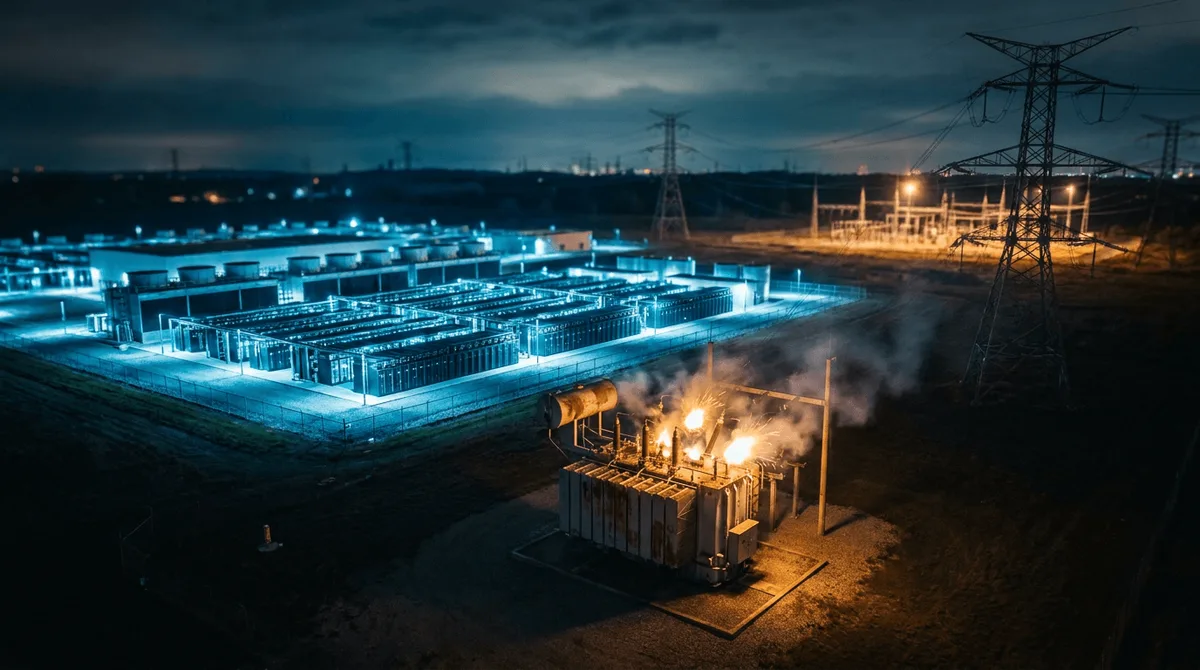

AI is going to break the American power grid. Not metaphorically. Literally.
The demand for electricity from new technology is creating a massive supply crisis, and it's turning power grid infrastructure stocks into the most important investment theme of the next five years.
By next summer, parts of the grid that power 65 million Americans across Virginia and Ohio will no longer be able to provide reliable electricity. Rolling blackouts. Brownouts. Severe outages on hot afternoons when every air conditioning unit fires up at once.
This is not a conspiracy theory, and I'm not saying it to scare you. It's the opposite.
Three companies are working overtime to fix this problem. They're getting paid tens of billions of dollars to do it. Most investors have never heard of them, but their stocks stand to benefit enormously.
Are Data Centers Breaking the Grid?
Bottom Line: The AI power crisis is not a future risk, it is a present infrastructure emergency, and the companies contracted to wire the grid for the next decade are already collecting tens of billions in revenue. PWR, FIX, and VRT represent the most direct equity exposure to that spending wave. The thesis holds as long as data center construction continues, which makes the demand side of this trade unusually visible compared to most growth investments.
Yes. AI data centers are showing up demanding gigawatts of power overnight. A single hyperscale campus uses as much electricity as a mid-sized American city. The grid is being pushed to its absolute limits.
The operator of the largest power grid in America has openly warned about this. By June of next year, they may no longer be able to provide reliable electricity. When all the AC turns on across millions of homes at the same time, the system will fail.
The grid is simply running out of room. The market is begging anyone with a working power plant to please not retire it. That's how severe this has become.
From $2.2 Billion to $16 Billion: Power Grid Infrastructure Stocks Take Center Stage
How PJM capacity pricing exploded overnight
The PJM electricity grid powers everything from data centers in Northern Virginia to factories in Ohio. Its capacity price just made a massive move: from $28 per megawatt day to $329 in just two years.
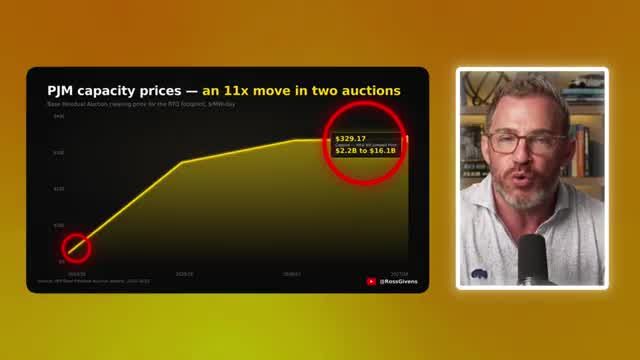
The math on power prices is not getting better anytime soon. The tailwind is entirely structural: demand heavily exceeds supply.
What Is the Real Bottleneck Slowing Down AI Infrastructure?
Right now, every finance commentator on the planet is pumping the exact same names. The big nuclear stocks. The independent power producers. The companies that own the power plants.
They're not wrong about the basic concept. The story is clean: AI needs power, these companies sell power, so you buy the stock.
The problem? That thesis is now consensus.
A lot of these stocks have already gone parabolic. Three, four, even five times higher. When everyone is shouting about the same stock, you have a crowded trade. The easy money has already been made.
I'm not saying these stocks are done. They might keep going. But the risk-reward is not nearly as good as it was. You're paying a fat multiple to chase a story Wall Street has already figured out.
Here's what most investors have missed. Owning a power company doesn't get a single megawatt of new power online. Owning a nuclear stock doesn't train one more electrician. Owning a utility doesn't manufacture one more transformer.
The bottleneck is not who owns the generator. The bottleneck is who can install the generator.
Get an entire year of live weekly mentoring sessions, my newsletter, indicators, bonus reports, tons more. Click the link and I'll see you in the next live session.
Join my Black Ops Trading ClubWhich Stocks Are the Picks-and-Shovels Play for AI Power Demand?
Three companies sitting dead center of the buildout
The companies getting paid to fix this crisis are the physical builders of the grid. Specialized contractors and equipment manufacturers who install the high-voltage wires, construct the data center facilities, and build the internal cooling systems required for advanced AI chips.
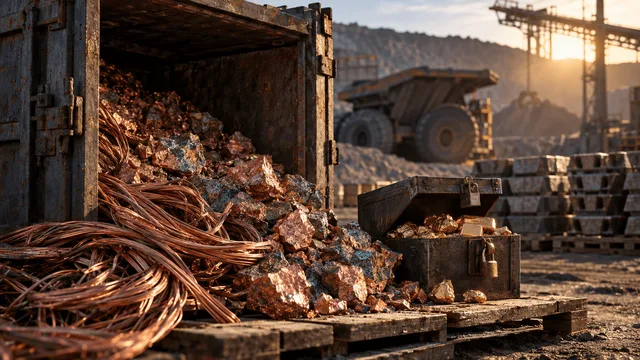
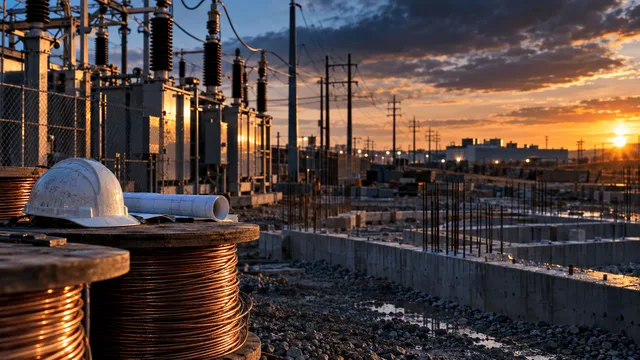
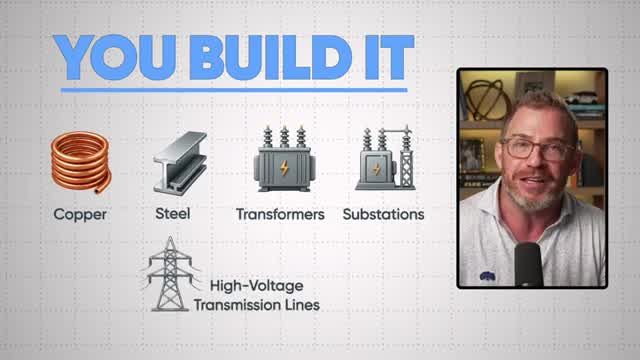
You can't summon a new gigawatt of capacity with a magic wand. You can't print it. You have to build it. That requires copper, steel, transformers, substations, and high-voltage transmission lines. Permitting alone can take five to seven years.
Then there's the human element. Electricians, linemen, project engineers. This country is running out of these skilled workers faster than we're running out of nurses.
In the Gold Rush, the people who made the real money were the ones selling picks and shovels. That's why we're still wearing Levi Strauss jeans today. In the railroads, it was the steel mills. In the dot-com era, it was Cisco. Now, in the AI power boom, it's the builders.
There's one company for each layer of this massive buildout: the wire that connects the grid, the building that houses the data center, and the guts that go inside that building.
1. Quanta Services (PWR): The Wire
Quanta Services is the largest electrical infrastructure contractor in North America. They physically build the high-voltage transmission lines, substations, and underground cabling. They are the spine of the grid itself.
If a utility wants to add a new power plant, they need somebody to connect it to the grid. That somebody is almost always Quanta.
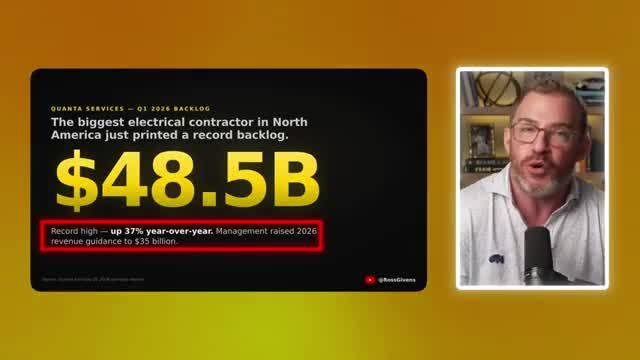
The stock is up 67% year-to-date, so it's no hidden gem. But people are missing the bigger picture. Quanta is no longer just a cyclical contractor. They are the federally incentivized, utility-funded, multi-decade buildout partner for the entire eastern half of the country.
That $48.5 billion backlog represents work that will be invoiced from today all the way through 2030.
2. Comfort Systems USA (FIX): The Building
Most investors haven't heard of this one. Comfort Systems is an HVAC and mechanical contractor handling heating, ventilation, plumbing, and refrigeration.
Sounds boring. Boring still pays the bills.
Cooling and mechanical engineering for a hyperscale data center is enormously complicated. Comfort Systems has positioned itself as the go-to subcontractor in the country for this exact work. Last quarter, 45% of their revenue came from data center projects. Just a year ago, that number was 33%.
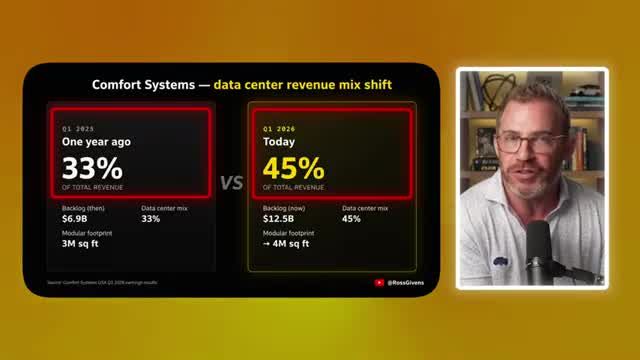
This is the company physically building the box that the data center lives inside.
3. Vertiv Holdings (VRT): The Guts
Vertiv makes the physical equipment that goes inside the data center. Power distribution units, liquid cooling systems, backup power. They're the undisputed leader in liquid cooling, the technology you absolutely need to cool Nvidia's new Blackwell-era AI chips.
The old air-cooled servers simply cannot keep up with what AI training demands today.
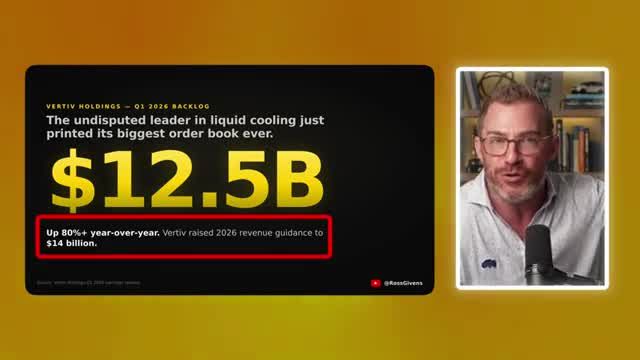
Comfort Systems builds the room. Vertiv builds what's in the room.
Three companies. PWR, FIX, VRT. The wire, the building, the guts. Different specialties, same tailwind, same backlog story. All of them with order books stretching into 2028 and beyond.
One ETF for the Whole Theme
These are not cheap stocks. Vertiv trades around $320 a share.
If you want exposure to the entire picks-and-shovels buildout at a lower share price, the answer is the Global X US Infrastructure Development ETF (ticker: PAVE). It trades for around $55.
Quanta is the number one holding in the entire fund. The ETF also holds Eaton, Trane, and a basket of other companies riding this exact infrastructure tailwind. One trade, one ticker, and you own the whole theme.
I actually own this in my retirement account.
The Two-Part Backdoor Test
How to find the better trade when a macro theme goes mainstream
When a hot macro theme shows up, 90% of the audience runs to the obvious play. Nvidia for AI. Tesla for EVs. Utilities for AI power.
There's a simple two-part test that tells you when the backdoor play is the better trade.
Test 1: Is the obvious trade now consensus?
You don't need fancy software to measure this. Log into Twitter and look at the finance accounts. Look at Jim Cramer. Look at the thumbnails in your feed. If every outlet is pumping the same three stocks, the obvious trade is already crowded.
Test 2: Is there a physical bottleneck the obvious trade doesn't solve?
The utility companies can charge more for electricity. But if the core story is about expanding capacity, you want the companies that are actually doing the expanding. They're the ones seeing the money first.
When the answer to both questions is yes, you go find the picks-and-shovels names. The builders, not the owners. The suppliers, not the operators.
The Structural Tailwind for Power Grid Infrastructure Stocks
This is how every infrastructure cycle has played out for 200 years. The backlogs that these companies are printing today are unlike anything this sector has ever seen.
The grid genuinely cannot support what is coming without a massive buildout. The math on power prices is not getting better anytime soon. Demand exceeds supply, and that creates a structural advantage that doesn't go away quickly.
This doesn't make these stocks crash-proof. But it does mean pullbacks are generally going to be buying opportunities.
I believe some of the biggest fortunes in the next five years will be made by owning the companies that physically build the grid those generators plug into. These power grid infrastructure stocks are the picks-and-shovels play of the AI era.
Keep a close watch on PWR, FIX, and VRT.
Get an entire year of live weekly mentoring sessions, my newsletter, indicators, bonus reports, tons more. Click the link and I'll see you in the next live session.
Key Takeaways
- PJM, the operator of the largest power grid in America, has warned that by June of next year it may no longer guarantee reliable electricity across a region serving 65 million Americans in Virginia and Ohio.
- A single hyperscale AI data center campus draws as much electricity as a mid-sized American city, and the wave of new builds is hitting a grid with no room left to absorb the load.
- The three power grid infrastructure stocks flagged as direct beneficiaries of this buildout are PWR (Quanta Services), FIX (Comfort Systems USA), and VRT (Vertiv Holdings).
- The core investment thesis is a picks-and-shovels approach: these companies get paid to physically build and upgrade the grid regardless of which AI platform or hyperscaler ultimately wins the technology race.
- Pullbacks in these names are framed as buying opportunities because the underlying contracts and regulatory tailwinds create durable competitive advantages that do not reset quickly.
DISCLAIMER: Traders Agency does not offer financial advice. The information provided is for educational purposes only and should not be considered financial advice. Traders Agency is not responsible for any financial losses or consequences resulting from the use of the information provided. Trading carries inherent risks and may not be suitable for all individuals. You are advised to conduct your own research and seek personalized advice before making any investment decisions, recognizing the potential risks and rewards involved.
See more from Traders Agency on Google
Make us a preferred source and our market analysis will appear more prominently in your Google Search, Top Stories, and AI results.
Add to Preferred Sources