
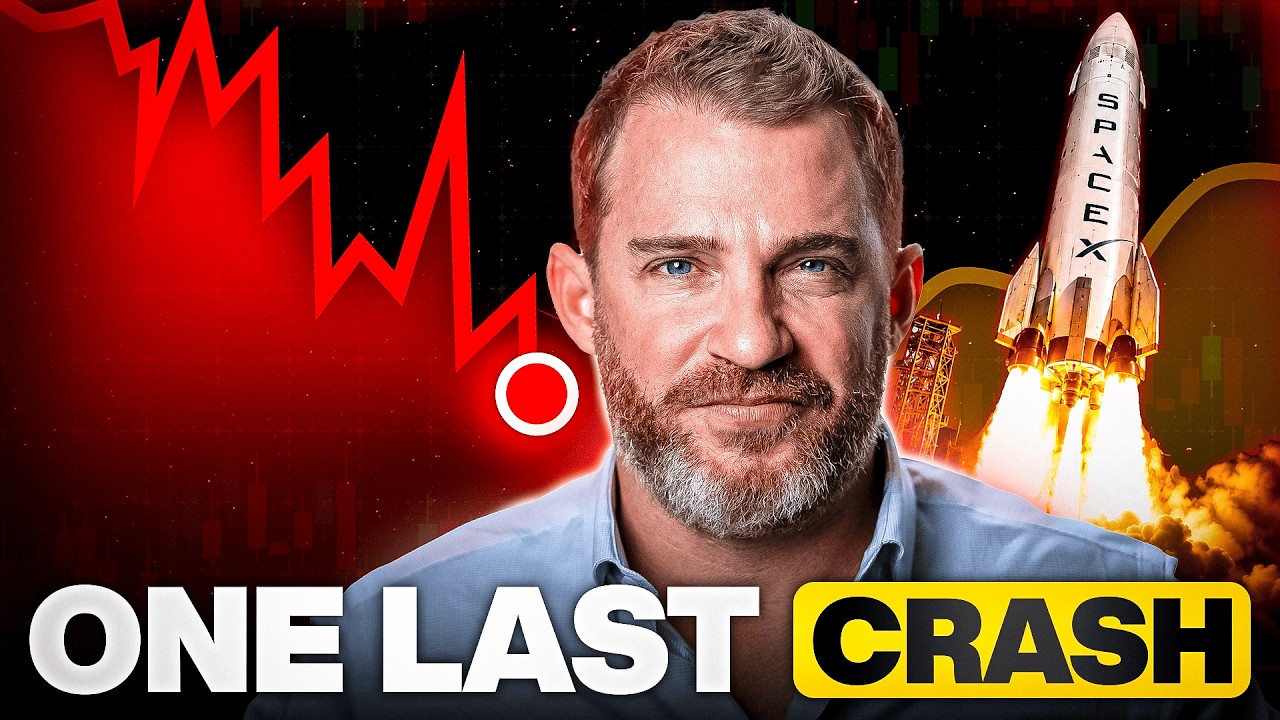
SpaceX has already minted more than 4,000 new millionaires, and it will create tens of thousands more. You could easily be one of them, but only if you buy the stock at the right price. This SpaceX stock price prediction lays out exactly why patience could pay off.
My prediction is simple. Within a few years, SpaceX will likely trade above $500 a share. But before it gets there, it is going to fall to $50.
Yes, $50. And I have the math to back it up.
This is not a judgment on Elon Musk or SpaceX. Starlink has more satellites in orbit than the rest of the world combined, and the addressable market for global broadband will be worth trillions. SpaceX will one day be the most valuable company on the planet.
But that day is not today. They do not yet have the sales or the profits to justify such a valuation. And even if they did, the stock would go down this year anyway. It comes down to pure supply and demand.
Early investors are sitting on 20, 50, even 100-fold gains. We are talking about hundreds of billions of dollars in pure profit the second they sell. Right now, they are restricted from doing so.
That is about to change.
What Happened to SpaceX Stock Over the Last 5 Weeks?
Bottom Line: SpaceX is a generational business trading at a price distorted by a tiny IPO float and locked-up early investors who are about to be free to sell. The trade thesis is straightforward: wait for the lockup-driven flush toward $50, then buy a dominant launch monopoly and the world's largest satellite network at a rational price. The $500 long-term target only makes sense if you avoid overpaying on the way down.
A tiny float, forced buying, and then the fall
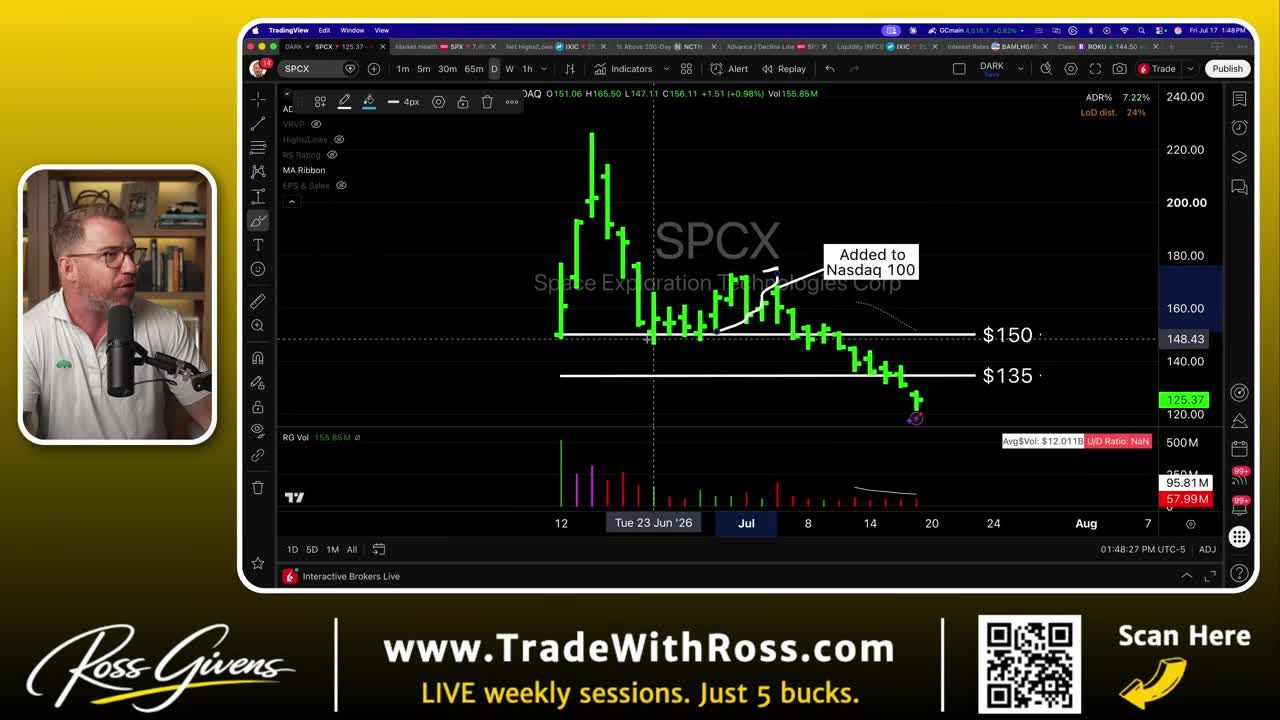
Five weeks ago, this was the hottest stock on Earth. It ran from $150 to $225 in just three days. Then the fall began.
The IPO only sold about 4% of the company. That is 555 million shares, a tiny sliver of the actual business. Everybody wanted in. Almost nobody got shares, so the stock shot up on pure scarcity.
Then the index funds arrived. The Nasdaq changed its rules and added the stock early to the Nasdaq 100, bringing another $4.3 billion of forced buying. But that is over. That was the last of the forced buying. Now the calendar flips. Every scheduled event left in 2026 adds shares to the market instead of taking them away.
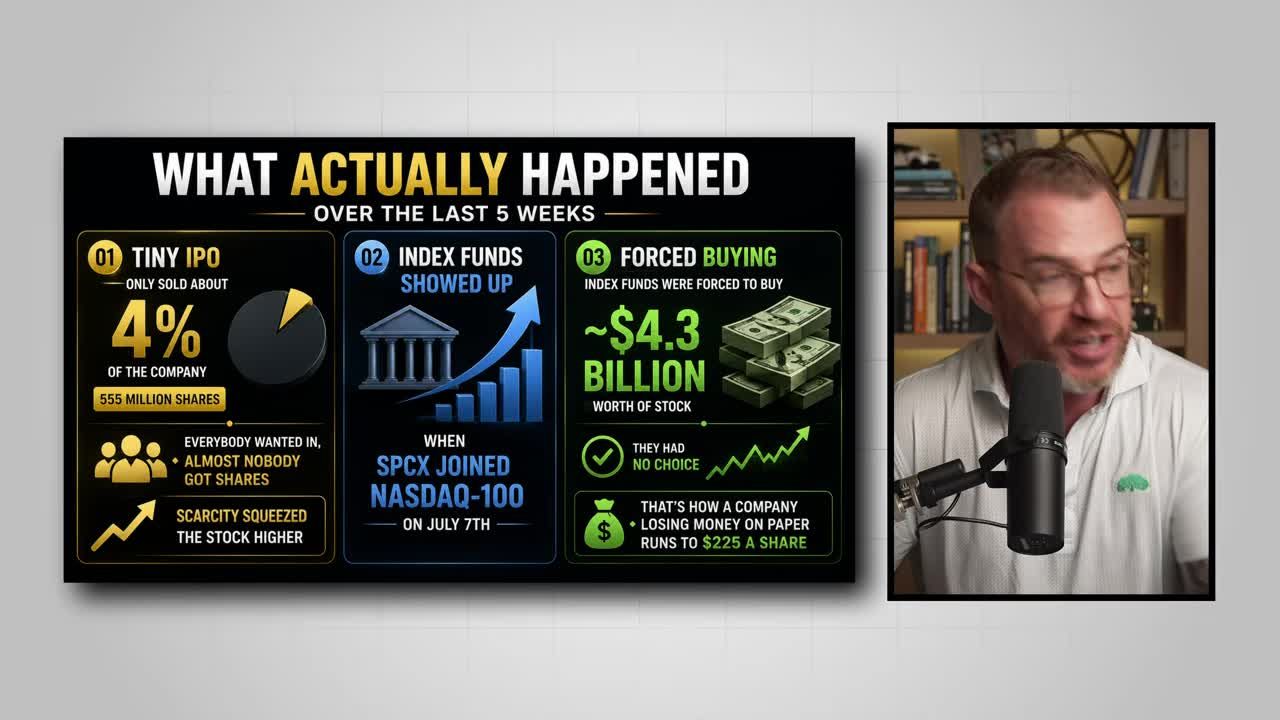
The stock is now trading around $120 a share, down roughly 44% from the high. It fell to $150, the post-IPO support shelf, hung out for a couple of days, and then dropped to $135, the IPO price. It stalled there briefly on buyers. But the real selling has not even started.
What Is the SpaceX Lockup Problem and Why Does It Matter?
5.3 billion shares are about to come free
When a company goes public, the insiders, employees, executives, and venture funds that invested for pennies on the dollar years ago are banned from selling their shares for a set period. That is a lockup. It exists so insiders do not dump their stock the minute it starts trading and crash the price.
A typical IPO has one lockup expiration 180 days out. Everything comes free at once. SpaceX did not do that. They built a staircase.
Three weeks from now, SpaceX insiders and early investors get to sell their shares for the very first time. This is not a small group. We are talking about 5.3 billion shares unlocking in stages between August and December. That is nine times the number of shares offered in the IPO.
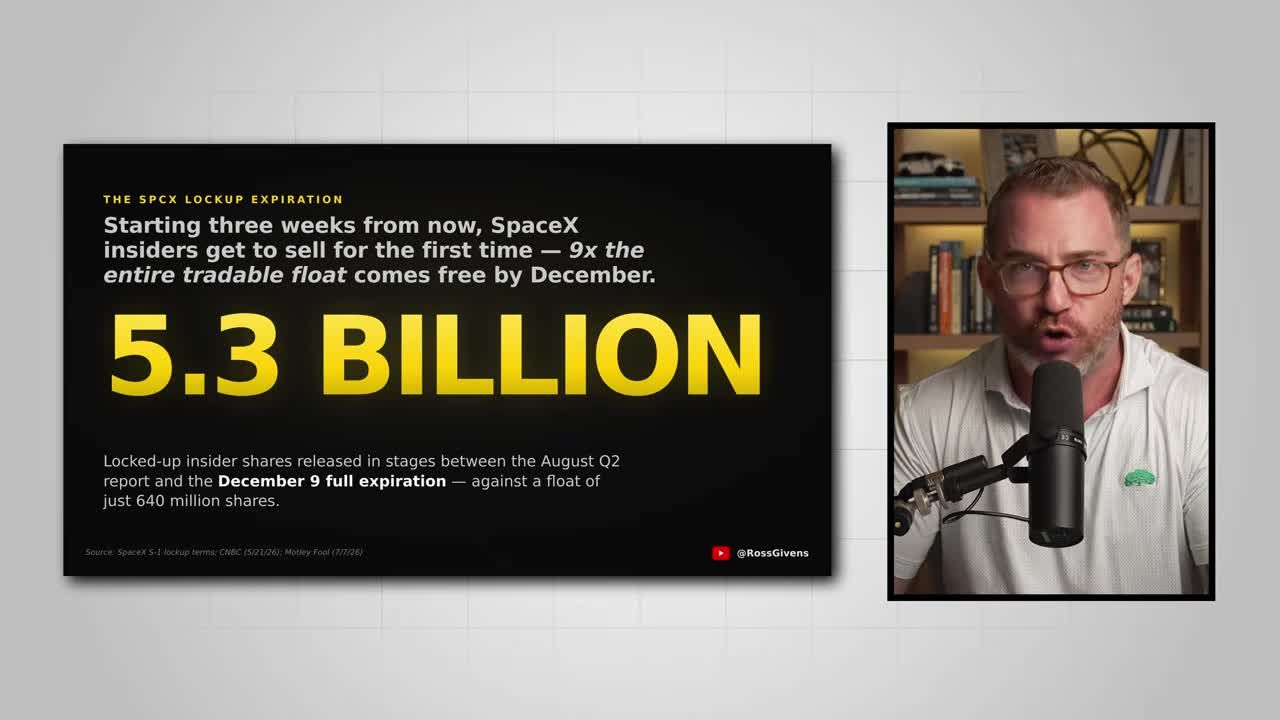
Here is the unlock schedule that matters:
- Around August 6th: SpaceX reports its first-ever earnings.
- Two days later: The first 20% of the eligible insider pool unlocks, just over one billion shares. August 10th is the first day any insider can sell a single share.
- August 21st (Day 70): Another 7% unlocks, then another 7% at Days 90, 105, 120, and 135, roughly 370 million shares every few weeks through late October.
- Early November: After Q3 earnings, another 28% unlocks, nearly a billion and a half shares in a single release, the biggest supply event of the year.
- December 9th (Day 180): The staircase ends. Everything else comes free.
There is a bonus tranche of an extra 10% that only unlocks if the stock trades and holds 30% above the IPO price of $175. Forget it. It is not happening.
Elon Musk's stake of about 6.4 billion shares is locked until June 2027. He is not part of this wave. The wave coming this year is the employees and the venture capital funds. Remember that.
Get an entire year of live weekly mentoring sessions, my newsletter, indicators, bonus reports, tons more. Click the link and I'll see you in the next live session.
Join my Black Ops Trading ClubWon't the Index Funds Save It?
The demand already showed up. The supply arrives next
The demand from index funds already came and went. We saw it in June and early July. The remaining index buying, Russell inclusion, and some ETF inflows add up to maybe $25 to $30 billion all in.
Helpful, but nowhere close to enough.
Unlocking 5.3 billion shares does not mean 5.3 billion shares get sold. Nobody is going to dump everything. Research on lockup expirations says somewhere between 15% and 40% of newly unlocked shares get sold in the first several weeks. I lean toward the high end here.
Think about who these sellers are. Venture funds have been stuck in this position for over a decade. Their cost basis is in pennies and single dollars. Even at $60 a share, they are sitting on some of the biggest venture returns in history. Many are well past their fund life. They owe money back to their own investors. They do not need SpaceX stock to be cheap or expensive. They just need the money.
Run the math at roughly 30% selling and you get around 1.6 billion shares hitting the market by year-end. That is well over $100 billion of supply crashing into a market with only $25 to $30 billion in index demand. The tradable float grows ninefold in five months. It is that simple.
The Short Sellers Are Piling In
A $25 billion bet against Elon
This gets ugly, because it is not just insiders selling.
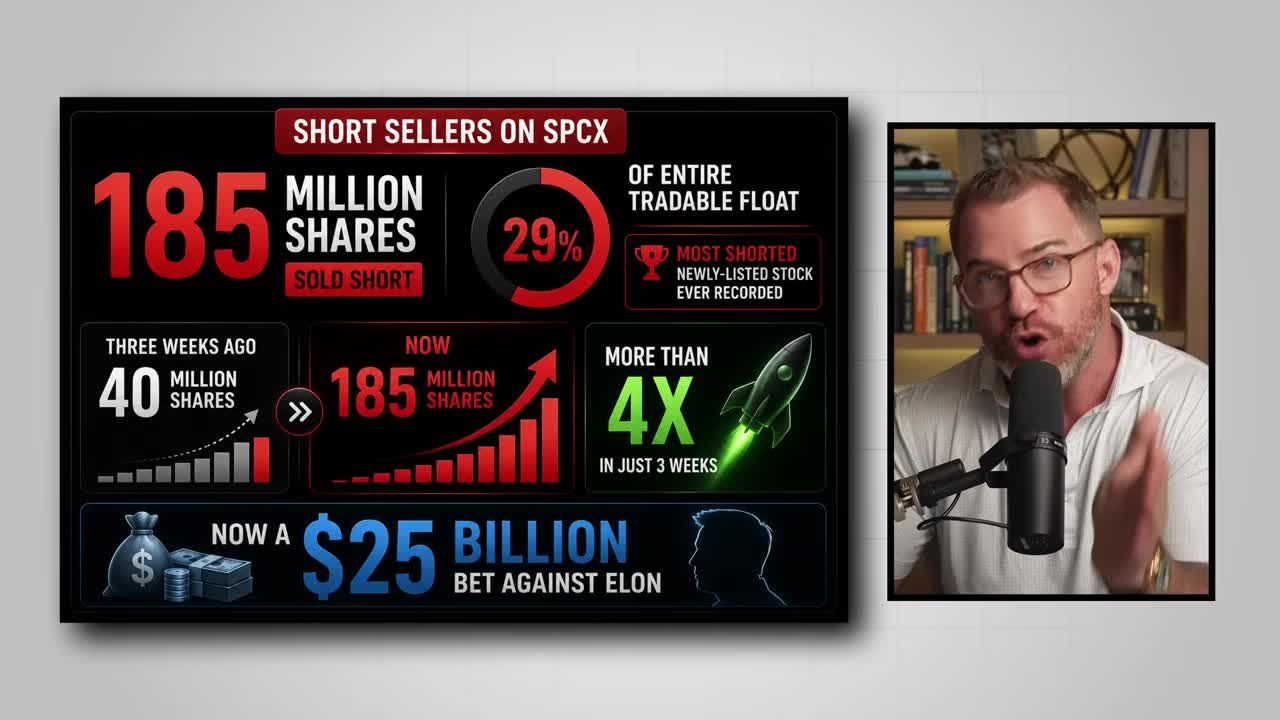
Short sellers currently have about 185 million shares of SpaceX sold short. That is 29% of the entire tradable float, the most shorted newly listed stock ever recorded. Three weeks ago that number was 40 million shares. It has more than quadrupled in three weeks. It is now a $25 billion bet against Elon and SpaceX.
Then you have the trend followers, the big systematic funds. These are machines, not people. They do not care about Starship. They do not watch earnings calls. Their computers see one thing: a mega-cap stock hitting its criteria below its IPO price, below its 50-day average, with declining momentum.
They sell it. Period. That is what their programming says to do every time. They sell and keep selling until the trend turns. Sellers attract more sellers. That is how a supply problem becomes a downtrend, and how a downtrend feeds on itself.
One warning: with 29% of the float short, this will not be a straight line down. Crowded short positions produce violent rallies. Every bounce from $100 down to $70, then back up to $85, is going to look like the bottom. Most of them will not be. Do not jump in just because you think the selling is over.
Why Is $50 the SpaceX Stock Price Prediction Target?
We have seen this movie before
Every hot IPO meets its lockup. No exceptions.
- Facebook fell 61% from its post-IPO high into its 2012 unlock wave.
- Uber dropped 46% and bottomed the very week its lockup expired in 2019.
- Lyft fell 58%.
- Beyond Meat dropped 69%.
- Snowflake fell 57%.
I built a full supply and demand model of this stock to shape my SpaceX stock price prediction. It factors in the insider selling, the short sellers, the trend-following funds, and the index money. It layers in value buyers stepping in as the stock gets cheap. Then it ran a Monte Carlo simulation, rolling the dice 20,000 times on everything we cannot know: earnings surprises, Starship outcomes, macroeconomic events.
The median path shows the stock chopping sideways into the August earnings, grinding lower through September and October as the tranches stack up. It bottoms in late November after the Q3 mega unlock and firms up into year-end, finishing somewhere around $80 to $85.
The middle half of outcomes bottom between $46 and $76. The mild case still dips to around $92. The deep bear case reaches into the $30s.
Morningstar pegs the fair value of SpaceX at about $780 billion. That works out to $60 a share. When the supply math and the valuation math land on the same number from two completely different methods, you should pay attention.
How I Plan to Trade It
Where I buy, and where I back up the truck
My SpaceX stock price prediction is that it trades at $50 a share before the end of 2026. Nearly 80% of my simulations put the low between mid-October and mid-December.
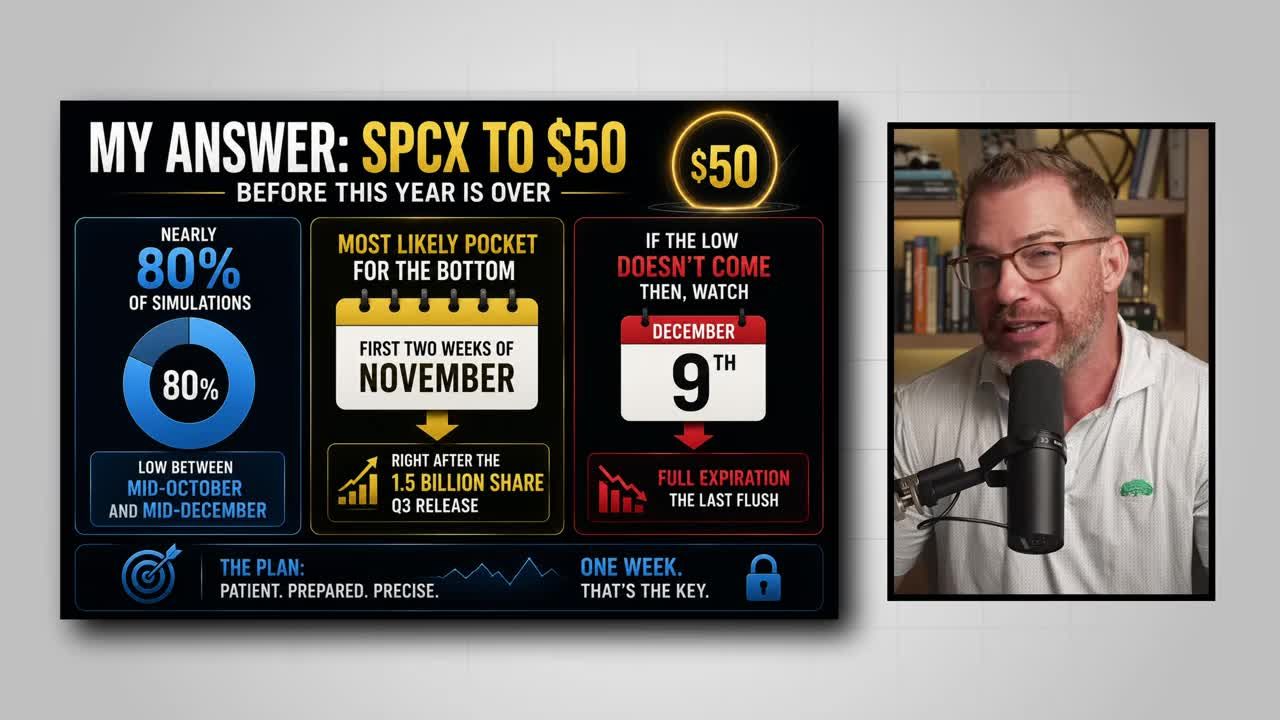
The single most likely pocket for the bottom is the first two weeks of November, right after the billion and a half share Q3 release. If the low does not come then, watch the December 9th full expiration. That will be the last flush.
History shows that when everyone knows a selling event is coming, they often sell in advance. Facebook bottomed before its biggest unlock and actually rallied the day the shares came free. It gets priced in. Do not wait for an all-clear that will never ring.
1. Do Nothing Through October
Am I shorting this? Absolutely not. I do not bet against Elon Musk companies, no matter how overvalued they are. Too many very smart people have gone bankrupt trying. Through August, September, and probably October, I will not buy or sell a single share. I am sitting on my hands and letting the calendar do the work.
2. Start Buying at $60
My plan is to start buying at $60 if we get there in late October. There could be opportunities to add in November as that mega tranche gets digested.
3. Back Up the Truck at $50
If we overshoot below $50 into the $40s, I am backing up the truck. The full position should be built by the December 9th unlock.
4. Hold for the Long Term
Once you are in, assuming this plays out, it is hands off. This is a long-term position. Sit back and let Elon Musk grow your capital.
The Long-Term Bull Case
This is not a bet against SpaceX
Let me be crystal clear. I want to own this company.
Starlink did $11.5 billion in revenue last year, growing at 50% with real profits. Their launch business is a monopoly. They fly more than 80% of everything humanity puts into orbit. I am not betting against Elon. I am betting that for the next few months, simple supply and demand is bigger than Elon Musk. That is the whole basis of my SpaceX stock price prediction.
The unlock calendar is what finally hands patient investors a decent price on a great company. Take the gift.
Insider lockup and share data can be verified through SpaceX's filings on the SEC EDGAR database.
Get an entire year of live weekly mentoring sessions, my newsletter, indicators, bonus reports, tons more. Click the link and I'll see you in the next live session.
Key Takeaways
- SpaceX's IPO only sold roughly 4% of the company (555 million shares), creating an artificially tiny float that drove the price from $150 to $225 in three days before the selloff began.
- Early investors are sitting on 20x to 100x gains representing hundreds of billions in unrealized profit. Once lockup periods expire, that selling pressure is expected to drive the price toward $50.
- SpaceX controls more than 80% of all commercial launches globally and has more satellites in orbit than every other operator combined, making the long-term bull case structural, not speculative.
- The $50 price target is driven entirely by lockup expiration mechanics and supply/demand, not by any fundamental weakness in the business.
- The long-term target of $500+ per share is grounded in Starlink's addressable market for global broadband, which is projected to be worth trillions of dollars.
DISCLAIMER: Traders Agency does not offer financial advice. The information provided is for educational purposes only and should not be considered financial advice. Traders Agency is not responsible for any financial losses or consequences resulting from the use of the information provided. Trading carries inherent risks and may not be suitable for all individuals. You are advised to conduct your own research and seek personalized advice before making any investment decisions, recognizing the potential risks and rewards involved.
See more from Traders Agency on Google
Make us a preferred source and our market analysis will appear more prominently in your Google Search, Top Stories, and AI results.
Add to Preferred Sources