
A global bond rout has pushed the 10-year Treasury yield to its highest level in 15 months, with borrowing costs rising across global markets. Traders are repricing risk as yields surge across the board, and our team has been tracking this move closely.
We're watching a spike in borrowing costs tied to inflation fears and elevated oil prices. With the 30-year Treasury yield at 5.123%, this setup deserves close attention from anyone holding equities or fixed income.
Why Are Treasury Yields Rising Right Now?
Treasury yields are rising as hotter-than-expected inflation data has pushed markets to price in a higher likelihood of delayed rate cuts, or even potential rate hikes. Elevated oil prices and concerns over public debt are adding upward pressure on government borrowing costs globally.
Different readings show the 10-year yield at 4.48% on Wednesday morning and at 4.591% on Monday. The 30-year yield has been reported between 5% and 5.123%. The upward trajectory is unmistakable.
Inflation data has been a key driver of this move. The Producer Price Index showed headline wholesale prices rose by 6% on an annual basis in April. The Consumer Price Index report released Tuesday also showed consumer price increases accelerated in April.
Key Shift: Markets now price in a 36% chance of a Federal Reserve rate hike by December, up from roughly 16% probability a week ago.
What Is the 10-Year Treasury Yield Tied To?
The 10-year Treasury yield is tied directly to investor expectations for future inflation, economic growth, and Federal Reserve monetary policy. It serves as the foundational benchmark for global borrowing costs, directly influencing mortgage rates, corporate debt issuance, and the valuation models used for pricing equities.
When inflation runs hot, investors demand higher yields to compensate for the erosion of purchasing power. We're seeing this play out in real time across the entire yield curve.
The 2-year Treasury note yield, which tends to react in line with short-term Federal Reserve interest rate decisions, sits at 4.075%. The 5-year yield has climbed to 4.14%.
Is This a Global Bond Rout or a U.S.-Specific Problem?
The pain is not limited to the United States. A synchronized selloff in global debt markets is complicating the picture for central bankers everywhere.
We're monitoring several international debt benchmarks that are flashing warning signs:
- Japan's 10-year JGB surged 13 basis points to reach 2.739%, while their 30-year yield hit its highest level ever recorded.
- Germany's 10-year bunds rose more than 2 basis points to 3.1827%.
- The U.K.'s 10-year Gilts remain elevated at 5.169%, with the 30-year Gilt about 3 basis points lower at 5.818% during uncertainty over the fate of Britain's Prime Minister Keir Starmer.
How Will This Affect the Market?
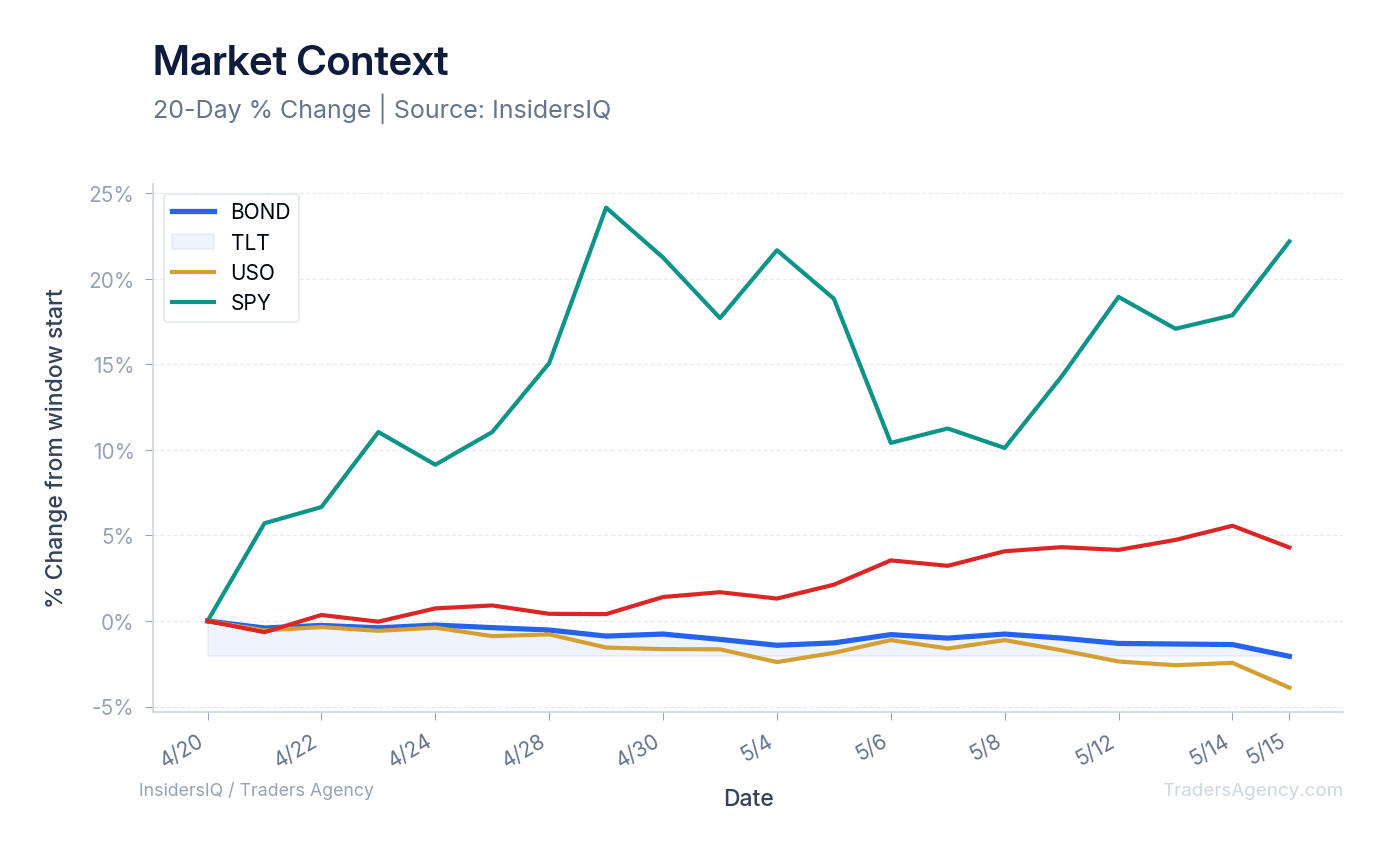
Rising yields typically exert downward pressure on bond prices and can trigger equity selloffs by making risk-free returns more attractive. Current market sentiment remains surprisingly resilient, with major equity indexes actually posting gains over the last month despite the fixed-income drawdown.
Bond Damage vs. Equity Resilience: The TLT ETF (long-term Treasuries) has dropped -3.89% over the last 30 days, while the broader BOND index is down -2.06%. Yet SPY is up +4.30% over the same period. This divergence cannot last forever.
Market sentiment remains elevated, with the Fear & Greed index sitting at 68. Retail chatter is quiet on the bond front, with WallStreetBets sentiment at 0.03 across 2,748 mentions.
Want expert trading insights delivered daily?
Join thousands of traders who rely on Traders Agency for market analysis and trade ideas.
Join Traders AgencyHow Are Oil Prices Pushing Treasury Yields Higher?
Energy markets are complicating the inflation picture and giving traders another reason to question how high yields can go. Oil prices remain elevated as the outlook on negotiations between the U.S. and Iran dampened, raising inflation fears alongside Middle East conflict concerns.
Brent crude is trading around $109 a barrel, and U.S. West Texas Intermediate futures are sitting at $105.
Energy Surge: The USO oil fund has surged +22.18% over the past 30 days. This energy spike feeds directly into the inflation fears driving the bond selloff.
What Should Traders Watch Next as Yields Keep Rising?
Our team is monitoring several developments as this global bond rout unfolds. The data we're watching suggests fixed-income volatility is far from over.
1. The 5% Threshold on the 30-Year
The 30-year Treasury bond yield in the 5% to 5.123% range is a significant technical event. We're watching to see if it sustains this level, which historically pressures stock valuations and corporate borrowing costs.
2. Rate Hike Probabilities
With the implied chance of a December rate hike rising to 36% from roughly 16% a week ago, any further hot data could push this probability higher. Traders need to watch upcoming inflation prints closely.
3. International Yield Spillovers
The record highs in Japan's 30-year yield indicate a shift in global capital flows. We're tracking the 13 basis point jump in Japanese debt for signs of further pressure on U.S. markets.
The Bottom Line
The era of cheap borrowing is facing a stress test as inflation fears grip the global economy. Our research team is maintaining a defensive posture on long-duration bonds like TLT while watching energy markets closely for the next inflation signal. Traders should respect the trend in yields and prepare for potential volatility if equity markets finally react to the rising cost of capital.
Want expert trading insights delivered daily?
Join thousands of traders who rely on Traders Agency for market analysis and trade ideas.
Join Traders AgencyKey Takeaways
- The 30-year Treasury yield has climbed to 5.123%, while the 10-year yield moved from 4.48% Wednesday morning to 4.591% on Monday, signaling a clear upward trend in borrowing costs.
- Markets now price in a 36% chance of a Federal Reserve rate hike by December, more than double the 16% probability from just one week earlier.
- The Producer Price Index showed wholesale prices rose 6% annually in April, and the April CPI report confirmed consumer price increases also accelerated, giving the bond selloff fundamental backing.
- Japanese government bond yields jumped 13 basis points, a move worth watching because sustained pressure in global debt markets can amplify selling in U.S. Treasuries.
- The research team cited in the article is holding a defensive posture on long-duration bond funds like TLT and flagging energy markets as the next key inflation signal to monitor.
DISCLAIMER: Traders Agency does not offer financial advice. The information provided is for educational purposes only and should not be considered financial advice. Traders Agency is not responsible for any financial losses or consequences resulting from the use of the information provided. Trading carries inherent risks and may not be suitable for all individuals. You are advised to conduct your own research and seek personalized advice before making any investment decisions, recognizing the potential risks and rewards involved.
See more from Traders Agency on Google
Make us a preferred source and our market analysis will appear more prominently in your Google Search, Top Stories, and AI results.
Add to Preferred Sources