A massive tech stock selloff is driving U.S. index futures sharply lower this morning. Our team is tracking a severe premarket drop across major indices as rising Treasury yields and underwhelming diplomatic developments weigh on sentiment across the board.
Futures Snapshot: S&P 500 futures are down 1.2%, Nasdaq-100 futures have plunged 1.6%, and Dow Jones Industrial Average futures have shed 440 points (0.9%). This sudden reversal follows a stretch of record highs for both the S&P 500 and the Nasdaq Composite.
Why Are Nasdaq Futures Tumbling This Morning?
Nasdaq futures are falling because investors are locking in profits after a massive tech run, combined with a sudden spike in Treasury yields and inflation concerns. Higher borrowing costs paired with geopolitical disappointment are pushing traders to reduce their exposure to high-growth equities.
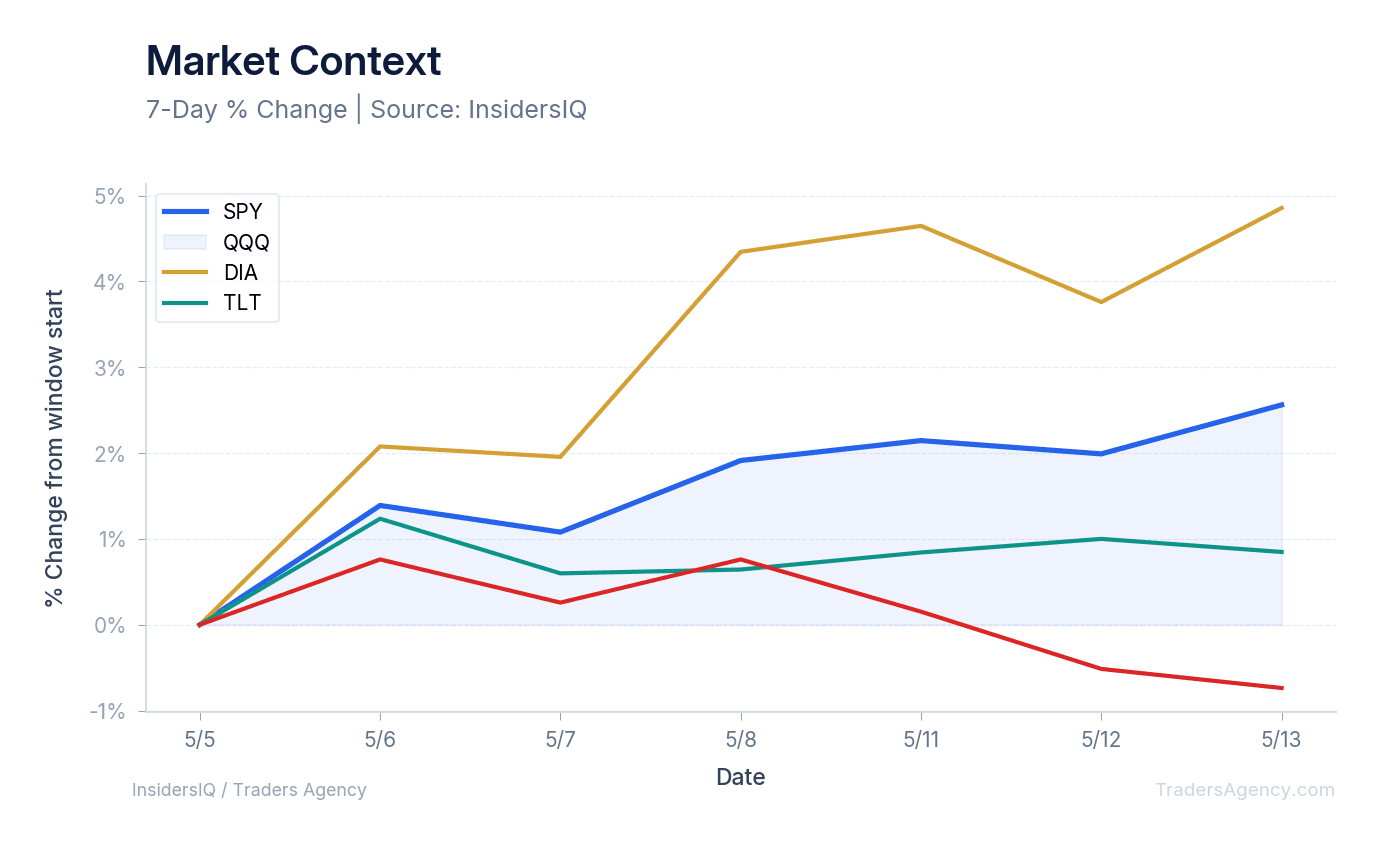
Our data shows the broader trend remains positive despite today's drop. QQQ still carries a 10-day price change of +4.86%, while SPY is up +2.56% over the same period. The short-term momentum, however, has clearly shifted.
Which Tech Stocks Are Getting Hit Hardest in the Selloff?
The selling pressure is highly concentrated in the semiconductor space. We're seeing aggressive liquidation across several market leaders:
- Intel (INTC): Leading the downside with a 4% loss.
- Advanced Micro Devices (AMD) and Micron Technology (MU): Both showing a 3% decline.
- Nvidia (NVDA): Down 2%, though the stock still holds a 10-day price change of +14.93%.
- Cerebras Systems: Shed 3%, cooling off after surging 68% during its Thursday Nasdaq debut.
The one major exception we're watching is Microsoft (MSFT). The stock pushed 0.6% higher after Bill Ackman's Pershing Square disclosed a new position in the company.
Why Are Rising Treasury Yields Pushing Tech Stocks Lower?
Rising Treasury yields hurt high-growth tech stocks by discounting the present value of their future cash flows. When risk-free government bonds offer higher returns, traders quickly rotate capital out of expensive technology equities and into fixed-income assets.
Yield Alert: The 30-year Treasury rate has topped 5.1%, threatening its highest level since 2023. The benchmark 10-year Treasury yield has climbed above 4.5%. TLT reflects this bond market pressure with a 10-day price change of -0.74%.
Bureau of Labor Statistics data confirms the inflation fears driving these yields. April Consumer Price Index figures rose 0.6% for the month and 3.8% year over year. Energy prices jumped 3.8% in April, with fuel oil up 54.3% annually.
Want expert trading insights delivered daily?
Join thousands of traders who rely on Traders Agency for market analysis and trade ideas.
Join Traders AgencyTrump-Xi Summit Fallout and Commodity Moves
Traders had hoped for major policy breakthroughs from the recent summit between President Donald Trump and Chinese President Xi Jinping. Instead, no major deals have been announced, disappointing the market.
While 16 top U.S. executives attended the two-day event, the results fell short of expectations. Boeing (BA) shares extended their losses following a nearly 5% drop in the previous session. The market was let down by news that China agreed to buy 200 Boeing jets, only 50 more than previously anticipated.
Commodities are also reacting sharply:
- West Texas Intermediate (WTI) crude rose 3% to $104 per barrel.
- Brent crude gained 2% to $108 per barrel.
- Gold fell 2.7% to $4,555 a troy ounce.
- Silver dropped 8% to $78 an ounce.
Can You Trade Nasdaq Futures Right Now?
Yes. Traders can actively trade Nasdaq futures during premarket hours to hedge against the current tech selloff. Contracts on the Nasdaq 100 are heavily traded before the opening bell, allowing market participants to react immediately to overnight yield spikes and international news.
What Should Traders Watch After a Tech Stock Selloff?
Our research team is monitoring several key factors as this tech stock selloff develops. The divergence between large-cap tech and the broader economy suggests a fragile rally.
1. The Energy Sector
With airline fares up 20.7% year over year and oil prices climbing, energy costs will continue to pressure inflation readings in the months ahead.
2. Semiconductor Support Levels
We're watching to see if AMD can hold onto its massive +25.40% 10-day gain despite today's premarket weakness. A breakdown here could signal deeper selling across the chip sector.
3. Corporate Earnings
Traders should look for pockets of strength. Figma shares jumped following a strong earnings report, proving that demand for artificial intelligence software remains high even as the broader tech trade cools.
The Bottom Line
The current tech stock selloff is a direct result of surging Treasury yields and sticky inflation data. Our team is adjusting risk exposure as the 30-year yield breaks the 5.1% threshold. We'll continue to monitor premarket futures and commodity prices for signs of a broader market rotation. This is a session that demands active risk management.
Want expert trading insights delivered daily?
Join thousands of traders who rely on Traders Agency for market analysis and trade ideas.
Join Traders AgencyKey Takeaways
- Nasdaq-100 futures dropped 1.6% in premarket trading, with Dow futures shedding 440 points (0.9%) and S&P 500 futures falling 1.2%.
- The selloff is concentrated in semiconductors: Intel (INTC) leads losses at -4%, while AMD, Micron (MU), and Nvidia (NVDA) are down 3%, 3%, and 2% respectively.
- Despite the premarket drop, QQQ still holds a 10-day gain of +4.86% and Nvidia carries a +14.93% 10-day price change, signaling this is a pullback within a broader uptrend.
- The 30-year Treasury yield breaking the 5.1% threshold is the key technical trigger traders should watch, as it directly pressures high-growth equity valuations.
- Figma shares bucked the trend with gains after a strong earnings report, suggesting AI software demand remains intact even as the broader tech trade cools.
DISCLAIMER: Traders Agency does not offer financial advice. The information provided is for educational purposes only and should not be considered financial advice. Traders Agency is not responsible for any financial losses or consequences resulting from the use of the information provided. Trading carries inherent risks and may not be suitable for all individuals. You are advised to conduct your own research and seek personalized advice before making any investment decisions, recognizing the potential risks and rewards involved.
See more from Traders Agency on Google
Make us a preferred source and our market analysis will appear more prominently in your Google Search, Top Stories, and AI results.
Add to Preferred Sources