
A stablecoin is a type of cryptocurrency designed to maintain a fixed value, typically pegged to a traditional fiat currency like the US dollar. You've probably watched wild price swings rip through crypto markets and wondered how traders protect their profits without cashing out to a bank account every single time. That's exactly the problem these digital assets solve, and understanding their mechanics is one of the most practical skills we can teach you.
When looking at the crypto market, the debate of USDC vs USDT comes up constantly. Traders need a reliable place to park their cash between active positions. Moving money back and forth to a traditional bank takes days and racks up heavy fees. Stablecoins keep your trading capital on the blockchain, ready to deploy in seconds.
We're going to walk you through how these tokens work, the real risks involved, and how to use them properly. Our team recommends understanding the mechanics behind these assets before trusting them with your trading capital. By the end of this guide, you'll know exactly how to evaluate stablecoin risks and apply them to your own portfolio.
What Are Stablecoins?
Bottom Line: USDC and USDT serve the same core function but carry different risk profiles, particularly around reserve transparency and de-pegging exposure. The practical takeaway is to diversify across both rather than concentrating in one, and to treat stablecoins as short-term trading tools rather than a substitute for insured savings. Understanding those mechanics before committing capital is what separates informed use from unnecessary risk.
Stablecoins are digital assets built on blockchain technology that track the price of a stable asset, usually the US dollar. They provide traders with a safe harbor from crypto volatility while keeping funds on an exchange, allowing for rapid trade execution and easy transfers between different platforms.
Think of them like casino chips. When you walk into a casino, you trade your cash for chips to play the games. The chips themselves have no inherent value outside the building, but inside, everyone agrees a $100 chip is worth exactly $100. When you're done playing, you take your chips back to the cashier and exchange them for real cash. Stablecoins work the same way inside the crypto ecosystem.
Key Concept: Stablecoins bridge the gap between traditional fiat currencies and digital assets by offering price stability on a blockchain. They allow you to lock in profits. If you buy Bitcoin at $50,000 and sell it at $60,000, you can trade it for a stablecoin to secure your $10,000 profit without leaving the crypto ecosystem.
Here's what we teach our members to look for in a reliable stablecoin:
- A clear 1-to-1 peg with a major fiat currency
- High daily trading volume across major exchanges
- Transparent reserves held in regulated financial institutions
- Fast transaction times with low network fees
What Are the Key Differences Between USDC and USDT?
When comparing USDC vs USDT, you're looking at the two dominant forces in the stablecoin market. Both aim to stay perfectly priced at $1.00, but they have different corporate structures and histories.
If you're wondering what USDC stands for, it translates to USD Coin. This token was created by a consortium called Centre. Today, the primary company managing the USDC stablecoin is Circle. Because of this corporate structure, you'll often hear traders refer to the asset as USDC Circle. Circle has built a reputation for strict regulatory compliance and transparent banking relationships.
On the other side of the trade is Tether, the company behind the USDT stablecoin. Tether is the oldest and largest stablecoin in existence. It commands a massive market capitalization, often exceeding $100 billion. While USDC focuses heavily on US regulatory compliance, USDT has historically focused on global reach and maximum liquidity.
| Feature | USDC (Circle) | USDT (Tether) |
|---|---|---|
| Issuing Company | Circle | Tether |
| Primary Focus | US regulatory compliance | Global reach and liquidity |
| Reserve Transparency | Monthly attestations from major accounting firms | Quarterly reserve reports |
| Trading Volume | High, especially on US platforms | Highest globally across all exchanges |
| Best For | Institutional use, DeFi protocols, long-term holding | Active trading, altcoin pairs, international exchanges |
The primary difference between the two comes down to their reserve composition and global adoption. USDT is the undisputed king of trading volume. If you're trading obscure altcoins on international exchanges, USDT is often the only available trading pair. USDC is highly favored by US-based institutions and decentralized finance protocols that require strict audits.
How Do Fiat-Backed Stablecoins Maintain Their Peg?
Fiat-backed stablecoins maintain their peg by holding one dollar's worth of reserves for every token issued. If a company issues one billion tokens, they should hold at least one billion dollars in cash or cash equivalents. This 1-to-1 backing ensures that users can always redeem their tokens for actual dollars.
The peg is maintained through a process called arbitrage. Arbitrage traders constantly monitor the price of stablecoins across different exchanges. When the price deviates from $1.00, these traders step in to profit from the difference, which naturally pushes the price back to its peg.
We can break this down into a concrete, step-by-step example of how market mechanics keep the price stable:
- The Setup: A Price Drop. Imagine heavy selling pressure hits the crypto market. Traders panic and sell their USDT for actual US dollars. This massive selling causes the price of USDT on an exchange to temporarily drop to $0.98.
- The Execution: Arbitrage Traders Step In. Professional traders see that USDT is trading at a discount. They buy 100,000 USDT tokens on the exchange for $98,000. They then take those 100,000 tokens directly to Tether (the issuing company) and redeem them. Because Tether guarantees a 1-to-1 redemption, they receive $100,000 in real cash.
- The Outcome: The Peg Is Restored. The trader just made a fast $2,000 profit. Because thousands of traders are doing this simultaneously, the massive buying pressure on the exchange quickly pushes the price of USDT back up to exactly $1.00. The system relies on this profit incentive to keep the price stable.
| Step | Action | Result |
|---|---|---|
| 1. Price Drops | USDT falls to $0.98 on exchange | Discount opportunity appears |
| 2. Arbitrage Buy | Buy 100,000 USDT for $98,000 | Tokens acquired below face value |
| 3. Redeem at Issuer | Redeem tokens 1-to-1 with Tether | Receive $100,000 in cash |
| 4. Peg Restored | Buying pressure pushes price back to $1.00 | Trader profits $2,000 |
What Is De-Pegging Risk and Why Does It Matter?
De-pegging risk occurs when a stablecoin loses its 1-to-1 value with its underlying asset. This happens if traders lose confidence in the reserves or if a structural flaw prevents redemptions. When a peg breaks, the token price can plummet rapidly as users rush to sell their holdings.
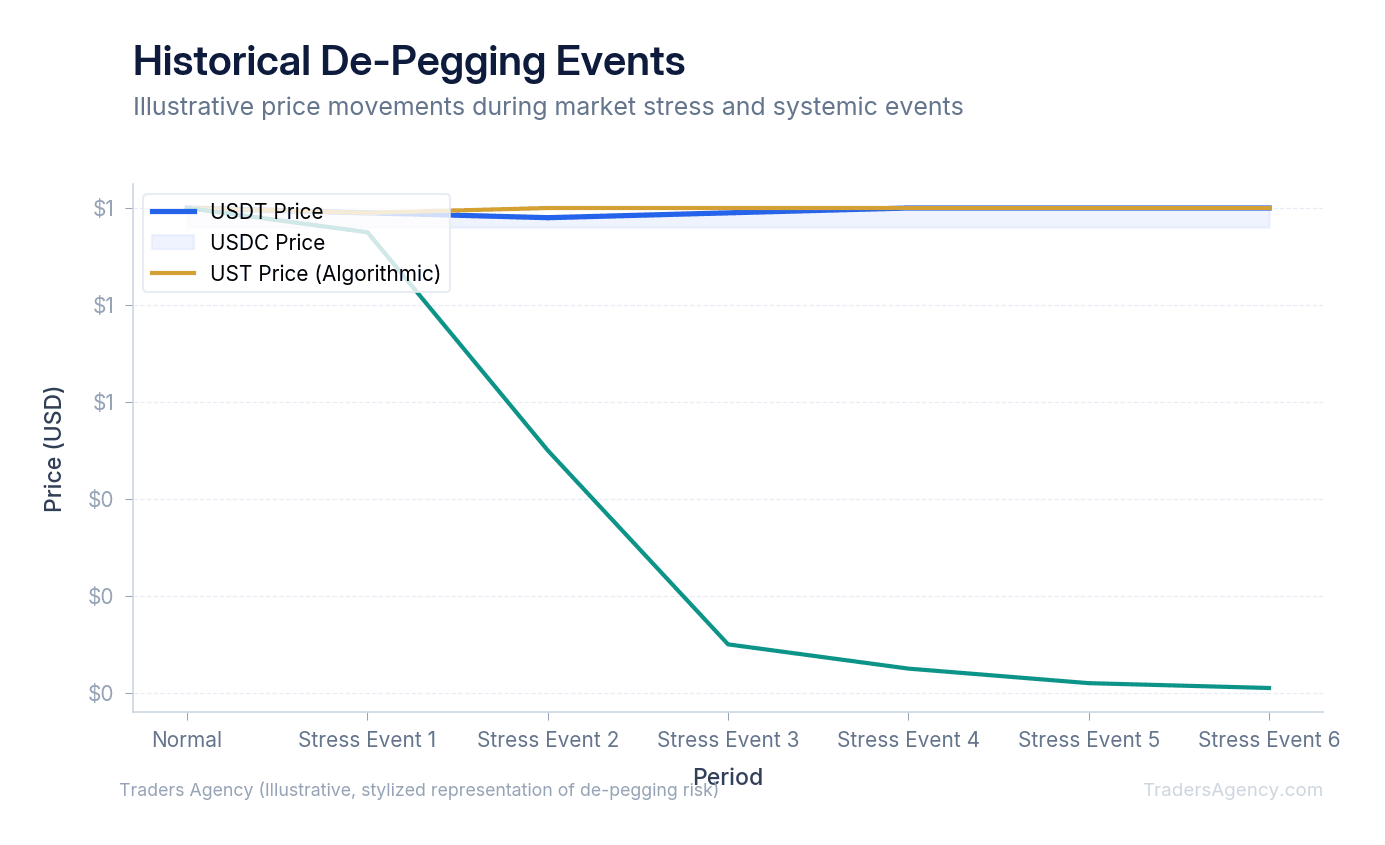
Not all stablecoins are fiat-backed. Some use complex algorithms to maintain their price. We teach our members to be extremely cautious with algorithmic stablecoins. The most well-known example of de-pegging risk is the collapse of TerraUSD (UST) in 2022.
UST was not backed by cash in a bank. It was backed by a sister cryptocurrency called LUNA. When the market panicked, the algorithm failed. The price of UST dropped from $1.00 to near zero over a matter of days. Traders who thought they were holding a safe asset lost nearly everything.
Risk Warning: Even fiat-backed tokens can experience temporary de-pegging. In early 2023, USDC temporarily dropped to around $0.87 after news broke that Circle held approximately $3.3 billion of its reserves at Silicon Valley Bank, which had been shut down by regulators. The peg was restored after the government guaranteed the bank deposits. This event served as a clear reminder that stablecoins carry counterparty risk.
Want expert trading insights delivered daily?
Join thousands of traders who rely on Traders Agency for market analysis and trade ideas.
Join Traders AgencyHow Do USDT and USDC Back Their Tokens?
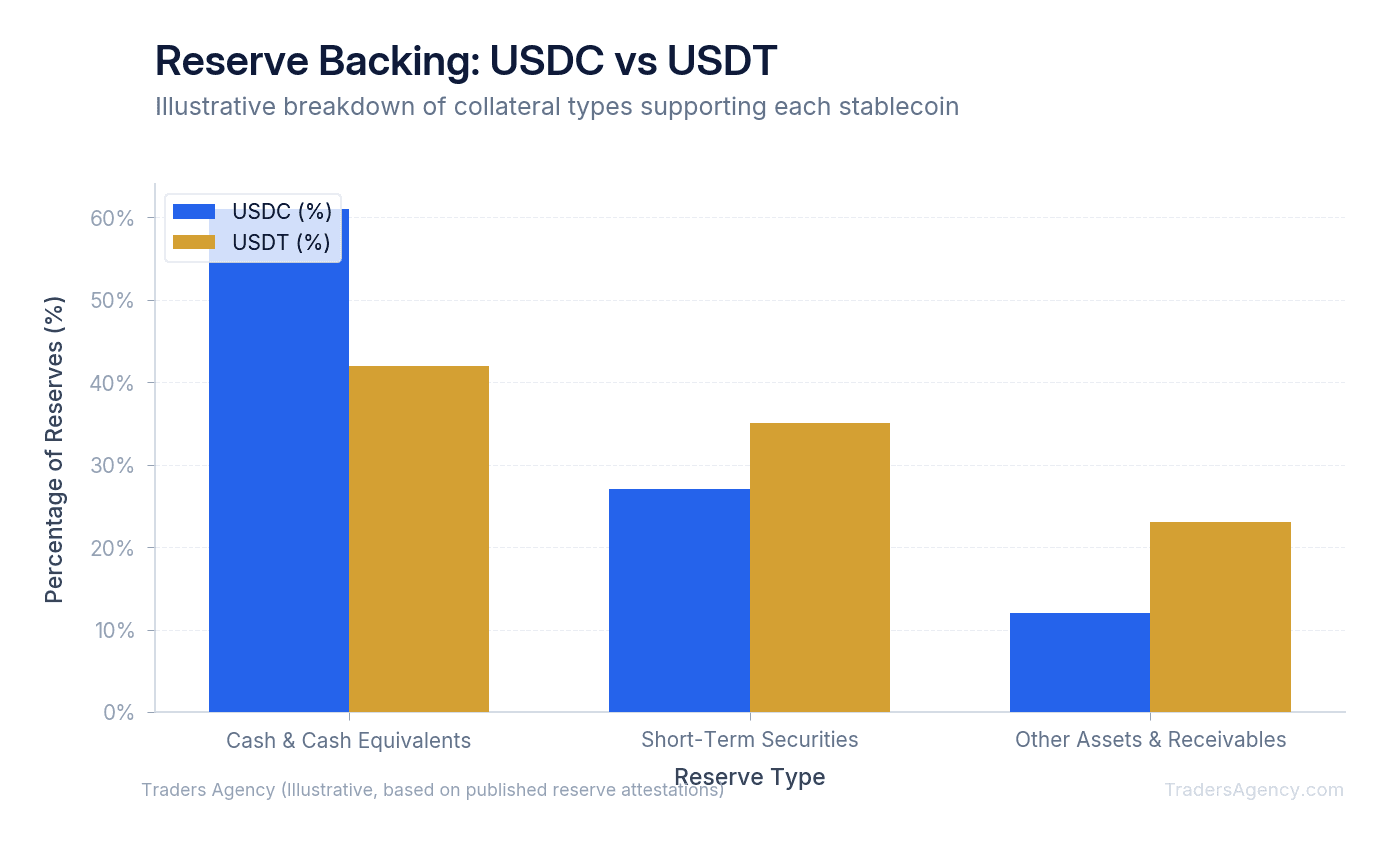
The safety of a fiat-backed stablecoin completely depends on the quality of its reserves. If a token claims to be worth one dollar, the company must have assets worth one dollar sitting in a vault or a bank account.
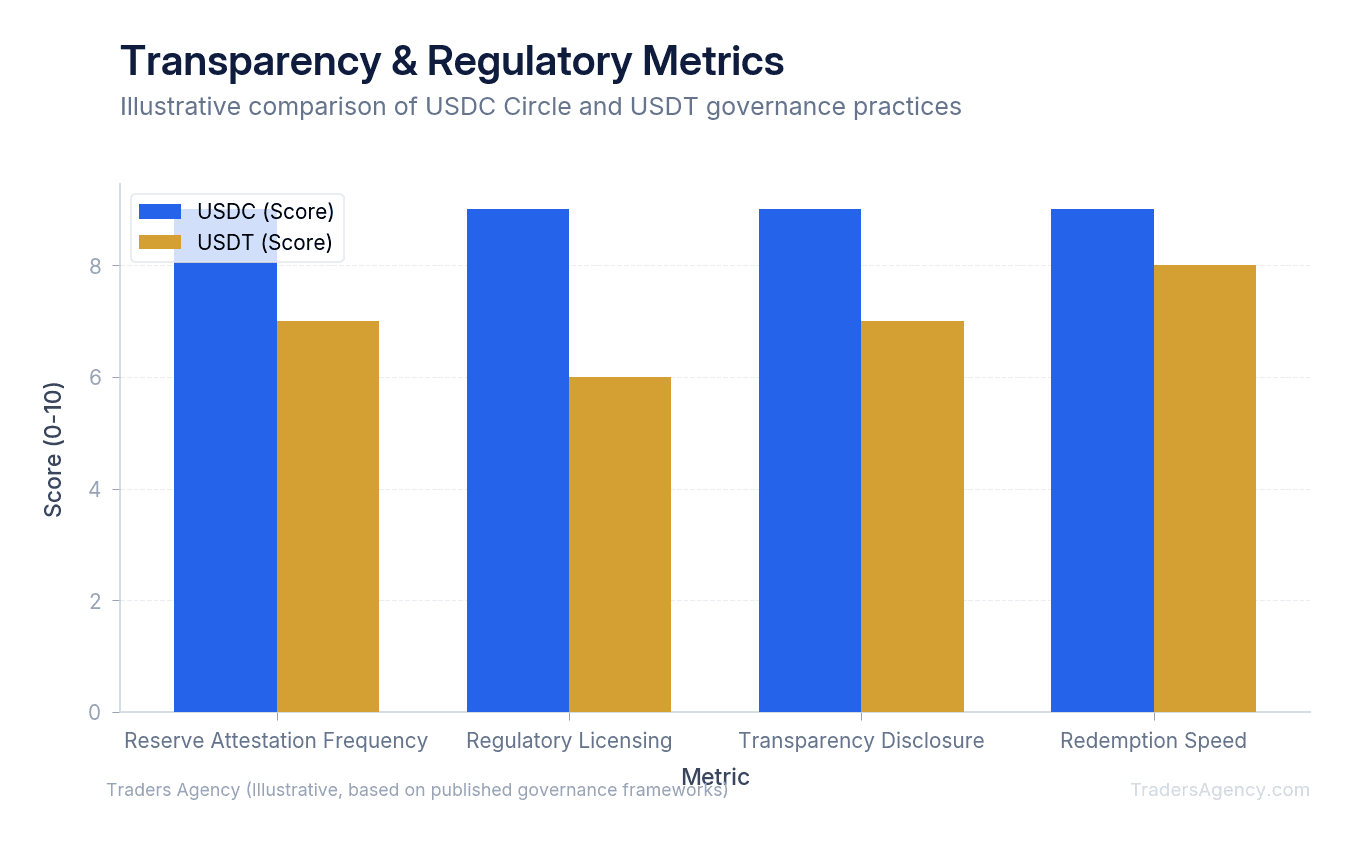
USDC has built its brand on extreme transparency. Circle publishes monthly attestations from major accounting firms proving they hold equivalent US dollars and short-term Treasury bills. This is why many traditional financial institutions prefer USDC.
Tether has a more complicated history with transparency. In its early years, the company faced heavy scrutiny for not providing clear audits of its reserves. Today, Tether publishes regular reports showing their reserves are backed by US Treasuries, gold, and other investments. However, their historical lack of transparency still makes some conservative traders nervous.
Regulatory bodies like the Securities and Exchange Commission (SEC) often emphasize the risks of undisclosed reserves in their educational materials. We always advise traders to check the reserve reports published by stablecoin issuers before allocating large amounts of capital.
Key Concept: Reserve transparency is your first line of defense. Before parking significant trading capital in any stablecoin, verify that the issuer publishes regular, third-party-attested reserve reports. If you can't find them, that's a red flag.
How Stablecoins Fit Into a Broader Investment Portfolio
Stablecoins are not investments that grow in value. You don't buy them expecting the price to go up to $1.10. Instead, they are utility tools for portfolio management and risk reduction.
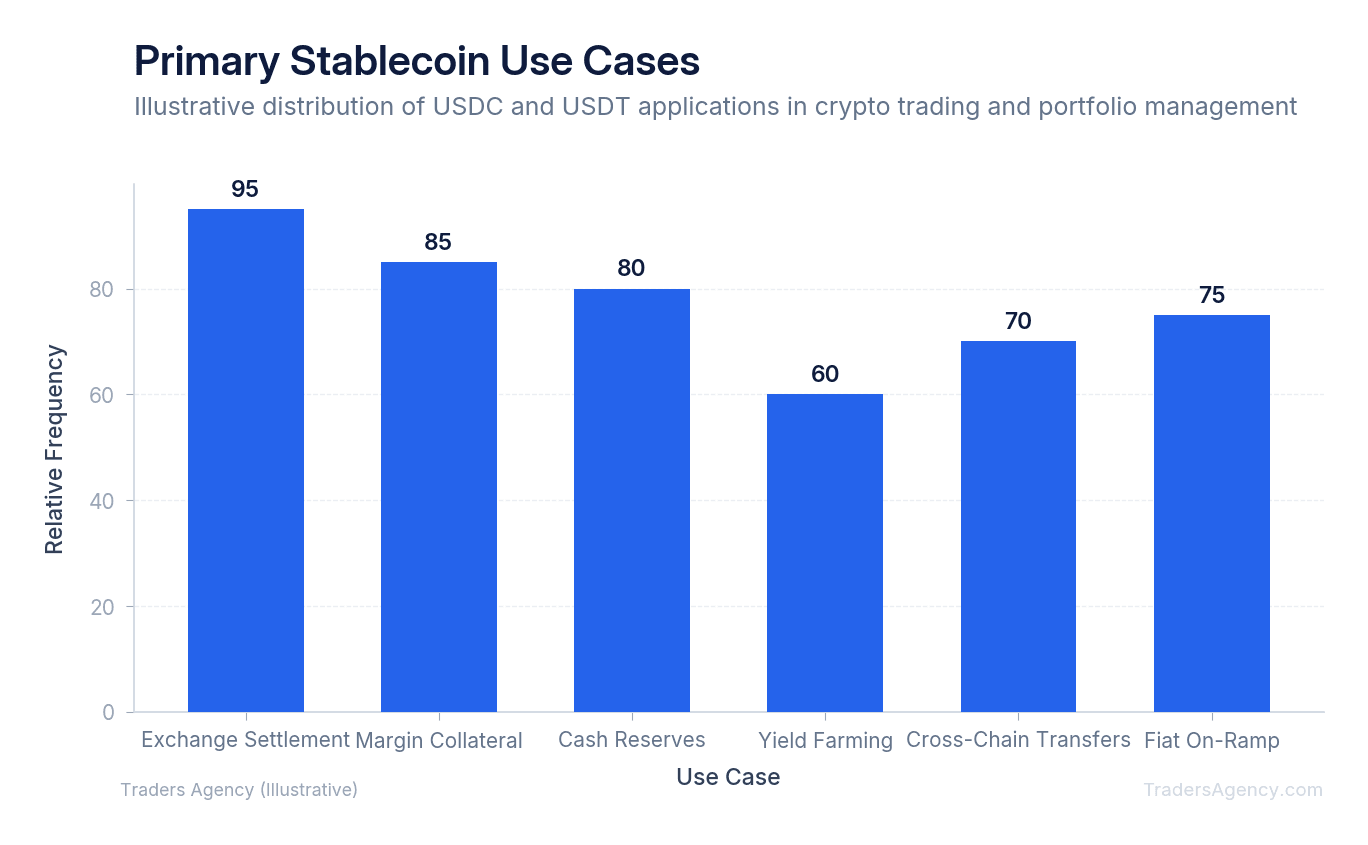
For active traders, stablecoins serve as the base currency for most transactions. When comparing USDC vs USDT on platforms like Binance, traders often notice that Tether pairs have significantly higher daily trading volume. If you want to trade a highly volatile asset with tight spreads, you'll likely need to use USDT to get the best execution price.
Here's how we prefer to use stablecoins in a broader trading strategy:
- Taking Profits: When a crypto asset hits our target price, we sell into a stablecoin to lock in the gain without triggering multiple banking fees.
- Margin Collateral: Many exchanges allow you to post stablecoins as collateral to trade futures or options contracts.
- Earning Yield: During periods of low market volatility, traders can lend their stablecoins on decentralized platforms to earn interest, often beating traditional savings accounts.
Watch Out: You should not use stablecoins as a long-term savings account. While they are pegged to the dollar, they do not carry FDIC insurance like a traditional bank account. If the issuing company goes bankrupt, your funds are at risk.
USDT vs USDC: Which Is Safer?
Determining which stablecoin is safer depends on your preference for transparency versus liquidity. USDC is widely considered safer regarding regulatory compliance and transparent cash reserves. However, USDT offers superior liquidity and trading volume across global exchanges, making it the preferred choice for active margin traders.
When our members ask us to declare a definitive winner in the USDC vs USDT debate, we explain that safety is relative to your specific trading goals. If you plan to hold a large amount of cash on the sidelines for six months, USDC offers peace of mind due to its strict US regulatory alignment.
If you're day trading volatile crypto assets on international exchanges, USDT is practically mandatory. The liquidity is simply too deep to ignore. A lack of liquidity can cause slippage, meaning you get a worse price on your trades. That's a very real risk to your daily profitability.
| Trading Goal | Recommended Stablecoin | Why |
|---|---|---|
| Long-term cash reserves (months) | USDC | Stronger regulatory compliance and transparent reserves |
| Active day trading on global exchanges | USDT | Deepest liquidity, most trading pairs available |
| DeFi protocol participation | USDC | Preferred by protocols requiring strict audits |
| Trading obscure altcoins | USDT | Often the only available trading pair |
| Balanced risk management | Both (50/50 split) | Diversification protects against single-token de-pegging |
Our team recommends a simple risk management strategy: never allocate 100% of your cash reserves to a single stablecoin. If you have $10,000 in trading capital sitting in cash, split it. Hold $5,000 in USDC and $5,000 in USDT. This diversification protects you if one token experiences a temporary de-pegging event.
Treat stablecoins as temporary vehicles for active trading, not permanent vaults for your life savings. Always keep your long-term wealth in regulated, insured traditional financial accounts. By understanding the mechanics and risks of these digital dollars, you can trade more efficiently while protecting your hard-earned capital.
Want expert trading insights delivered daily?
Join thousands of traders who rely on Traders Agency for market analysis and trade ideas.
Join Traders AgencyKey Takeaways
- Splitting stablecoin holdings between USDC and USDT (for example, $5,000 in each on a $10,000 position) reduces exposure if one token experiences a temporary de-pegging event.
- Stablecoins keep trading capital on-chain and ready to deploy in seconds, avoiding the multi-day settlement times and fees associated with moving funds back to a traditional bank.
- Reserve transparency differs meaningfully between the two: the article flags this as a key factor traders should evaluate before deciding how much capital to trust with either token.
- Stablecoins are described as temporary vehicles for active trading, not long-term storage. The article explicitly recommends keeping life savings in regulated, insured traditional financial accounts.
- De-pegging risk is real and worth planning for. Diversifying across more than one stablecoin is presented as a practical hedge against that specific scenario.
DISCLAIMER: Traders Agency does not offer financial advice. The information provided is for educational purposes only and should not be considered financial advice. Traders Agency is not responsible for any financial losses or consequences resulting from the use of the information provided. Trading carries inherent risks and may not be suitable for all individuals. You are advised to conduct your own research and seek personalized advice before making any investment decisions, recognizing the potential risks and rewards involved.
See more from Traders Agency on Google
Make us a preferred source and our market analysis will appear more prominently in your Google Search, Top Stories, and AI results.
Add to Preferred Sources