
Crypto mining stocks vs holding crypto is a strategic choice between owning the underlying digital asset and owning the infrastructure that produces it. You've probably seen this play out during a strong market rally: Bitcoin jumps 10% in a single day, but a specific mining company rockets higher by 25% during the exact same session. That amplification works both ways, and understanding the mechanics behind it is what separates informed traders from those who get caught on the wrong side.
Our team sees traders struggle with this dynamic constantly. They buy a mining stock thinking it's a perfect, one-to-one substitute for the digital asset itself. Then they suffer heavy losses when the market turns and the stock crashes much harder than the coin.
In this guide, we'll teach you exactly how these two asset classes differ in real-world trading. We'll show you how to evaluate mining operations, when to trade the equity, and when to stick to the coin. By the end, you'll understand the exact mechanics that drive mining profitability and how to position yourself on the right side of the trade.
How Does Holding Crypto Directly Differ from Owning Mining Stocks?
Holding crypto directly differs from owning mining stocks because direct ownership exposes you only to the supply and demand of the coin itself. Owning mining stocks introduces corporate variables like operating costs, debt, management decisions, and hardware depreciation, all of which heavily amplify both gains and losses.
We teach our members to think of this like the traditional commodities market. Holding Bitcoin in a cold storage wallet is similar to holding physical gold bars in a home safe. You own the bearer asset directly. Its value moves strictly based on global spot market prices, and you face zero corporate bankruptcy risk.
Buying shares in a mining company is like buying a commercial gold mining operation. You're taking on significant operational risk. If the price of the asset drops below the cost to mine it, the company loses money rapidly. The stock price can plummet much faster than the underlying asset as investors flee the cash burn.
Key Concept: Direct crypto ownership isolates you to pure asset price risk. Mining stock ownership layers on corporate risk: debt, dilution, energy costs, management quality, and hardware efficiency. The equity is not a substitute for the coin. It's a fundamentally different trade.
Tax treatment also differs significantly between the two approaches. Selling a stock triggers traditional capital gains based on standard equity rules. Disposing of directly held cryptocurrency carries its own specific reporting requirements for digital assets under IRS guidelines. This can complicate your tax filings if you trade frequently across multiple wallets.
Mining Stocks as a Leveraged Bitcoin Play: MARA, RIOT, and CLSK Compared
Traders often use mining equities as a high-beta proxy for the digital asset market. When Bitcoin trades above a miner's break-even cost, every additional dollar of price appreciation goes straight to the company's bottom line. This creates a magnification effect on the stock price.
Here's a specific mathematical scenario that illustrates why. Assume Bitcoin trades at $40,000, and a miner produces it for $35,000. The profit margin is exactly $5,000 per coin.
| Scenario | BTC Price | Mining Cost | Profit Per Coin | Change in Profit Margin |
|---|---|---|---|---|
| Starting Point | $40,000 | $35,000 | $5,000 | Baseline |
| BTC Rises 25% | $50,000 | $35,000 | $15,000 | +200% (tripled) |
| BTC Falls 25% | $30,000 | $35,000 | -$5,000 | Negative cash flow |
The underlying asset moved 25%, but the company's profit margin tripled. This profit explosion attracts massive institutional volume to the stock. This is exactly why we see such aggressive moves in companies like Marathon Digital (MARA), Riot Platforms (RIOT), and CleanSpark (CLSK). These firms operate massive data centers dedicated to securing the network. They offer traders a way to multiply their returns during a confirmed bull run.
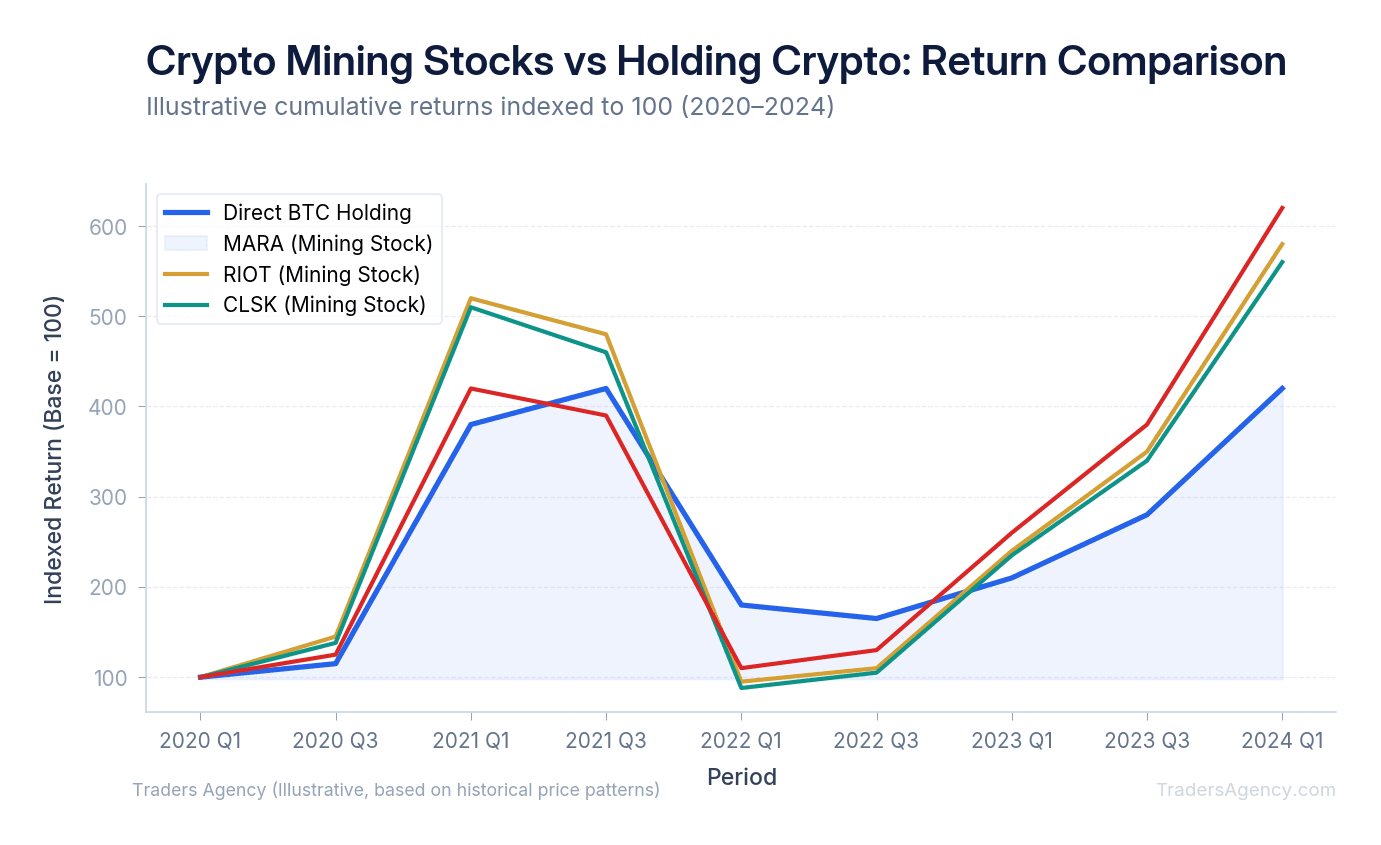
Watch Out: When evaluating a bitcoin mining stocks list, remember that this magnification works in both directions. If Bitcoin drops from $40,000 to $30,000, the miner in our example goes from a $5,000 profit to a $5,000 loss per coin. The stock will crash aggressively as the market prices in negative cash flow.
What Are the Best Crypto Mining Stocks?
The best crypto mining stocks depend entirely on your trading timeframe and risk tolerance. Companies with low production costs, zero debt, and massive cash reserves generally perform best during bear markets. Highly indebted miners with aggressive expansion plans often yield the highest returns during explosive bull market phases.
We don't believe in a single perfect stock for every market environment. Instead, we prefer to evaluate crypto mining companies to invest in based on their current balance sheet strength and their specific cost to mine a single coin.
For example, a company like CLSK has historically focused on high-efficiency operations and aggressive hash rate expansion. A company like MARA often holds a massive treasury of mined coins on its balance sheet. Your choice depends on whether you want exposure to operational efficiency or a large stockpile of digital assets.
When searching for undervalued crypto mining stocks, you must look beyond the simple share price. A $5 stock is not necessarily cheaper than a $50 stock. You need to calculate the enterprise value per exahash of mining power to find true value in this specific sector.
What Actually Drives Mining Stock Value Beyond the Price of Bitcoin?
The single most important metric for any mining stock is the all-in sustaining cost (AISC) to produce one coin. This includes electricity, hardware depreciation, facility maintenance, and corporate overhead. If a miner cannot control these costs, their stock will ultimately trend to zero.
If a company spends $45,000 to mine one Bitcoin, and Bitcoin trades at $42,000, they are burning cash every single day. They will eventually have to dilute shareholders by issuing new stock just to keep the lights on. This dilution destroys shareholder value over time.
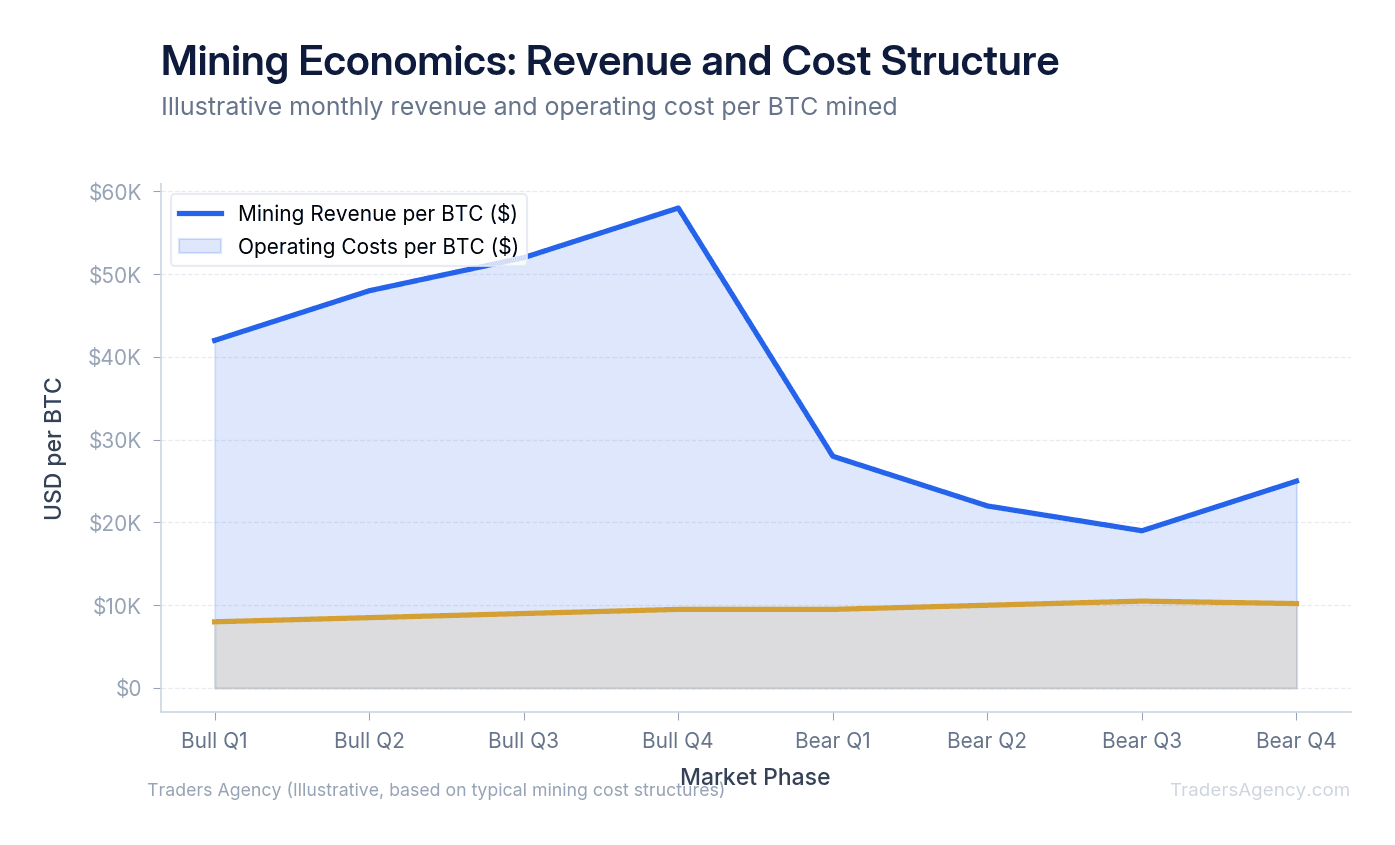
We always check a company's energy contracts before trading their stock. Miners with fixed-rate, long-term power purchase agreements have highly predictable costs. Miners buying electricity on the spot market can see their margins destroyed during a summer heatwave when energy prices spike.
The type of hardware a company uses also dictates their operating costs. Older machines consume significantly more power to produce the same amount of crypto. Companies that fail to upgrade their fleets regularly will see their profit margins vanish as network difficulty increases.
Want expert trading insights delivered daily?
Join thousands of traders who rely on Traders Agency for market analysis and trade ideas.
Join Traders AgencyWhen Does Mining Stock Correlation to Bitcoin Break Down?
Mining stock correlation to Bitcoin breaks down during extended bear markets and immediately following network halving events. When the block reward is cut in half, miners produce less revenue for the exact same energy cost, causing their stock prices to drop even if the underlying asset remains perfectly flat.
Many traders make the mistake of assuming a permanent one-to-one relationship between the coin and the equities. This is a highly dangerous assumption. During the 2022 bear market, Bitcoin fell roughly 75% from its all-time high. Many top mining stocks fell 90% to 95% during that exact same period.
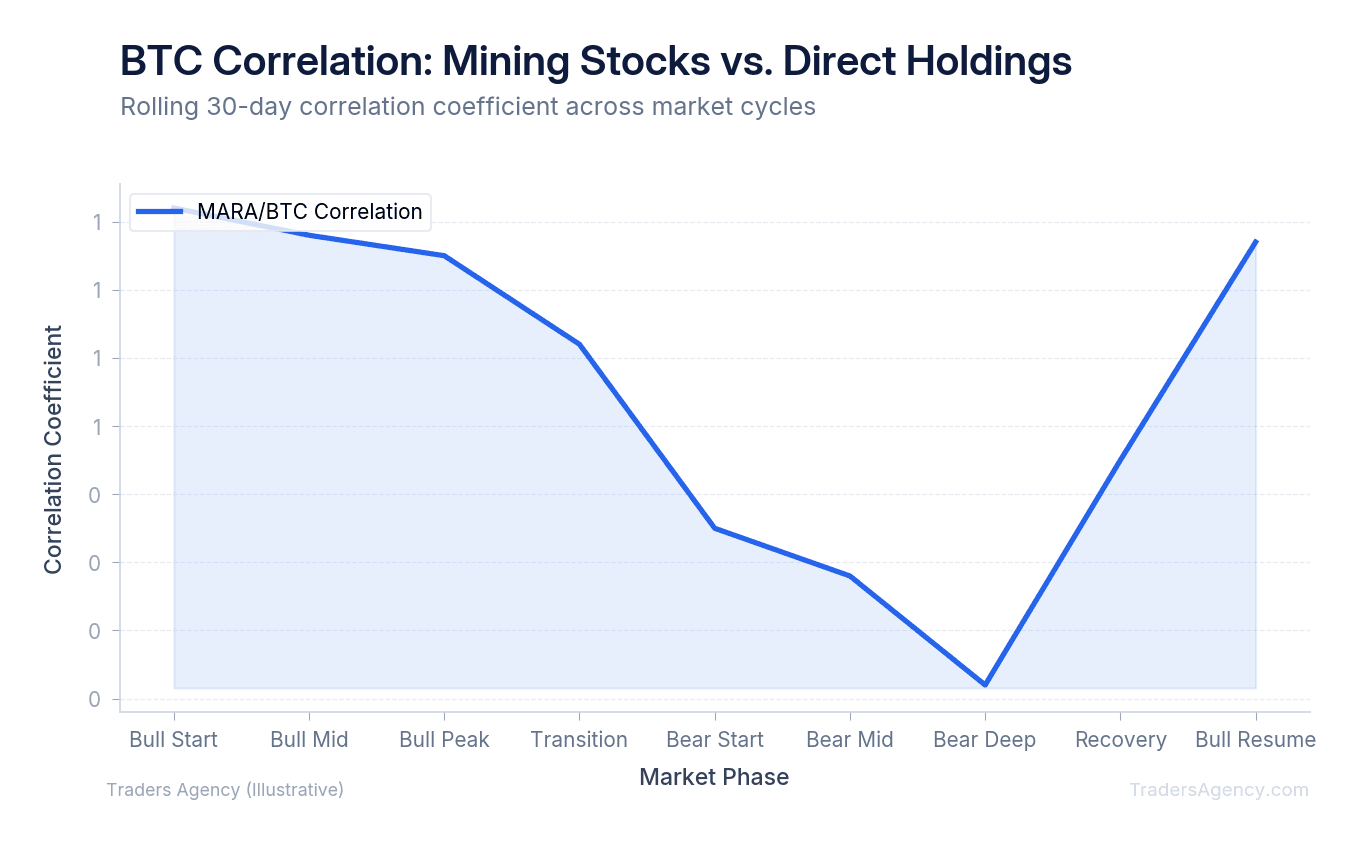
The correlation also fractures when a company makes poor management decisions. If a miner takes on high-interest debt to buy expensive hardware at the absolute top of a bull market, they will severely underperform the underlying asset. Holding crypto directly protects you entirely from this specific type of corporate mismanagement.
We also see correlation breakdowns when a company announces massive stock offerings. The underlying digital asset might be rallying, but the mining stock will drop because the market is flooded with millions of new shares. You must monitor SEC filings for these dilution events.
How to Evaluate the Top 10 Largest Bitcoin Miners by Hashrate
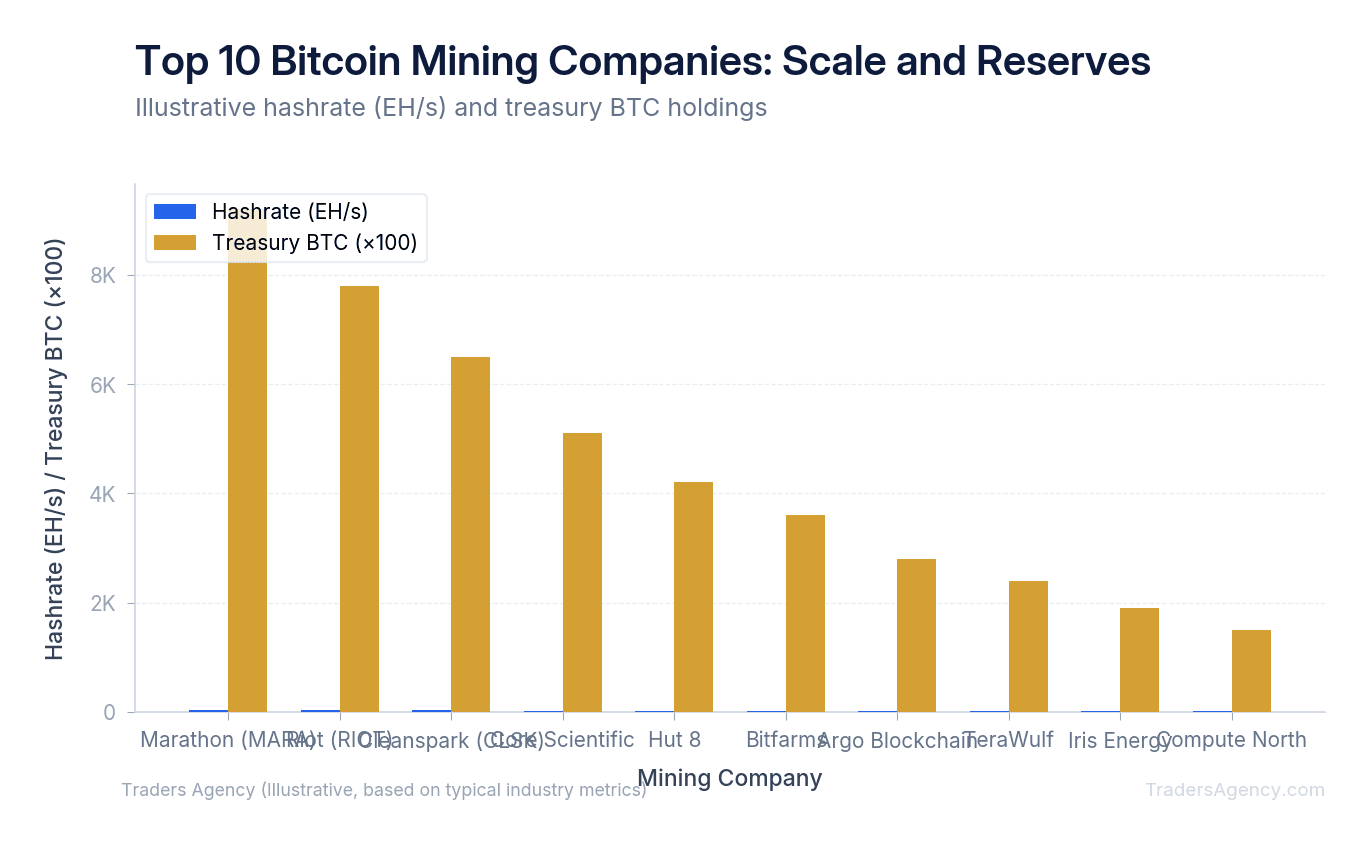
To trade this sector effectively, you need a systematic approach to valuation. The top 10 largest bitcoin miners by hashrate command the most market attention, but they require careful analysis before you risk your capital. Here is the exact step-by-step process our team uses to evaluate these companies before entering a trade:
- Check the Hashrate and Efficiency. Look at the company's current operational hashrate, measured in exahashes per second (EH/s). Then check their fleet efficiency, measured in joules per terahash (J/TH). Lower J/TH means the machines use less electricity to compute data. We prefer companies actively upgrading to the newest, most efficient hardware available.
- Analyze the Balance Sheet. Look at their cash and digital asset holdings. Many of the top 10 bitcoin mining companies act as bitcoin treasury companies, holding thousands of coins on their balance sheet to boost their valuation. You must calculate the value of this treasury against their total corporate debt.
- Calculate the Dilution Rate. Check the outstanding share count over the last two years. Mining is an incredibly capital-intensive business. Companies often fund their facility expansion by selling new shares to the public. If a company doubles its hashrate but triples its share count, your actual ownership stake has been heavily diluted.
Key Concept: Enterprise value per exahash is the most reliable way to compare mining stocks. A low share price means nothing if the company has billions of shares outstanding. Always normalize your valuation against actual mining power.
How Do Mining Stocks Fit Into a Broader Crypto Portfolio?
When deciding between crypto mining stocks vs holding crypto, you must consider your overall portfolio construction. We treat mining stocks as high-risk satellite positions rather than core, long-term holdings. They are trading vehicles, not savings accounts.
If you want long-term exposure to the digital asset space, holding the actual coin in self-custody or through a spot ETF is generally the safer approach. It completely removes the operational risks of the mining business. You don't have to worry about power grid failures, broken machines, or bad executives.
We prefer to use the best crypto mining stocks strictly for swing trading during confirmed bull markets. When the underlying asset breaks out of a long consolidation phase, the equities often provide a faster, more aggressive trade. We ride the momentum up and exit before the cycle turns.
Risk Management and Position Sizing
Because of their extreme volatility, position sizing is absolutely essential. A standard 5% portfolio allocation to Bitcoin might be appropriate for an intermediate trader. However, a 5% allocation to a single mining stock is incredibly dangerous and can blow up your account.
We recommend the following risk management rules for mining equities:
- Never allocate more than 1% to 2% of your total account to a single mining stock.
- Always use hard stop losses, typically placed just below the most recent daily swing low.
- Take partial profits quickly when the stock experiences a parabolic multi-day run.
- Never hold a losing mining stock through a network halving event.
Watch Out: The primary advantage of crypto mining stocks vs holding crypto is the potential for rapid percentage gains during a bull run. The primary disadvantage is the very real possibility of a company going bankrupt during a prolonged crypto winter. Stick to your stop losses, monitor the underlying asset's price action daily, and never fall in love with a mining company.
Trading these assets requires strict discipline and constant monitoring. Our team publishes new strategy guides and market analysis every week to help you stay on the right side of these trades.
Want expert trading insights delivered daily?
Join thousands of traders who rely on Traders Agency for market analysis and trade ideas.
Join Traders AgencyKey Takeaways
- Mining stocks can move 2x or more relative to Bitcoin in a single session: a 10% Bitcoin rally can produce a 25% gain in a mining stock, but the same leverage applies on the downside.
- Owning a mining stock means you are exposed to corporate risk layers that direct crypto ownership avoids entirely, including operating costs, debt load, management decisions, and hardware depreciation.
- Treating a mining stock as a one-to-one substitute for the underlying coin is one of the most common and costly mistakes traders make in this space.
- During a prolonged crypto winter, mining companies face genuine bankruptcy risk, making position sizing and stop losses non-negotiable when trading these equities.
- Monitoring the underlying asset's price action daily is a baseline requirement for mining stock traders, not an optional habit.
DISCLAIMER: Traders Agency does not offer financial advice. The information provided is for educational purposes only and should not be considered financial advice. Traders Agency is not responsible for any financial losses or consequences resulting from the use of the information provided. Trading carries inherent risks and may not be suitable for all individuals. You are advised to conduct your own research and seek personalized advice before making any investment decisions, recognizing the potential risks and rewards involved.
See more from Traders Agency on Google
Make us a preferred source and our market analysis will appear more prominently in your Google Search, Top Stories, and AI results.
Add to Preferred Sources