

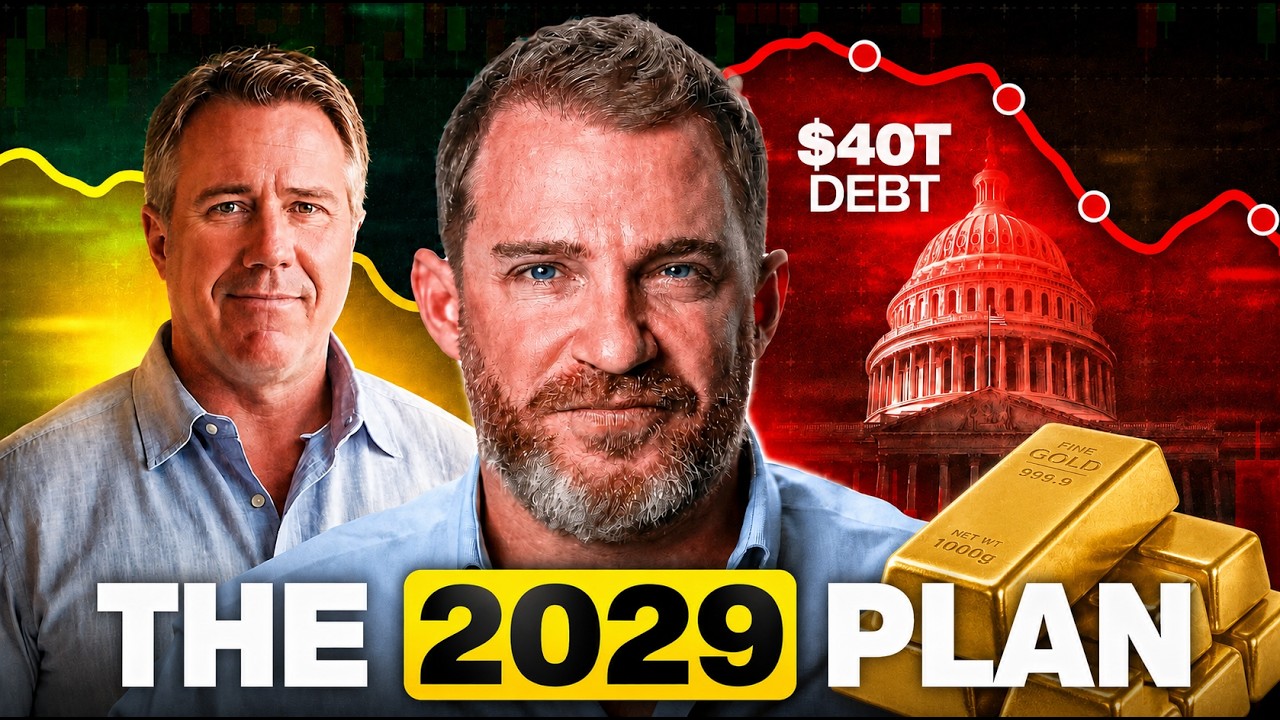
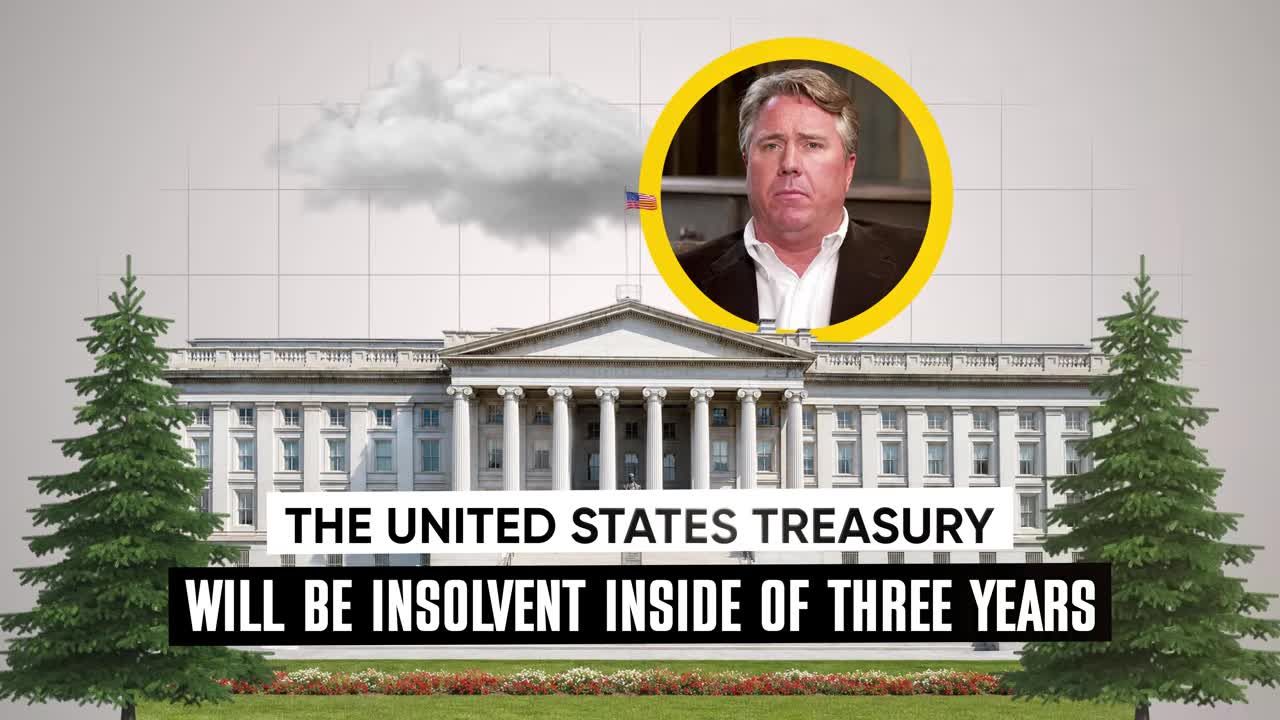
The United States Treasury is on a collision course with insolvency. The math says we have less than five years before a forced default, and that reality sits at the center of any serious conversation about us debt crisis investing today.
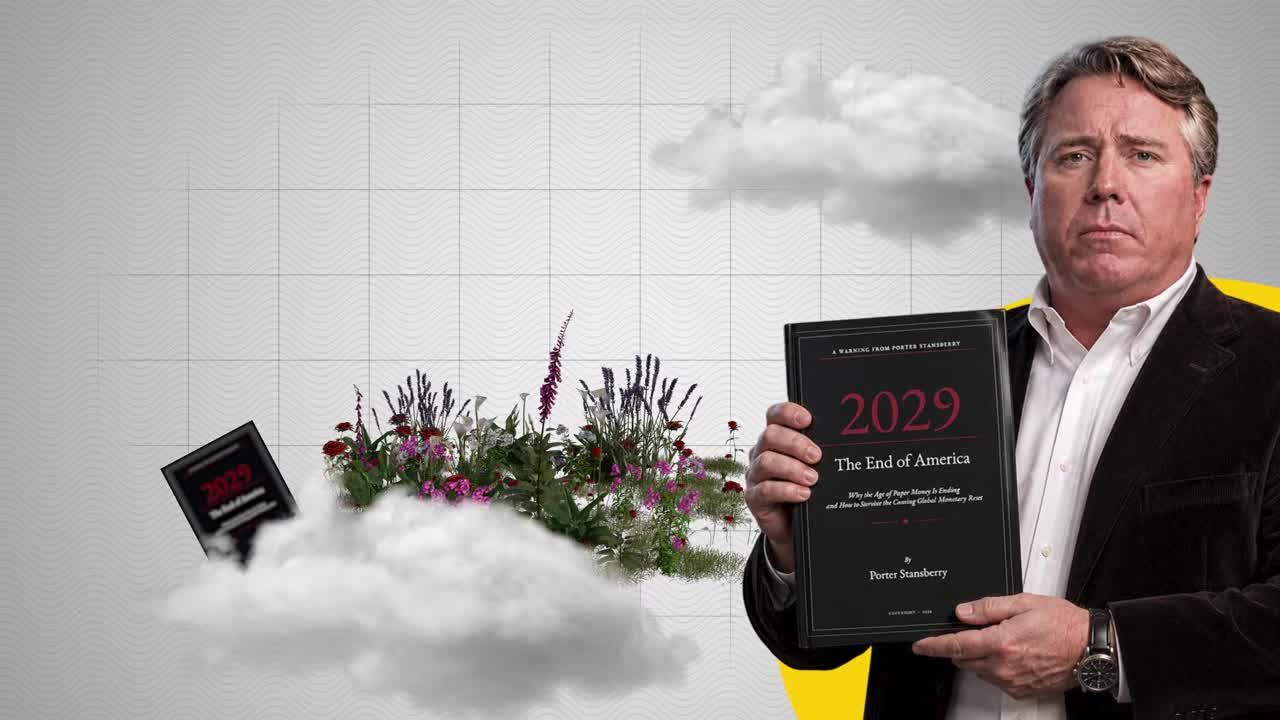
Porter Stansberry just published 2029: The End of America, and his data is impossible to ignore. I read the book, then sat down with him to work through it. What follows is his case, and more importantly, the four-bucket portfolio he built specifically for this event.
Why Does Stansberry Predict a U.S. Default by 2029?
A prediction he first made fifteen years ago
Fifteen years ago, Stansberry produced a documentary called The End of America. He argued the government was using the printing press to bail out the global banking system, and that debauching the currency would push a huge slice of the middle class into the lower class without anyone understanding how it happened.
He predicted a decline in labor force participation. An explosion in gambling, prostitution, drug addiction, alcoholism, and crimes of desperation. A sharp rise in political violence.
All of it before Occupy Wall Street. Before Black Lives Matter. Before the government tried to trap us in our homes for the flu.
Today the problem is mathematically worse. The government runs a 5% to 7% of GDP fiscal deficit while carrying $40 trillion in debt, and it's doing this during full employment. So far this year alone, roughly $100 billion has been printed. That's not legislated tax. It's a wealth transfer, and it cannot continue.
When the Money Actually Runs Out
The government's ability to finance its existing debts hits a hard limit around 2029. That's the same moment the trust funds propping up Social Security and Medicare operating deficits begin to run dry.
Official estimates say 2032 to 2034. Those estimates are wrong. They don't account for the higher-than-expected inflation we're already living through, and they assume zero recessions and no bear markets for a decade.
Every future debt ceiling fight will end the same way: more unbacked printing. That only accelerates the clock, and it's why so many people are rethinking their approach to us debt crisis investing right now.
The Insolvency Nobody Talks About
The engine driving all of this is transfer payments. Social Security, Medicare, and Veterans Administration benefits are legislatively linked to inflation. They're growing twice as fast as GDP, and they aren't financeable.
Print your way out and those benefits skyrocket further, because they're indexed to the very inflation you just created. Raise taxes instead? History says it won't work. America has never collected more than about 20% of GDP in tax revenue, no matter how the rates were structured. Even at 90% top rates, revenue flatlined, because people like you and me simply stop working.
Here's the part that enrages retirees, and they're not entirely wrong to be angry. Social Security is not a protected account. The Supreme Court has already ruled on it: you have zero legal right to the FICA payroll taxes you paid. The money goes straight into the general fund and gets spent in the same calendar year it's collected. The government writes an IOU to Social Security in the form of a Treasury bond and moves on.
Those statements you get in the mail? An accounting charade.
A generation ago there were five workers for every retiree. Today it's 2.6 or 2.7. Two working people cannot support two retirees. The math simply fails.
What Happens to Your Money in a U.S. Debt Crisis?
If the Treasury defaults, anyone holding cash and long-duration bonds loses a massive share of their purchasing power. The stock market may not even open. Equity prices could crater. This is exactly why us debt crisis investing starts with getting out of fiat dependency.
But high-quality businesses that can raise prices survive. Fiat holders get wiped out.
Bankrupt governments always do the same thing. They find a way to steal from their creditors. Look at Philip the Fair. And the biggest creditor to the U.S. government isn't a foreign central bank sitting on $7 trillion in Treasuries. It's the citizens owed Medicare and Social Security who paid in their entire lives.
Stansberry watched this play out in Argentina during the 2003 crisis. The peso went from 1-to-1 against the dollar to 4-to-1. His tour guide was a medical doctor who lost his job because nobody could afford care anymore.
Get an entire year of live weekly mentoring sessions, my newsletter, indicators, bonus reports, tons more. Click the link and I'll see you in the next live session.
Join my Black Ops Trading ClubWhat Is the Four-Bucket Portfolio for U.S. Debt Crisis Investing?
Built with Harry Browne's permanent portfolio approach
You and I don't control fiscal or monetary policy. We control our own capital. That means acquiring productive real assets before the music stops, which is the foundation of smart us debt crisis investing.
Stansberry uses a permanent portfolio modeled after his mentor, Harry Browne. Split your capital into four equal 25% buckets and rebalance once a year. You can build it yourself, or use his ETF, Porter & Company's Permanent Portfolio (Ticker: PCPP).
1. High-Quality "Lindy" Stocks (25%)
Own businesses that kept paying dividends straight through the Great Depression. On default day, would you rather hold $100 in the bank or $100 of Coca-Cola stock? A dollar is just a receipt from a bankrupt Treasury. It owns nothing.
Great companies raise prices to pay their suppliers, so both the stock and the dividend climb as the currency falls. Stick to century-old names that ordinary people use and can afford.
- Coca-Cola, Philip Morris, Hershey
- McDonald's, Caterpillar
- Johnson & Johnson, Taiwan Semi
2. Property and Casualty Insurance (25%)
The old 60/40 portfolio is dead. Replace the fixed-income half with property and casualty insurance equities. This is the formula Warren Buffett perfected over 70 years.
A P&C insurer's balance sheet is essentially a giant pile of fixed income. But unlike a plain bond, the company can hedge duration risk and buy shorter-term paper. Add an underwriting unit collecting premiums and investing the float, and a well-run insurer earns a combined return on equity between 15% and 20%. That protects you from inflation while anchoring the portfolio.
3. Gold, Hard Assets, and Bitcoin (25%)
Gold and Bitcoin are private money, sitting entirely outside the government system. Stansberry expects gold above $10,000 an ounce, possibly above $20,000.
His favorite vehicles are gold streaming companies. They take U.S. dollars, buy stakes in mines with 20 to 30-year productive lives, and get paid a percentage of output in physical gold. They don't run the mines or fix them. That structure is highly leveraged to a rising gold price and a falling dollar.
- Versamet
- Royal Gold
- Franco-Nevada
Bitcoin belongs here too. It's easier to hide and easier to transact in bulk than gold. Stansberry doesn't mess with flash drives. He uses the ETFs run by trillion-dollar banks. And even if the government outlaws it, the way gold was outlawed for Americans from 1933 to 1975, that won't stop adoption. Gold survived. So will Bitcoin.
Timber fits the same category, historically performing well through inflation and uncertainty while throwing off steady income.
4. Cash for Rebalancing (25%)
Cash is dry powder. If the Treasury defaults in 2029 and stocks fall 50%, you survive, then buy high-quality dividend payers at a steep discount. Meanwhile your gold and P&C positions rise, balancing the equity drawdown and keeping your overall returns intact.
The One Asset to Avoid
Long-duration fixed income. Any bond over five years in duration is no longer an investable asset.
Since the end of COVID, the bond market has lost about 60% of its value. Buy a 10-year or 15-year bond today and you'll lose between 50% and 75% of your wealth. Bonds will keep bleeding that much every five to seven years, because the government has no choice but to print to service its debts.
Final Word
The math is objective. $40 trillion in debt, a collapsing worker-to-retiree ratio, and inflation-linked entitlements that are mathematically impossible to fund. A default by 2029 is the logical outcome.
Don't wait for the government to announce a crisis. Reposition now. Move out of long bonds and fiat dependency. Allocate into high-quality dividend payers, P&C insurance float, gold streaming companies, Bitcoin ETFs, and enough cash to buy the panic. The government will protect itself. You have to protect your portfolio.
You can read Stansberry's full case at Porter's Journal.
Get an entire year of live weekly mentoring sessions, my newsletter, indicators, bonus reports, tons more. Click the link and I'll see you in the next live session.
Key Takeaways
- The U.S. is running a 5–7% of GDP fiscal deficit while carrying $40 trillion in debt, and doing so during full employment, which Stansberry argues makes a default by 2029 the logical mathematical outcome.
- The four-bucket portfolio built for this scenario allocates across high-quality dividend payers, property and casualty insurance float, gold streaming companies, Bitcoin ETFs, and cash reserves held specifically to buy during a panic.
- Stansberry's original 2009 prediction flagged currency debasement as the mechanism that would quietly push middle-class Americans into the lower class, a thesis he argues has since been confirmed by rising political violence, labor force dropout, and addiction rates.
- The core repositioning advice is to move out of long bonds and fiat-dependent assets before a crisis is officially announced, on the premise that government will act to protect itself first.
- Gold streaming companies and P&C insurance float are highlighted as specific structural positions, not just generic inflation hedges, because both generate returns tied to hard assets or underwriting discipline rather than currency value.
DISCLAIMER: Traders Agency does not offer financial advice. The information provided is for educational purposes only and should not be considered financial advice. Traders Agency is not responsible for any financial losses or consequences resulting from the use of the information provided. Trading carries inherent risks and may not be suitable for all individuals. You are advised to conduct your own research and seek personalized advice before making any investment decisions, recognizing the potential risks and rewards involved.
See more from Traders Agency on Google
Make us a preferred source and our market analysis will appear more prominently in your Google Search, Top Stories, and AI results.
Add to Preferred Sources