
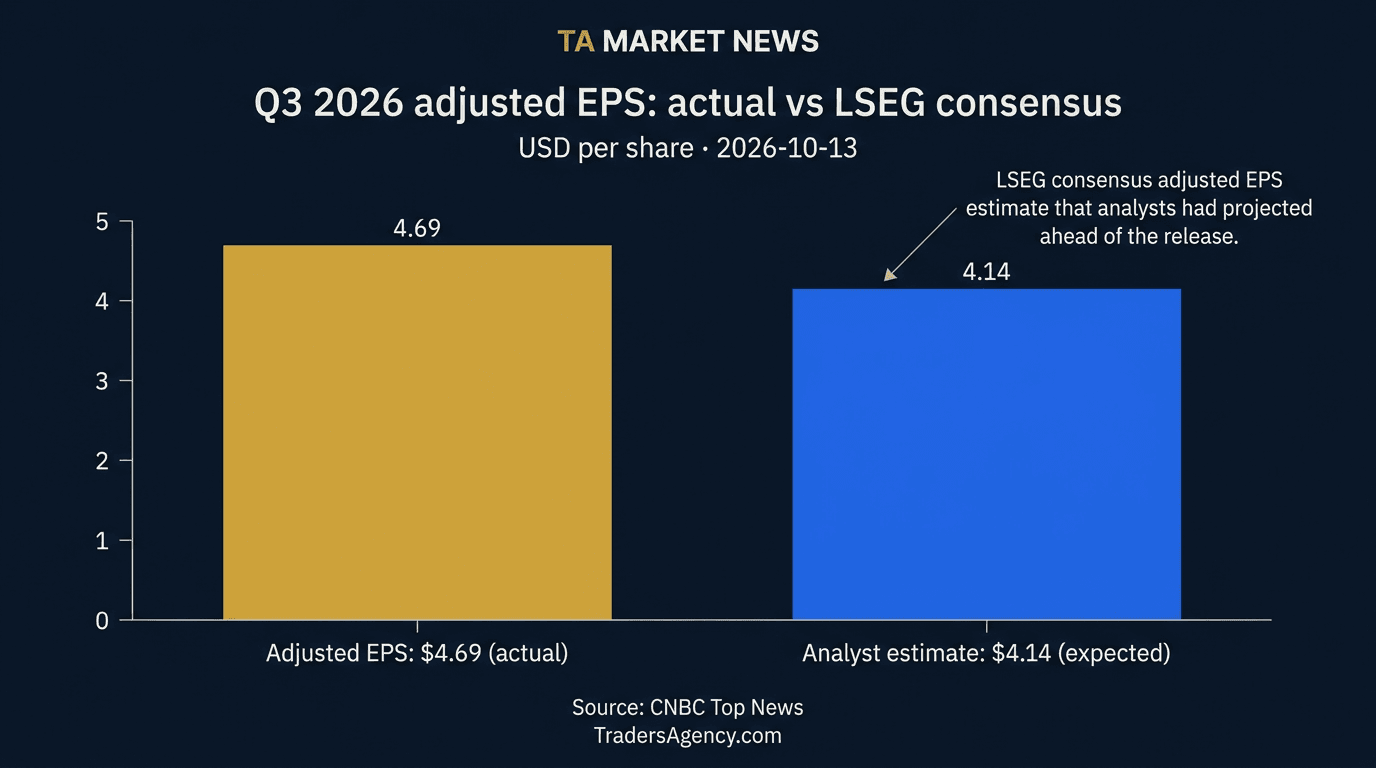
UnitedHealth Group reported third-quarter 2026 adjusted earnings of $4.69 a share on revenue of $112.7 billion, beating Wall Street expectations and prompting the company to raise its full-year 2026 adjusted earnings outlook to at least $20.50 a share, up from a prior range of $19.50 to $20 per share, according to the company's third-quarter results release. The insurer's medical care ratio, a closely watched gauge of claims costs relative to premiums, improved to 88.4% from 89.9% a year earlier.
Quarterly Results Beat Estimates
UnitedHealth posted net income of $4.11 billion, or $4.56 per diluted share, compared with $2.35 billion, or $2.59 per share, in the same period a year ago, CNBC reported. Adjusted earnings of $4.69 per share excluded items such as business divestitures, restructuring and an expected reduction of reserves for unprofitable contracts. Revenue of $112.69 billion slipped from $113.16 billion in the prior-year quarter.
According to CNBC, citing LSEG consensus data, adjusted EPS of $4.69 compared with an expected $4.14, a beat of $0.55, or roughly 13.3%, by our calculation ($4.69 minus $4.14, divided by $4.14). Revenue of $112.69 billion compared with an expected $111.40 billion, a beat of $1.29 billion, or about 1.2%, by our calculation ($112.69 billion minus $111.40 billion, divided by $111.40 billion).
The updated full-year outlook calls for GAAP earnings of at least $19.50 per share and adjusted earnings of at least $20.50 per share, the company said in its release carried by Financial Times Markets/Business Wire.
Medical Care Ratio Improves, But Management Urges Caution
The medical care ratio of 88.4% beat the 89.9% analysts had expected, according to StreetAccount data cited by CNBC. The company attributed the year-over-year decline to "medical cost management initiatives, benefit design changes and pricing discipline, as well as care delivery enhancements focused on affordability and integrated value-based care," per the earnings release.
The ratio was also helped by $610 million of net favorable prior-period reserve development tied to 2026 dates of service, the company disclosed, though it did not quantify how many basis points of the year-over-year improvement that development represented. The year-over-year move from 89.9% to 88.4% is 1.5 percentage points, by our calculation (89.9% minus 88.4%); the release does not break out how much of that reflects reserve releases versus underlying claims trends, so the split is unknown rather than estimable from the disclosed figures.
CFO Wayne DeVeydt cautioned against reading the improved ratio as a sign that cost pressures have fully eased. He told CNBC that medical costs in the quarter "continue to be elevated versus historical norms" and said, "I think you'll see that our medical care ratio has improved quite a bit, but I don't want that to be misleading in terms of [medical cost trends]." DeVeydt also said the independent dispute resolution process under the No Surprises Act is adding at least 100 basis points to total medical costs, and that inpatient services and specialty pharmacy, particularly costly drugs for cancer and rare diseases, remain elevated, per CNBC's reporting.
On a more favorable note, DeVeydt said acute hospital admissions among UnitedHealth members fell 15% year over year through the third quarter while home health admissions rose 10%, which he suggested points to more care shifting to lower-cost settings. He also said patient self-scheduling, rather than scheduling with provider assistance, rose 27% year over year, according to CNBC.
Segment Performance: UnitedHealthcare and Optum
Both UnitedHealthcare and Optum topped analysts' operating earnings estimates for the quarter, according to StreetAccount data cited by CNBC.
- UnitedHealthcare served 48.3 million people and generated revenue of $86.3 billion, down from $87.1 billion a year earlier. Earnings from operations rose to $2.8 billion with a 3.3% operating margin, up from $1.8 billion and 2.1% in the third quarter of 2025, per the company's release.
- Optum Health revenue fell 10% year over year to $22.9 billion, which the company said reflected fewer value-based care patients served in markets where Optum lacked sufficient presence to sustain its clinicians. Earnings from operations jumped to $735 million, a 3.2% margin, from $41 million and 0.2% a year earlier, which the company attributed to strengthened operational discipline and medical cost management.
- Optum Rx revenue rose slightly to $39.9 billion from $39.7 billion, with earnings from operations of $1.7 billion versus $1.5 billion, which the company linked to continued adoption of biosimilars and operational improvements. Adjusted scripts fell to 393 million from 414 million, which the company attributed to membership declines within UnitedHealthcare and other customers.
- Optum Insight revenue rose 3% to $5.5 billion, with earnings from operations climbing to $1.3 billion from $920 million.
The company's overall operating cost ratio improved to 12.8% from 13.5% a year earlier, which it said reflected realized operating efficiencies partially offset by accelerating investments in technology, processes and people.
Membership Trends and Medicare Advantage Stars
UnitedHealth disclosed that Medicare Advantage enrollment, including programs serving complex populations counted within Medicaid, has contracted by 935,000 people since year-end 2025. Employer & Individual membership fell 165,000 in the quarter on employer attrition, while Community & State membership fell 85,000 on ongoing Medicaid eligibility changes, according to the earnings release. The company did not provide an updated full-year Medicare Advantage membership outlook in the materials reviewed.
On quality, the company said its 2027 Medicare Advantage Stars results, with at least 69% of members in 4-plus Star plans, were "in line with expectations and reflect continued investments in quality and focus on execution," citing improvement in 11 of 12 HEDIS measures and 4 of 4 pharmacy measures.
Capital Returns and ACA Commitment
UnitedHealth generated $5.1 billion in operating cash flow, or 1.2 times net income, with a debt-to-capital ratio of 41.7% as of September 30, 2026, up from 41.2% in the second quarter. The company has repurchased $5.0 billion of common stock and paid $6.2 billion in dividends year-to-date, per the release.
The company also reiterated a commitment to voluntarily eliminate and rebate profits from individual Affordable Care Act coverage offerings in 2026, returning money directly to roughly 1 million ACA members, and said it committed $1 billion to the United Health Foundation to support rural healthcare, maternal and children's health, and behavioral health initiatives.
Management Commentary
CEO Stephen Hemsley said the results "reflect the discipline and execution our teams are bringing to every part of our business, as we continue evolving UnitedHealth Group to deliver a simpler, more supportive experience for patients and the clinicians who care for them," according to the company's release.
DeVeydt framed the quarter as execution on a strategy of shrinking membership, exiting unprofitable contracts and investing in value-based care and artificial intelligence. "You'll see in the quarter that we continue to execute not only on the financial aspects of our business, but really doing them with a simpler approach and an approach that's really focused on investing heavily in value-based care," he told CNBC.
Shares and Sector Context
CNBC reported that UnitedHealth shares rose about 3% in premarket trading following the release. Comparable same-day trading data for managed-care peers such as Humana, Elevance Health, Centene, CVS Health and Molina was not available in the materials reviewed for this report.
Separately, Elevance Health, Inc. (NYSE: ELV) closed at $422.09 on October 12, 2026, up from $394.51 on October 5 across six recorded sessions, based on verified price-history data. All of those closes precede UnitedHealth's October 13 earnings release, so the move cannot be attributed to UnitedHealth's results; characterizing it as sector positioning ahead of the print is interpretation of the price observations, not a reported cause.
Bottom Line
UnitedHealth's third-quarter beat and raised guidance came largely from a medical care ratio that improved more than analysts expected, but the company's own finance chief cautioned that elevated medical cost trends, regulatory dispute-resolution costs and specialty pharmacy pressures have not disappeared. With $610 million of favorable prior-period reserve development embedded in the quarter and Medicare Advantage enrollment still contracting, investors weighing the raised outlook will likely watch whether the underlying cost trend, not just reserve timing, continues to support the new $20.50 floor through year end.
DISCLAIMER: Traders Agency does not offer financial advice. The information provided is for educational purposes only and should not be considered financial advice. Traders Agency is not responsible for any financial losses or consequences resulting from the use of the information provided. Trading carries inherent risks and may not be suitable for all individuals. You are advised to conduct your own research and seek personalized advice before making any investment decisions, recognizing the potential risks and rewards involved.
- CNBC Top News: UnitedHealth Group (UNH) earnings Q3 2026 · accessed Oct 13, 2026
- Seeking Alpha Market News: UnitedHealth beats top-line and bottom-line estimates; updates FY26 outlook · accessed Oct 13, 2026
- UnitedHealth Group: UnitedHealth Group Reports Third Quarter 2026 Results · accessed Oct 13, 2026
- Financial Times Markets / Business Wire: UnitedHealth Group Reports Third Quarter 2026 Results · accessed Oct 13, 2026
- Business Wire via FinancialContent: UnitedHealth Group Reports Third Quarter 2026 Results · accessed Oct 13, 2026
See more from Traders Agency on Google
Make us a preferred source and our market analysis will appear more prominently in your Google Search, Top Stories, and AI results.
Add to Preferred Sources