
Humana enters the next Medicare Advantage ratings cycle still absorbing a steep star-rating decline. According to KFF, the insurer holds the program's second-largest enrollment base — 20% of all Medicare Advantage enrollees — yet collects just 11% of quality bonus dollars in 2026, after one of its largest contracts slid from 4.5 stars to 3.5 stars. Humana has told investors it expects the share of its members in plans rated at least four stars to be “meaningfully higher” than 20% in 2027, according to its securities filing as reported by Healthcare Dive, but that improvement remains a company expectation rather than a confirmed outcome.
The Contract Drop Behind the Bonus Gap
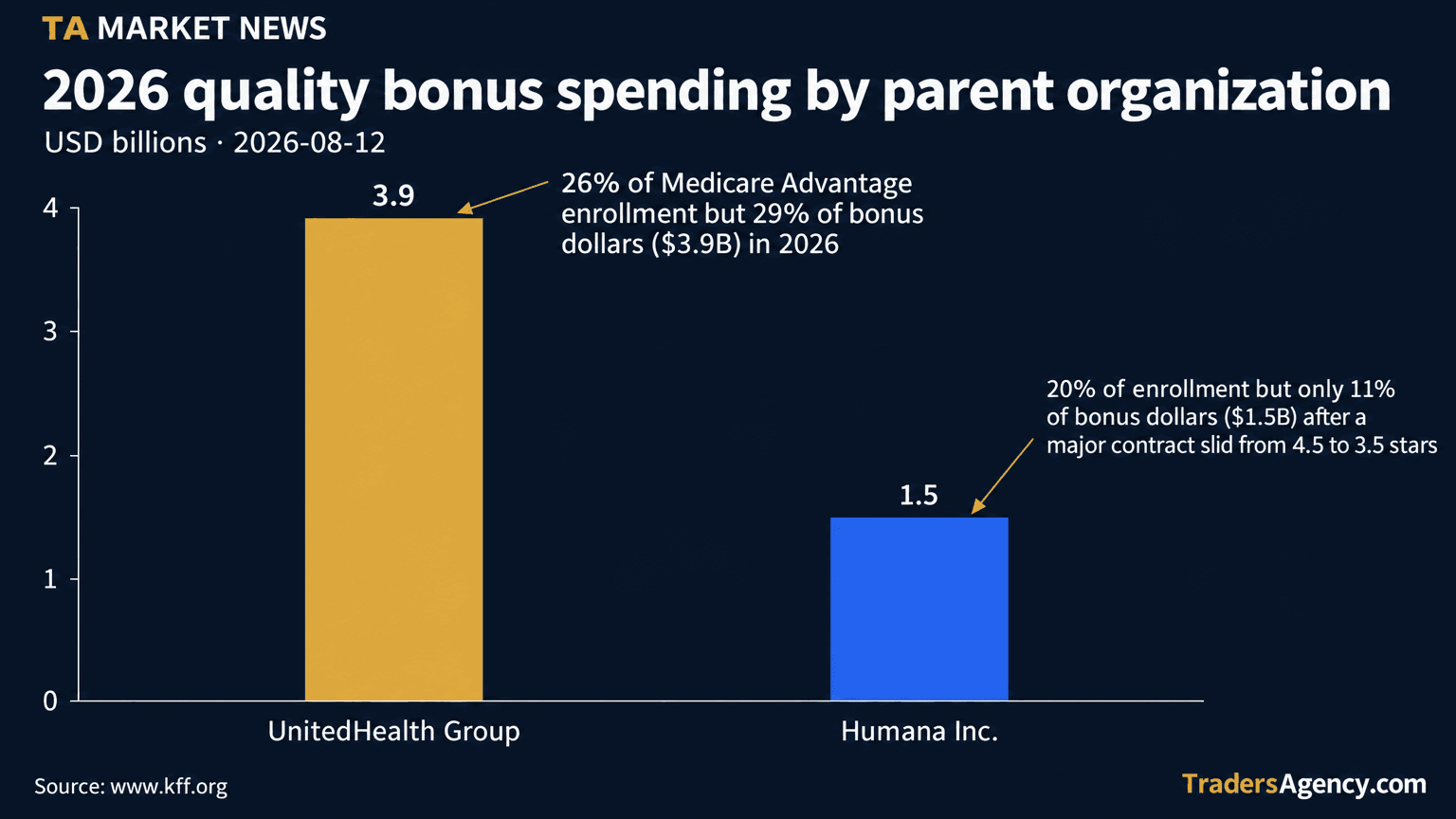
According to KFF, Humana's average star rating fell considerably for the 2025 plan year, the measurement period that determines 2026 bonus eligibility, after one of its largest contracts slid from 4.5 stars to 3.5 stars. The consequence shows up directly in bonus economics: Humana holds 20% of Medicare Advantage enrollment but collects only $1.5 billion, or 11% of total quality bonus program dollars, in 2026. By contrast, UnitedHealth Group, with 26% of enrollment, is expected to receive $3.9 billion, or 29% of bonus spending. By our calculation, that is a $2.4 billion gap between the two insurers' bonus payouts ($3.9B minus $1.5B), a 160% relative difference, even though their enrollment bases are much closer in size. The disparity underscores how concentrated quality bonus dollars have become among top-rated contracts.
Humana's Own Case for a Rebound
Humana has publicly addressed the gap. Reporting from Healthcare Dive cites Humana's securities filing stating the company was "not satisfied with its 2026 Star Ratings" but pointing to "tactical operational improvements made during the final months of the 2026 measurement period" as a foundation for an expected "return to Top Quartile results for the 2027 Star Ratings." In that same filing, Humana said it expects the share of members in plans rated at least 4 stars to be "meaningfully higher" than 20% in 2027. This is Humana's own forward-looking expectation as reported by Healthcare Dive, not a confirmed outcome.
Part of the mechanism behind any improvement is structural. As Healthcare Dive explains, CMS measures quality through star ratings at the contract level rather than at the level of an individual plan, and one contract can include many different plans. By adjusting member enrollment in certain plans and the attribution of plans to certain contracts, Humana can move more members into more highly rated contracts and secure the higher per-member payouts that follow.
What Remains Unconfirmed
What has not been publicly confirmed is contract-level detail showing that a Humana contract actually crossed above four stars in the 2027 ratings, or any figure for incremental 2028 bonus revenue or earnings tied to such a move. CNBC listed Humana among the biggest premarket movers on Friday, Oct. 9, 2026, but that listing alone says nothing about the ratings cycle. Until CMS publishes 2027 contract-level ratings, any claim of a specific Humana upgrade — or of a share move driven by one — should be treated as unverified.
Litigation and the Clover Health Wildcard

Humana has separately pursued litigation against CMS over the star-ratings methodology, but KFF's August 2026 update notes that courts have so far sided with the Administration in that case. A different legal challenge, brought by Clover Health, produced a more consequential result: CMS recalculated the 2026 star ratings for all plans, though it revised only ratings that increased as a result, and that recalculation affects the 2027 payment year. CMS has appealed the decision, according to KFF, leaving uncertainty over whether the revised methodology persists past 2027.
KFF estimates the recalculation will push 2027 quality bonus program payments about $600 million higher industry-wide than they otherwise would have been. The largest beneficiaries, per KFF, are UnitedHealth Group, Clover Health, Blue Cross Blue Shield of Alabama, Humana, and CVS Health, in that order. Separately, CMS has finalized changes effective with the 2029 star ratings, based on 2027 plan-year performance, that remove several administrative measures and others CMS said no longer meaningfully differentiate plan quality — a change KFF scores as increasing Medicare spending by $18.6 billion over 10 years as more contracts are expected to clear the four-star line.
Peer Context in the Bonus Program
The bonus program's concentration extends beyond the Humana-UnitedHealth comparison. Data compiled by RISE Health show the number of Medicare Advantage contracts rated four stars or higher fell from 261 to 209 industry-wide, a drop of 52 contracts; put another way, the earlier total stood about 25% above the current one ((261 − 209) ÷ 209 × 100 = 24.9%, our calculation). At the low end of per-enrollee payouts, RISE Health puts Centene at $23 per enrollee, the lowest in the market, while KFF reports that only 6% of Centene's 938,000 Medicare Advantage enrollees are in plans receiving bonus payments in 2026 — and that its only qualifying contracts are those too new or too small to be rated. At the high end, RISE Health puts Kaiser Foundation Health Plans at $577 per enrollee, a gap of $554 and roughly 25 times Centene's figure ((577 − 23) ÷ 23 × 100 = 2,409%, our calculation). KFF estimates total quality bonus spending at roughly $13.4 billion in 2026, more than four times the $3.0 billion paid in 2015.
Bottom Line
Humana's path into the 2027 star ratings cycle is defined by a documented setback — a 20% bonus-eligible membership share and a large contract that fell from 4.5 stars to 3.5 stars, per Healthcare Dive and KFF — alongside a company-stated expectation of recovery that published ratings data has not yet confirmed. The clearest confirmation would come from CMS's contract-level ratings and Humana's own disclosures once the 2027 ratings are released; industry guidance notes ratings typically post to medicare.gov in early October, just before the Annual Election Period opens October 15.
DISCLAIMER: Traders Agency does not offer financial advice. The information provided is for educational purposes only and should not be considered financial advice. Traders Agency is not responsible for any financial losses or consequences resulting from the use of the information provided. Trading carries inherent risks and may not be suitable for all individuals. You are advised to conduct your own research and seek personalized advice before making any investment decisions, recognizing the potential risks and rewards involved.
- CNBC Top News: Stocks making the biggest moves premarket: DAL, SPCX, TMUS · accessed Oct 9, 2026
- www.kff.org: Medicare Will Spend More Than $13 Billion on the Medicare Advantage Quality Bonus Program in 2026 · accessed Oct 9, 2026
- www.healthcaredive.com: Humana’s Medicare Advantage star ratings slip for 2026 · accessed Oct 9, 2026
- www.risehealth.org: bonus-eligible enrollment falls to 68 percent · accessed Oct 9, 2026
- www.humana.com: Explore 2027 Medicare Advantage Plans (Part C) · accessed Oct 9, 2026
- www.youtube.com: - YouTube · accessed Oct 9, 2026
- www.meetaugust.ai: Humana Medicare Advantage Plans 2026: Top Picks & Reviews · accessed Oct 9, 2026
- content.medicareadvantage.com: 2026 Medicare Star Ratings Coming Soon Humana – H4329 · accessed Oct 9, 2026
- www.humana.com: Find Medicare Plans and Health Insurance Coverage · accessed Oct 9, 2026
- policy.humana.com: Humana’s 2026 Medicare Advantage Plans Prioritize Simplicity, Stability and Quality Care for Beneficiaries · accessed Oct 9, 2026
See more from Traders Agency on Google
Make us a preferred source and our market analysis will appear more prominently in your Google Search, Top Stories, and AI results.
Add to Preferred Sources