
Delta Air Lines missed Wall Street's earnings estimate for the first time in two years and lowered its full-year profit outlook, as a roughly $6 billion jump in fuel costs ate into margins even as travel demand held firm, according to CNBC and the company's own September-quarter release.
A Rare Miss for the Industry's Most Profitable Carrier
Delta, which CNBC described as the country's most profitable airline and the first major carrier to report third-quarter results, posted adjusted earnings per share of $1.72, falling short of the $1.75 LSEG consensus, CNBC reported. That is a miss of 3 cents, or roughly 1.7%, calculated by comparing the two figures (1.72 minus 1.75, our calculation).
Adjusted revenue, which strips out Delta's refinery sales, maintenance business and profit-sharing, rose 16% year over year to $17.59 billion, just under the $17.67 billion analysts expected, per CNBC, a shortfall of about $80 million or 0.45% (our calculation: 17.59 minus 17.67, divided by 17.67). On a GAAP basis, operating revenue jumped 21% to $20.19 billion, and Seeking Alpha's separate tally put headline revenue at $20.2 billion, up 32.9% year over year and $1.28 billion above consensus.
Reported net income fell 47% to $756 million, or $1.15 per share, from $1.42 billion, or $2.17 per share, a year earlier, CNBC reported. Delta's own release confirmed GAAP pre-tax income of $1.1 billion on a 5.3% margin and EPS of $1.15, alongside non-GAAP operating income of $1.7 billion at a 9.4% margin and non-GAAP pre-tax income of $1.5 billion at an 8.5% margin, with operating cash flow of $1.7 billion.
Fuel Bill Forces a Lower Full-Year Target
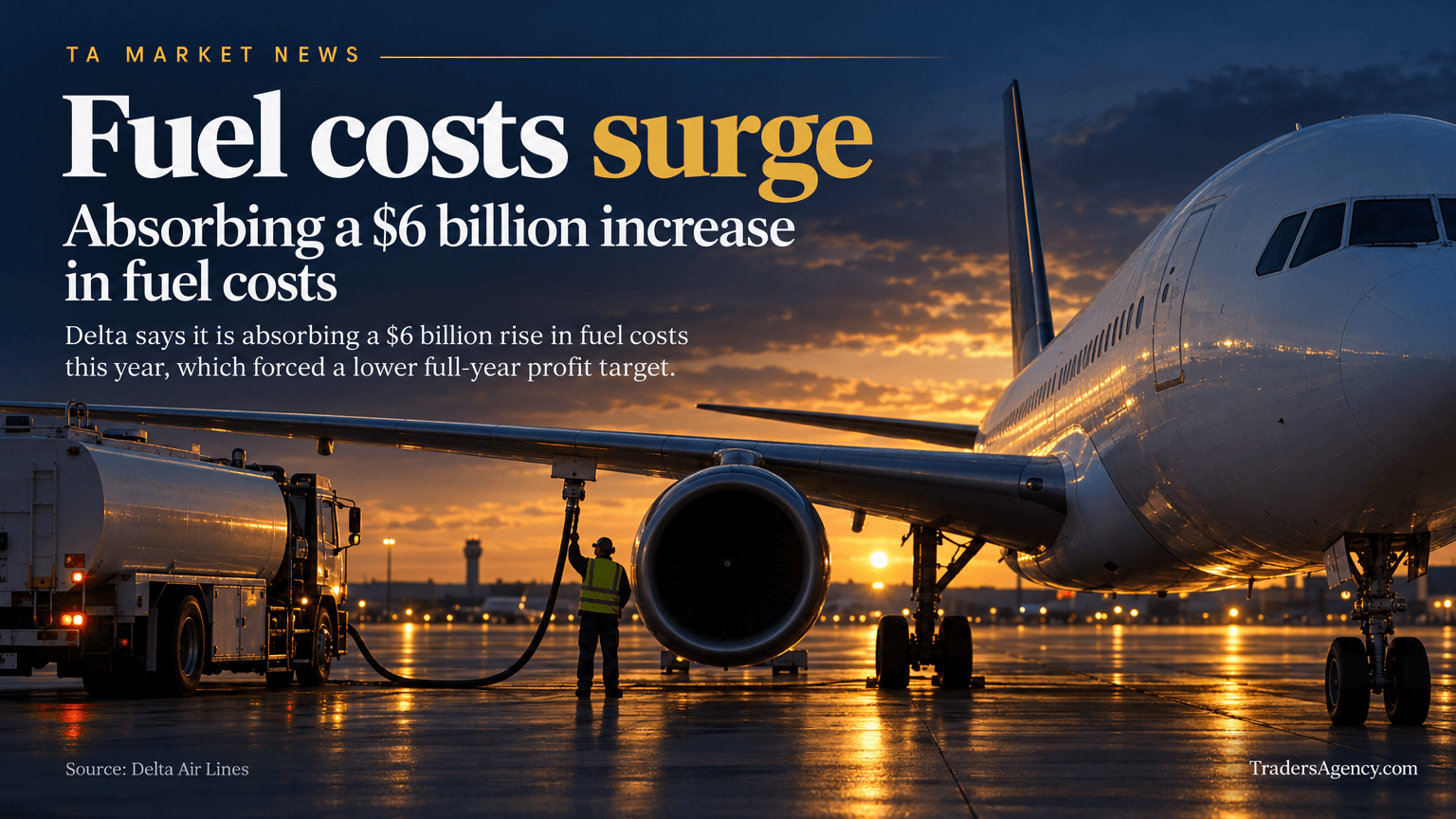
CEO Ed Bastian said in the release that Delta now expects full-year pre-tax profit of roughly $4.5 billion while "absorbing a $6 billion increase in fuel costs." Seeking Alpha separately reported that Delta now forecasts full-year adjusted earnings of about $5.35 per share, below Bloomberg's $5.44 estimate, a gap of 9 cents, or about 1.65% (our calculation: 5.35 minus 5.44, divided by 5.44), attributing the shortfall in part to the higher fuel bill. CNBC reported that Delta also cut its free-cash-flow outlook for the year to $2.5 billion from as much as $4 billion it had projected in July, a reduction of $1.5 billion, or 37.5% (our calculation: 2.5 minus 4, divided by 4).
CNBC tied the fuel-price surge to the Iran war that began in February and noted that the latest inflation reading, from September, showed airfare up more than 23% from a year earlier. Delta's own forward-looking risk disclosure flagged "increases in the price of aircraft fuel" and "extended disruptions in the supply of aircraft fuel," including risks tied to Monroe Energy, its wholly owned subsidiary that operates the Trainer, Pennsylvania refinery.
Demand Still Strong, Premium Revenue Outpaces Main Cabin
Despite the cost pressure, Bastian struck a confident tone on demand. In the release, he said demand "remains strong, supported by consumers' growing preference for experiences and travel," adding that air travel "continues to be one of the best values in the consumer economy." He said September-quarter pre-tax profit of $1.5 billion matched the prior year's performance, with $1.9 billion of free cash flow generated year-to-date.
In an interview reported by CNBC, Bastian said fares have continued to rise as Delta passes along much of the fuel-cost increase, and that bookings have not slowed: "The consumer response continues to be quite strong. We're seeing it across all channels, all cabins of service, all geographies, business, leisure," he said.
That strength showed up unevenly across the cabin. Premium revenue grew 18% in the quarter to $6.82 billion, CNBC reported, edging past main cabin sales, which rose 12% to $6.8 billion, a difference of about $20 million, or 0.3% (our calculation: 6.82 minus 6.8, divided by 6.8). CNBC noted premium revenue has become a larger portion of Delta's total sales. Separately, Seeking Alpha's chart-based review of the results reported that non-fuel unit costs, or non-fuel CASM, ticked up even as fuel costs surged — which, by interpretation of that report, points to cost pressure extending beyond jet fuel alone.
Fourth-Quarter Guidance Tops Growth Estimates but Still Disappoints
Delta guided to roughly 20% revenue growth for the fourth quarter, well above the 13.5% consensus compiled by Seeking Alpha, a gap of 6.5 percentage points, or about 48% above the consensus figure (our calculation: 20 minus 13.5, divided by 13.5). CNBC reported that the 20% projected growth tops the third quarter's 16% adjusted increase, with Bastian noting fuel-price volatility as a factor: "Obviously the fuel pricing, the volatility of fuel prices have something to do with that," he said. Even so, CNBC reported that Delta's overall fourth-quarter guidance came in below analyst estimates, and Seeking Alpha reported that Delta shares fell as higher fuel costs pressured margins and the outlook missed expectations.
Management's Longer-Term Framing

Bastian framed the quarter's performance as evidence of "structural durability" built over years, which he said allowed Delta to navigate "one of the most elevated fuel environments in recent times," according to the company's release. He reiterated a long-term financial framework targeting mid-teens margins and returns, durable free cash flow, and gross leverage of approximately one times. Those are stated long-term goals rather than near-term guidance; by interpretation, the quarter's reported 9.4% non-GAAP operating margin and 8.5% non-GAAP pre-tax margin sit below that mid-teens target in a year Bastian said includes a $6 billion fuel-cost increase.
Bottom Line
Delta's first earnings miss in two years was driven less by weak demand than by a fuel bill that CNBC linked to the Iran war that began in February. Premium travel and fares held up, and fourth-quarter revenue growth guidance of roughly 20% outpaced the 13.5% consensus compiled by Seeking Alpha, but the scale of the cost increase was enough to push full-year profit and free-cash-flow targets lower, and Delta shares fell after the release, according to Seeking Alpha. The next test is whether fuel costs stabilize and whether other carriers — Delta was the first to report third-quarter results, per CNBC — face a similar squeeze.
DISCLAIMER: Traders Agency does not offer financial advice. The information provided is for educational purposes only and should not be considered financial advice. Traders Agency is not responsible for any financial losses or consequences resulting from the use of the information provided. Trading carries inherent risks and may not be suitable for all individuals. You are advised to conduct your own research and seek personalized advice before making any investment decisions, recognizing the potential risks and rewards involved.
- CNBC Top News: Delta Air Lines (DAL) Q3 2026 earnings · accessed Oct 9, 2026
- Seeking Alpha Market News: Delta Air Lines Non-GAAP EPS of $1.72 misses by $0.04, revenue of $20.2B beats by $1.28B · accessed Oct 9, 2026
- Seeking Alpha Market News: Delta Air Lines in charts: Non-fuel CASM ticks up as fuel costs surge · accessed Oct 9, 2026
- Delta Air Lines: Delta Air Lines announces September quarter 2026 financial results · accessed Oct 9, 2026
- Seeking Alpha Market News: Delta falls as higher fuel costs pressure margins, outlook misses · accessed Oct 9, 2026
See more from Traders Agency on Google
Make us a preferred source and our market analysis will appear more prominently in your Google Search, Top Stories, and AI results.
Add to Preferred Sources