You've probably seen the financial headlines: a massive corporation announces a multi-billion dollar stock repurchase program, and the stock price jumps immediately. What exactly is happening behind the scenes? A share buyback is a corporate action where a company purchases its own outstanding shares from the open market, reducing the total number of shares available to the public. Getting share buybacks explained properly is essential for any trader looking to understand fundamental analysis and market mechanics.
We'll walk you through exactly how these repurchases work and why management teams choose them. Our team recommends learning this concept because it directly impacts the valuation metrics you use every day. Many novice traders see a repurchase announcement and blindly buy the stock, completely ignoring the underlying financial health of the business. We want to help you avoid that trap.
By the end of this guide, you'll know how to calculate buyback yield and spot the difference between value-creating and value-destroying repurchases. You'll also learn how to apply this data to your trading strategy. We'll cover the exact steps to verify if a company is actually retiring shares or just masking executive compensation.
What Is a Share Buyback? A Simple Explanation
Bottom Line: Share buybacks are not automatically bullish signals. The real question is whether a company is genuinely retiring shares and buying them at a reasonable valuation, or using repurchases to mask dilution from stock-based compensation. Learning to calculate buyback yield and cross-check actual share count changes in filings is what separates a meaningful signal from a misleading headline.
A share buyback occurs when a publicly traded company uses its cash reserves to purchase its own shares from the open market. These shares may be cancelled (retired) or held as treasury stock, which reduces the total supply of outstanding stock. As a result, each remaining share represents a larger ownership percentage of the company.
Think of a company like a pizza cut into ten slices. If the company buys back two slices and destroys them, the pizza is now divided among eight slices. The total size of the pizza has not changed, but each remaining slice holds more cheese and pepperoni.
Key Concept: A share buyback reduces the number of outstanding shares, which increases each remaining shareholder's ownership stake in the company. Fewer shares outstanding means each share represents a bigger piece of the pie.
When we teach fundamental analysis, we always start with this concept. Having share buybacks explained through the lens of supply and demand makes the price action easier to understand. Fewer shares available on the open market generally supports higher stock prices, assuming demand remains constant.
Why Do Companies Buy Back Shares Instead of Paying Dividends?
Companies buy back shares instead of paying dividends because repurchases offer greater flexibility and better tax efficiency for investors. While dividends require a long-term commitment and trigger immediate taxable income for shareholders, buybacks allow management to return capital only when excess cash is available without creating immediate tax liabilities.
This directly answers how share buybacks return cash to shareholders. Instead of handing you a physical check, the company increases the intrinsic value of the shares you already own. You only pay taxes when you eventually sell your shares at a profit.
Our team prefers to see buybacks when a stock is deeply undervalued. If management believes the broader market is pricing their stock too low, buying their own shares is the best possible investment they can make. It signals supreme confidence in their future cash flows.
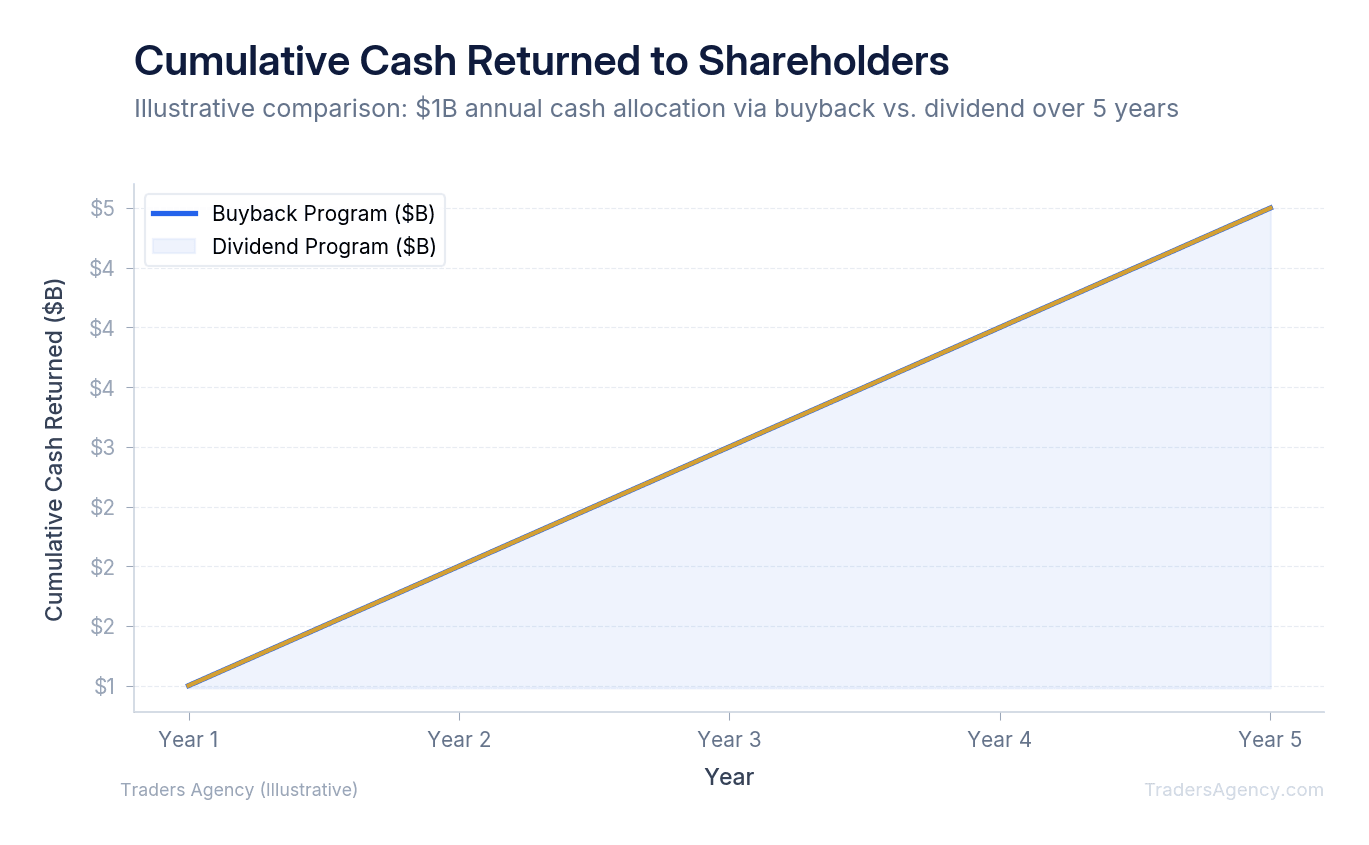
Dividends send a strong signal of financial stability, but cutting a dividend usually causes a massive stock sell-off. Repurchase programs do not carry the same rigid expectations from Wall Street analysts. A company can pause or accelerate its buying based on current market conditions.
If a recession hits, management can quietly halt their open-market purchases to preserve cash. They cannot do that with a quarterly dividend without causing a panic. This flexibility makes repurchases the preferred capital allocation tool for modern corporate boards.
How Do Buybacks Affect Earnings Per Share and Stock Price?
Share buybacks mathematically increase a company's Earnings Per Share (EPS) by reducing the denominator in the EPS formula. If net income stays exactly the same but the total number of outstanding shares decreases, the earnings attributed to each remaining share will automatically increase, making the stock appear more profitable.
This is where share repurchase accounting comes into play. When a company buys its own stock, those shares become "treasury stock" on the corporate balance sheet. They no longer have voting rights, and they do not receive dividend payments.
Here's the basic math. If a company earns $10 million in net income and has 10 million shares outstanding, the EPS is $1.00. If the company buys back 2 million shares, the outstanding share count drops to 8 million. That same $10 million in net income now generates an EPS of $1.25.
| Metric | Before Buyback | After Buyback |
|---|---|---|
| Net Income | $10 million | $10 million |
| Shares Outstanding | 10 million | 8 million |
| Earnings Per Share | $1.00 | $1.25 |
| EPS Increase | +25% |
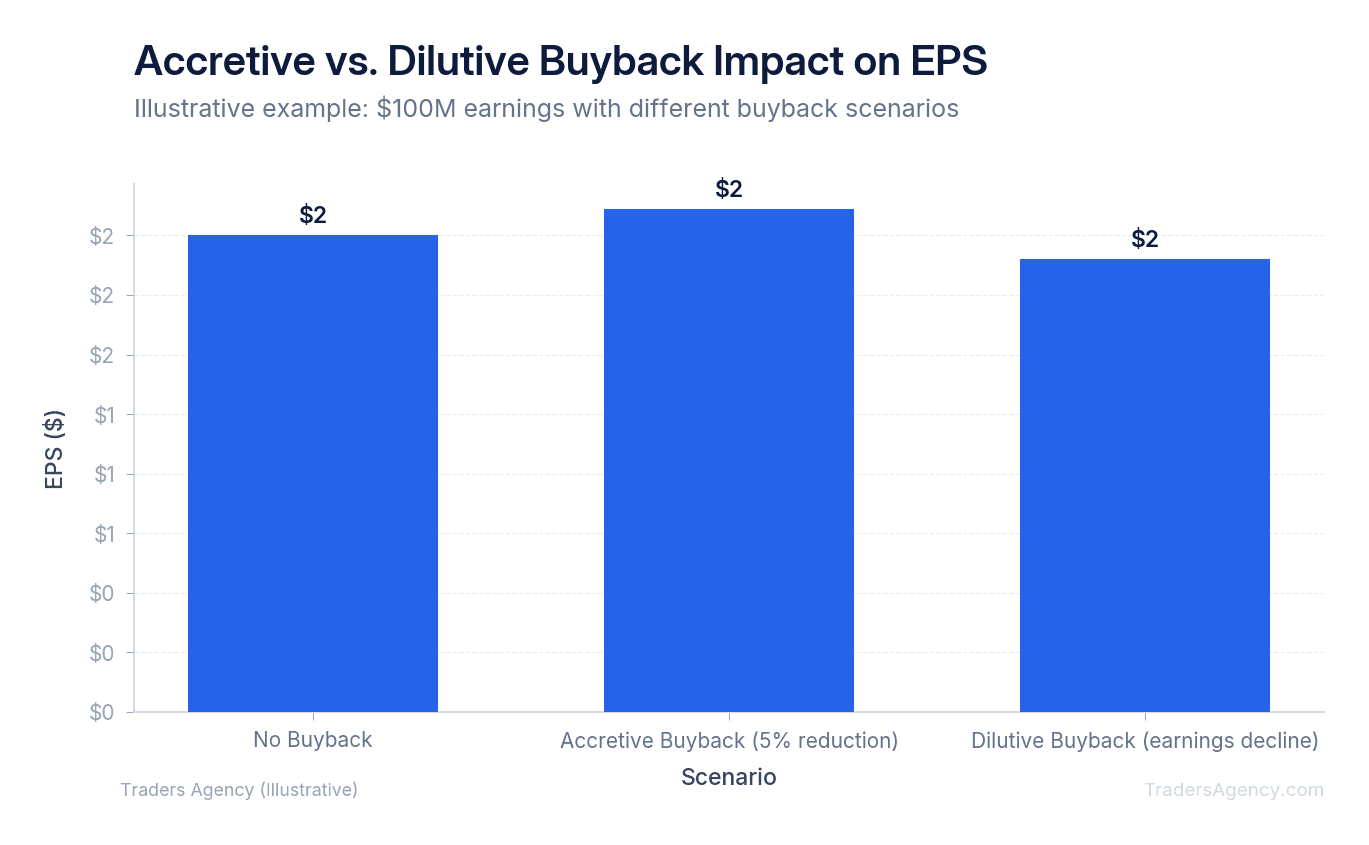
Because Wall Street values companies based on price-to-earnings multiples, a higher EPS typically leads to a higher stock price. This financial engineering can mask flat revenue growth. Our team always checks the top-line revenue to ensure the company is actually growing, rather than just shrinking its share count.
Watch Out: A rising EPS does not always mean a healthier business. If revenue is flat or declining while EPS grows, the company may be using buybacks to disguise stagnation. Always verify that top-line growth supports the EPS trend.
Step-by-Step: A Buyback Example in Action
To make this practical, we'll walk through a concrete example. We'll look at a hypothetical company, TechCorp, to see exactly how this plays out for an active trader. We'll track the numbers from the initial announcement to the final execution.
- Step 1: The Setup. TechCorp has 100 million shares outstanding, trading at $50 per share. The company has a total market capitalization of $5 billion. TechCorp generates $500 million in net income, giving it an EPS of $5.00. The stock trades at a Price-to-Earnings (P/E) ratio of 10. Management announces a $500 million share repurchase authorization.
- Step 2: The Execution. Over the next six months, TechCorp uses its cash reserves to buy shares on the open market. Because they are buying at an average price of $50, the $500 million allows them to repurchase 10 million shares. The total outstanding share count drops from 100 million to 90 million. The accounting department records these as treasury shares.
- Step 3: The Outcome. Assuming net income remains flat at $500 million, we now divide that profit by the new share count of 90 million. The new EPS jumps to $5.55. If the broader market continues to value TechCorp at a P/E multiple of 10, the new stock price should adjust to $55.50.
| Parameter | Before Buyback | After Buyback |
|---|---|---|
| Shares Outstanding | 100 million | 90 million |
| Net Income | $500 million | $500 million |
| EPS | $5.00 | $5.55 |
| P/E Multiple | 10x | 10x |
| Implied Stock Price | $50.00 | $55.50 |
| Shareholder Gain | +11% |
As a trader, you did absolutely nothing, yet your shares increased in value by 11%. This is the exact mechanism we look for when screening for companies with active repurchase authorizations. However, you must remember that authorizations do not obligate the company to actually buy the shares.
Want expert trading insights delivered daily?
Join thousands of traders who rely on Traders Agency for market analysis and trade ideas.
Join Traders AgencyWhat Is the Difference Between Accretive and Dilutive Buybacks?
Not all share repurchases benefit investors. Accretive buybacks increase the intrinsic value of remaining shares by purchasing stock below its fair value. Dilutive buybacks occur when a company overpays for its own stock or issues so many new shares for employee compensation that the buyback merely offsets the dilution.
To evaluate a repurchase program, we teach our members to calculate the buyback yield. You find this by taking the total dollar amount spent on repurchases over the last 12 months and dividing it by the company's total market capitalization.
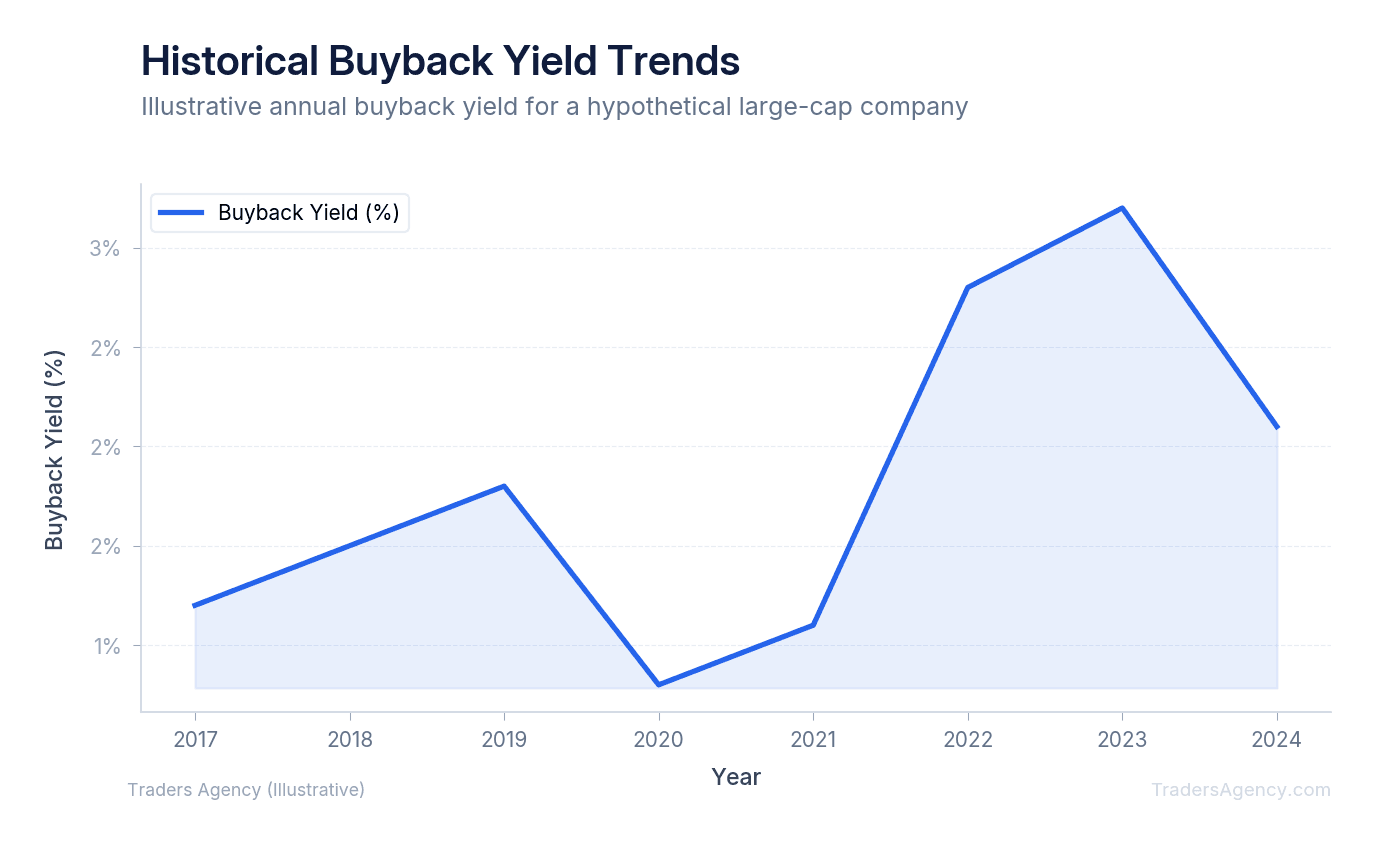
If a $10 billion company spends $500 million buying back stock, the buyback yield is 5%. You can combine this with the dividend yield to find the total shareholder yield. We use stock screeners to filter for companies with a shareholder yield above 8%.
You can find exact share count data in a company's quarterly 10-Q filings or annual 10-K filings with the Securities and Exchange Commission (SEC). Look at the balance sheet under "Treasury Stock" to see the accumulated repurchases. Then, check the cash flow statement under "Cash Flows from Financing Activities" to see exactly how much cash was actually spent during that specific quarter.
Many screeners will show a declining share count, but checking the SEC filings confirms the reality. If the cash spent does not match the reduction in shares, management is likely issuing heavy stock-based compensation to themselves.
Key Concept: Buyback Yield = (Total Repurchase Spending over 12 months) ÷ (Market Capitalization). Combine this with dividend yield to get Total Shareholder Yield. Our team screens for companies with a total shareholder yield above 8%.
Is a Share Buyback Good or Bad?
A share buyback is generally a good thing when a company has excess cash, lacks better growth opportunities, and its stock is trading below intrinsic value. However, a buyback is a bad thing if the company borrows money to fund it or buys shares at inflated, overvalued prices.
Understanding the advantages and disadvantages of buybacks will keep you out of bad trades. The primary advantage is downside support. A massive corporate buyer stepping into the market creates buying pressure, absorbing selling pressure during market corrections.
However, the biggest red flag is debt-funded repurchases. If management takes out high-interest corporate bonds just to buy back stock and artificially inflate their EPS, they are putting the entire company at risk of bankruptcy during a downturn.
Here are the criteria our team uses to evaluate if a buyback is actually good for your portfolio:
- Free Cash Flow: The company must generate enough cash from operations to fund the purchases without taking on new debt.
- Valuation: The stock should be trading at a reasonable P/E ratio compared to its historical average. Buying overvalued stock destroys capital.
- Share Count Reduction: The outstanding share count must actually go down. If the company buys 5 million shares but issues 6 million shares to executives as stock options, you are still being diluted.
- Alternative Investments: The company should not be sacrificing necessary research and development just to prop up the stock price.
Watch Out: If a company announces a buyback but its total share count stays flat or increases year over year, management is likely using the repurchase program to offset heavy stock-based compensation. Always compare the buyback spending to the actual change in diluted share count.
What Are the Tax Implications of Stock Buybacks?
The regulatory environment for stock repurchases has shifted significantly over the decades. Historically, buybacks faced strict manipulation rules, but modern safe harbor regulations allow companies to repurchase shares within specific guidelines. Recently, new tax laws have introduced a 1% excise tax on corporate repurchases to encourage alternative uses of capital.
Many new traders wonder why stock buybacks were once considered illegal. Before 1982, the SEC viewed large-scale open market repurchases as potential market manipulation. Companies feared that buying their own stock would trigger federal investigations for artificially propping up share prices.
This changed when the SEC adopted Rule 10b-18. This rule created a "safe harbor" that protects companies from manipulation charges as long as they follow specific guidelines. For example, a company cannot purchase more than 25% of the average daily trading volume on any single day. They also cannot make purchases during the final portion of the trading session.
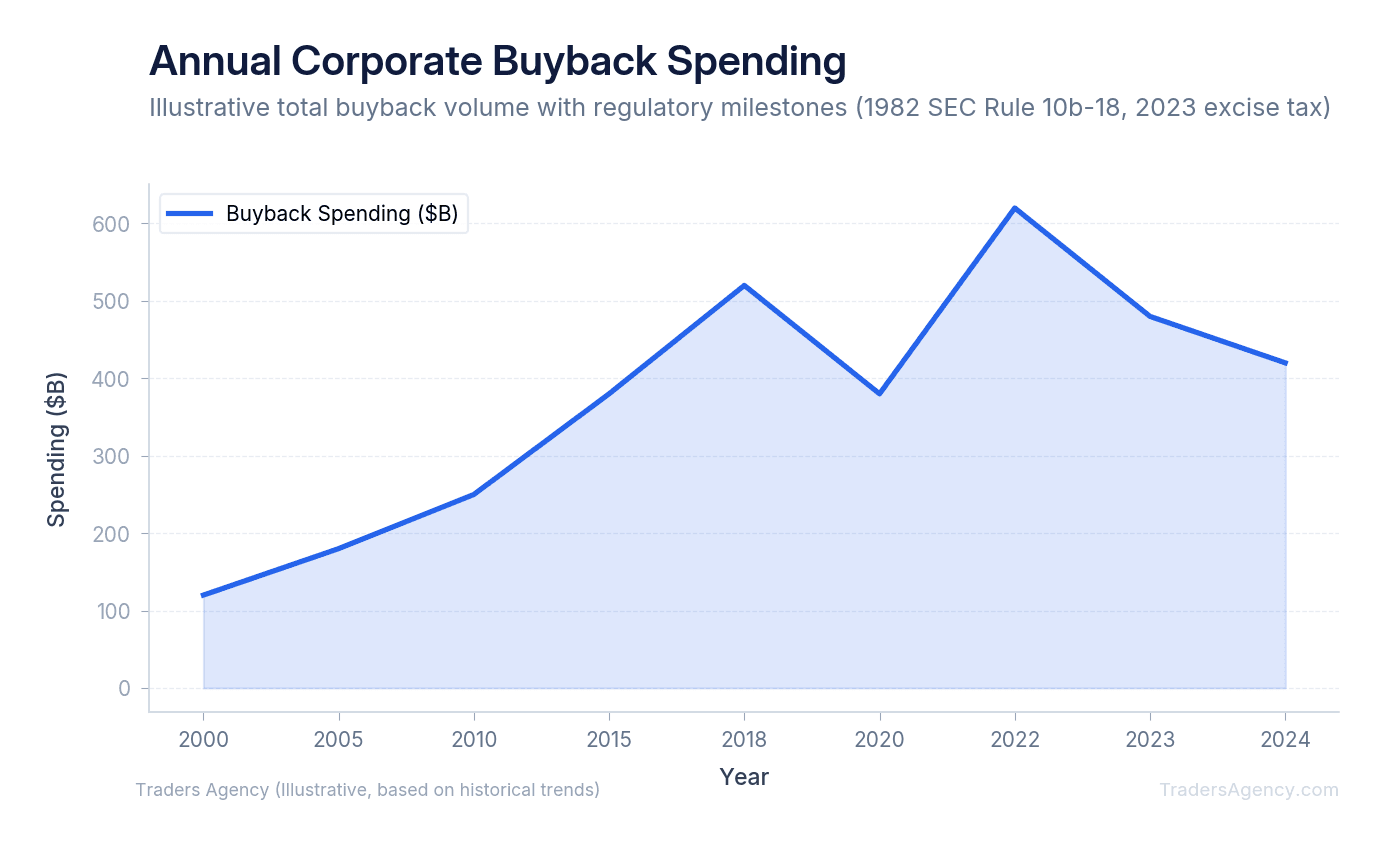
Today, the regulatory environment is shifting again. In 2023, the U.S. government implemented a 1% excise tax on the net value of stock repurchases. While 1% is not enough to stop highly profitable tech giants from buying back shares, it does change the math for management teams deciding between buybacks, dividends, or internal investments.
Having share buybacks explained in the context of these taxes helps you anticipate corporate behavior. If the excise tax increases in the future, our team expects to see a shift back toward special dividends as the preferred method of returning cash to shareholders. We constantly monitor these regulatory changes to keep our trading strategies aligned with corporate cash flows.
The Traders Agency education team publishes new strategy guides and market analysis every week.
Want expert trading insights delivered daily?
Join thousands of traders who rely on Traders Agency for market analysis and trade ideas.
Join Traders AgencyKey Takeaways
- A share buyback reduces the total number of shares outstanding, which mechanically increases earnings per share (EPS) even if net income stays flat.
- Buybacks can be accretive or dilutive depending on whether the company is retiring shares or simply offsetting new shares issued as executive compensation.
- You can calculate buyback yield by dividing the dollar value of repurchases by the company's market capitalization, giving a cleaner picture of actual capital return.
- As of recent U.S. tax law, share buybacks are subject to a 1% excise tax, a regulatory shift that may influence whether companies favor buybacks or special dividends going forward.
- A repurchase announcement alone does not confirm shares are being retired. Verifying the actual share count reduction in financial filings is a necessary step before treating a buyback as value-creating.
DISCLAIMER: Traders Agency does not offer financial advice. The information provided is for educational purposes only and should not be considered financial advice. Traders Agency is not responsible for any financial losses or consequences resulting from the use of the information provided. Trading carries inherent risks and may not be suitable for all individuals. You are advised to conduct your own research and seek personalized advice before making any investment decisions, recognizing the potential risks and rewards involved.
See more from Traders Agency on Google
Make us a preferred source and our market analysis will appear more prominently in your Google Search, Top Stories, and AI results.
Add to Preferred Sources