


Rapid7 Stock: Why the Cheapest Cybersecurity Play Just Tripled
Rapid7 stock (RPD) has tripled since April, and it's still the cheapest cybersecurity stock in its entire industry by a mile. The sector leader trades for 48 times sales. Rapid7 trades for about one and a half. That gap is the whole story, and it's why I bought 700 shares of this name.
Agentic AI is creating a brand new security problem inside every major company in America, and Wall Street has already priced that opportunity into CrowdStrike, Palo Alto, Qualys, and Tenable. Rapid7 is the one name in the group that hasn't caught up, and the chart says that's changing fast.
Why Is Rapid7 Stock Soaring Right Now?
Bottom Line: Rapid7 stock tripled off its lows because it is still priced far below rivals like CrowdStrike and Palo Alto even as the same agentic AI security demand lifts the whole sector. The breakout, heavy volume, and shrinking pullback supply suggest the cheap valuation gap may be starting to close, with $20 to $25 flagged as the next zone to watch.
A twelve-day move from $12 to $16
Rapid7 stock sat at $12 just twelve days ago. It tacked on 9% Thursday, a couple more percent Friday, and another 8% the session after that. This stock once traded for far more per share than it does today, which is exactly why it still has room to run.
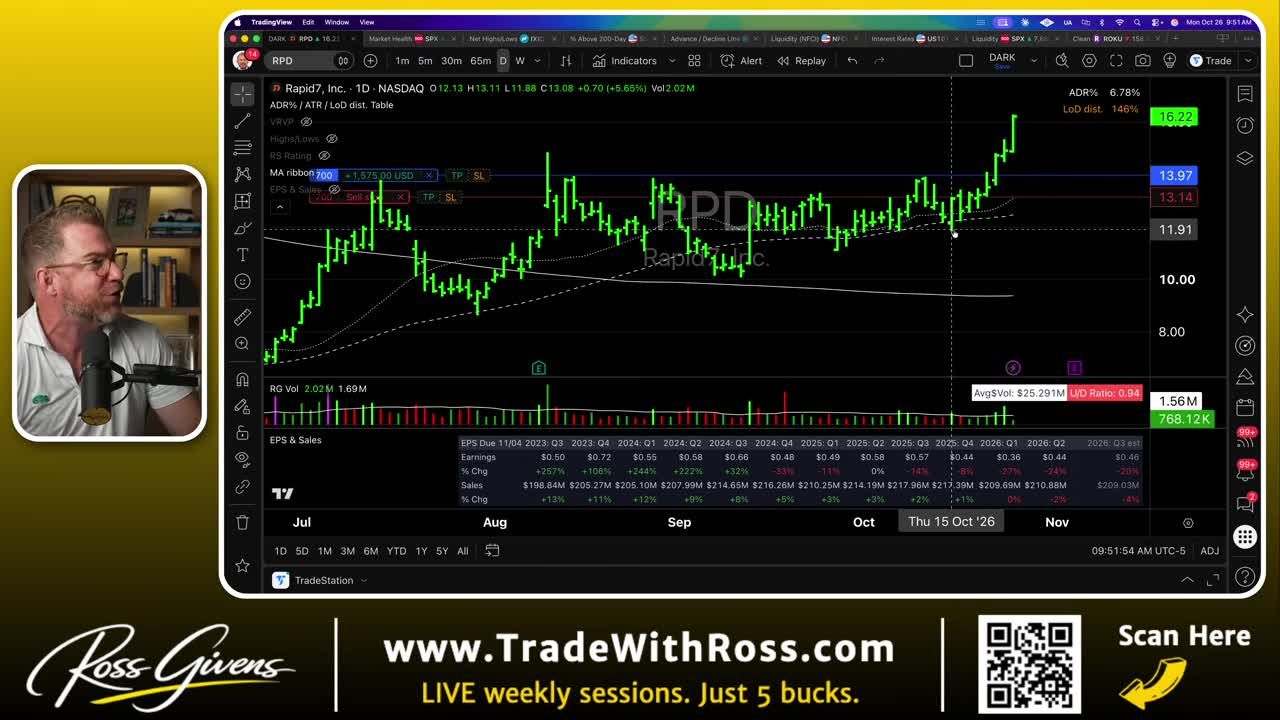
This is a classic breakout. Years of supply and selling hammered the stock down until it got cheap enough that demand finally stepped in. RPD ran from $6 to $14 in about a week and a half on what I'd call massive institutional buying. Purple candles on the chart, the highest up-volume in at least a year, showed up in April, May, and June. Each one was a sign of big money powering into the stock.
Then came the basing formation, the kind of consolidation pattern that shows up when the big shops and hedge funds are quietly accumulating. Each pullback got shallower moving from left to right: roughly 35%, then about 26%, then 14%, then 10%.
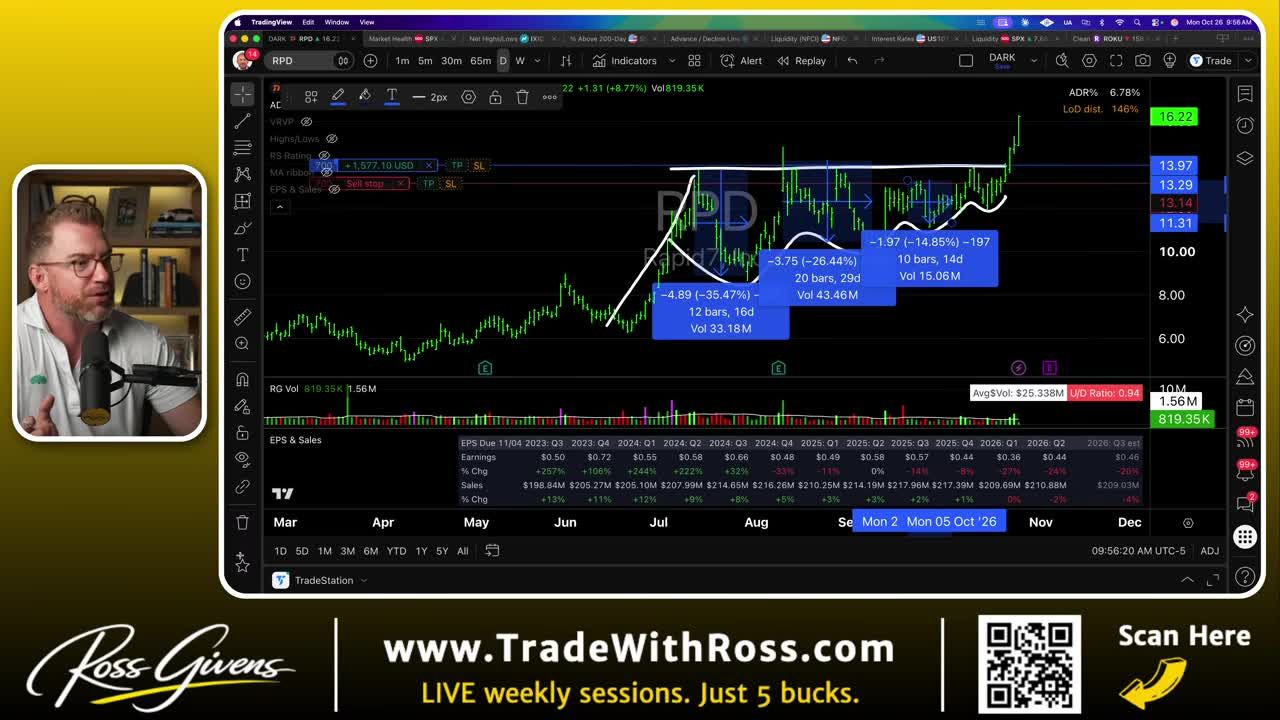
That shrinking supply is exactly why I bought where I did, right at the breakout line. My risk on the entry was 5.8%. Since Thursday, the position is already up 16.5%, about three times the risk. The last major acceptance area for this stock sits in the $20 to $25 range, which lines up with where analysts are valuing it.
The Agentic AI Problem
Every AI agent is another door into the building
Until recently, AI was just a chatbot. You asked a question, it gave an answer, end of story. That's not what's happening anymore.
Today it's agentic AI: programs that don't just answer questions, they act. They log into systems, write emails, move files, create code, approve invoices. They behave like employees, and every one of those digital employees needs a login, a password, and access to company data.
From a hacker's point of view, every AI agent a company turns on is another door into the building. Most companies don't even know how many doors they have, let alone how those systems work. Gartner, the research firm big corporations pay to tell them where to spend money, put agentic AI at the top of its list of cybersecurity trends for 2026. Gartner's take: it's creating new attack surfaces faster than security teams can contain them, and it's already out of control.
It isn't just Gartner saying this. In April, KeyBank surveyed chief information officers at major companies and confirmed that AI is going to push cybersecurity budgets significantly higher. Rapid7 jumped 7% that day on that single piece of commentary.
Get an entire year of live weekly mentoring sessions, my newsletter, indicators, bonus reports, tons more. Click the link and I'll see you in the next live session.
Join my Black Ops Trading ClubWhat Does Rapid7 Actually Do?
A rented security team, armed with AI
Rapid7 operates like a security team you rent. Outside of giants like Coca-Cola, most companies can't afford to hire a room full of security experts watching systems around the clock, and there aren't even enough qualified experts to go around.
Rapid7's software watches everything connected to a client's network: laptops, cloud accounts, logins. Its analysts jump on anything suspicious, a service called Managed Detection and Response (MDR). The company currently has 11,500 customers.
Here's where AI changes the equation. A company gets thousands of security alerts every day, and humans simply cannot look at all of them, so most never get examined. A hacker only needs one to slip through. Add a few thousand AI agents to a network and alert volume doesn't just grow, it explodes into the millions. You can't hire your way out of that.
So Rapid7 decided to fight AI with AI. In March, it acquired Kinzo Security, which builds teams of AI agents that investigate security alerts with no human interaction. One agent gathers evidence, another checks it against known threats, another decides what action to take.
Instead of a security team catching one alert out of eight or nine and hoping for the best, the software now looks at every single one. Rapid7 is plugging that technology directly into its MDR service, and the company also says it has access to Anthropic's newest frontier AI models through a program called Project Glasswing. The end result: a rental security business that just handed its analysts an army of AI agents working at machine speed. Each analyst can now cover more customers, which is how a service business scales into a far more profitable one.
The Valuation Gap
14 cents of cash flow for every dollar you pay
The numbers here are hard to ignore. Over the last 12 months, Rapid7 generated about $145 million in free cash flow, the actual cash left over after paying every bill, while the entire company is valued at roughly $1 billion.
All four companies ride the same agentic AI tailwind, but Rapid7 throws off more than two and a half times the cash of its nearest rival. On a forward earnings basis, Rapid7 trades at about 8 times forward earnings, a multiple you'd expect on a bank or a business that isn't growing, not a cybersecurity company sitting inside the biggest technology shift of a generation.
Software companies tend to get valued on a multiple of sales rather than earnings, looking at the full value of the business including debt against total revenue. CrowdStrike trades at 48 times sales. Qualys, about 10 times. Tenable, roughly 5 times. Rapid7, about 1.5 times.
Rapid7 brings in $856 million a year in total sales, and the whole company is worth just over $1 billion. If RPD gets repriced to even half of Tenable's multiple (2.4 times sales), the business is worth a little over $2 billion. That's a double from current levels, even after accounting for debt, and it would put the stock somewhere in the mid-$20s. Right now it sits at $16, priced at half the multiple of the cheapest competitor in the group.
One more data point worth sitting with: private equity firms valued this company at $2.5 billion back in 2024. Today it's worth about $1 billion, despite being leaner, more profitable, and now armed with AI tools the 2024 version of the company didn't have.
Why Has RPD Stock Been So Cheap?
Rapid7 stock has been under pressure for years, trading at a fraction of where it once traded per share. Even after tripling off its lows, RPD is still down relative to where it started the year and sits well below past highs, which explains why it remains the cheapest name in its industry on a sales basis.
The stock spent years getting hit by nothing but supply and selling until it became cheap enough that institutional buyers finally stepped back in. That long decline is exactly why the current multiple, 1.5 times sales versus 48 times for the sector leader, looks so disconnected from the company's actual cash generation and its position inside the agentic AI trend.
Is Rapid7 a Buy
A laggard inside a leading sector
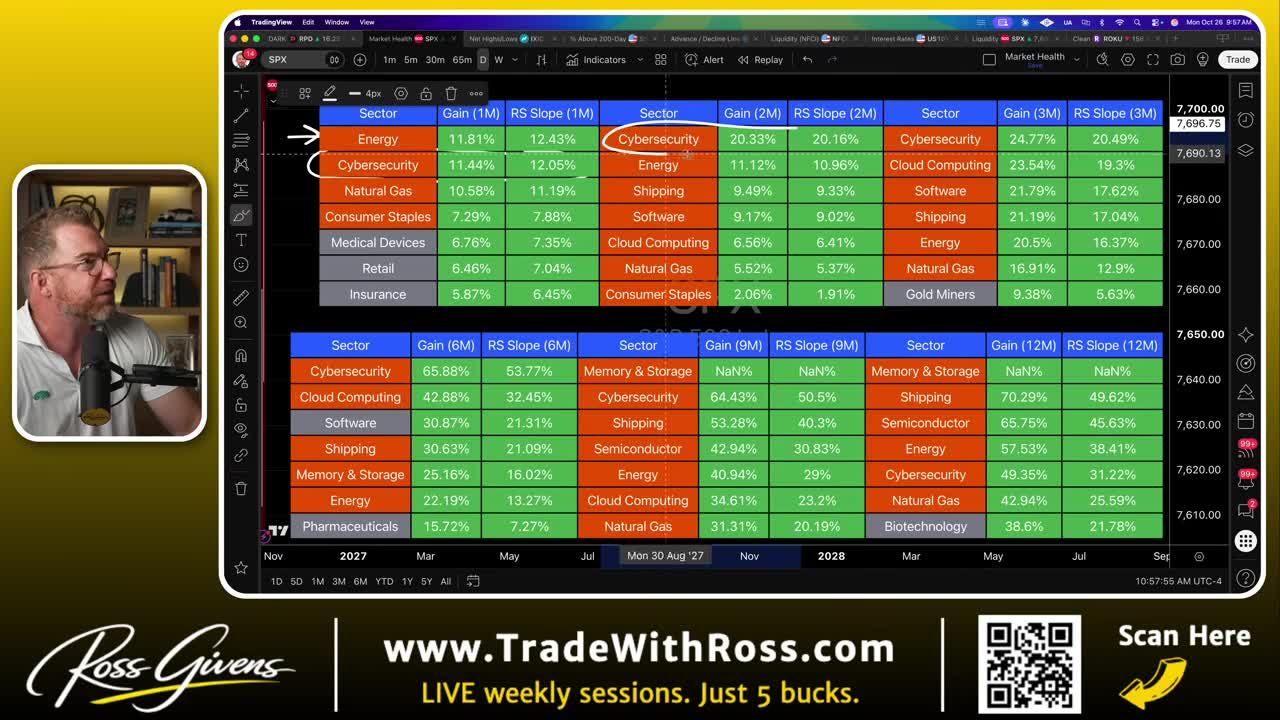
Cybersecurity has been a consistently leading industry group over the last one, two, and three month periods, trailing only energy over the past month because of the situation with Iran. That's a sign institutional money is flowing into this space broadly, and Rapid7 is simply playing catch-up to peers that already made their move.
- CrowdStrike: up about 97% over the last year
- Palo Alto: up 77%
- Qualys: up 77%
- Tenable: up 57%
- Rapid7: the lone laggard, now breaking out
Rapid7 has tripled since April, yet it's still down relative to where this stock traded in years past, which suggests the recovery is early rather than late. Whether it's a buy for you depends on your risk tolerance, but sector strength, a technical breakout, and a valuation sitting at half the cheapest competitor's multiple is a setup worth paying attention to.
Price Target: $20 to $25
The last major acceptance area for Rapid7 sits in the $20 to $25 range, which roughly lines up with where analysts have been valuing the business. If the stock simply gets repriced to half of Tenable's sales multiple, the math points to a company worth a little over $2 billion, roughly double the current $1 billion valuation, even with debt included.
That repricing scenario would put RPD somewhere in the mid-$20s, up from the current $16. None of this requires Rapid7 to out-execute its peers, just to trade at a multiple that's still far below the cheapest name in the group.
Playing Catch-Up, Not Chasing a Top
Rapid7 stock is the cheapest name in a sector that Wall Street has already decided to fund aggressively. CrowdStrike, Palo Alto, Qualys, and Tenable have all made their moves. Rapid7 is just getting started, and the gap between its 1.5 times sales multiple and the rest of the industry is the entire thesis.
This isn't a story stock riding hype. It generates real free cash flow, more per dollar than any direct competitor, and it just bolted AI-driven investigation tools onto a service business that was already profitable. Cheap valuation, a sector tailwind, and a technical breakout with shrinking supply on every pullback: that combination is why I took the position and why I'm holding it.
The risk on my entry was 5.8%, and the stock is already up 16.5% since I bought it. There's a lot more room between here and the $20 to $25 acceptance zone analysts have flagged.
Get an entire year of live weekly mentoring sessions, my newsletter, indicators, bonus reports, tons more. Click the link and I'll see you in the next live session.
Industry trend data referenced from Gartner's 2026 cybersecurity trends list. Company financials and investor materials available via Rapid7's investor relations page.
DISCLAIMER: Traders Agency does not offer financial advice. The information provided is for educational purposes only and should not be considered financial advice. Traders Agency is not responsible for any financial losses or consequences resulting from the use of the information provided. Trading carries inherent risks and may not be suitable for all individuals. You are advised to conduct your own research and seek personalized advice before making any investment decisions, recognizing the potential risks and rewards involved.
See more from Traders Agency on Google
Make us a preferred source and our market analysis will appear more prominently in your Google Search, Top Stories, and AI results.
Add to Preferred Sources