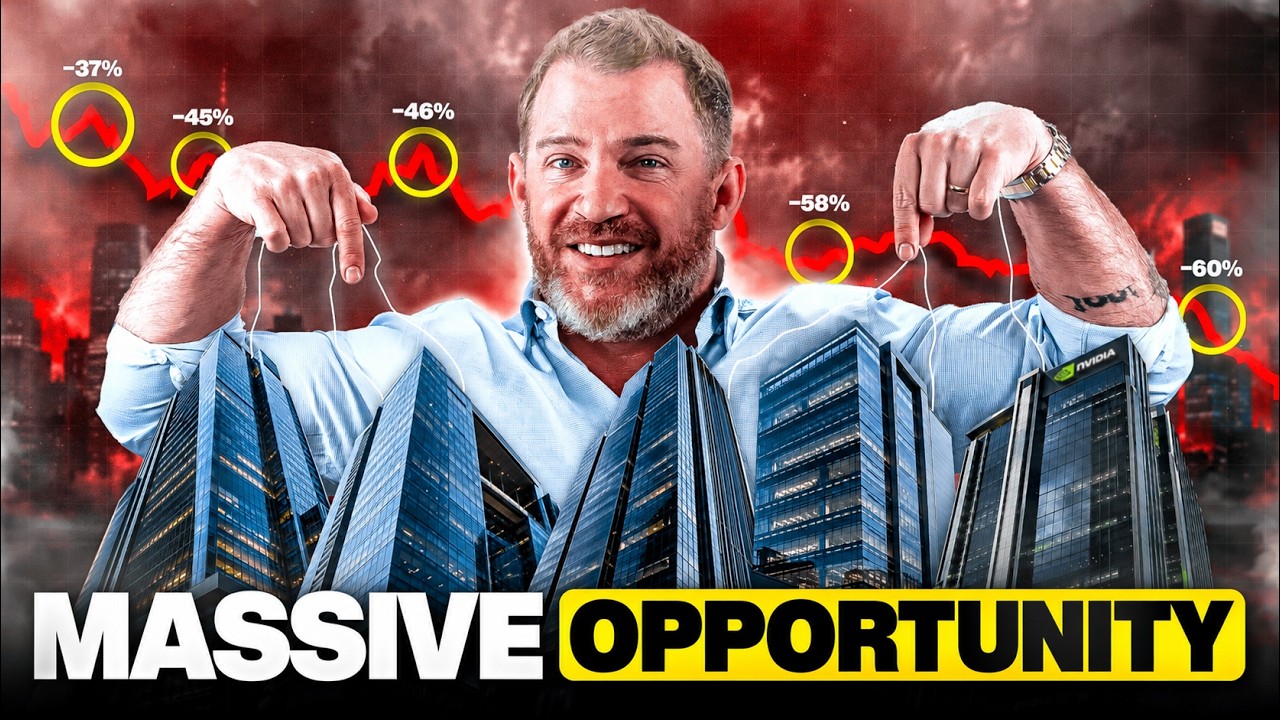
In September 2001, in the middle of a stock buying opportunity almost nobody wanted, you could buy Amazon for about 30 cents a share, split-adjusted. Everybody hated it. The stock was down more than 90%, and the financial press had nicknamed it "Amazon.bomb."
A $1,000 investment near that low would be worth about $839,000 today.
That's what a market bust does. It doesn't just wreck the bad companies. It wrecks the good ones too, and puts them on sale.
We're approaching the next one of those sales, and the size of this stock buying opportunity could rival anything we've seen in 25 years.
What Is a Stock Buying Opportunity?
Bottom Line: A market panic does not just punish weak, overhyped companies; it also drags down strong, cash-generating businesses, creating a window to buy them far below their real value. The edge in that moment goes to investors who already have a specific list of quality companies and target prices set before the sell-off starts, not after.
Strong businesses dragged down by weak ones
A real stock buying opportunity happens when cash-generating companies get sold off alongside the overhyped junk during a broad market panic. The fundamentals haven't changed. Fear has simply pushed the price far below what the business is worth.
This is not chasing a trending stock or guessing which name pops next week. Three things have to line up: a company that can survive a bust without begging anyone for money, a business that makes real money from something other than hype, and a price that actually makes sense. Buying a great company at the wrong price is still a bad investment.
And a huge chunk of the chips NVIDIA sells are going into data centers built for just two companies, OpenAI and Anthropic. Neither one has ever turned a real profit.
Why Does AI Concentration Beat Almost Every Bubble?
There are 41 AI-related stocks that together represent half of the S&P 500. That is a bigger share than tech had in 2000, and bigger than Japan had in 1989. The only time one theme owned more of the market was the railroads in 1881.
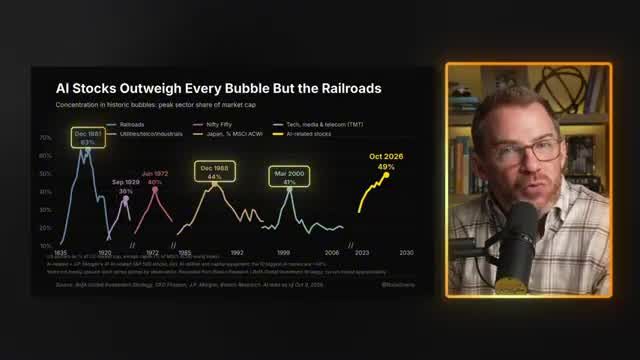
To be fair, that 41-stock group includes names like Apple, Tesla, and some power companies. Count only the 10 biggest AI names and the concentration is closer to 40%. Either way, that's dot-com territory.
Most people hear numbers like that and get scared. I get excited. When a group that big comes down, it takes the good companies down with it, and that is when fortunes get made.
Is Today a Stock Buying Opportunity?
Not yet. Not in the way 2002 or 2009 were. But the conditions that created those windows are building again, and my best guess is cracks start showing within the next 12 months or so. The time to prepare is before the sale starts, not after.
I'm not calling a crash for tomorrow. I'm saying it is eventually coming, and when it does, I already know what I want to buy and at what price.
Here's how big these opportunities get when they land:
- NVIDIA, October 2002: $0.06 a share, split-adjusted. $1,000 near that low is worth $3.5 million today.
- Apple, April 2003: $0.23 a share. $1,000 there is worth $1.5 million.
- Amazon, September 2001: about 30 cents a share. $1,000 there is worth about $839,000.
- Microsoft, March 2009: about $15 a share. $1,000 there is worth about $35,000, a 35-bagger on the biggest company in the world.
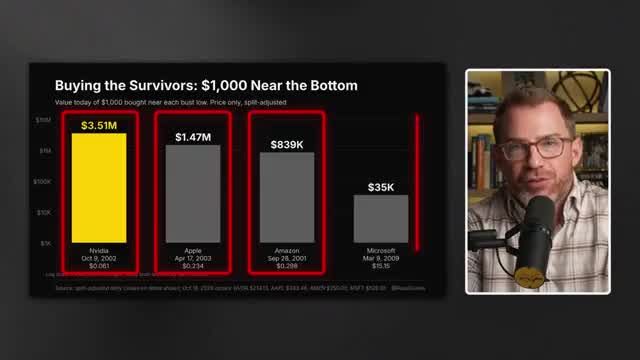
I want to be fair here. These are the winners, picked with hindsight. For every Amazon, there was a pets.com that went to zero, and buying the exact bottom would be luck.
But this part isn't luck: every one of these was a real business with real cash that got thrown out with the trash during the panic. You didn't need to catch the dead low. You needed a list, a price, and the nerve to act when everyone else was selling.
Get an entire year of live weekly mentoring sessions, my newsletter, indicators, bonus reports, tons more. Click the link and I'll see you in the next live session.
Join my Black Ops Trading ClubWhere Do You Hide While You Wait?
The worst thing that can happen in a bust is having no cash when the sale starts.
From the top in March 2000 to the bottom in October 2002, the S&P 500 fell about 47% and the NASDAQ fell 82%. Consumer staples, the toothpaste and cereal companies, were roughly flat, down just 1%. Warren Buffett's Berkshire Hathaway went up 26%. Buffett got laughed at in 1999 for refusing to buy tech. Nobody was laughing the following year.
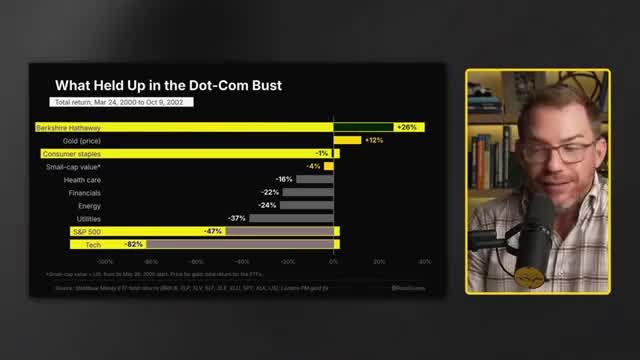
Gold rose 12% over that same stretch. Small cap value stocks, the boring little companies nobody wanted in 1999, fell only 4%. Value beat growth by a mile: the big value index lost about 26%, while big growth lost 57%. Same market, same time, very different outcomes.
Even a plain equal-weight S&P 500 fund, ticker RSP, where every company counts the same instead of being weighted toward the giants, held up far better than a regular index. It wasn't stuffed with the most expensive stocks at the top.
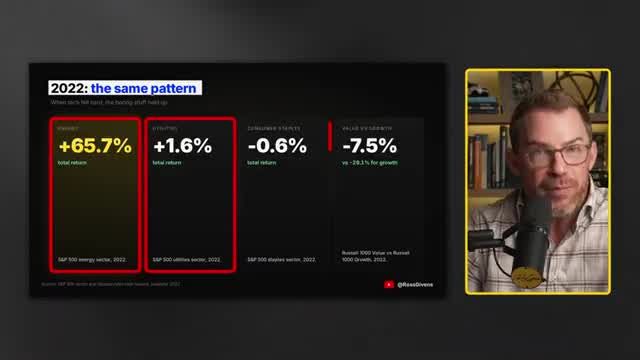
This isn't just a dot-com story. In 2022, when tech fell hard again, energy stocks returned 66%, utilities rose 2%, staples were about flat, value lost just 8%, and growth lost 29%.
Some Old Hiding Places Are Gone
Utilities used to be boring and safe. Not now. J.P. Morgan's own AI basket includes eight utility stocks, because data centers have become the new growth story for power. If AI spending gets cut, those stocks go from safe to very much not safe, fast. Same risk applies to the capital equipment makers selling gear into these data centers.
So this time, the boring list looks more like consumer staples (Johnson & Johnson, Clorox type names), healthcare, insurance, banks that don't lend to data centers, broad-based energy, gold, value, and cash.
What Starts the Next Sale?
The trigger is already visible in the financials of the two biggest AI labs.
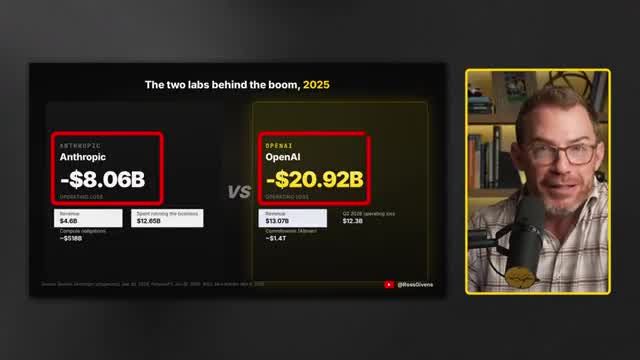
Anthropic, the company behind Claude, lost about $8 billion last year, spending roughly $12.6 billion running the business. The $42 billion figure floating around is an accounting change, not cash out the door.
OpenAI is bigger on both sides of the ledger. Its 2025 financials, leaked and verified by the Financial Times, show $13.07 billion of revenue and an operating loss of $20.92 billion. It hasn't gotten better. In the second quarter of this year, OpenAI lost $12.3 billion running the business on $6.7 billion of revenue, spending almost $3 for every $1 it brought in.
The revenue growth is real. Anthropic told investors it brought in $16.5 billion last quarter, and it even claims profitability once you strip out what it pays employees in stock. (You're not profitable.)
Here's the part nobody talks about enough: Anthropic's IPO filing shows $518 billion of cloud and computing spend it has already agreed to pay for. At today's pace, that's almost eight years of revenue, already spoken for. And growth just slowed, from more than doubling last quarter to about 46% this quarter.
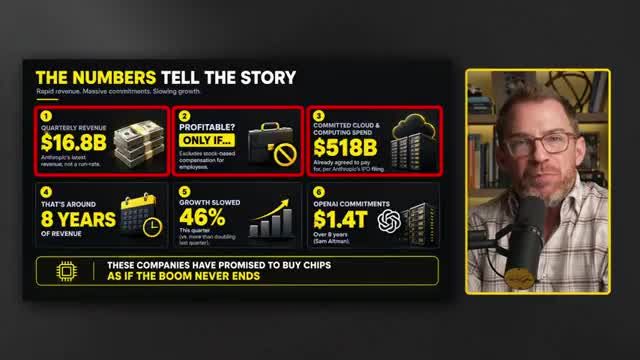
Sam Altman has talked about $1.4 trillion of OpenAI commitments worldwide over the next eight years. These companies have promised to buy chips as if the boom never ends, and that's an enormous amount of money to raise from investors when you aren't generating anywhere near that much.
Who's On the Hook?
- Microsoft owns roughly 27% of OpenAI
- Oracle has a contract with OpenAI worth about $300 billion
- NVIDIA has put up roughly a $105 billion guarantee for an OpenAI data center in Ohio
- AMD gave OpenAI warrants for up to 160 million AMD shares at one penny each
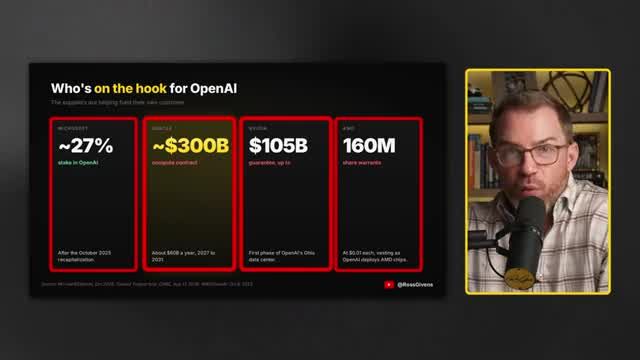
The suppliers are literally helping pay for their own customer. That works fine as long as the customer can keep raising money and keep borrowing. When it can't, here comes the sale.
What Happens When AI Spending Stops?
Most people assume big tech gets crushed, and the stocks probably do at first. But look at the cash.
Last quarter, Amazon, Alphabet, Microsoft, and Meta spent 96% of their operating cash on data center build-outs. Over the last 12 months, those four produced about $150 billion of free cash flow combined, down from $235 billion at the peak a few years ago.
Run the math on what happens if they went back to 2022-level spending as a percentage of sales, with the same revenue they have today. Free cash flow jumps from $150 billion to $414 billion, nearly tripling. Amazon goes from burning $12 billion to making $65 billion. Microsoft more than doubles, from $67 billion to $143 billion.
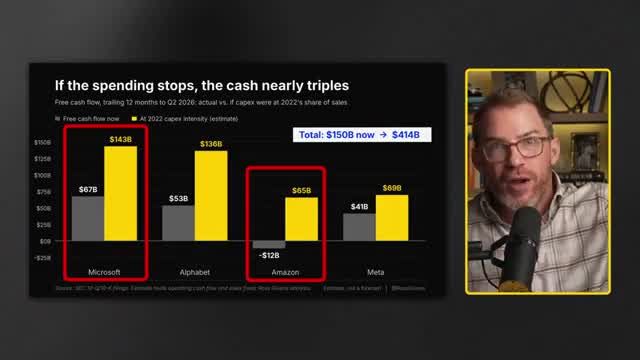
This isn't a fantasy. It already happened. In 2023, after rate hikes pushed the market down, Amazon cut its spending from about $63.5 billion to $52.5 billion, and its free cash flow swung from negative $16.9 billion to positive $32 billion in a single year. Meta's free cash flow more than doubled.
The Crack in the Story
In 2022, these companies paid for everything out of their own pockets. Today, they're borrowing.
- Alphabet: long-term debt from $10.9 billion at the end of 2024 to $98 billion by June, plus another $50 billion raised selling new stock
- Amazon: $58 billion to $133 billion
- Meta: $28.8 billion to $83.7 billion, not counting a separate $27 billion Hyperion bond
- Oracle: $80 billion to $117 billion
- Microsoft: debt actually went down, from $45 billion to $40.3 billion
Microsoft is the only one of the big spenders paying for AI out of its own pocket. If the cash flip happens for the others, a chunk of that new cash goes straight to lenders first. That debt doesn't disappear just because the building stops, and it has to be priced in.
My Buy List and Exact Prices
Five stocks. Each one passed the three tests: survives a bust without begging for money, makes real money outside of AI hype, and comes with a price I'd actually pay. I built a simple bust model for each, what it might earn in a bad year and what a fair price looks like on the other side. These are my estimates, not predictions.
1. Microsoft
Trading around $530. My buy zone is $336 or lower, about a 37% discount. Microsoft fell 38% in 2022 and 65% in the dot-com bust. It's the only major AI spender funding this from cash, and its core business runs on products companies can't just quit using. The 27% stake in OpenAI cuts both ways. If this breaks, Microsoft is probably the first one I want to own.
2. Alphabet
Trading around $346. My buy zone is $189, a drop it has already made before: it fell 44% in 2022, a year with no real tech bubble, just rising interest rates. Alphabet has search, YouTube, Google Cloud, and its own AI chips. The catch is it's now spending about 30 cents of every sales dollar on the build-out, triple what it spent four years ago, and it borrowed to do it. It still holds more cash than debt.
3. Amazon
Trading around $260. My buy zone is $142, about 46% below today's price. Amazon fell 56% in 2022 and 94% in the dot-com bust. It has the biggest potential cash swing of anybody if spending stops, moving from burning $10 to $12 billion to making $60 to $70 billion.
4. Taiwan Semiconductor (TSM)
Trading around $426. My buy zone is 58% lower. TSM fell that same amount in 2022 and 85% in the dot-com bubble. Whoever wins the AI race, whether that's NVIDIA, Google's chips, or someone nobody's heard of yet, the chip almost certainly gets made at Taiwan Semi. It's the toll booth for the entire industry. You just don't want to overpay for it at the peak of the boom.
5. NVIDIA
Trading around $219. My buy zone is $88, about 60% below today's price. That sounds insane for the most valuable company on earth, but NVIDIA traded for $88 a year and a half ago, in 2025. It fell 66% in 2022, 85% in 2008, and 90% in the dot-com bust. It has done this three times. If chip rental prices start falling and the guaranteed deals come due, the hardest-charging stock tends to get hit hardest on the way down.
Stocks I Would Avoid in a Bust
Not every beaten-down name belongs on a buy list.
Oracle. I used to like it. Not anymore. $88 billion of net debt, plus another $44 billion of leases, and it burned about $29 billion of free cash flow in the last year. Its credit rating sits one notch above junk and looks headed there.
Constellation and Vistra. Great while power is scarce and they can name their price, but they're carrying $24 billion and $19 billion of net debt respectively. These utilities stopped being boring a couple of years ago and became risk assets.
AMD. You're paying roughly $107 for every $1 of free cash flow.
Micron. It looks great earning a 75% operating margin, which is exactly what the top of a memory cycle looks like. Competition will drive that down, and shrinking demand makes it worse.
What Could Trigger the Next Crash?
I'm not betting on a date. Anybody who gives you one is guessing. I'm watching for signs instead:
- Microsoft, Alphabet, or Amazon cutting spending plans when they report earnings
- Oracle getting downgraded to junk
- Anthropic's IPO flopping
- GPU rental prices starting to fall
All major crashes tend to start with a debt crisis, and one of the big AI companies getting downgraded could kick that off. There's one more wrinkle this time: the Fed may not ride to the rescue the way it did before. In 2001, it cut rates 11 times. This year, it raised rates in September because inflation is still running at 3.7%. My best guess is we start seeing cracks within the next 12 months or so.
Patience Pays More Than Prediction
I'm not calling for doom. Every big boom leads to a bust, and every bust leads to the next boom. If this sale never comes, that's fine. Cash earning 4% while I wait is still a win, because I refuse to overpay for anything.
The investors who did best in 2002 weren't the ones who called the top or shorted the market. They were the ones holding a list and a price, ready to act while everyone else was selling.
My list is Microsoft, Alphabet, Amazon, Taiwan Semi, and NVIDIA. Those are my prices. When the panic comes, I'll be watching those levels to buy.
If you're serious about building your own buy list and learning how to time entries instead of guessing, get the tools and the mentoring in place before the sale starts, not after.
Get an entire year of live weekly mentoring sessions, my newsletter, indicators, bonus reports, tons more. Click the link and I'll see you in the next live session.
DISCLAIMER: Traders Agency does not offer financial advice. The information provided is for educational purposes only and should not be considered financial advice. Traders Agency is not responsible for any financial losses or consequences resulting from the use of the information provided. Trading carries inherent risks and may not be suitable for all individuals. You are advised to conduct your own research and seek personalized advice before making any investment decisions, recognizing the potential risks and rewards involved.
See more from Traders Agency on Google
Make us a preferred source and our market analysis will appear more prominently in your Google Search, Top Stories, and AI results.
Add to Preferred Sources