
Holding gold, silver, or related assets as a hedge when growth slows is one of the oldest defensive plays in the book. Gold has historically attracted demand during downturns because investors treat it as a store of value when confidence in stocks and currencies weakens. In this guide, our education team walks through how precious metals in a recession actually behave, how much to hold, and which vehicles make the most sense. By the end, you'll know how to size a gold recession portfolio, how silver tends to differ from gold during contractions, and when adding metals exposure doesn't make sense at all.
Do Precious Metals Go Up During a Recession?
Bottom Line: Gold tends to benefit from safe-haven demand early in a recession, while silver often lags because industrial demand drops when factories slow down. Sizing a metals position before the panic hits, and holding through volatility, is what separates a real hedge from a reactive trade.
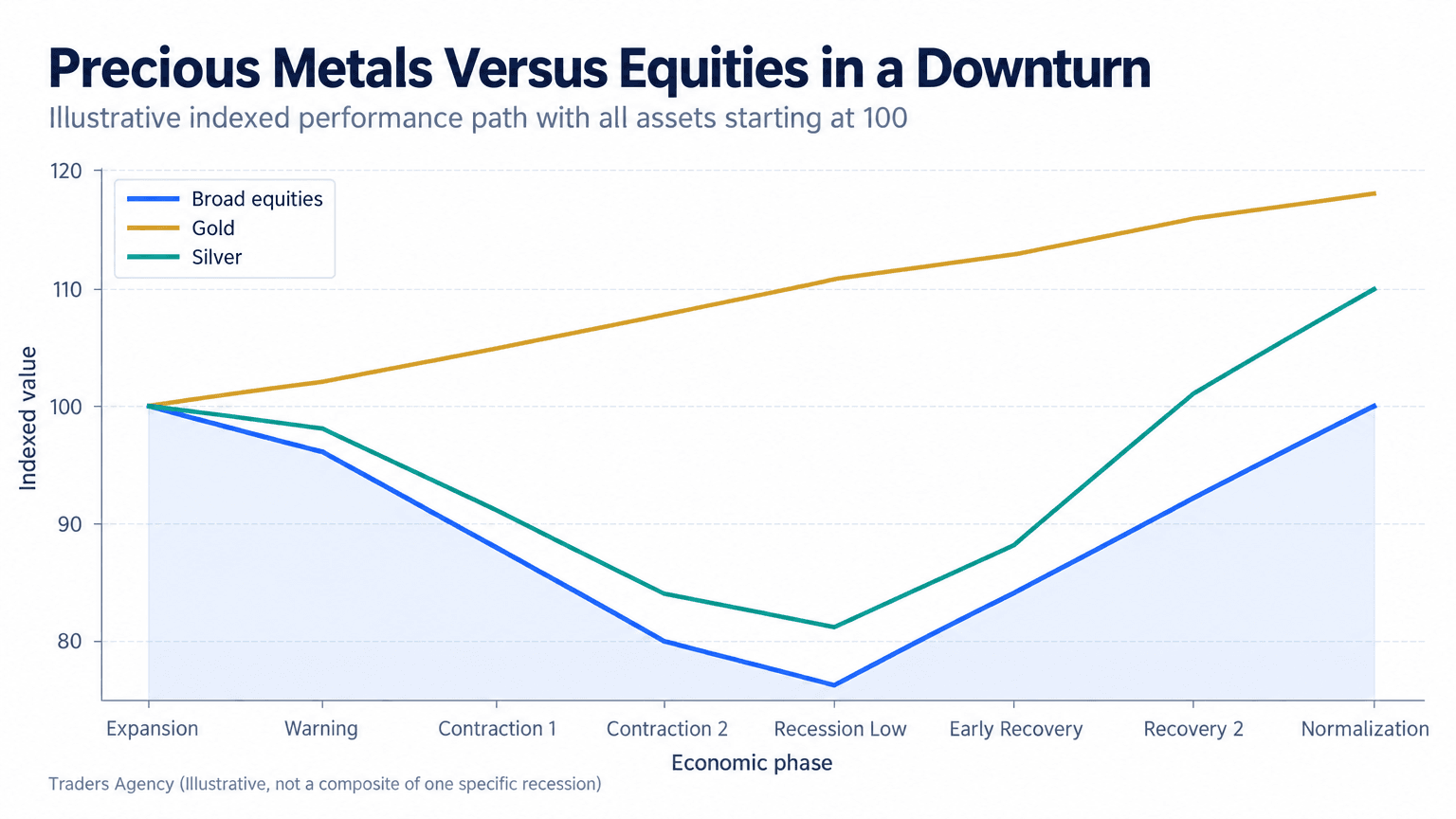
Not automatically. Gold often gains during recessions because of safe-haven demand, but the relationship isn't guaranteed or uniform across every downturn.
Gold during a recession tends to perform best in the early-to-middle phase, when fear is rising and central banks are cutting rates. Silver behaves differently. Because roughly half of silver demand comes from industrial use (electronics, solar panels, manufacturing), silver often lags gold when factories slow down and industrial orders drop. That's a key reason we never treat precious metals during a recession as a single, uniform trade.
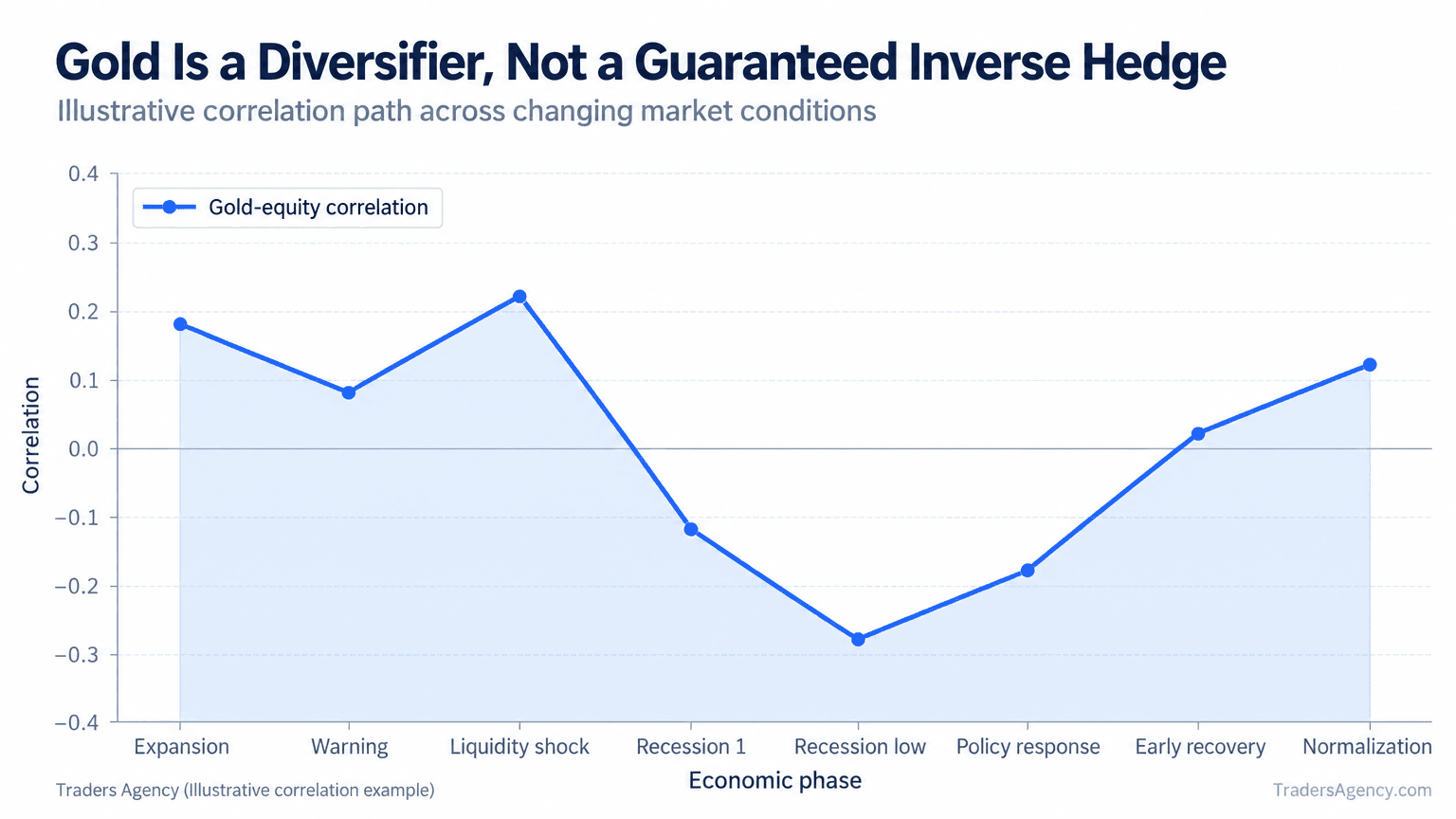
Gold's relationship with stocks also shifts within a single cycle. It can trade with a mild positive correlation to equities early on, turn negative once panic selling hits, then drift back toward neutral as markets stabilize. We never assume gold moves in perfect lockstep opposite to stocks. It's a tendency, not a rule.
Key Concept: Gold is an investment-demand asset, while silver is roughly half an industrial commodity. That single difference explains most of why the two metals diverge when the economy contracts.
How Much Gold Should You Hold in a Recession Portfolio?
The guideline we teach is keeping precious metals exposure between 5% and 15% of a total portfolio, depending on your risk tolerance and your conviction in the hedge.
A conservative investor might hold 5% gold as basic insurance. A moderate holder bracing for a prolonged slowdown might sit at 10%. Someone deeply worried about currency debasement or a sharp equity drawdown might push to 15%, though we rarely recommend going much higher, since concentration risk starts to outweigh the diversification benefit.
Here's how that might look across three illustrative profiles:
| Profile | Stocks | Bonds | Gold/Silver | Cash |
|---|---|---|---|---|
| Conservative (5% metals) | 55% | 30% | 5% | 10% |
| Moderate (10% metals) | 45% | 30% | 10% | 15% |
| Defensive (15% metals) | 35% | 30% | 15% | 20% |
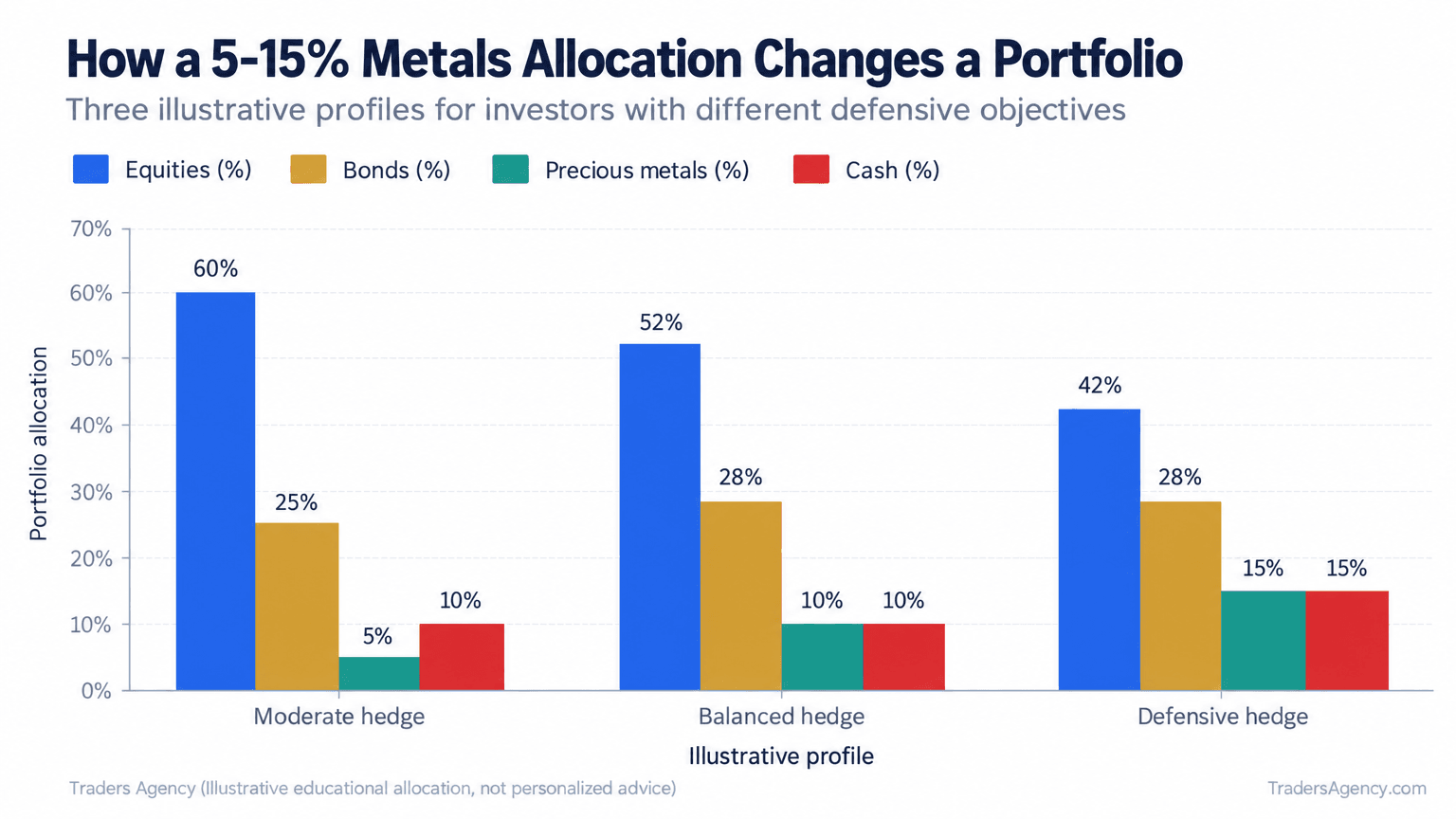
These numbers are illustrative starting points, not personalized advice. Your actual allocation depends on your time horizon, liquidity needs, and overall risk budget. Rate policy matters here too, which is why we keep an eye on Federal Reserve policy statements when deciding whether to scale a metals position up or down.
Gold vs Silver: Which Performs Better in a Downturn?
Gold typically holds up better than silver in a recession. Gold's demand is driven mostly by investment and central bank buying, while silver depends heavily on industrial consumption that contracts when factories slow down.
This is one of the most overlooked points when traders start building a recession playbook with gold and silver together. Silver can actually fall while gold climbs, simply because roughly half its demand comes from solar panels, electronics, and industrial manufacturing. When a recession hits, that industrial leg weakens at the same moment investors are bidding up gold.
That doesn't mean silver has no place in a downturn allocation. Silver tends to be more volatile, so it can offer bigger upside once the recovery phase begins and industrial demand picks back up. Traders also ask us whether silver at $200 an ounce is realistic during a severe supply shock or currency crisis. We treat that kind of price target as speculative and not something to build a core portfolio around. Base your allocation on historical behavior and diversification logic, not on headline price predictions.
Want expert trading insights delivered daily?
Join thousands of traders who rely on Traders Agency for market analysis and trade ideas.
Join Traders AgencyMining Stocks, Physical Metals, or ETFs: Which Vehicle Should You Choose?
Each exposure vehicle carries a different risk and convenience trade-off, and the right choice depends on what you're actually trying to hedge against.
- Physical Bullion: Coins and bars carry no counterparty risk and give you the purest hedge, but they're the least convenient. Storage, insurance, and selling quickly all take real effort.
- Precious-Metals ETFs: Broad gold or silver trusts offer high liquidity and easy trading through a standard brokerage account. The trade-off is exposure to fund structure and custodian risk, even if that risk is small.
- Mining Stocks: Miners give you leveraged exposure to metal prices and can move faster in either direction, but they also carry full equity-market sensitivity. They can fall alongside stocks even when the metal itself holds steady.
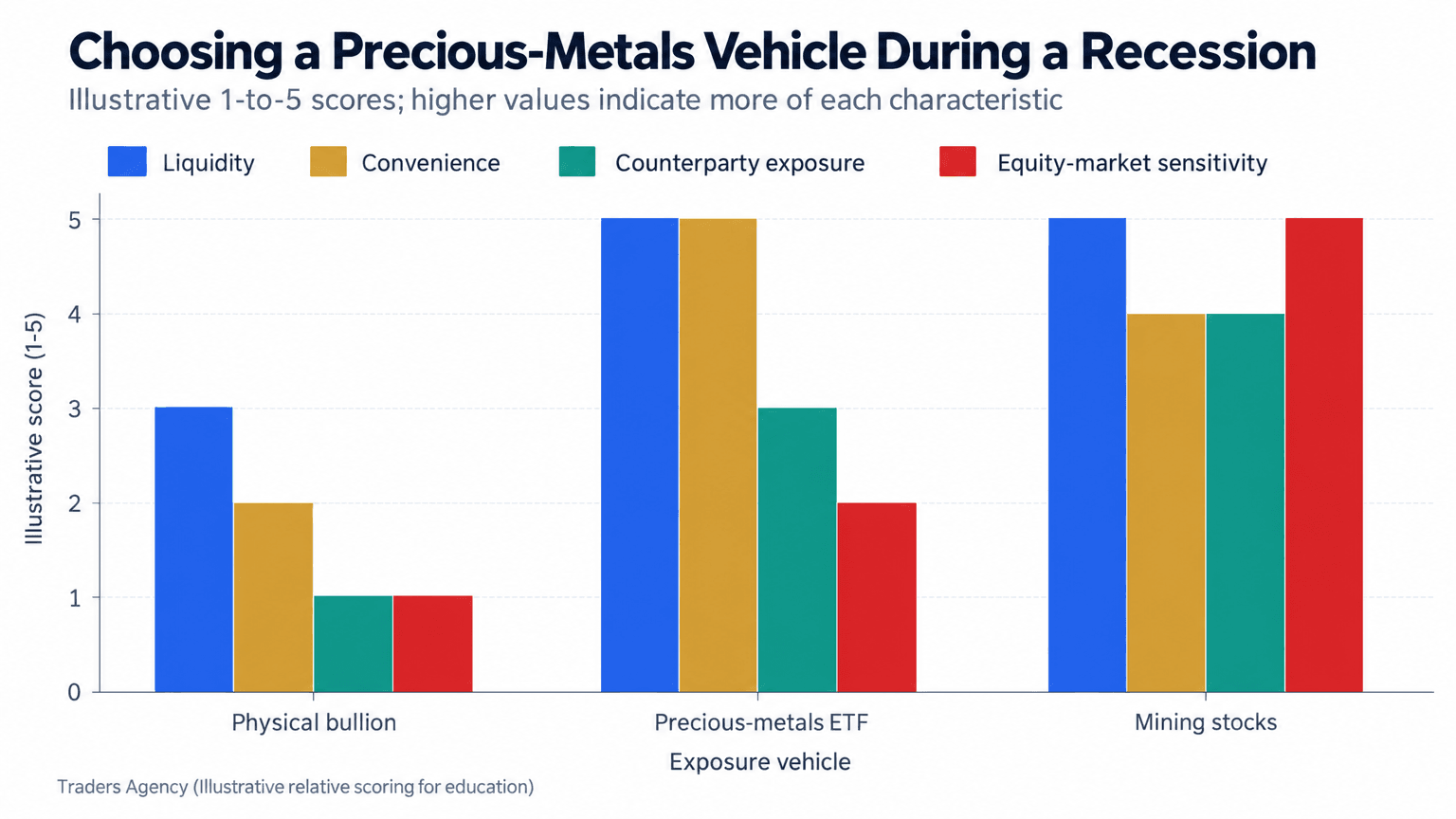
Our approach pairs a core position in physical bullion or ETFs for the hedge itself with a smaller, separate allocation to mining stocks if you want upside participation. Don't substitute mining stocks for your actual hedge. They simply don't behave like the metal during a sharp equity selloff.
Watch Out: In a liquidity crunch, mining stocks often sell off with the broader market even while gold itself holds up. A miner-only "hedge" can fail at exactly the moment you need it most.
When Should You Hold Off on Adding Gold?
Knowing when to hold off on gold matters just as much as knowing when to add it. If the economy is clearly late-cycle but inflation is falling fast and rate cuts aren't imminent, gold's near-term driver may already be priced in.
Here are the mistakes we see traders repeat most often:
- Chasing gold after it has already run up sharply on recession fear, rather than scaling in earlier
- Treating silver as a direct substitute for gold without accounting for its industrial demand sensitivity
- Over-allocating beyond 15% because of short-term headlines, which concentrates risk instead of diversifying it
- Ignoring that mining stocks often fall with the broader market in a liquidity crunch, even while gold itself holds up
What Is the Best Investment During a Recession?
There's no single best investment during a recession. A balanced approach that spreads risk across cash, quality bonds, defensive equities, and a modest precious metals allocation tends to hold up better than betting everything on one asset.
Precious metals are one tool in that mix, not a replacement for a diversified portfolio. Cash and short-duration bonds provide stability and dry powder, while a 5-15% metals position adds a hedge against currency and confidence shocks.
On the Warren Buffett precious metals question that always comes up in this conversation: the long-standing value-investing argument favors productive businesses that generate cash flow over metals that produce nothing. That's a legitimate counterpoint worth weighing, since it reflects a multi-decade ownership philosophy rather than a short-term recession hedge. We think both views have merit depending on your goals and your time horizon.
How Do You Build a Recession Playbook with Precious Metals?
A workable playbook combines a defined metals allocation, a chosen vehicle, and clear rules for rebalancing. Here's the sequence we teach:
- Set your target allocation at 5%, 10%, or 15% based on your risk tolerance, and write it down before you buy anything.
- Choose your core vehicle using physical bullion or a liquid ETF for the hedge portion of the position.
- Add a satellite position in mining stocks only if you want extra upside, and keep it sized well below your core hedge.
- Rebalance on movement by adjusting the position back toward your target weight once gold or silver has moved sharply in either direction.
- Review the macro backdrop each quarter, paying attention to rate policy and inflation trend rather than headlines.
If you ever consider going beyond physical and ETF positions into futures-based exposure, contract specifications and margin requirements published by CME Group are the right starting point for understanding how that market actually works.
Remember This: The hedge only works if you size it in advance and hold it through the noise. A metals position you buy in a panic and sell in a relief rally isn't a hedge, it's a trade.
Want expert trading insights delivered daily?
Join thousands of traders who rely on Traders Agency for market analysis and trade ideas.
Join Traders AgencyDISCLAIMER: Traders Agency does not offer financial advice. The information provided is for educational purposes only and should not be considered financial advice. Traders Agency is not responsible for any financial losses or consequences resulting from the use of the information provided. Trading carries inherent risks and may not be suitable for all individuals. You are advised to conduct your own research and seek personalized advice before making any investment decisions, recognizing the potential risks and rewards involved.
See more from Traders Agency on Google
Make us a preferred source and our market analysis will appear more prominently in your Google Search, Top Stories, and AI results.
Add to Preferred Sources