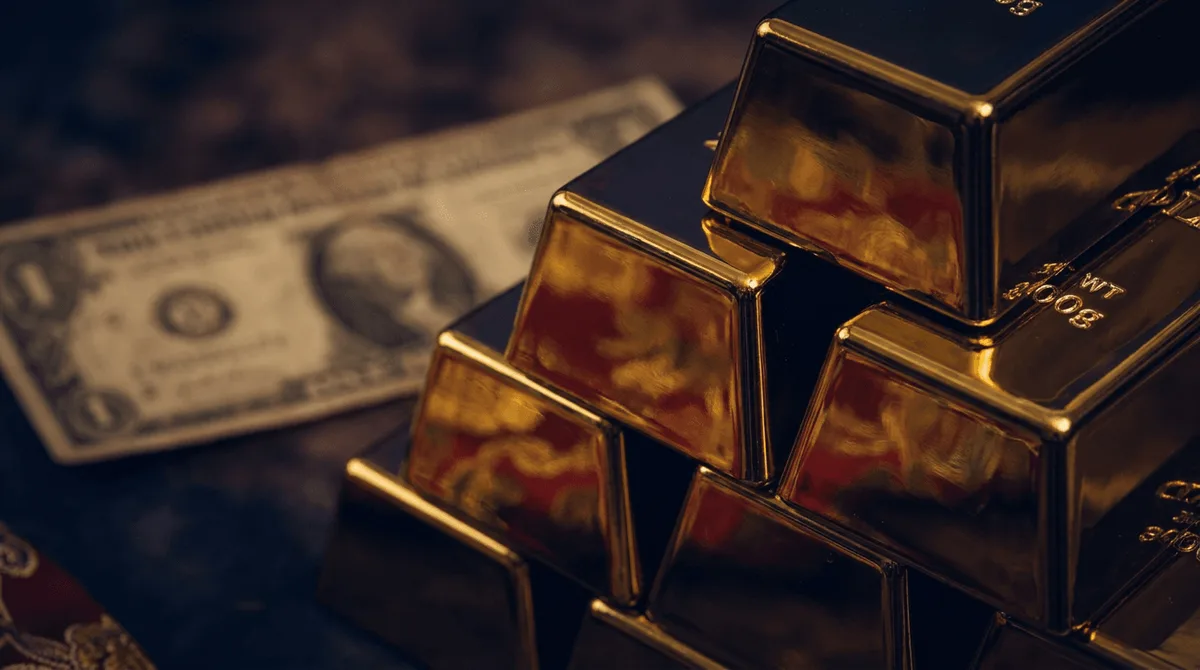
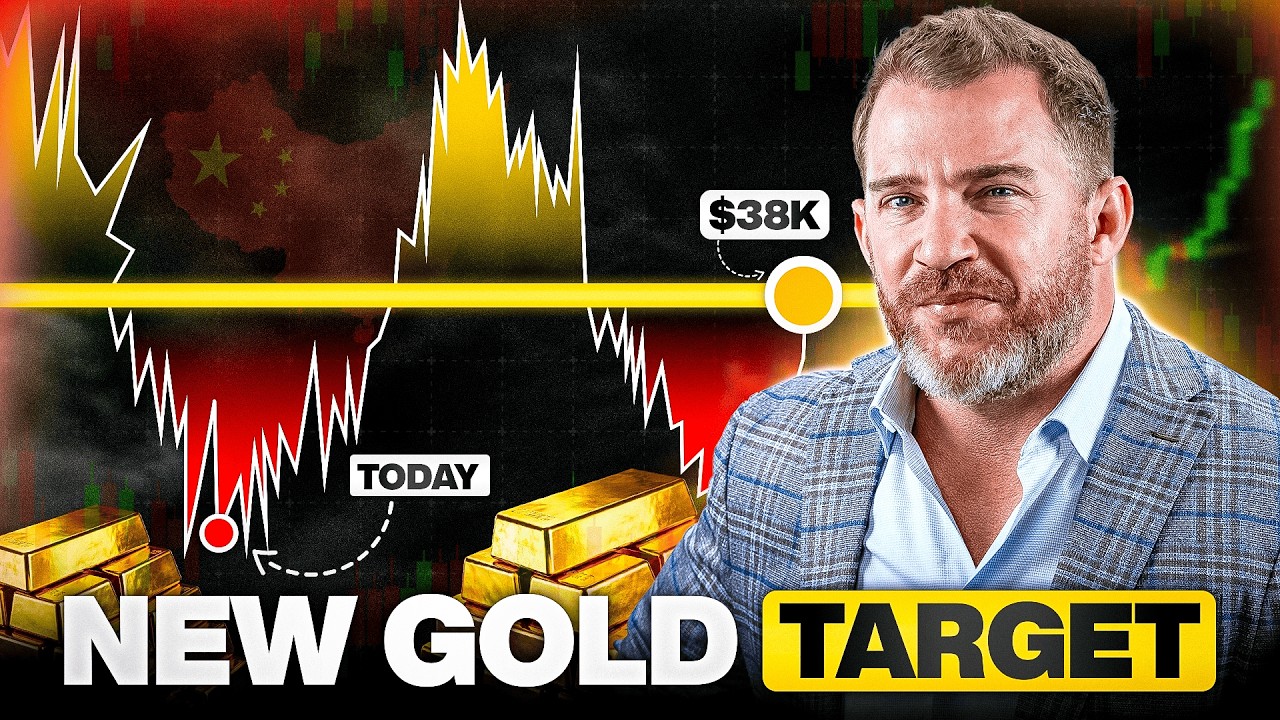
The global financial system is quietly rotating out of the US dollar and into gold. This isn't speculation. It's a calculated move by the world's largest economies to abandon the dollar in favor of a neutral reserve asset, and the math points to a massive revaluation of real money. The China gold stockpile strategy is at the center of it.
If you measure your wealth in US dollars, you're using a broken scale. The Federal Reserve makes the dollar worth less every single year. The stock market looks like it's hitting record highs, but price your assets in real, unprintable money and a much darker picture emerges: the American middle class has been hollowed out.
Washington knows this. Beijing knows this. And the smartest money on Earth is already positioned for what comes next.
Has 77% of American Wealth Actually Vanished?
Bottom Line: The core argument is that the dollar's dominance is ending not with a crash but with a slow, deliberate rotation by central banks and sovereign wealth into gold. The $38,000 price target is the arithmetic result of repricing gold to absorb the dollar's reserve role, and China's accumulation strategy is the most visible proof that this transition is already underway. Measuring wealth in dollars right now is like measuring distance with a ruler that shrinks every year.
What the Dow-to-gold ratio actually reveals
I've been reading a new book called 2029, The End of America by financial publisher Porter Stansbury. In the very first chapter, he lays out a case that America has actually gotten much poorer, even as it looks richer on paper.
If you invested in an index fund in 1999 and left it there for the last 27 years, you would be poorer today than when you started.
To see it, you have to measure prosperity in ounces of gold. In August 1999, at the absolute peak of the dot-com bubble, it took 44 ounces of gold to buy one unit of the Dow Jones Industrial Average. That was the high-water mark of American financial wealth. It has never been matched before or since in the entire recorded history of the country.
By April 2026, when Stansbury's book was published, it takes only about 10 ounces of gold to buy the Dow.
Three-quarters of the real wealth held in equities by every pension fund, every 401k, every endowment, and every family trust in the United States is simply gone. It didn't vanish in a crash. It vaporized slowly and invisibly over 27 years through the quiet debasement of the dollar itself.
What Is China's Gold Stockpile Strategy?
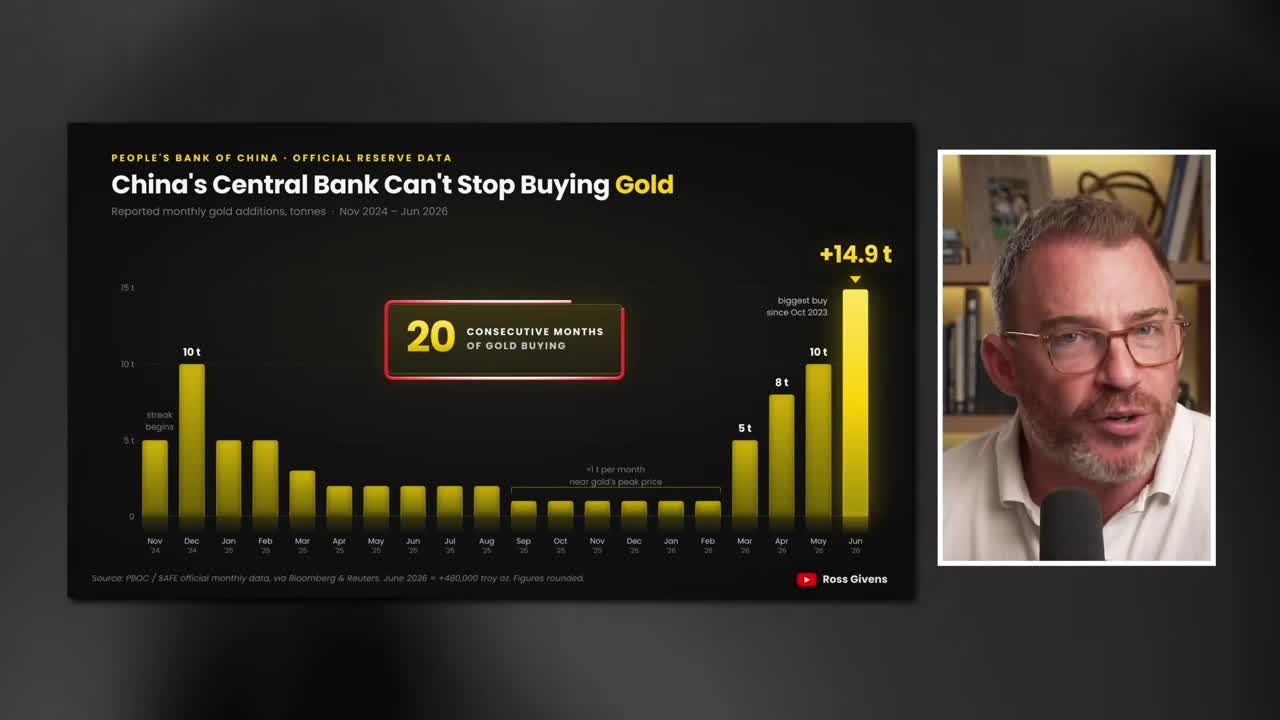
China is buying massive amounts of gold to protect its wealth from a depreciating dollar and to prepare for a new system of international trade settlement. The People's Bank of China just bought gold for the 20th month in a row, its longest streak on record.
Their timing has historically been excellent. They buy big before the massive runs and buy less when prices are advancing. June was their largest monthly buy yet: a whopping 14.9 tons.
They would not be doing this if they thought the move in gold was over. They're expecting the exact opposite.
And they're not alone. World central banks as a group have bought roughly a thousand tons a year for three straight years. Poland is buying. Kazakhstan is buying. Almost nobody is selling.
Beijing wants physical metal, not paper
On July 24th, four of China's biggest banks plan to shut down paper gold trading for regular customers. Beijing wants its citizens holding actual metal, not somebody's IOU with a futures contract stacked on top, before whatever comes next.
Investors on the other side of the globe are waking up to this faster than Americans are. Today, Americans own far more stocks than gold. The largest S&P index funds, SPY and VOO, manage a combined $1.78 trillion. The gold fund, GLD, holds less than a tenth of that.
In China, the exact opposite is happening. For the first time ever, the single biggest fund in the country is a gold fund. Ordinary Chinese savers are parking $13 billion in gold, compared to just $12 billion in their version of the S&P 500.
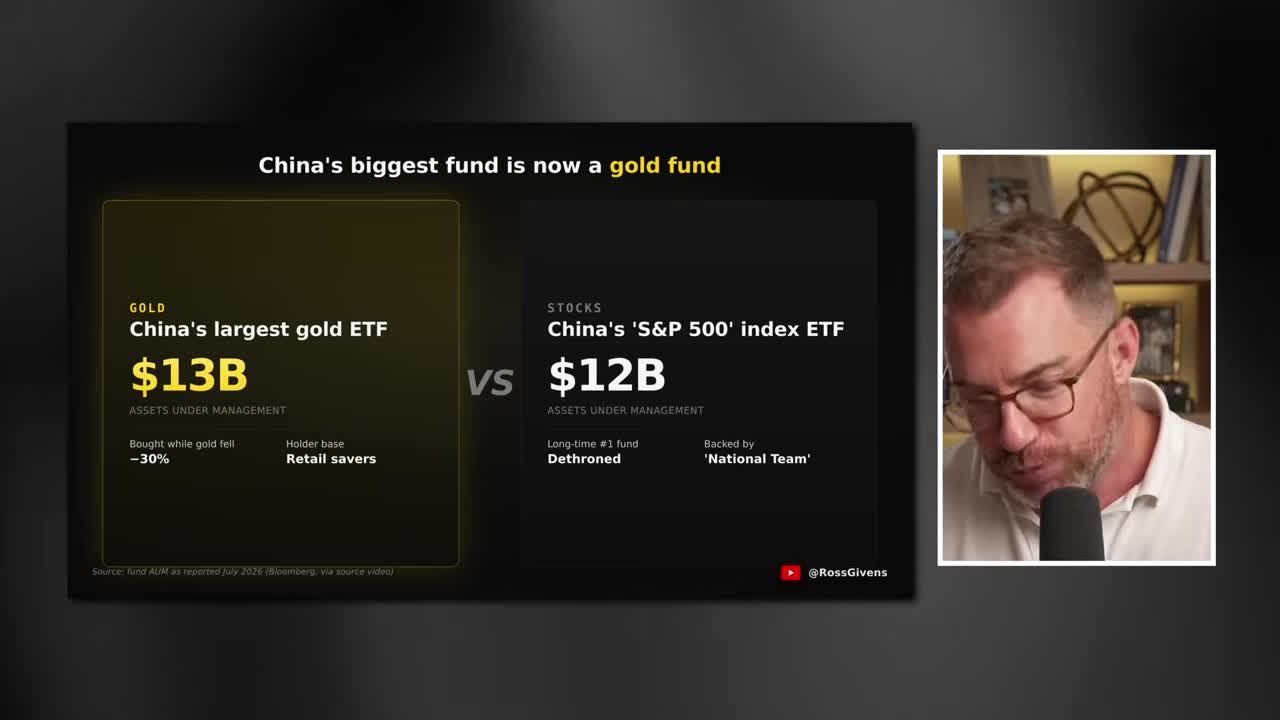
In the second biggest economy on Earth, the largest pile of retail money now sits in gold. These investors are not chasing hype. Most of the buying happened while gold was down. Gold peaked at around $5,600 an ounce earlier this year, then dropped 30% to just below $4,000. America ran away. China ran toward it.
Get an entire year of live weekly mentoring sessions, my newsletter, indicators, bonus reports, tons more. Click the link and I'll see you in the next live session.
Join my Black Ops Trading ClubThe Dollar Is a Broken Yardstick
And Washington is signaling its own pivot
This isn't only a China story. Two weeks ago, US Treasury Secretary Scott Bessent published an op-ed in the Wall Street Journal laying out the administration's plan.
Bessent is a brilliant investment manager who earned hundreds of millions of dollars working under Stanley Druckenmiller, arguably the greatest investor who has ever lived. He works one-on-one with President Trump on every monetary and economic question, from tariffs and subsidies to nominating the next Fed chair.
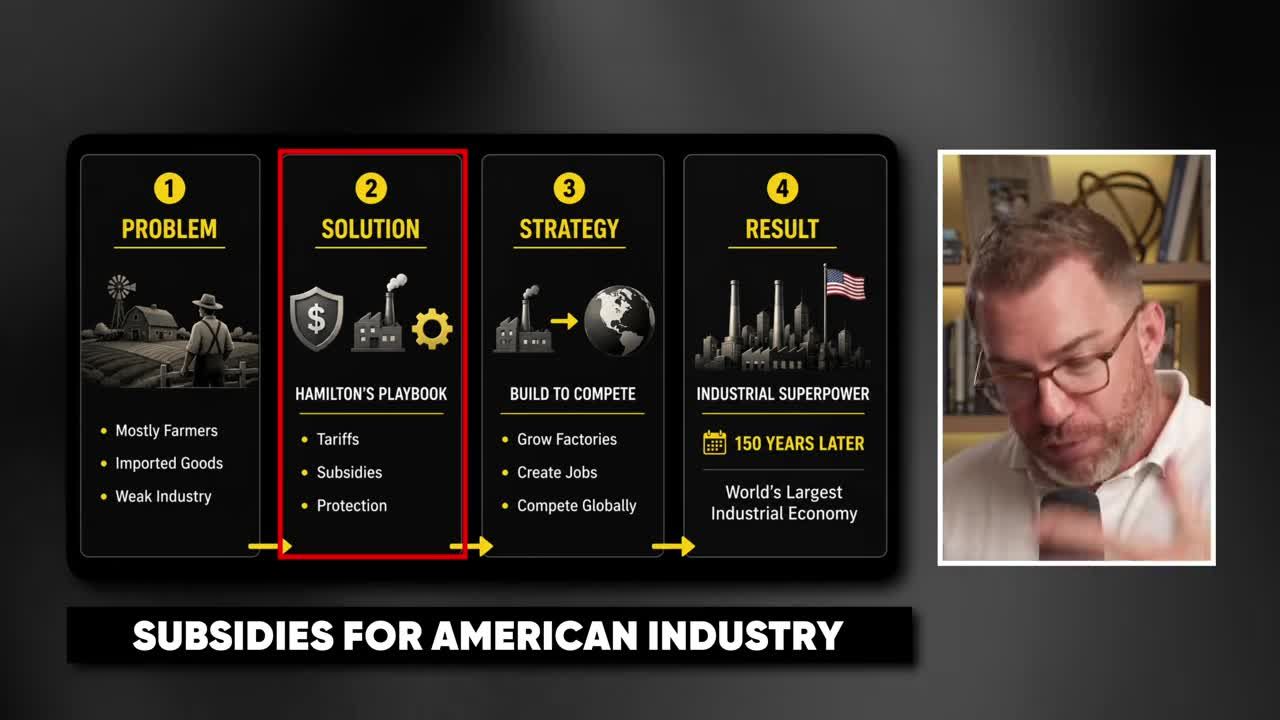
The plan he laid out was first introduced by Alexander Hamilton, America's first Treasury Secretary.
Back in 1791, America had just 4 million people, mostly farmers. We were importing tools and weapons from the very empire we'd just fought a war to escape. Hamilton looked at that and said a nation that can't make the things it needs is not an independent nation. His fix was simple: tariffs on foreign goods, subsidies for American industry.
That became America's operating system for the next 150 years. It took us from a farm economy to the biggest industrial power in human history.
Every empire dismantles the playbook on the way down
Britain ran protectionist trade policy for centuries. They won the game, converted to the religion of free trade in 1846, and by 1931 their factories had drained away. Their empire was finished. It took about 85 years, slow enough that almost nobody noticed.
America's version of that clock started in 1971, when President Nixon took the dollar off the gold standard.
The declining dollar made American wages more expensive, so jobs went overseas. Companies stopped holding cash because it loses value every year. Instead, they buy back their own stock. Stock prices go up. The country gets richer on paper. Underneath, the industrial base gets hollowed out.
What did Americans get in exchange? Cheap stuff.
Since 2000, TVs are down 98%. Toys down 74%. Computers cost a fraction of what they did. Everything China could put on a boat got cheaper. Everything it couldn't skyrocketed. Housing is up 111%. Child care is up 159%. College tuition is up 200%. Hospital services are up 281%.
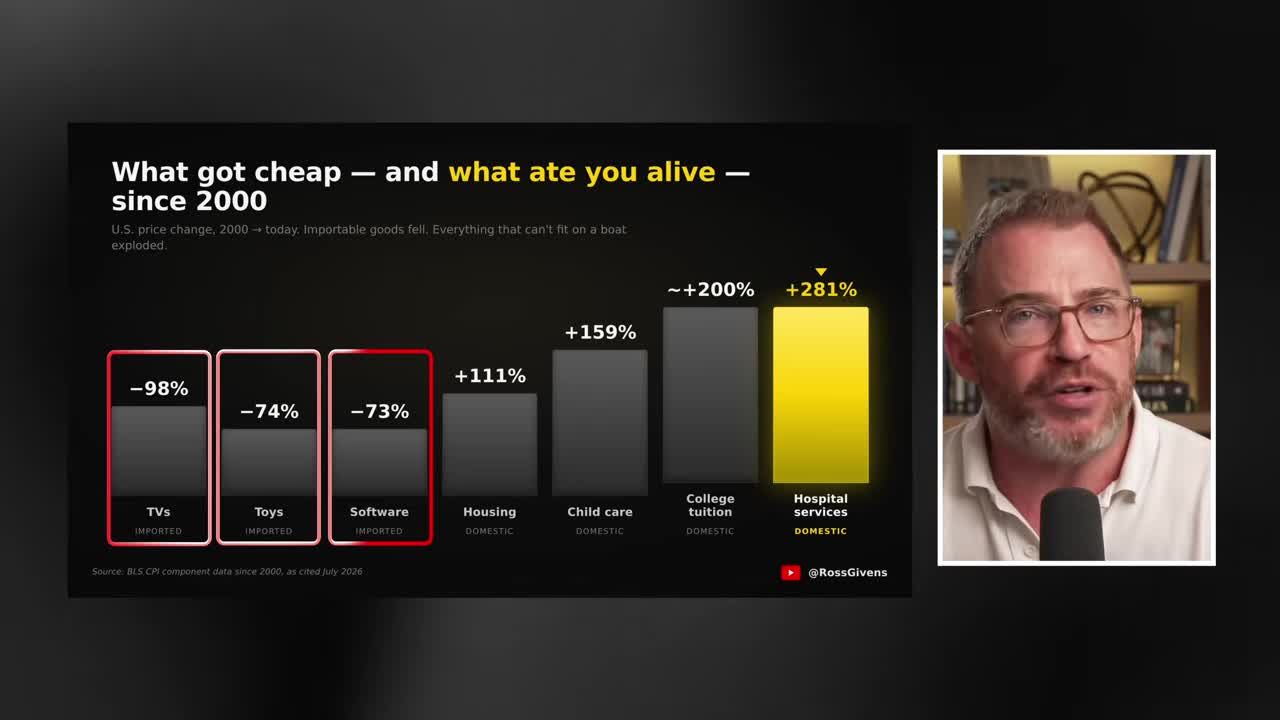
That was the trade. Cheap TVs in exchange for the single-income, buy-a-house jobs that built the middle class. Asset owners got rich on paper. The middle class got poor. That simple.
How Does the Math Get Gold to $38,000?
Now Washington wants to undo 50 years of this. That creates a math problem.
The government is promising three things at once: rebuild American industry, protect Main Street from higher prices, and keep the dollar strong. You cannot have all three. Pick any two, and you'll be forced to give up the third.
- Want factories and affordable prices? The dollar has to come down a lot.
- Want Main Street and a strong dollar? That's the deal that's been running for 50 years, and the factories never come back.
- Want factories and a strong dollar? Then you wall everything off with massive tariffs and inflation, eating your voters alive.
Bessent is too smart not to know this. The smart money reading his own op-ed knows the dollar is the one that gets sacrificed.
But here's the clever part. You don't crash the dollar directly. You let a neutral reserve asset absorb the adjustment, something that isn't any one country's funny money. There's exactly one asset on Earth with a few thousand years of experience doing that job: gold.
Financial analyst Luke Gromen at FFTT did the deep dive on the math. Take China's trade surplus of about $1.2 trillion and divide it by the roughly 940 tons of gold China imported last year. If that surplus ever had to settle in metal instead of dollars, the math only balances at roughly $38,000 an ounce.
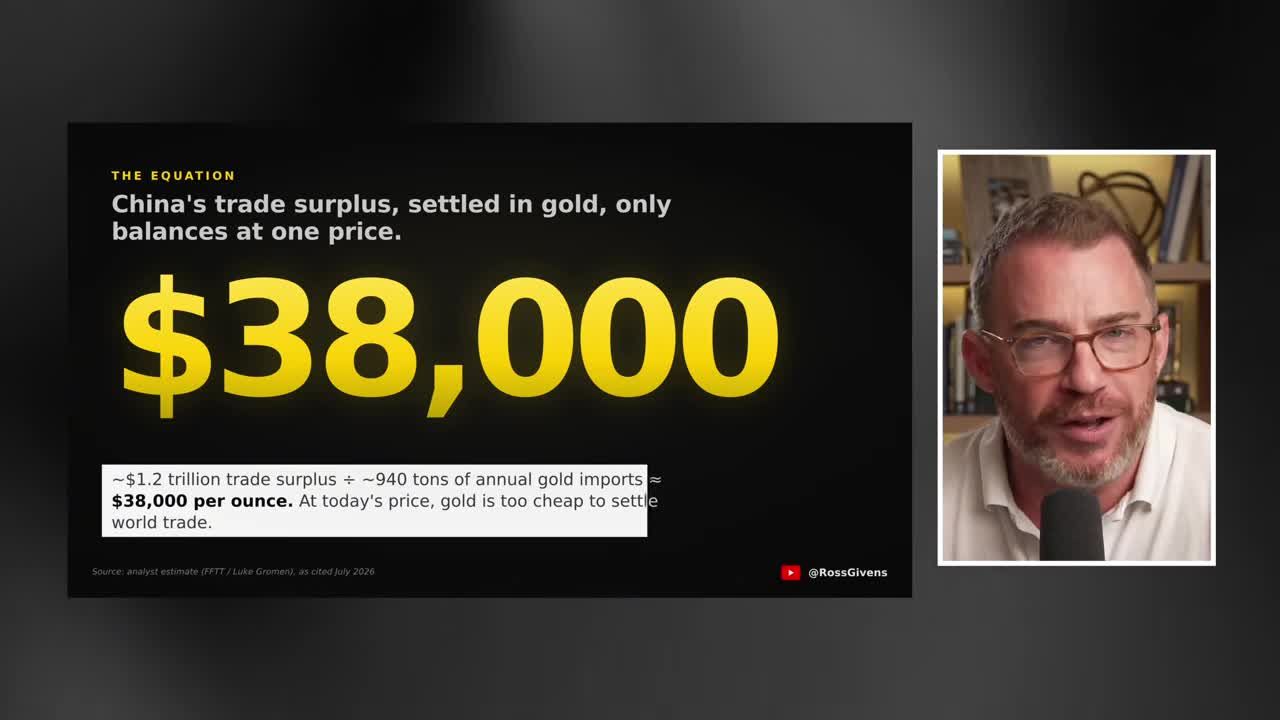
At today's price, gold is simply too cheap to settle world trade. At $38,000, it works. That's the exact size of the gap between the paper system we have and the neutral system both superpowers keep describing.
This is why the China gold stockpile strategy has been front-running the math for years. And the US is quietly participating. US gold exports are spiking right now, the biggest jump in the history of the data. Starting right after US and Chinese officials met last year, America is literally shipping record amounts of gold to China as we speak.
The Rotation Has Already Started
Most investors can't see it because they measure in dollars
Since the first China trade war kicked off in early 2018, the S&P 500 is up 161%. In dollars, that sounds great. Measured in gold, the S&P 500 is actually down 15%.
Long-term Treasury bonds, widely considered the safest asset on Earth, are down 78% measured in gold. Meanwhile, gold miners are up over 200%.
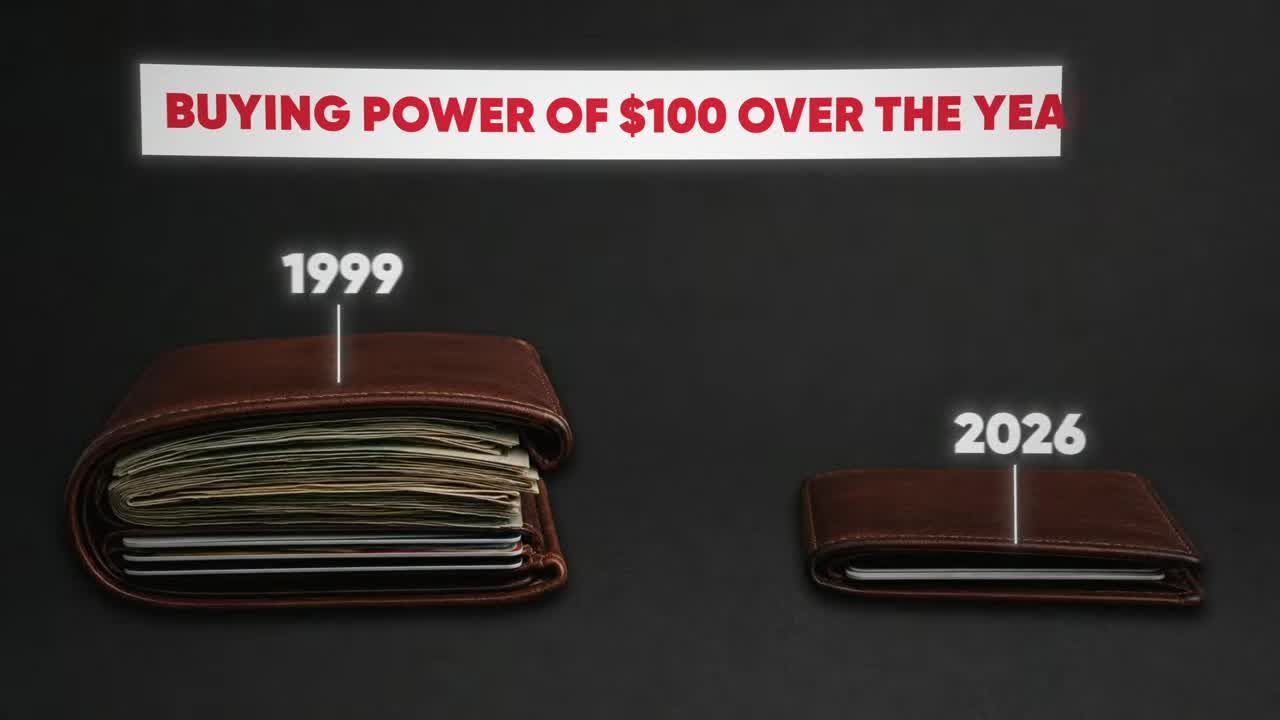
Dollars are paper. Every year they're worth 3% to 5% less in actual buying power. We say housing has gone up, or eating out has gotten expensive. That's false. If eating out were really getting more expensive, cooks and waiters would be getting rich. They're not. The yardstick is broken. It just takes more worthless dollars to buy the same things.
When you buy gold, you're trading a depreciating asset for one that doesn't lose value.
How I'm Playing Gold Right Now
I'm a trader, which means I rely on charts and data to find precise entry points. You can't just buy blindly. You need to understand market mechanics.
1. Identify the super cycle breakout
We called the initial breakout of this gold super cycle back in March 2024. If you had acted then, you'd have secured gold at $2,000 an ounce. The market has pulled back since the peak in January and currently sits around $4,000 an ounce.
2. Target areas of acceptance
Commodities typically move between price discovery and price acceptance. Price discovery means strong, rapid moves up or down. Price acceptance is where the market finds equilibrium between buyers and sellers, creating a stair-stepping pattern.
Previous areas of acceptance act as magnets for future price action. The last major one ran all the way from $4,000 to $5,600. Price came flying back down and stopped right at that level, then stalled there for months.
3. Wait for the buy zones
The next big acceptance area, and it's a big one, sits in the $3,200 to $3,400 range. Personally, I think today is a great time to buy gold, but I'm hoping it drops to that $3,200 to $3,300 level so I can accumulate much more.
And if some crazy fluke incident pushes the price down to $2,700, I'm backing up the truck. I'll load up on real money in exchange for fewer and fewer depreciating dollars.
The End of the Paper Illusion
The global financial order is fracturing, and the China gold stockpile strategy is the loudest warning siren in the market today.
In 2009, right after Lehman blew up and the Fed started printing trillions, the governor of China's central bank published an official paper calling for a neutral international reserve asset. He dusted off an idea from the 1940s, first proposed by economist John Maynard Keynes. The US killed that idea in 1944 because we were the surplus country selling everything to everybody. We built the dollar system instead.
Eighty years later, the roles have flipped. Now Washington is quoting the same dead economist that Beijing quoted in 2009. The US Trade Representative said it openly at Davos in January. The World Bank president floated gold as a reference point back in 2010. The IMF's former chief economist told emerging markets to swap treasuries for gold in 2016.
The writing is on the wall. The dollar will be devalued to save American industry, and gold will be the asset that absorbs the shock. Position your portfolio accordingly.
Get an entire year of live weekly mentoring sessions, my newsletter, indicators, bonus reports, tons more. Click the link and I'll see you in the next live session.
Key Takeaways
- The Dow-to-gold ratio peaked at 44 ounces per unit in August 1999. That ratio has never recovered, meaning dollar-denominated stock gains have masked a real decline in purchasing power wealth.
- An index fund investor who bought in 1999 and held for 27 years is poorer today when wealth is measured in gold ounces rather than nominal dollars.
- The $38,000 gold price target is derived from a revaluation model, not speculation. It reflects what gold would need to be worth if it were repriced to back a meaningful share of global dollar reserves.
- China's gold accumulation is a deliberate reserve diversification strategy, mirroring the same argument the US made against the gold standard in the 1940s, now turned against the dollar.
- The IMF's former chief economist recommended emerging markets swap treasuries for gold in 2016, and the World Bank floated gold as a reserve reference point as early as 2010, signaling institutional momentum well before recent headlines.
DISCLAIMER: Traders Agency does not offer financial advice. The information provided is for educational purposes only and should not be considered financial advice. Traders Agency is not responsible for any financial losses or consequences resulting from the use of the information provided. Trading carries inherent risks and may not be suitable for all individuals. You are advised to conduct your own research and seek personalized advice before making any investment decisions, recognizing the potential risks and rewards involved.
See more from Traders Agency on Google
Make us a preferred source and our market analysis will appear more prominently in your Google Search, Top Stories, and AI results.
Add to Preferred Sources