


For 70 years, air power meant one thing: expensive jets flown by expensive pilots. That era is ending, and one Pentagon defense contract small cap is perfectly positioned to benefit from the shift.
Right now, over the battlefields of Ukraine and the Middle East, a six-figure flying robot is destroying $10 million tanks and knocking out billion-dollar air defense systems. Cheap, smart, expendable killing machines. Every general on Earth knows this is the future of combat.
What Is a Loitering Munition?
Bottom Line: The core thesis is a binary event play: a sub-$10 small cap with exclusive or preferred access to combat-proven loitering munition technology is competing for a Pentagon contract worth up to $200 million, against a current market cap of roughly $300 million. If the contract is awarded to this company, the revaluation case is straightforward on paper. The risk is equally straightforward: small caps chasing single government contracts are high-variance bets, and the contract may not be awarded on the expected timeline or to the expected winner.
And why does the U.S. Army need one right now?
A loitering munition is a drone that doesn't just scout. It is the bomb. It launches, circles a battlefield for hours hunting targets, and when it finds one, it dives in and destroys it. They call them suicide drones, but the military calls them the future.
The United States Army put out a notice looking for a precise long-range loitering munition, something that can fly more than 100 kilometers, hunt down an enemy's radar and anti-aircraft systems, and take them out. Hunter-killer drones for enemy air defense.
There is just one problem. America doesn't have a combat-proven version at scale.

Why Does Israel Have a Battle-Tested Edge in Loitering Munitions?
The Harpy and Herup drones are exactly what the Army needs
Israel has the exact weapon. Israel Aerospace Industries makes a family of loitering munitions called the Harpy and Herup. The Harpy is named after the bird of prey that circles, hunts, and strikes. Herup is a blend of Harpy and optical. Pretty fitting.
These are combat-proven weapons. They have spent years doing the exact job the U.S. Army is now scrambling to fill: flying deep behind enemy lines and killing the radars and missile batteries that keep our pilots out. A dangerous mission in modern air war, and these drones do it autonomously.

The Pentagon Defense Contract Small Cap With Exclusive Rights
Palladyne AI (Ticker: PDYN) is the American company that owns the bridge between Israel's weapons and the U.S. Army. On June 8th, Palladyne announced a partnership with Israel Aerospace Industries.
Under this deal, Palladyne gets to manufacture, integrate, and sell the Harpy, Herup, and mini-Harpy systems to the U.S. Department of War. They are going to Americanize these drones for U.S. requirements and bolt on their own autonomous swarming AI.
What Are the Pentagon's Requirements for This Loitering Munition Contract?
A real prototype award, not a feasibility study
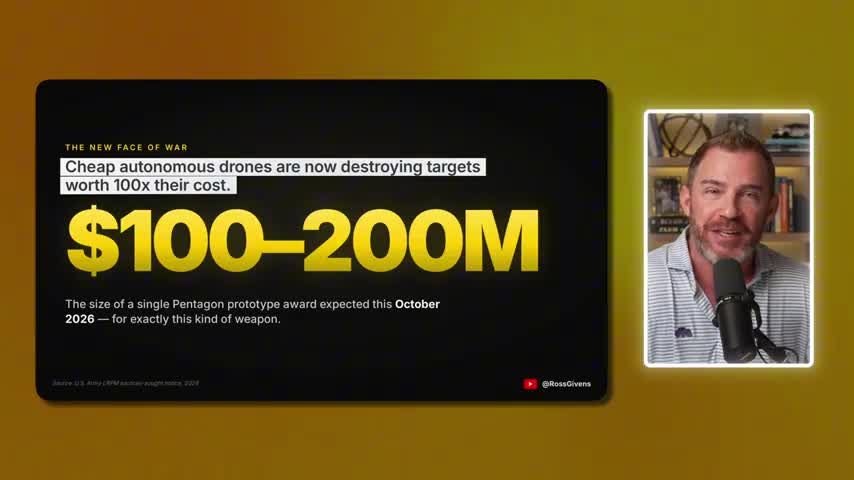
The Army's notice for the long-range hunter-killer program anticipates awarding a prototype contract this October. They don't want a feasibility study or bureaucratic nonsense. This is a real prototype award expected to be worth between $100 million and $200 million.
The government is awarding this through an OTAA, an Other Transaction Agreement. An OTAA is the Pentagon's fast lane. It skips years of red tape to put new technology into the field quickly. Less paperwork, faster money. That is the whole point of it.
A dated event. A specific dollar figure. A fast-track contract vehicle built for exactly this kind of weapon.

Get an entire year of live weekly mentoring sessions, my newsletter, indicators, bonus reports, tons more. Click the link and I'll see you in the next live session.
Join my Black Ops Trading ClubWhy Does the Contract Deadline Matter for This Trade?
This Pentagon defense contract small cap is sitting at a valuation that makes no sense compared to the size of the impending award.
Palladyne AI is worth right around $300 million. That is the entire market cap of the business. A single contract in this program could be worth half to two-thirds of the entire company.
The market seems to be treating PDYN like a small AI software story. It is about to become a defense prime contractor story. Those two things do not trade at the same valuation.
By the time the award is announced and hits CNBC, the move is over. A name this size will gap up violently on the news, 20%, 30%, or 50% in a single morning. You cannot buy that print. You must be positioned before the news.
Is PDYN Undervalued at $6?
The chart is ugly and highly volatile. This is not a clean technical breakout. This is purely an event-driven play.
PDYN is a small cap that ran from $2 to $15 in 2024 before falling back to $5. It has a big $6 support level propping it up. The stock has an Average Daily Range (ADR) of 9.85%. On an average day, it moves almost 10% from low to high. That is good if we are right and bad if we are wrong.
Just recently, the stock went from $6 to $9 in a week on absolutely no news. No press releases. No earnings announcements. Nothing. It sits right around $6.50 now, with that big $6 support level holding all year.
The Trading Plan
This environment requires strict discipline and a clear entry plan.
Position Before the Announcement
You buy the runway into the announcement. Stocks always move in anticipation of an event before the actual thing happens. If a company is getting added to the S&P 500 index, if there's a drug approval or earnings growth, the stock moves before the news drops. Buy the rumor, sell the news.
Build at Support
I picked up 3,000 shares around $6.40 to $6.50. I have an order to buy 3,000 more on a break above $7. I am targeting a 30% to 80% range on this trade.
Let Volatility Work for You
This stock makes massive moves. It has seen swings of 140%, 60%, and a 98% rip off the low. Just last week it went up 50% on nothing. It is very reasonable to think this could be a $9, $10, or $11 stock in the not-so-distant future.
The Risks
Like a lot of young companies, Palladyne AI is not yet profitable. Revenue is growing, but off a tiny base of a few million dollars. The company did set guidance for 2026 to hit $24 million to $27 million for the full year.
The October award would be huge, but it is not guaranteed. This is a speculative Pentagon defense contract small cap stock with a history of high volatility. Do not bet the farm on it.
Don't be scared to take profits along the way. Get up 20%, sell a piece. Get up 50%, sell a piece. Raise your stop loss along the way to lock in your gains if this thing starts moving.
The Asymmetric Bet
The Army's need is documented in black and white. There is a dated nine-figure event sitting right in front of a company worth around a quarter of a billion dollars.
This is an asymmetric bet. Based on my research, the upside dwarfs the downside. The drones are real, combat-proven weapons systems. Any mention of a Department of Defense contract or media focus on autonomous drones will kick up demand for this stock instantly.
A $200 million contract potentially being awarded to a $300 million company. That instantly revalues the stock. For anyone watching the Pentagon defense contract small cap space, this is the kind of setup worth paying attention to.
Get an entire year of live weekly mentoring sessions, my newsletter, indicators, bonus reports, tons more. Click the link and I'll see you in the next live session.
Key Takeaways
- The Pentagon is expected to award a $100–200M prototype contract for a long-range loitering munition capable of striking targets 100+ km away, specifically designed to hunt and destroy enemy air defense systems.
- The target stock trades around $6 with a market cap near $300 million, meaning a $200 million contract award would represent roughly two-thirds of the company's entire current valuation.
- Israel's Harpy and Harop drones are cited as the combat-proven benchmark the U.S. Army is trying to match, giving companies with Israeli defense technology partnerships a structural edge in the bidding process.
- Loitering munitions have demonstrated the ability to destroy targets worth 100x their own cost, which is the core economic argument driving Pentagon urgency to field these weapons at scale.
- The contract deadline is treated as a hard catalyst: media coverage of the award is expected to drive immediate retail and institutional attention to the small-cap winner.
DISCLAIMER: Traders Agency does not offer financial advice. The information provided is for educational purposes only and should not be considered financial advice. Traders Agency is not responsible for any financial losses or consequences resulting from the use of the information provided. Trading carries inherent risks and may not be suitable for all individuals. You are advised to conduct your own research and seek personalized advice before making any investment decisions, recognizing the potential risks and rewards involved.
See more from Traders Agency on Google
Make us a preferred source and our market analysis will appear more prominently in your Google Search, Top Stories, and AI results.
Add to Preferred Sources