


The United States owes $39 trillion it can never pay back. Not won't pay back. Can't. There is no version of the math where this obligation gets retired through standard means. The government erasing national debt is not some far-off theory. It is already happening, quietly, using a playbook they have run before.
This connects directly to your money, your savings, your paycheck, and the cash sitting in your bank account right now. Once you understand the exact strategy they are running, you will see exactly where to stand so this economic shift does not bury you.
Why Can't the U.S. Repay Its $39 Trillion Debt?
Bottom Line: When a government cannot repay its debt through conventional means, inflation becomes the default tool, and that process is already underway. The practical response is to hold assets that historically appreciate as currency purchasing power erodes, particularly gold and domestic mining companies with real reserves in the ground. Waiting for the trend to become obvious in headlines means the best entry points are already gone.
The U.S. national debt sits at $39 trillion and is on pace to hit $50 trillion by 2030. For the first time in American history, we now spend more on interest alone than we spend on the entire military.

The math simply does not work. Interest payments alone are consuming the budget. When a government is buried this deep, it has to find an alternative exit strategy.
Three Ways Out
Austerity, default, or inflation. That's it.
Option 1: Austerity. Raise taxes, cut spending, tighten the belt, pay it down. It is the responsible thing to do. It is also political suicide. Nobody is cutting Social Security, Medicare, and defense in the same breath. They would not make it home.
Option 2: Default. The government stands up and says it is broke. For the country that issues the world's reserve currency, that is the financial equivalent of lighting a match in a room full of gas. It would trigger a global depression. Entirely off the table.
Option 3: Inflation. The quiet option. The one they actually use.

How Does the Government Actually Erase National Debt?
Inflating away the national debt is a process economists call financial repression. You do not announce it. You do not pass any laws. You simply keep interest rates below the rate of inflation, year after year, and let rising prices quietly shrink what the government owes.
On paper, the debt is still there. In real terms, it is melting, because they are paying back yesterday's debt with tomorrow's cheaper dollars.
That melting debt does not just vanish. The cost gets transferred out of the government's books and directly into your bank account.
The Post-WWII Playbook
They ran this exact strategy after World War II. The debt reached over 100% of GDP, right where we are today. That is more than the entire production of every man, woman, and child in this country.
The Federal Reserve pinned interest rates to the floor and let inflation run hot.
They never saw a tax form. The debt got healthier. The savers got poorer. That is the trick.
Same Setup, Same Outcome
Every condition to run this exact playbook again is lining up right now. A new Fed chair who wants lower rates. A balance sheet stuffed with $6.6 trillion in printed money. A government that desperately needs cheap debt.

The people holding cash, savings accounts, and bonds are the ones who will pay for it. Same as last time.
If they are going to quietly drain the value of paper dollars, the question becomes simple: what do you want to be holding instead?
Get an entire year of live weekly mentoring sessions, my newsletter, indicators, bonus reports, tons more. Click the link and I'll see you in the next live session.
Join my Black Ops Trading ClubWhere Does Money Go During Government Inflation Cycles?
When real interest rates go negative and cash loses value every year, money does not just sit there and take it. It runs. It runs out of paper and into things they cannot print.
Historically, the first place it runs is gold. Right now, gold is sitting around $4,100 an ounce, roughly 25% off its peak. When the people running the printing press cannot be trusted to protect your dollar, you buy the one form of money they cannot create out of thin air.
Why Gold Miners, Not Just Gold
I do not just want to own gold sitting in a vault. If gold is going to make another big run, I want operational leverage on the move.
When gold goes up 30% or 40%, a well-run gold miner can go up 200% or 300%. The math is simple: their costs are mostly fixed.

Right now, gold is down 25% from its peak. These mining stocks are down 50%. If gold gets back to its highs, these stocks will double and triple right alongside it.
Steady dividends and large-cap stability? Stocks like Kinross Gold or Newmont Mining will suit you better. But for aggressive upside, you need to look at small American miners.
Two Small-Cap Mining Plays
Profitable American miners trading at discounts, standing right where the money is going to flow.
1. Idaho Strategic Resources (ID)
This is the strategic two-for-one play. Idaho Strategic is actively pulling gold out of the ground in Idaho, and doing so profitably. This past quarter, they nearly doubled their revenue year-over-year and posted a record profit. A profitable small American gold producer. That alone is rare in this corner of the market.
But here is the big edge. Idaho Strategic also sits on the single largest rare earth land package in the United States. Rare earths are the metals that go into everything from EVs to electronics, missiles, and fighter jets. China controls the supply through processing dominance and keeps threatening to cut us off.
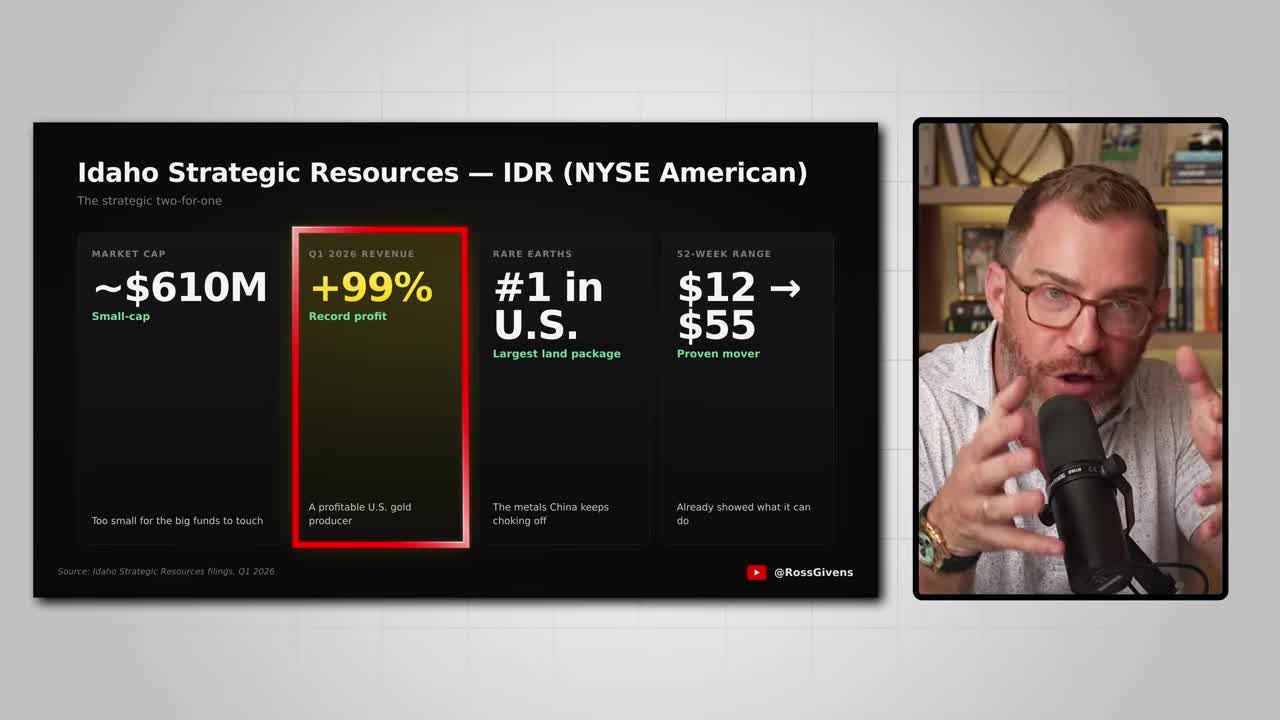
America is desperate to build a domestic source. This company is sitting on the biggest one in the country while mining gold to pay the bills. Two of the most important macro stories of the decade, the flight into gold and the scramble for American strategic metals, in one stock that big Wall Street funds are too small to bother with.
The chart shows a clear support zone. The stock fell from $56 down to about $28, stayed there for two weeks, then launched higher. It came back down to that $28 to $30 range again, ripped to its highs, and is now stalling around $30. That $28 to $30 area is a major support and resistance level built into the stock.
2. Integra Resources (ITG)
This one is super cheap, around $2.50 a share. And despite what the chart might suggest, they are making real money. Integra runs the Florida Canyon mine in Nevada with roughly 40% operating margins.
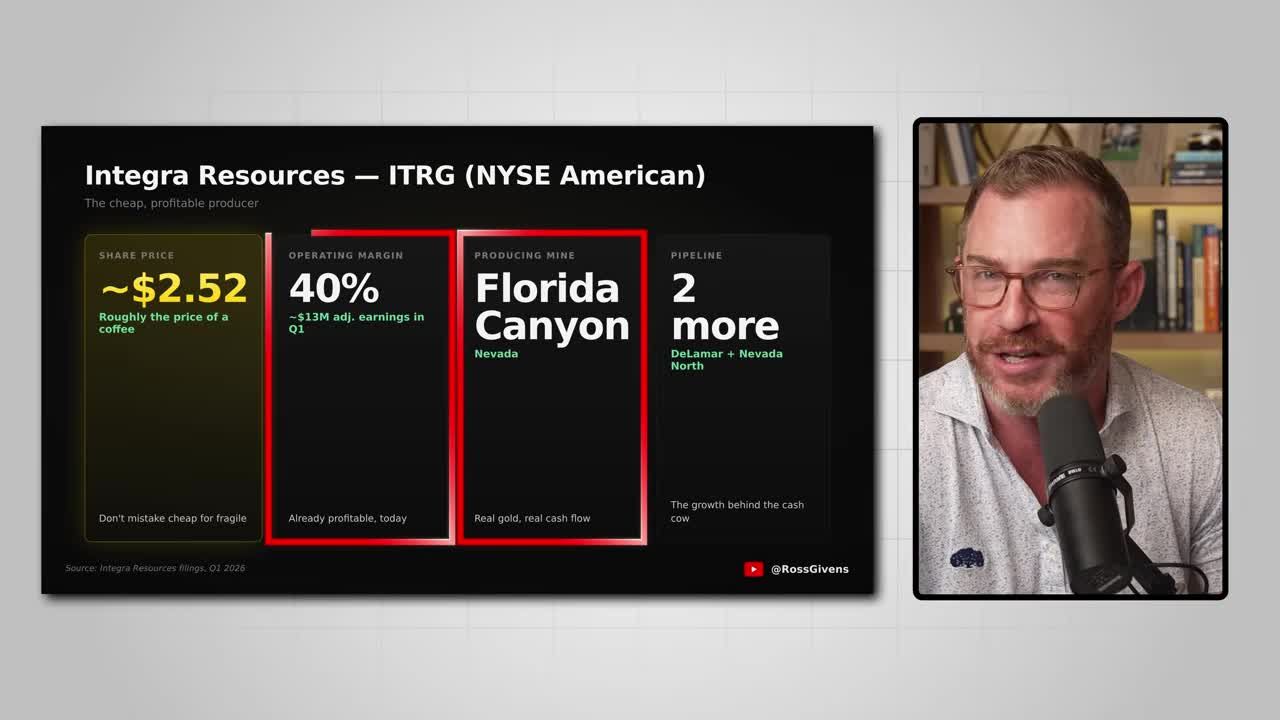
Behind Florida Canyon, they have two more American projects in the pipeline: DeLamar in Idaho and Nevada North. These represent the real growth. If these mines produce as expected, you will see a big jump in earnings.
The best part: they are not diluting shareholders to fund the expansion. Instead of taking on debt or issuing new stock, Integra is funding growth with its own profits. This is a company run by grown-ups. If you are a dividend investor, this is probably not your stock. But for someone who wants growth with a macro tailwind at its back, this is exactly the kind of setup I look for.
Positioning for the Inevitable
The government erasing national debt through inflation is not a theory. It is a mathematical certainty. They have to inflate it away because there is no other realistic path. With $39 trillion on the books, the government erasing national debt quietly is the only option that does not end in political or economic catastrophe.
This will cause money to flee paper and run into hard assets, just like it always has. You do not need to go all in on any single small-cap miner. These are smaller names, which means more upside but also more volatility.
But the big picture is clear. We have a government that must inflate away an inconceivable number. Gold is the historical beneficiary of that exact force. And these are two profitable American mining companies, one sitting on the country's biggest rare earth deposit, both trading well off their highs, right as the wind starts blowing their way.
The smartest money is already moving. Make sure your portfolio is standing where the capital is going to flow before it actually gets there.
Get an entire year of live weekly mentoring sessions, my newsletter, indicators, bonus reports, tons more. Click the link and I'll see you in the next live session.
Key Takeaways
- The U.S. national debt stands at $39 trillion and is projected to reach $50 trillion by 2030, with interest payments now exceeding the entire military budget for the first time in American history.
- Governments facing unpayable debt have three exits: austerity, default, or inflation. Austerity is political suicide and default is catastrophic, which makes inflation the historically preferred path.
- Inflation functions as a hidden tax that quietly erases the real value of debt over time, transferring wealth from savers and wage earners to the government and hard asset holders.
- Gold is identified as the primary historical beneficiary of government-driven inflation cycles, with two U.S. gold and rare earth mining companies flagged as specific plays, both trading well off their highs.
- The rare earth angle adds a second layer: one of the named companies sits on the largest rare earth deposit in the United States, positioning it at the intersection of inflation protection and domestic resource demand.
DISCLAIMER: Traders Agency does not offer financial advice. The information provided is for educational purposes only and should not be considered financial advice. Traders Agency is not responsible for any financial losses or consequences resulting from the use of the information provided. Trading carries inherent risks and may not be suitable for all individuals. You are advised to conduct your own research and seek personalized advice before making any investment decisions, recognizing the potential risks and rewards involved.
See more from Traders Agency on Google
Make us a preferred source and our market analysis will appear more prominently in your Google Search, Top Stories, and AI results.
Add to Preferred Sources