
Luiz Inácio Lula da Silva has won an unprecedented fourth term as Brazil's president, overturning a first-round loss to defeat Senator Flávio Bolsonaro in a runoff that split the country almost evenly, CNBC reported. Bolsonaro has refused to concede and says he will seek to have the result annulled, setting up a contested transition ahead of markets reopening.
A Historic Comeback
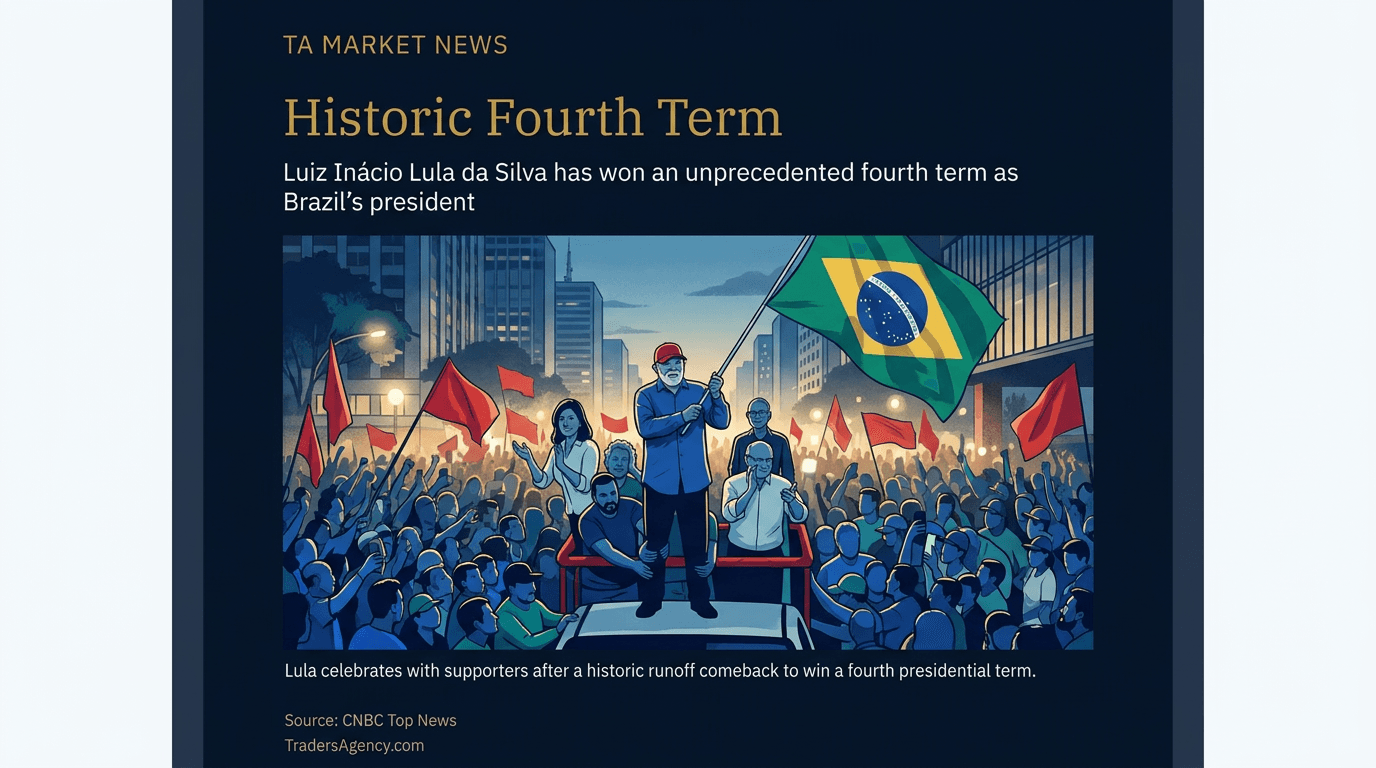
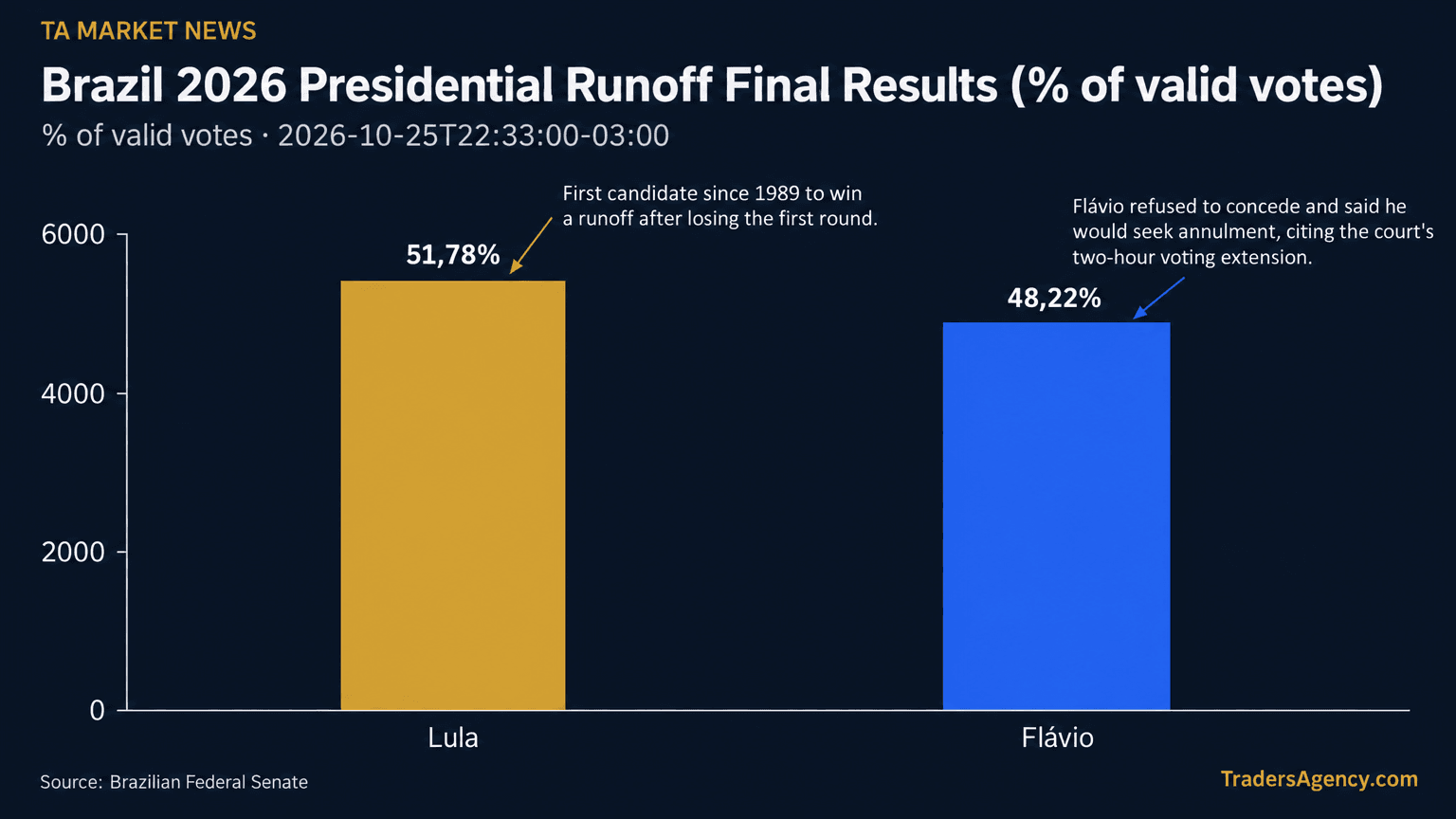
According to Brazil's Superior Electoral Court, as cited by CNBC, Lula took 51.8% of valid votes to Bolsonaro's 48.2%, with nearly all ballots counted on Sunday. The Brazilian Federal Senate's own tally put the final count at 64.2 million votes for Lula, or 51.78%, against 59.8 million votes, or 48.22%, for Flávio, as of 22:33 local time on October 25, according to the Brazilian Federal Senate.
By our calculation, using the Senate's figures, Lula's margin was 3.56 percentage points (51.78% minus 48.22%), which represents roughly a 7.4% relative advantage over Flávio's vote share (356 divided by 4,822, multiplied by 100). That is a straightforward arithmetic comparison of the reported totals and does not imply any forecast about governing strength or future elections.
CNBC reported that the result is historic in a specific sense: it marks the first time since Brazil returned to direct elections in 1989 that a candidate has won a presidential runoff after losing the first round. The Brazilian Federal Senate similarly reported that this is the first time a presidential candidate has reversed the scoreline between the first and second rounds. With this win, Lula extends his record to four direct presidential election victories, in 2002, 2006, 2022 and 2026, the Senate reported. His inauguration for the new term is scheduled for January 5, 2027, per the same source.
Bolsonaro Refuses to Concede
Bolsonaro refused to accept the outcome and said he would seek the annulment of the result, according to a Reuters report cited by CNBC. The Brazilian Federal Senate separately quoted Flávio as saying he intends to request annulment of the election.
At the center of his objection is a decision by Supreme Court Justice Cristiano Zanin to extend voting by two hours, which Flávio called "unacceptable," per CNBC's report, and which he said amounted to a Supreme Court justice unilaterally changing the rules of the contest, according to the Senate's account of his remarks. The Senate reported that Zanin ordered voting extended until 7 p.m. local time after Lula's campaign flagged suspended public transportation affecting voters in several regions, a claim CNBC also reported in describing allegations of voter suppression during the race. CNBC additionally reported that Bolsonaro's own campaign had separately requested an extension, citing heavy rain that shut polling stations in the south, a right-wing stronghold.
Neither CNBC nor the Senate specified what legal mechanism Flávio Bolsonaro would use to pursue annulment, or how Brazil's electoral courts might treat such a challenge. No ruling on any such request has been reported.
Markets Brace for Volatility

CNBC reported that investors are bracing for heightened volatility across Brazilian markets, since Bolsonaro was seen as more likely than Lula to push for fiscal austerity and deregulation. The outlet reported that the iShares MSCI Brazil ETF (EWZ) plunged nearly 20% in overnight trading following the election results.
CNBC also reported that analysts had expected a rally in Brazilian assets ahead of Sunday's vote, given Bolsonaro's narrow lead earlier in the month. Chris Turner, global head of markets and regional head of research for the UK and CEE at ING, had forecast that both the currency and bond markets would rally if Bolsonaro won, according to CNBC. With Lula's victory instead, that anticipated rally did not materialize, based on the ETF reaction CNBC described. CNBC's report did not include separate real-time figures for the Brazilian real, the Bovespa index or sovereign bond spreads beyond the EWZ move.
Fiscal Backdrop and Analyst Expectations
Lula is set to govern from 2027 to 2030 facing a Congress where Bolsonaro's Liberal Party holds its largest bench in decades, and with substantial public debt to manage, CNBC reported. Brazil's gross public debt reached 82.9% of GDP in August, the highest level since March 2021, according to the Central Bank of Brazil, as cited by CNBC.
Alejo Czerwonko, a fellow at the Atlantic Council, told CNBC that the new president will need to convince investors that Brazil can stabilize its debt trajectory. He said Lula's administration will likely extend a more "gradual approach," building on the existing fiscal framework while seeking to preserve public investment and social spending, according to CNBC's report.
Separately, Goldman Sachs analysts told CNBC they expect only "modest measures" to contain the government's spending growth, alongside further increases to an already high tax burden, with major structural reforms seen as unlikely. Those are analyst expectations rather than policy commitments: neither CNBC nor the Senate reported any formal fiscal, monetary or trade announcement from Lula or his transition team.
Regional and Geopolitical Reaction
CNBC reported that Lula's victory blocks a rightward shift in Latin America that U.S. President Donald Trump has backed. Trump had called Bolsonaro's first-round lead "a very, very big victory" and would have preferred a Brazilian leader more closely aligned with U.S. foreign policy, according to Daniela Portella Sampaio, senior research fellow for Latin American security at the UK-based Royal United Services Institute, as cited by CNBC.
Leaders across Latin America largely congratulated Lula, per CNBC. Peruvian President Keiko Fujimori called the result a "democratic day" for the Brazilian people in a post on X, while Uruguayan President Orsi Yamandu congratulated Lula in a call and referred to him as a "friend," CNBC reported.
In remarks reported by the Brazilian Federal Senate, Lula said he would not speak of national unity, noting the word does not always fit the country, but added that if it were up to him, Brazil would maintain civility. He said the country has a Constitution, that no one is obligated to like the elected president, but that he was elected to govern for everyone.
Bottom Line
Lula's runoff comeback is historic by Brazil's own electoral record, and the vote margin reported by the Senate was narrow enough to leave the country closely divided. Flávio Bolsonaro's refusal to concede and his stated intent to seek annulment, centered on the Supreme Court's two-hour voting extension, introduces near-term uncertainty that remains unresolved in the reporting from CNBC and the Senate. Markets have already registered unease, with CNBC reporting a sharp overnight drop in the iShares MSCI Brazil ETF (EWZ), though those reports did not detail broader currency, equity index or bond-market reactions. Analysts cited by CNBC, including the Atlantic Council's Alejo Czerwonko and Goldman Sachs, expect gradual fiscal adjustment rather than major structural reform, but these remain attributed forecasts, not confirmed policy from Lula's incoming administration.
DISCLAIMER: Traders Agency does not offer financial advice. The information provided is for educational purposes only and should not be considered financial advice. Traders Agency is not responsible for any financial losses or consequences resulting from the use of the information provided. Trading carries inherent risks and may not be suitable for all individuals. You are advised to conduct your own research and seek personalized advice before making any investment decisions, recognizing the potential risks and rewards involved.
- CNBC Top News: Brazil's Lula wins historic presidential election; Bolsonaro reportedly refuses to concede · accessed Oct 26, 2026
- Brazilian Federal Senate: Lula é reeleito para quarto mandato de presidente · accessed Oct 26, 2026
See more from Traders Agency on Google
Make us a preferred source and our market analysis will appear more prominently in your Google Search, Top Stories, and AI results.
Add to Preferred Sources