
Meta said Monday that it is planning to raise a total of $95 billion to support its investments in AI infrastructure and superintelligence, according to CNBC. The announcement follows months of market speculation about how the social-media giant would pay for its rapidly expanding data-center ambitions, and it lands just days after Meta posted third-quarter results that beat revenue expectations but rattled investors over cash burn and spending plans.
What Meta Announced

According to CNBC, Meta said it plans to balance funding for its AI investments through a mix of operating cash flow, investment-grade debt, partnerships and equity capital. The company said the planned investments will support what it called "emerging AI opportunities," including its family of apps, its AI agent Muse, and its data-center business. Meta's stock rose 1.6% in premarket trading after the announcement, CNBC reported.
CNBC also noted that Meta is among the major hyperscalers that are increasingly tapping debt to fund the infrastructure required for the AI boom, a dynamic that has become more visible across the sector as computing demand for AI models accelerates.
Capex Guidance Keeps Climbing
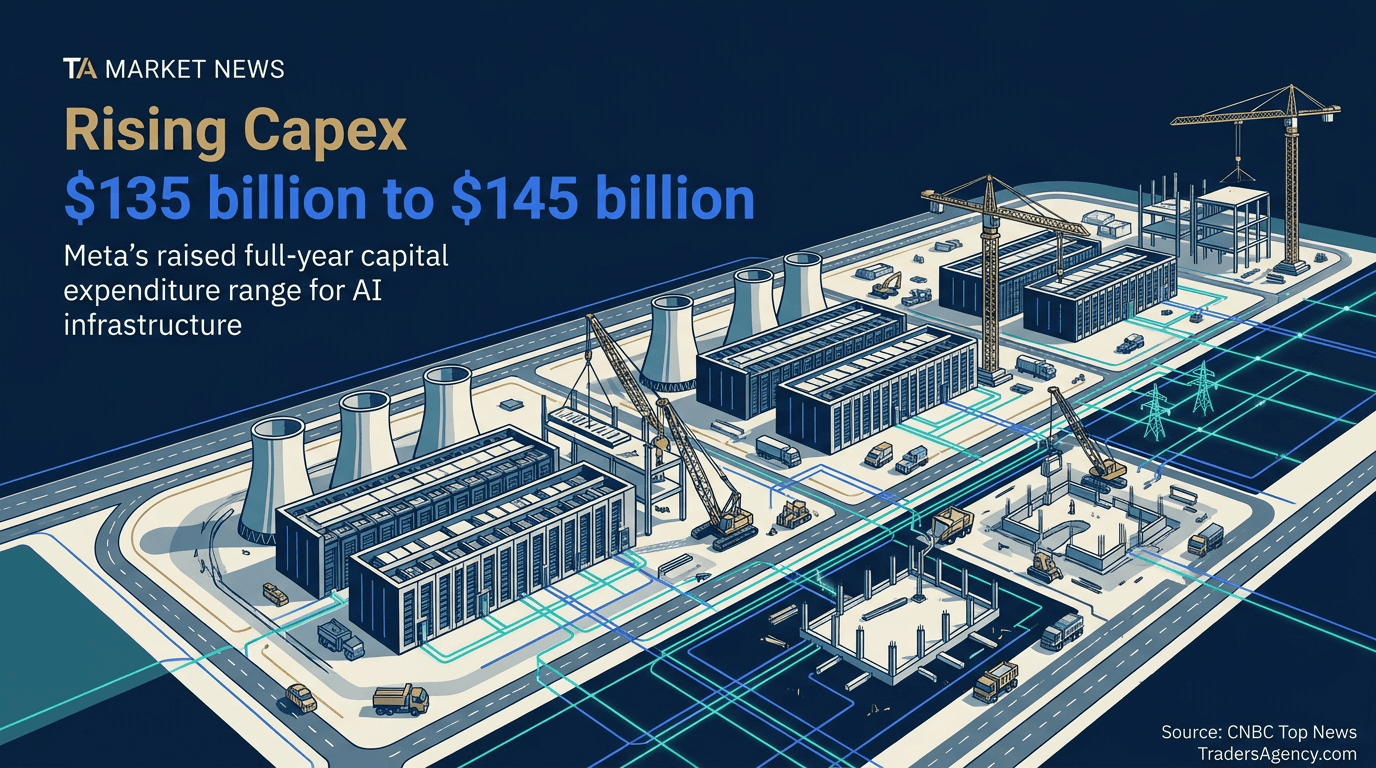
The $95 billion funding plan arrives against a backdrop of rising spending targets. Meta now expects full-year capital expenditure to range from $135 billion to $145 billion, having raised the bottom of that range from a prior $130 billion, CNBC reported following Meta's third-quarter results. CNBC had earlier reported another increase: in April, Meta raised its 2026 capex guidance to as high as $145 billion from a previous forecast of up to $135 billion.
Using the figures Meta and CNBC have disclosed, the lower end of the capex range increased by $5 billion ($135 billion minus $130 billion), by our calculation. Taking the midpoint of the current $135 billion to $145 billion range, which is $140 billion, the newly announced $95 billion raise would cover roughly 68% of that midpoint figure ($95 billion divided by $140 billion equals approximately 67.9%), also by our calculation. This comparison is offered only to size the raise against Meta's own stated spending range; it is not a claim about how the proceeds will actually be allocated, since Meta's public statement did not break down the $95 billion by specific use.
Earnings Context
Meta's third-quarter revenue rose 26% year-on-year to $64.60 billion, beating the $63.37 billion analysts had expected, CNBC reported. Despite that beat, CNBC said investors focused more on the company's negative free cash flow and its higher full-year capex forecast, and shares fell on the day the results were released.
From Speculation to Confirmation
The scale of Meta's financing needs has been the subject of market discussion for months. In June 2026, CNBC reported that Meta stock sank after a report suggested the company could raise tens of billions of dollars for AI. At the time, a Meta spokesperson called the Financial Times report "pure speculation" and said the company had "been clear that huge opportunities lie ahead in AI" and would "continue focusing on raising capital in the most flexible ways to support that," according to CNBC's account of the spokesperson's emailed statement. Monday's announcement attaches a specific $95 billion figure to that financing effort, according to CNBC.
What Remains Undisclosed
Based on the available reporting, Meta's statement described only the broad categories it intends to draw on, cash flow, debt, partnerships and equity, without detailing the specific securities, pricing terms, or conversion mechanics tied to any equity component, or how proceeds might be split between data-center construction, GPU purchases and other AI-related costs. No credit-rating agency reaction or shareholder response to the capital plan was included in the reporting reviewed here.
Interpretation: Weighing Leverage and Dilution
In our assessment, a financing plan that blends debt and equity in unspecified proportions makes it difficult to project the precise effect on Meta's balance-sheet leverage or share dilution. What can be said, based on the reported facts, is that Meta is pursuing multiple capital sources simultaneously rather than relying on a single instrument, which is consistent with CNBC's reporting that hyperscalers broadly are turning to debt markets to fund AI infrastructure. Meta shares were up 1.6% in premarket trading after Monday's announcement, per CNBC, even though the capex increase disclosed with the prior week's third-quarter results had sent the stock lower on that day. That contrast suggests markets may be distinguishing between open-ended spending uncertainty and a defined, if still partially unspecified, funding plan, though this is our interpretation of the reported price moves rather than a conclusion Meta has stated.
Bottom Line
Meta has put a specific number, $95 billion, on its AI financing plans, pairing it with a funding mix of operating cash flow, investment-grade debt, partnerships and equity capital, according to CNBC. The plan follows increases in full-year capex guidance and a third quarter in which, CNBC reported, investors focused more on negative free cash flow and the higher spending forecast than on revenue that beat expectations. Key structural details, including how the equity and debt components will be sized and priced, and how rating agencies or large shareholders will respond, have not been reported in the coverage reviewed.
DISCLAIMER: Traders Agency does not offer financial advice. The information provided is for educational purposes only and should not be considered financial advice. Traders Agency is not responsible for any financial losses or consequences resulting from the use of the information provided. Trading carries inherent risks and may not be suitable for all individuals. You are advised to conduct your own research and seek personalized advice before making any investment decisions, recognizing the potential risks and rewards involved.
- CNBC Top News: Meta launches plan for $95 billion stock offering to fund AI expansion · accessed Oct 26, 2026
- CNBC Top News: Meta launches plan for $95 billion stock offering to fund AI expansion · accessed Oct 26, 2026
- www.clearygottlieb.com: Alphabet in Upsized $90 Billion Equity Offerings · accessed Oct 26, 2026
- finance.yahoo.com: Rocket Lab Corporation Announces Dollar-for-Dollar Replacement At-The-Market Equity Program · accessed Oct 26, 2026
- www.cnbc.com: Meta stock sinks on report company could raise tens of billions for AI · accessed Oct 26, 2026
- www.linkedin.com: Meta explores major stock offering to fund AI ambitions · accessed Oct 26, 2026
- www.tradingview.com: Meta is considering raising tens of billion dollars in a stock offering · accessed Oct 26, 2026
- investingnews.com: Forward Industries Announces $4 Billion At-The-Market Equity Offering Program · accessed Oct 26, 2026
See more from Traders Agency on Google
Make us a preferred source and our market analysis will appear more prominently in your Google Search, Top Stories, and AI results.
Add to Preferred Sources