
French government bonds and Paris-listed equities sold off on Monday, 19 October 2026, after a weekend of nationwide protests over living costs and public services turned violent, adding fresh pressure on Prime Minister Sébastien Lecornu's minority government a day before a scheduled National Assembly vote on the first part of the 2027 budget. CNBC and The Guardian reported that government bonds and Paris stocks came under renewed pressure as social unrest, political instability and mounting national debt weighed on French assets.
Weekend unrest shakes confidence
According to CNBC, roughly 550,000 people marched in cities across France on Saturday, including 110,000 in Paris, figures the outlet attributed to authorities. The demonstrations followed a month-long student movement over teacher shortages and school conditions, compounded by broader union anger. The Guardian reported that the weekend violence left public buildings burned, hundreds of shops looted and thousands of people arrested across the country, while Reuters via Yahoo Finance described it as one of the worst bouts of protest violence in years.
President Emmanuel Macron condemned the violence in a televised address Sunday night, per CNBC and The Guardian, saying "nothing justifies it, nothing explains it, nothing excuses it," and pledging an "uncompromising" response to what he called agitators from ultra-left fringe groups joined by delinquents. He stopped short of declaring a state of emergency or imposing a curfew but said prefects and mayors would be allowed to ban certain gatherings to protect public buildings and businesses. Macron also ordered a review of possible policing or intelligence failings and asked the government to convene students, teachers, lawmakers, unions and business leaders this week to produce what CNBC reported he called "concrete proposals." Economy Minister Roland Lescure, CNBC said, pledged government support for business owners who suffered losses in the unrest.
Yields jump, spread widens to crisis-era levels
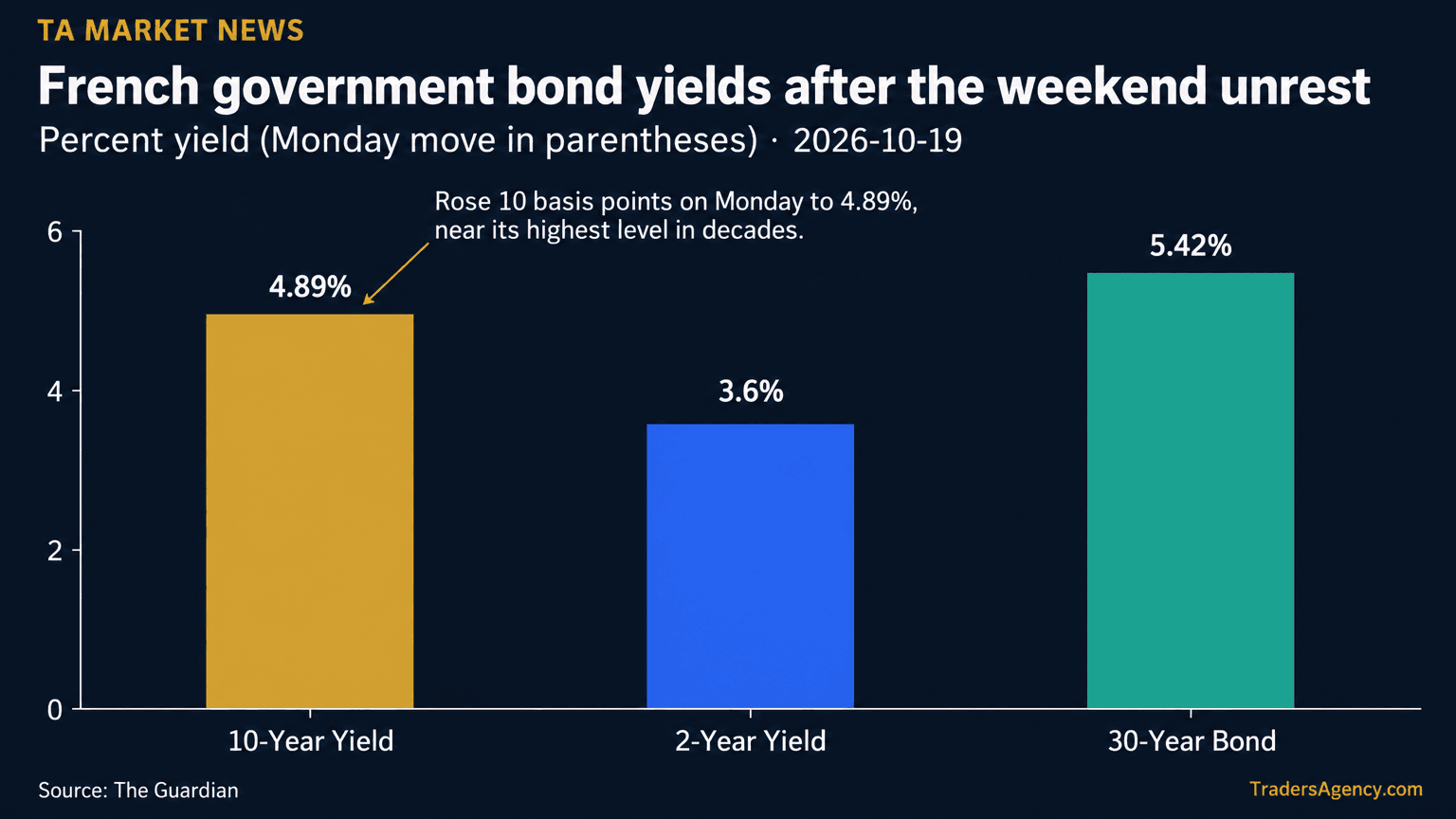
The Guardian reported France's 10-year bond yield rose 10 basis points on Monday to 4.89%, with the two-year yield up five basis points to 3.6% and the 30-year bond up five basis points to 5.42%. CNBC separately described the 10-year move as a jump of more than 10 basis points, keeping yields near their highest level in decades despite some recent easing.
CNBC reported that the OAT-Bund spread, the premium France pays over Germany on 10-year debt, has widened to its highest level since the early-2010s euro-area sovereign debt crisis, and that French yields now exceed those of both Italy and Greece. The National Assembly's own record of the 13 October session shows lawmakers being told that no eurozone country currently borrows at higher rates than France. In that session, budget rapporteur général Philippe Juvin said the five-year credit default swap on French debt, effectively an insurance premium against default, had doubled in a month, and that debt-servicing costs in 2027 will exceed €91 billion, compared with the €64 billion devoted to education.
Carrefour, Unibail lead domestic names lower
Reuters, via Yahoo Finance, reported that French equities led losses across Europe on Monday. Among individually named stocks, retailer Carrefour fell 1.9% and shopping-mall operator Unibail-Rodamco-Westfield declined 2%, both companies with direct exposure to French consumer spending and store footfall.
A fraught vote and censure arithmetic
The National Assembly was due to hold a formal vote Tuesday on the first part of the 2027 budget bill, as Lecornu's minority government seeks €54 billion ($61 billion) in fiscal savings to narrow France's deficit, CNBC reported. Budget negotiations have already toppled two of Lecornu's recent predecessors, and CNBC noted markets are weighing whether his government can get the budget through ahead of a presidential election in which Marine Le Pen is topping many polls.
ING's research team wrote in a 1 October note that the Rassemblement National appeared inclined to avoid a censure motion, and that unless the RN and the Socialists unite behind the same no-confidence motion, it is unlikely to secure the required majority in the Assembly. Separately, the Assembly's own record of debate shows concessions already made under pressure: an LFI deputy said high-school mobilisations had forced the government to abandon proposed enrolment fees for BTS and preparatory-class students that had been floated when the finance bill was presented on 1 October.
Political reaction has sharpened along familiar lines. CNBC reported Marine Le Pen said the unrest showed Macron's government is "running on fumes, exhausted and disoriented," while Jean-Luc Mélenchon warned the country could be heading toward "events that will eventually become uncontrollable."
What investors and officials are saying

CNBC reported that overseas investors' share of French government debt has risen from around 48% at the start of 2022 to nearly 60% at the start of 2026, a shift the outlet said could amplify bond-market volatility during risk-off episodes such as this one. Mike Bell, head of market strategy at RBC BlueBay Asset Management, told CNBC's Squawk Box Europe that the unrest is unhelpful for international buyers of French bonds, adding: "It looks like either the bond markets riot, or the people riot, or both."
Not every read was uniformly bearish. Ken Egan, senior director of sovereigns at ratings agency KBRA, told CNBC that auctions last week showed "still very solid underlying demand for French debt," even as France absorbs more pressure than peers in the current risk-off mood. Goldman Sachs strategist Sharon Bell told CNBC that OAT-Bund spreads are not narrowing because investors are skeptical that fiscal consolidation will materialize, and that taxes on French businesses could well rise. She added that she did not believe current conditions warranted emergency European Central Bank intervention, though the ECB would be prepared to deploy its Transmission Protection Instrument if spreads began disrupting market liquidity, in her view.
Banque de France Governor Emmanuel Moulin told CNBC last week that rising French yields reflected political uncertainty but said it remained "possible to get back to a 3% deficit in 2029, which is the objective of the government." UBS Global Wealth Management's Kiran Ganesh told Reuters, via Yahoo Finance, that the protests imply near-term volatility but that other factors matter more for the medium and longer-term picture.
Bottom Line
France enters Tuesday's budget vote with bond yields and credit insurance costs elevated and its benchmark spread over Germany at its widest since the euro crisis era, conditions that analysts cited by CNBC and ING tie directly to doubts over whether Lecornu's minority government can pass fiscal savings and avoid a successful censure motion. Reported demand at recent debt auctions and the absence, for now, of a unified no-confidence coalition in the Assembly leave the near-term outcome unsettled rather than resolved.
DISCLAIMER: Traders Agency does not offer financial advice. The information provided is for educational purposes only and should not be considered financial advice. Traders Agency is not responsible for any financial losses or consequences resulting from the use of the information provided. Trading carries inherent risks and may not be suitable for all individuals. You are advised to conduct your own research and seek personalized advice before making any investment decisions, recognizing the potential risks and rewards involved.
- CNBC Top News: France protests push bond yields higher, euro slips · accessed Oct 19, 2026
- CNBC Top News: France hit by worst unrest in years as Macron condemns violence · accessed Oct 19, 2026
- The Guardian: France hit by debt sell-off as protests unnerve investors · accessed Oct 19, 2026
- Reuters via Yahoo Finance: European shares slip on French unrest; earnings in focus · accessed Oct 19, 2026
- ING THINK: France’s budget offers no quick relief for bond markets · accessed Oct 19, 2026
- Assemblée nationale: Organisation de la discussion budgétaire — PLF 2027 · accessed Oct 19, 2026
- Assemblée nationale: Projet de loi de finances pour 2027 · accessed Oct 19, 2026
- Assemblée nationale: Compte rendu de la deuxième séance du mardi 13 octobre 2026 · accessed Oct 19, 2026
See more from Traders Agency on Google
Make us a preferred source and our market analysis will appear more prominently in your Google Search, Top Stories, and AI results.
Add to Preferred Sources