
IV crush after earnings is the sharp drop in an option's implied volatility that happens right after a company reports earnings, regardless of whether the stock goes up, down, or sideways. It happens because the market prices in uncertainty before the announcement, then removes that uncertainty the moment the news is out. If you've ever bought a call before earnings, watched the stock move in your favor, and still lost money, you've experienced IV crush firsthand.
In this guide, we'll walk you through what IV crush actually is, why it happens mechanically, and how to calculate it with real numbers. We'll also show you which strategies are built to profit from this phenomenon, which trades to avoid entirely, and how to tell the difference before you place an order.
By the end, you'll know how to read an options chain heading into an earnings date and recognize whether you're about to buy into a trap or set up a trade that works with the volatility crush instead of against it.
What Is IV Crush in Options Trading?
Bottom Line: IV crush is a predictable, mechanical repricing of options around earnings, not random bad luck, so buying calls or puts into an earnings report without accounting for the IV drop can lose money even if the stock moves the right way. Traders who understand how to calculate expected IV crush can structure trades, like spreads or premium-selling strategies, that work with the volatility collapse instead of getting caught by it.
IV crush meaning, in simple terms: it's the rapid decline in an option's implied volatility (IV) that occurs after a scheduled event, like an earnings report, removes uncertainty from the market. Because option prices are built partly from IV, when IV drops, the option's extrinsic value drops too, even if the stock price barely moves.
Implied volatility is the market's estimate of how much a stock might move in the future. It's baked into every option's price through pricing models like Black-Scholes, the standard framework we use when teaching how option premiums behave around major events. The Cboe publishes option chain data that reflects this pricing mechanism in real time.
Here's the part that trips up a lot of newer traders: IV isn't about direction. It's about the magnitude of expected movement. Before earnings, nobody knows if a stock will jump 8% or drop 8%, so the market prices options as if either outcome is possible. That uncertainty inflates premiums across the board, calls and puts alike.
Once the earnings report hits and the outcome is known, that uncertainty disappears instantly. The IV collapses, usually within hours, and it takes a big chunk of the option's value down with it.
Key Concept: IV crush isn't about whether you were right on direction. It's the loss of value that happens when the market stops paying for uncertainty the moment that uncertainty is resolved.
Why This Matters for Options Pricing
An option's price has two components: intrinsic value (how much it's worth if exercised right now) and extrinsic value (time value plus the volatility premium). IV crush attacks the extrinsic portion directly.
- Intrinsic value only changes when the stock price moves relative to the strike
- Extrinsic value is heavily influenced by IV and collapses once the event passes
- A stock can move in the direction you predicted and your option can still lose value if the IV drop outweighs the price gain
When Does an IV Crush Happen?
An IV crush after earnings typically happens within minutes to hours of the report being released, most often overnight or before the market open if the company reports outside trading hours. The volatility spike builds in the days leading up to the print and then unwinds almost immediately once the numbers are public.
This isn't limited to earnings. Any scheduled binary event, FDA decisions, major court rulings, economic data releases, can trigger the same pattern. But earnings season is where traders run into it most often, which is why we see so many traders every quarter asking why their calls lost money on a stock that went up.
The pattern is predictable enough that you can almost set a clock to it. IV climbs steadily for the five to ten trading days before the report, peaks the day of (or the day before, depending on when the company reports), then falls sharply once the news is released.
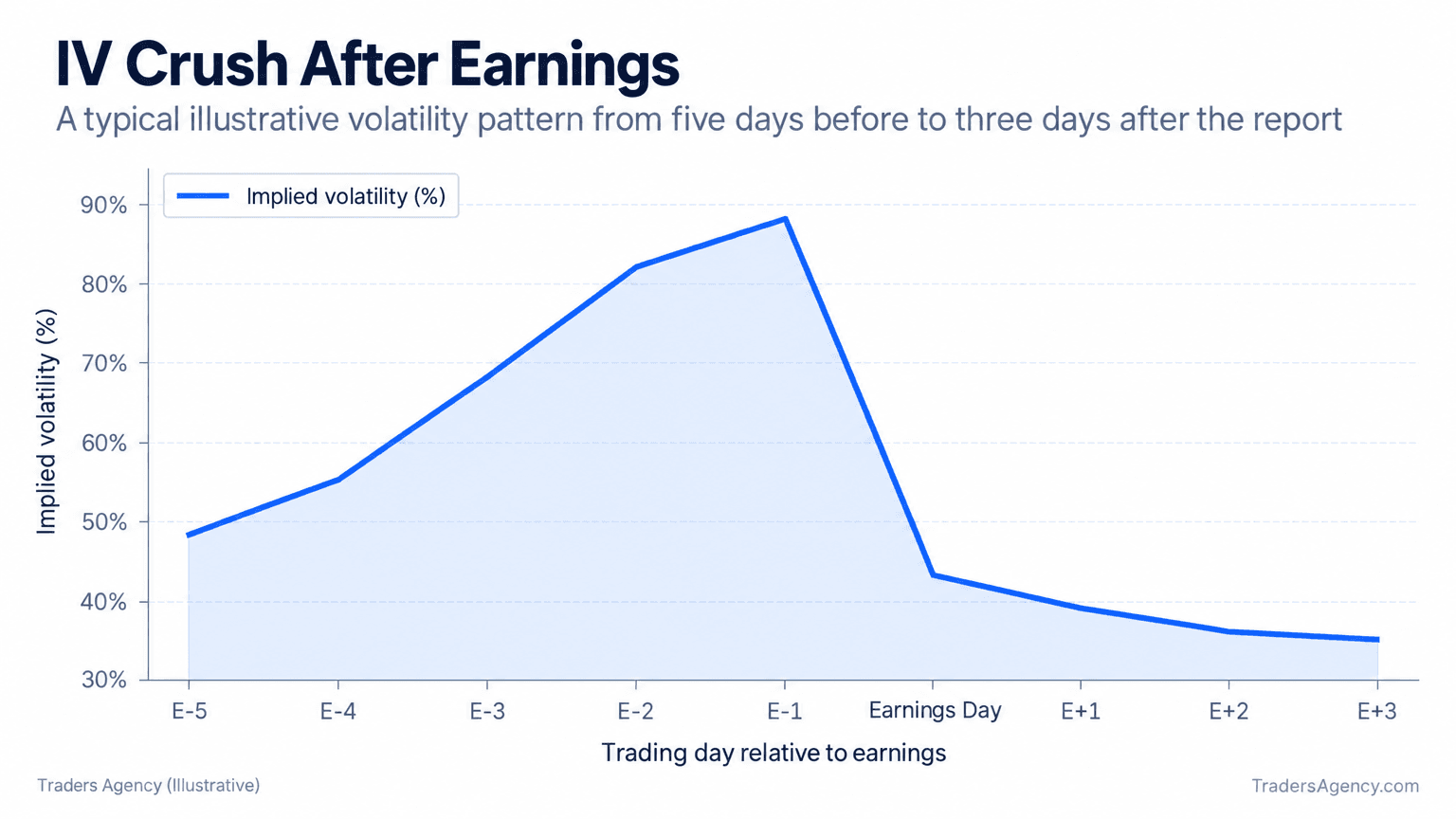
Notice that the IV in this illustration almost doubles, from 48% to 88%, in the days leading up to the print, then falls back down near 35% within three days afterward. That's the entire mechanism in one picture.
How Does IV Crush Work Mechanically?
IV crush works mechanically because option pricing models treat implied volatility as a live input that updates constantly based on expected future movement. When a known event like earnings is removed from the calendar, the model has less reason to price in a wide range of outcomes, so IV resets lower.
Think of IV like an insurance premium. Insurers charge more for a policy during hurricane season because the risk of a claim is higher. Once hurricane season ends, premiums drop, even if no hurricane ever hit your area.
Options work the same way. The "storm" is earnings day. Premiums (option prices) get expensive leading into it because of the uncertainty, then cheapen once the storm has passed, whether the news was good, bad, or neutral.
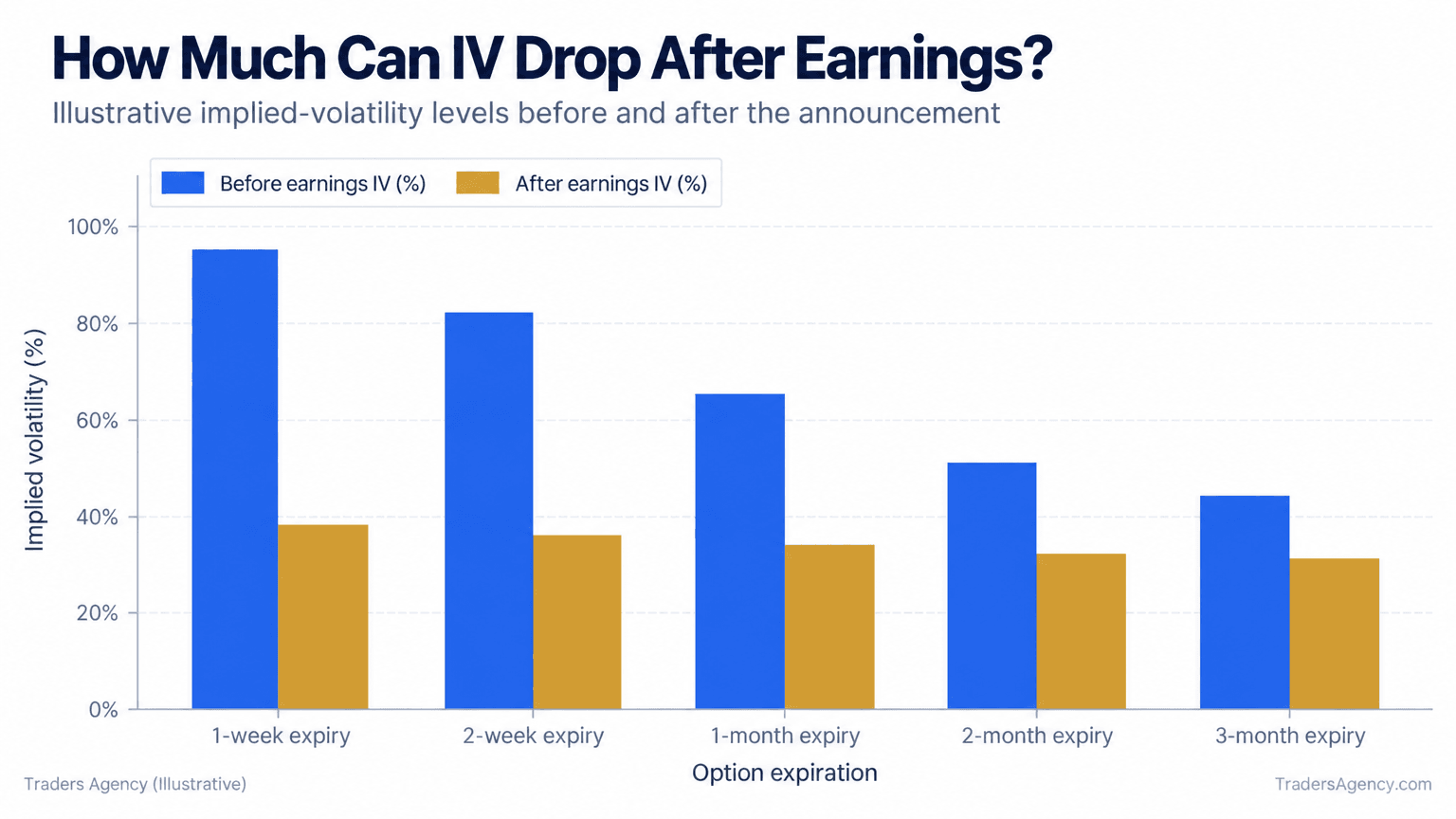
This is also why option expirations that fall right after earnings tend to carry higher IV than expirations further out, a pattern you'll see reflected in nearly every options chain during earnings season.
How to Calculate IV Crush
If you want to know how to calculate IV crush before placing a trade, you don't need anything fancy. You just need to compare the implied volatility of an option before the event to its typical level after. Here's the process we teach:
- Pull up the current IV for the option expiration you're considering, usually shown as "IV" in your broker's options chain
- Check the historical IV for the same expiration a week or two before the previous earnings cycle, many platforms show historical IV charts for this
- Compare the current pre-earnings IV against that historical "resting" IV level to estimate how much premium is inflated
- Use an IV crush calculator (several brokers and third-party options tools offer these) to model what the option would be worth if IV dropped to its post-earnings average while holding the stock price constant
- Repeat the comparison across a couple of different strikes and expirations to see where the inflation is most extreme
A lot of traders skip step 4 and only focus on where the stock will go, but modeling the IV drop separately from the price move is the key habit that separates traders who understand IV crush from those who get blindsided by it.
Want expert trading insights delivered daily?
Join thousands of traders who rely on Traders Agency for market analysis and trade ideas.
Join Traders AgencyWhat Is an Example of IV Crush After Earnings?
Let's walk through a concrete IV crush example using round numbers so the math is easy to follow.
Say a stock is trading at $100 two days before its earnings report. You're looking at a call option with a $105 strike, expiring in 5 days, priced at $4.50. At this point, IV on that option is sitting at 140%, inflated because of the upcoming report (short-dated expirations that span an earnings date routinely carry IV that high).
The Setup
| Parameter | Value |
|---|---|
| Stock Price | $100 |
| Strike | $105 call |
| Premium Paid | $4.50 ($450 per contract) |
| IV at Entry | 140% |
| Days to Expiration | 5 |
The Outcome
The company reports earnings and beats expectations. The stock rallies 4%, moving from $100 to $104. That sounds like a win, but the stock is still below your $105 strike, so the option has no intrinsic value.
Meanwhile, IV collapses from 140% down to 45% now that the uncertainty is gone. With the stock below the strike, three days left on the clock, and IV crushed, the option's price falls to roughly $1.25, a loss of about $325 per contract, or roughly 72% of the premium paid.
| Scenario | Stock Move | Result |
|---|---|---|
| Entry | $100, IV 140% | Premium paid: $450 |
| Post-Earnings | $104 (+4%), IV 45% | Option worth ~$125 |
| Net P/L | -$325 (-72%) |
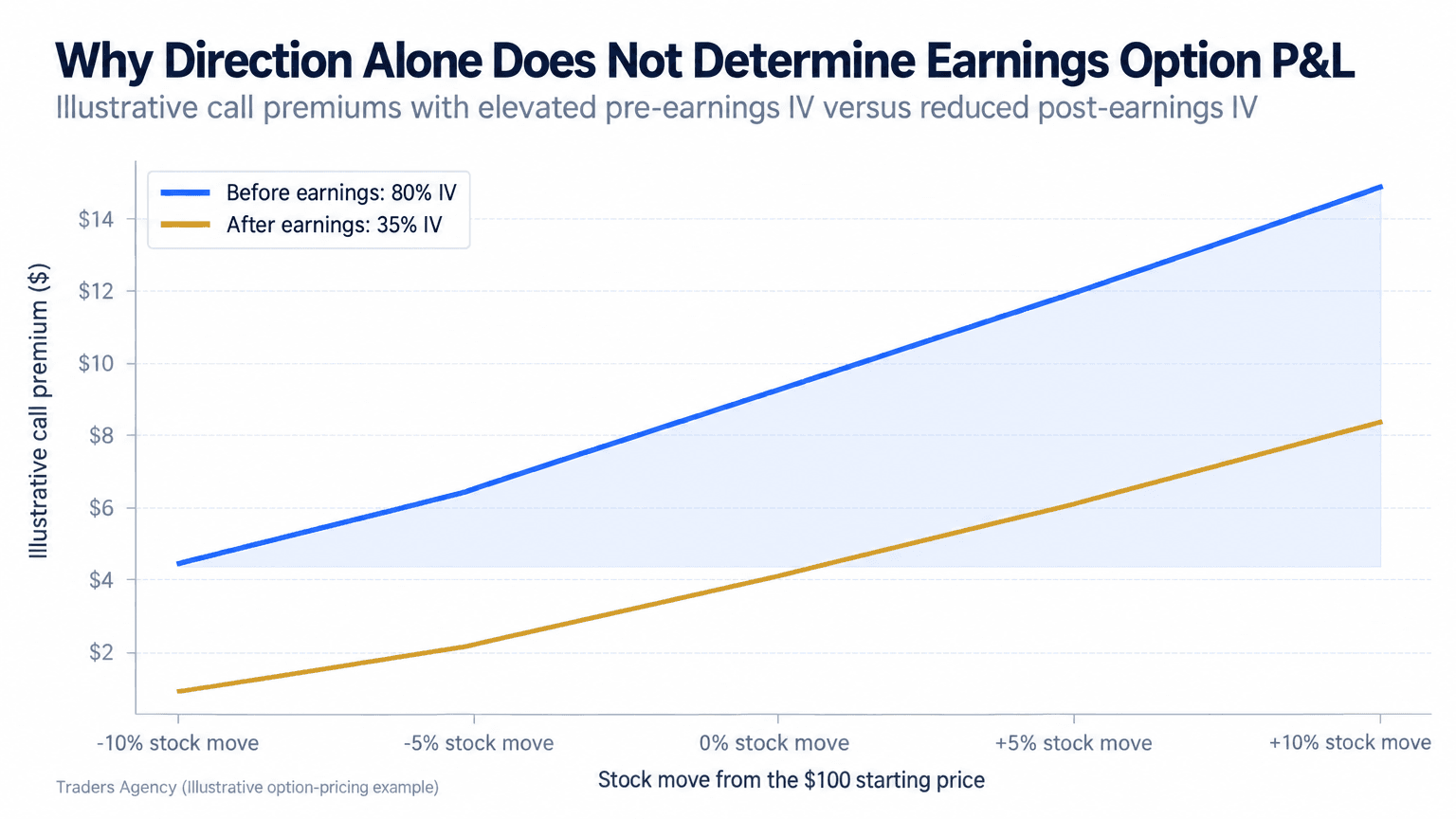
This is the chart that explains most of the confused "why did I lose money, the stock went up" questions we hear from traders every earnings season. The stock moved in your favor and the option still lost close to three quarters of its value because the volatility premium evaporated faster than the price gain could compensate for it.
Watch Out: Being right about direction isn't enough when you buy options into earnings. If the magnitude of the move doesn't clear your breakeven once IV resets, you can still lose money on a correct prediction.
- Best case: The stock gaps well above $105, intrinsic value outpaces the IV drop, and the option still profits
- Most likely case: The stock makes a modest move that doesn't clear the strike by enough margin, and IV crush eats most or all of the gain
- Worst case: The stock moves against you entirely, and the option loses value from both the wrong direction and the IV collapse at once
How Do You Avoid an IV Crush?
If you're asking how to avoid IV crush, the simplest answer we give our traders is to stop buying naked calls or puts directly into an earnings announcement unless you have a very specific reason and a plan for the volatility drop.
Buying single-leg options (just a call or just a put) right before earnings means you're paying the inflated pre-earnings premium and betting that the stock's move will be large enough to overcome both the IV crush and the breakeven cost. That's a tough bet, because it requires being right about direction and magnitude at the same time.
Ways to Reduce Your Exposure
- Buy further out in time. Options with more time until expiration are less sensitive to a single IV crush event, since the relative weight of that one earnings cycle is smaller
- Trade a spread instead of a single option. A vertical spread (buying one strike, selling another) involves selling an option too, which offsets some of the IV crush hitting your long leg
- Enter after the report, not before. If you have a thesis about the post-earnings trend, consider waiting for the IV to settle before building a directional position
- Check the IV percentile or IV rank before entering. If IV is already sitting at a multi-month high, you're paying a premium that's primed to collapse
- Size the trade smaller than you normally would. Earnings trades carry more binary risk than your average swing trade, so position size should reflect that
None of these fully eliminates the risk, but each one reduces how exposed you are to the moment IV resets.
How Can You Profit From an IV Crush?
The traders who consistently try to make money from IV crush after earnings generally aren't buying options, they're selling them. Strategies that collect premium benefit when IV drops, because the options they sold lose value as the volatility premium disappears, as long as the stock's actual move stays inside the premium collected.
Short Straddles
A short straddle involves selling a call and a put at the same strike and expiration, collecting two premiums upfront. If the stock stays relatively contained after earnings, both options lose value from the IV crush, and you can buy them back cheaper or let them expire worthless.
Risk Warning: A short straddle carries theoretically unlimited loss potential if the stock gaps higher, and substantial loss potential (bounded only by the stock falling to zero) if it collapses, since you're naked on both sides. This is not a strategy to enter without a clear plan and the account size to support it.
Iron Condors
An iron condor is a more defined-risk way to express the same idea. You sell a call spread and a put spread around the current stock price, capping both your maximum gain and your maximum loss.
For example, with the stock at $100, you might sell the $105 call and buy the $110 call for protection, while also selling the $95 put and buying the $90 put. Your maximum gain is the net premium collected, and your maximum loss is the width of either spread minus that premium.
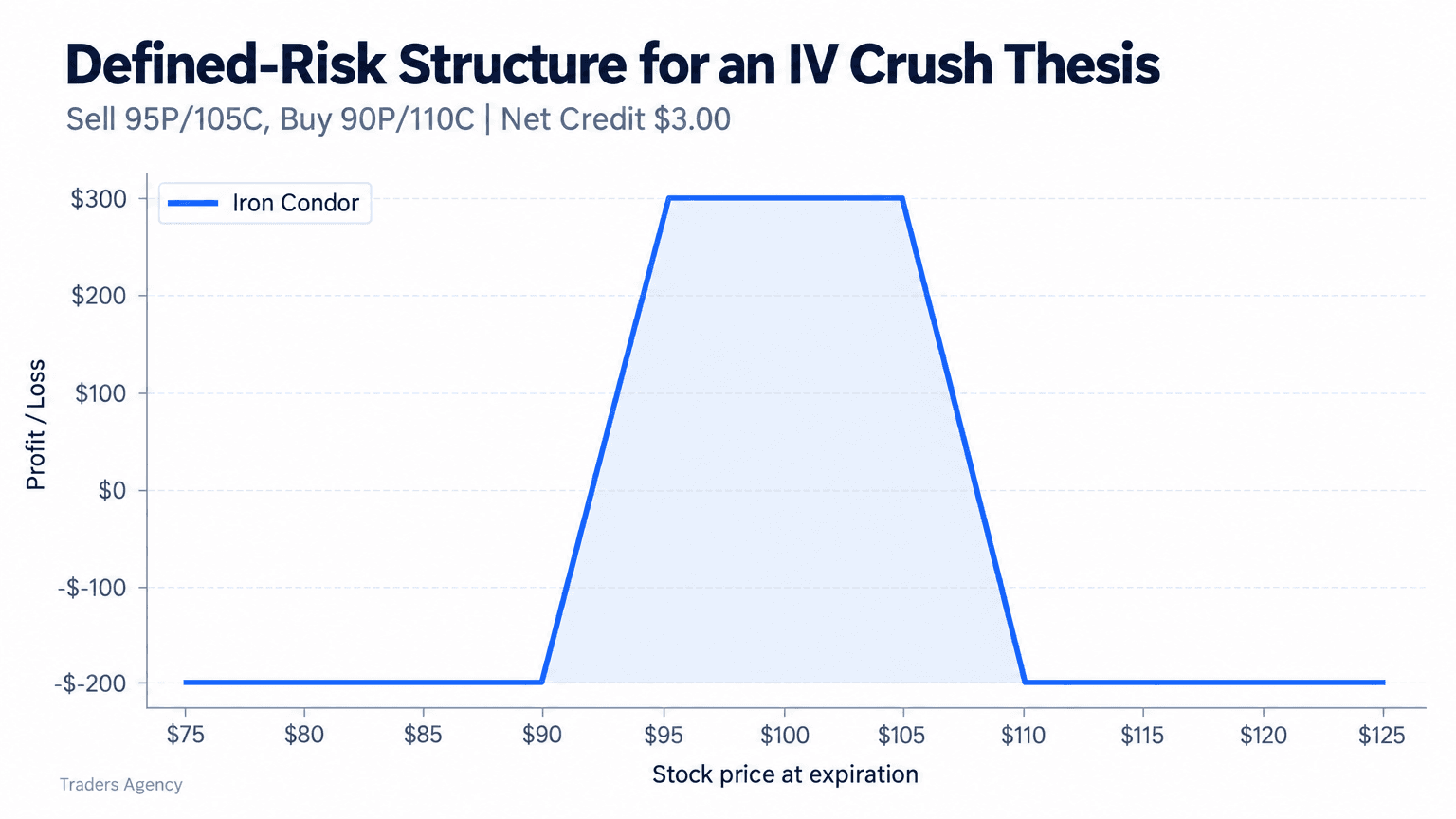
The iron condor's flat profit zone in the middle of that chart is exactly where you want the stock to land. It profits from time passing and IV dropping, as long as the stock doesn't make an extreme move outside the short strikes.
- Step 1: Study the Range -- Confirm the stock has a history of moving within a predictable range after earnings
- Step 2: Set Your Short Strikes -- Choose short strikes outside that typical range, leaving yourself a cushion
- Step 3: Define Your Risk -- Buy long strikes further out to cap your maximum loss
- Step 4: Enter When IV Is Richest -- Open the position when the pre-earnings IV spike is near its high, typically just before the report, so you collect the most inflated premium
- Step 5: Manage the Exit -- Close or let expire shortly after the report, once IV has reset
When Should You Stay Away From IV Crush Trades?
We teach our traders to stay away from IV crush strategies when the underlying stock carries binary, open-ended risk that goes beyond normal earnings uncertainty, like small-cap biotech companies awaiting FDA decisions or heavily shorted stocks prone to extreme moves.
In these situations, the historical "typical range" that iron condors and short straddles depend on simply doesn't apply. A biotech stock can move 50% or more overnight on a drug trial result, blowing through short strikes that were sized for a normal earnings reaction.
Red Flags to Watch For
- Thin options chains with wide bid-ask spreads, which make it expensive to enter and exit premium-selling strategies
- Stocks with a history of outsized earnings moves, where the "normal range" assumption breaks down
- Low open interest on the strikes you want to trade, a sign you might struggle to get filled at a fair price
- Any company with a pending binary event beyond the earnings report itself, like litigation outcomes or regulatory decisions
This connects to a broader truth about options trading: a commonly cited figure is that roughly 90% of options traders lose money over time, and a big contributor to that is traders overestimating their edge in exactly these high-uncertainty binary situations. Selling premium into a true binary event isn't collecting a volatility discount, it's gambling with defined-sounding risk that isn't actually defined.
Risk Management Checklist
- Never allocate more than a small percentage of your account to a single earnings trade
- Always know your max loss before entering a spread or condor
- Avoid holding short, undefined-risk positions (like naked straddles) through an event you haven't sized for
- Close or adjust positions before the report if the thesis behind the trade has changed
Key Concept: Defined-risk strategies like iron condors only work when the stock's typical range is actually predictable. Remove that assumption, and you're taking on risk the structure was never built to handle.
Frequently Asked Questions
How to make money from IV crush?
Traders generally try to profit from IV crush by selling option premium before an earnings report, through strategies like short straddles or iron condors, rather than buying calls or puts outright. The goal is to collect inflated premium and benefit as IV resets lower after the announcement.
How to avoid IV crush on earnings?
Avoid buying single-leg options directly into an earnings report, use spreads instead of naked long options, check IV rank before entering, and consider waiting until after the report to establish a directional position once volatility has normalized.
How much does IV drop after earnings?
The drop varies widely by stock and sector, but it's common to see implied volatility fall by 30 to 50 percentage points within a day or two of the report, and short-dated expirations that span the event can fall much further than that.
Why do 90% of options traders lose money?
A commonly repeated figure suggests the vast majority of retail options traders lose money over time, often tied to buying options without accounting for time decay and volatility crush, misjudging position size, and trading binary events without a clear risk plan.
What is IV crush meaning in simple terms?
IV crush meaning refers to the rapid drop in an option's implied volatility, and therefore its price, that happens once a known uncertain event (like earnings) has passed and the outcome is known.
Is there a reliable IV crush calculator?
Many broker platforms and third-party options tools include an IV crush calculator or volatility modeling feature that lets you estimate an option's value if IV reverts to its historical post-earnings level, holding the stock price constant.
Want expert trading insights delivered daily?
Join thousands of traders who rely on Traders Agency for market analysis and trade ideas.
Join Traders AgencyDISCLAIMER: Traders Agency does not offer financial advice. The information provided is for educational purposes only and should not be considered financial advice. Traders Agency is not responsible for any financial losses or consequences resulting from the use of the information provided. Trading carries inherent risks and may not be suitable for all individuals. You are advised to conduct your own research and seek personalized advice before making any investment decisions, recognizing the potential risks and rewards involved.
See more from Traders Agency on Google
Make us a preferred source and our market analysis will appear more prominently in your Google Search, Top Stories, and AI results.
Add to Preferred Sources