
Interest rates and stock valuations are connected through a simple but powerful mechanism: the price you're willing to pay today for a company's future profits depends on what else you could do with your money right now. When interest rates rise, future earnings become worth less in today's dollars, and stock prices tend to adjust downward. When rates fall, the opposite happens.
You've probably watched a stock drop 3% on a day when nothing changed about the company itself. No bad news, no disappointing earnings, nothing in the headlines about the business at all. Instead, a Federal Reserve announcement moved markets. That's interest rates and stock valuations in action, and it trips up a lot of newer investors who assume stock prices only move on company-specific news.
In this guide, we'll walk through why interest rates move stock prices even when nothing about a company's actual business has changed. We'll cover the math behind this relationship, show you why growth stocks react more violently than value stocks, and give you a practical framework for factoring rate expectations into your own investment decisions.
What Is the Relationship Between Interest Rates and Stock Valuations?
Bottom Line: Interest rates move stock prices by changing the discount rate applied to future earnings, not by changing anything about a company's actual business. Growth stocks feel this more than value stocks because more of their expected profits sit far in the future, so understanding this mechanism helps explain market moves and keeps investors from being caught off guard every time the Fed meets.
The interest rate and stock market relationship works through something called the discount rate. In theory, a stock's price reflects the present value of all the cash it's expected to generate in the future, and the discount rate is the tool we use to translate those future dollars into today's dollars.
Here's the logic we teach. A dollar you receive ten years from now is worth less than a dollar in your pocket today, because you could invest today's dollar and let it grow. The higher the return available elsewhere (a savings account, a bond, a Treasury bill), the more that future dollar gets "discounted" when you calculate what it's worth right now.
Interest rates set the baseline for that comparison. When the Fed funds rate rises, safer investments like bonds start paying more, so investors demand a higher return from stocks too. To hit that higher required return, the price investors are willing to pay for the same future earnings has to drop.
This is why you'll often hear stocks and rates described as moving in opposite directions, though the real-world picture gets messier once you account for growth expectations, inflation, and sector differences.
How Do Rising Interest Rates Affect the Stock Market?
When rates climb, three things tend to happen at once, and together they explain what happens to stocks when interest rates go up.
1. Future earnings get discounted more heavily
A company's profits five or ten years out are worth less today, which lowers the "fair value" price a rational investor should pay now.
2. Borrowing costs rise for companies
Businesses that rely on debt to expand, buy equipment, or fund operations suddenly pay more in interest. That eats into profit margins.
3. Bonds become more competitive with stocks
If a 10-year Treasury bond suddenly yields 4.5% instead of 2%, some investors shift money out of riskier stocks and into that safer, higher-paying bond.
None of this means stocks automatically fall every time rates rise. Strong earnings growth can offset a higher discount rate. But as a general pattern, rising rates put downward pressure on valuations, and this shows up clearly when you plot an interest rates vs. stock market chart against major indexes going back a few decades.
The Discount Rate: How Future Earnings Get Valued Today
The discount rate is the percentage used to shrink a future dollar amount down to what it's worth in today's money, and it's the single biggest mechanical link between interest rates and stock valuations.
Here's a beginner-friendly walkthrough using a simplified formula. Let's say a company is expected to pay out $100 in earnings ten years from now, and nothing else about the company changes.
The formula for present value is:
Present Value = Future Payment ÷ (1 + discount rate) ^ number of years
| Discount Rate | Calculation | Present Value of $100 |
|---|---|---|
| 2% | $100 ÷ (1.02)^10 | ~$82 |
| 6% | $100 ÷ (1.06)^10 | ~$56 |
| 10% | $100 ÷ (1.10)^10 | ~$39 |
That same $100 payment, ten years out, is worth more than twice as much today when rates are at 2% compared to 10%. Nothing about the company changed in this example. Only the discount rate moved, and the valuation was cut by more than half.
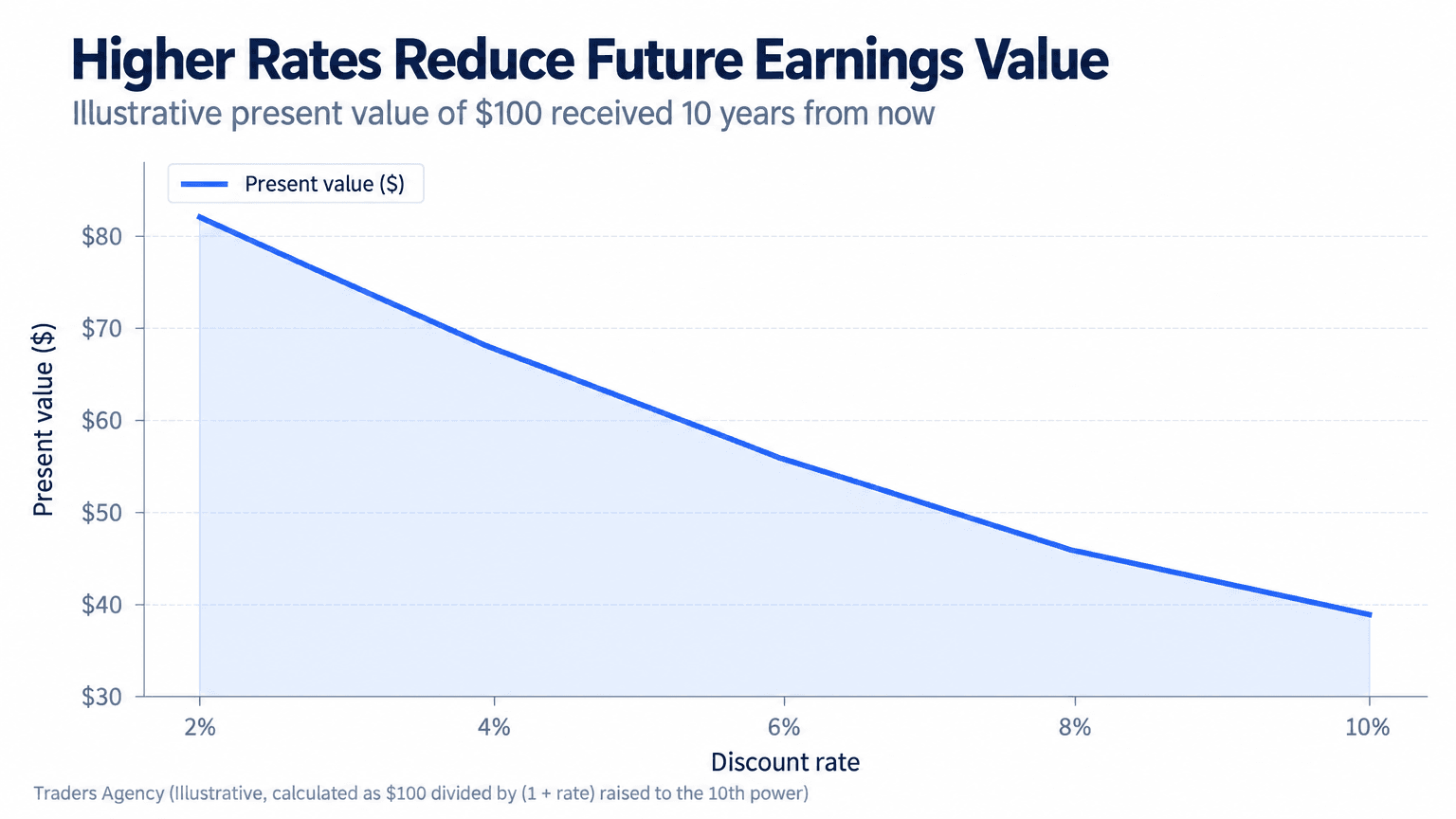
This is also why any interest rates and stock valuations chart tends to show a loose inverse pattern over long stretches of time. It's not a perfect, day-to-day correlation, but the underlying math is always working in the background.
Want expert trading insights delivered daily?
Join thousands of traders who rely on Traders Agency for market analysis and trade ideas.
Join Traders AgencyWhy Do Growth Stocks React More to Interest Rate Changes?
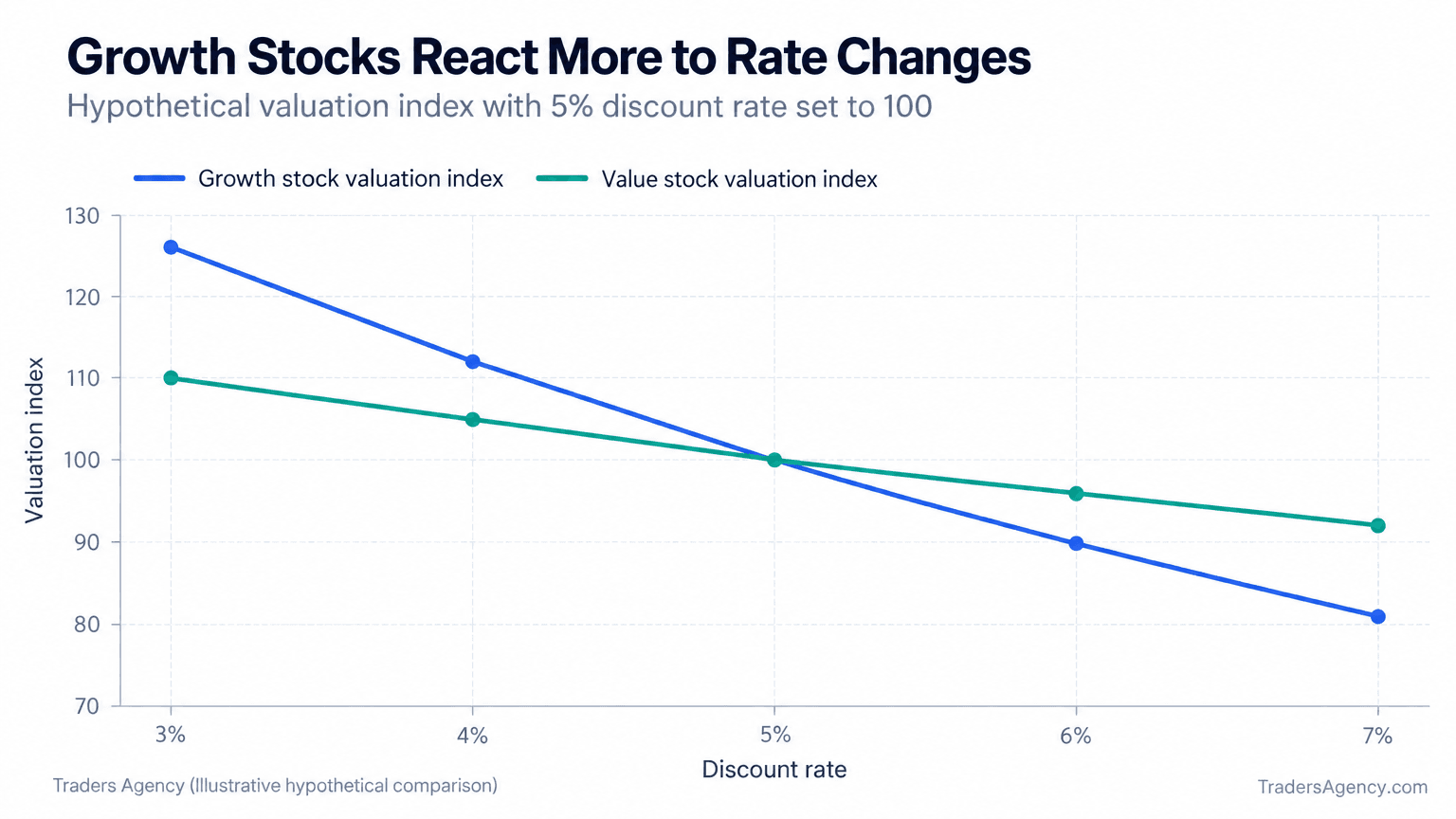
Growth stocks fall harder than value stocks when rates rise because more of their expected value sits far in the future. Value stocks generate steadier cash now, so their valuations depend less on long-term discounting and more on current profits.
We borrow this concept directly from bond investing, where it's called duration. A bond that matures in 30 years is far more sensitive to interest rate changes than one maturing in 2 years, because its payments are locked in further out and get discounted over a longer stretch of time.
Stocks work the same way. A young tech company that isn't expected to turn a meaningful profit for eight years has "long duration" earnings. A utility company or an established bank paying steady dividends today has "short duration" earnings. When the discount rate rises, the long-duration company's valuation takes the bigger hit, because a larger share of its worth was sitting way out in the future where discounting does the most damage.
Key Concept: The further out a company's expected profits sit, the more its stock price gets squeezed when the discount rate rises. This is the same "duration" math bond traders have used for decades.
This dynamic played out visibly in 2022, when the Fed raised rates aggressively and high-growth technology stocks, many of them unprofitable, fell far more sharply than steadier, cash-generating value stocks.
How Does the Fed Funds Rate Transmit to Stock Prices?
The Fed funds rate is the short-term rate banks charge each other for overnight loans, and the Federal Reserve sets a target range for it. Its effects ripple outward into mortgage rates, corporate borrowing costs, bond yields, and eventually stock valuations across the whole market.
Here's the chain reaction, step by step:
- Step 1: The Federal Reserve moves. The Federal Reserve adjusts its target range for the fed funds rate at its policy meetings.
- Step 2: Banks adjust lending rates. Banks adjust the rates they charge businesses and consumers for loans.
- Step 3: Borrowing costs shift. Companies that rely on borrowing see their costs rise or fall accordingly.
- Step 4: Bond yields reprice. Bond yields across the market shift, changing the competition for investor capital.
- Step 5: Investors recalculate. Investors recalculate the discount rate they apply to future stock earnings.
- Step 6: Stock prices adjust. Stock prices move to reflect the new valuation math.
This is also the mechanism behind headlines about a Fed rate cut moving the market the same day. A single Fed announcement can move trillions in market value within hours, not because company fundamentals changed, but because the discount rate used to value every future dollar of earnings just shifted. You can track official rate decisions directly through the Federal Reserve.
Which Stock Sectors Benefit When Rates Fall?
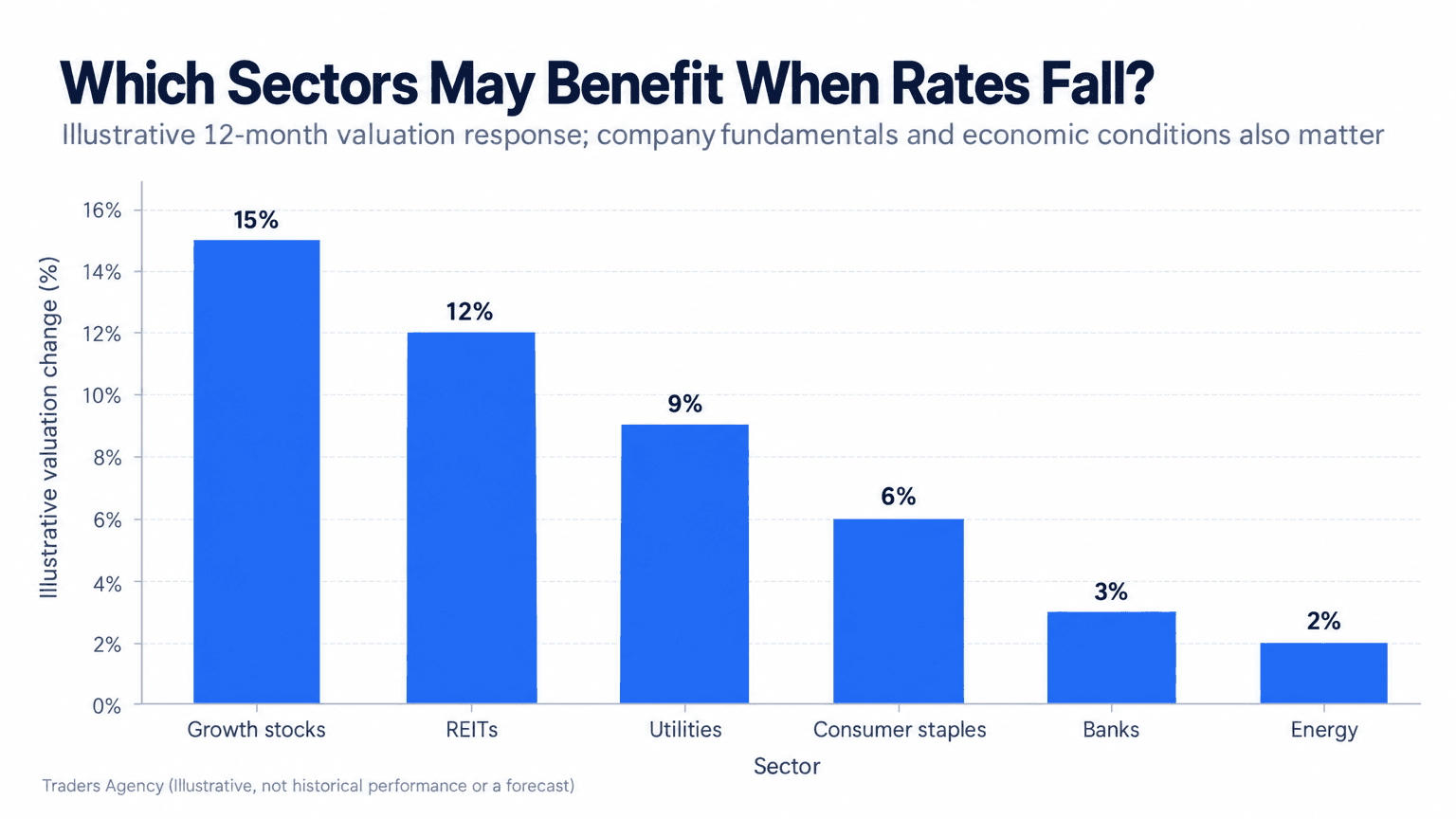
Not every sector responds the same way, and knowing the differences helps answer a common question we hear: will bank stocks go up when interest rates drop?
Bank stocks are actually more complicated here than most people assume. Lower rates can shrink the spread banks earn between what they pay depositors and what they charge borrowers, which can hurt profitability in some cases. Growth stocks and REITs (real estate investment trusts), on the other hand, tend to benefit more clearly from rate cuts, since lower discount rates boost the present value of their longer-dated earnings and REITs carry heavy debt loads that get cheaper to service.
A few general patterns we watch for:
- Growth and technology stocks: often benefit the most from rate cuts due to long-duration earnings
- REITs and utilities: tend to benefit because they carry significant debt that becomes cheaper
- Banks: mixed response, sometimes helped by loan growth but hurt by shrinking interest margins
- Energy and materials: typically less sensitive to rate changes, more tied to commodity prices
How Should You Use Interest Rate Trends in Your Investment Decisions?
Understanding interest rates and stock valuations only matters if it changes how you actually invest. Here's the approach we use.
- Step 1: Check the rate direction before adding growth exposure. If the Fed is signaling future hikes, we think twice before adding heavily to long-duration growth names, since they're more vulnerable to valuation compression.
- Step 2: Use rate cut expectations as a tailwind, not a guarantee. A falling rate environment tends to favor growth stocks and REITs, but it's a tailwind, not a certainty. Company fundamentals still matter.
- Step 3: Diversify across duration. Just like a bond portfolio, we suggest holding a mix of long-duration (growth) and short-duration (value, dividend-paying) stocks so your whole portfolio isn't equally exposed to rate swings.
- Step 4: Size positions with rate sensitivity in mind. If you're holding a stock with high rate sensitivity, consider a smaller position size than you would for a steady, cash-generating value stock. This is simple risk management, not a prediction about where rates are headed.
- Step 5: Watch Fed communications, not just the rate decision. Markets often react more to the Fed's forward guidance about future meetings than to the actual rate move itself, since stock prices already reflect expectations.
When rates are rising, we favor trimming exposure to unprofitable, high-multiple growth names and leaning toward companies with current earnings. When rates are falling or expected to fall, we're more comfortable adding measured growth exposure, while still respecting position sizing and never concentrating a portfolio in a single sector bet.
Watch Out: A falling rate environment can lift growth stocks and REITs, but it's never a guarantee. Weak fundamentals can still drag a stock down even when the broader rate backdrop is favorable.
What Is the 7% Rule in Stocks?
The 7% rule is a guideline some investors use for setting a stop-loss: selling a stock if it falls 7-8% below your purchase price, to limit downside losses before they compound further.
It's not related to interest rates directly, but we consider it a useful risk management tool to pair with rate awareness. If you know a stock is rate-sensitive, a firm stop-loss rule like this can help protect your capital during periods of rapid rate-driven repricing, like what many growth investors experienced in 2022.
Interest rates won't tell you which specific stock to buy, and they're not a substitute for understanding a company's actual business and financial statements, which you can review directly in SEC filings like 10-K annual reports. But understanding the discount rate mechanism gives you a framework for understanding why markets move the way they do, and for building a portfolio that isn't blindsided every time the Fed meets.
Want expert trading insights delivered daily?
Join thousands of traders who rely on Traders Agency for market analysis and trade ideas.
Join Traders AgencyDISCLAIMER: Traders Agency does not offer financial advice. The information provided is for educational purposes only and should not be considered financial advice. Traders Agency is not responsible for any financial losses or consequences resulting from the use of the information provided. Trading carries inherent risks and may not be suitable for all individuals. You are advised to conduct your own research and seek personalized advice before making any investment decisions, recognizing the potential risks and rewards involved.
See more from Traders Agency on Google
Make us a preferred source and our market analysis will appear more prominently in your Google Search, Top Stories, and AI results.
Add to Preferred Sources