The Federal Reserve just put traders on notice. The central bank's latest report identifies three specific forces driving what it calls "stepped-up" inflation: tariffs, the Iran war, and the massive AI infrastructure buildout. Our team sees this Fed stepped-up inflation warning as a significant shift in the macroeconomic outlook, and it immediately changes the calculus for anyone holding equities, bonds, or precious metals.
What Did the Fed Say About Inflation Today?
The Federal Reserve released a report detailing new inflationary pressures threatening the economy. The central bank cited tariffs, the Iran war, and the artificial intelligence buildout as forces driving "stepped-up" inflation. This creates a complex environment for traders trying to price in future monetary policy.
We see this as a meaningful departure from previous inflation narratives. The inclusion of the AI buildout is a major signal for the tech sector. The technology industry requires unprecedented capital for this infrastructure, and traders must now account for these costs bleeding into broader inflation metrics. The combination of geopolitical conflict and trade policy adds layers of friction that won't resolve quickly.
The Core of the Fed's Stepped-Up Inflation Warning
The data we're watching suggests this warning requires immediate attention. The report isolates three distinct variables pushing prices higher:
- Tariffs: Contributing to inflationary pressure on the economy.
- Iran war: Introducing geopolitical risk that contributes to inflationary pressure.
- AI buildout: Adding inflationary pressure through large-scale infrastructure spending.
We believe this signals a lasting shift in how the central bank views structural inflation. The AI buildout is now cited by the Fed as a factor in stepped-up inflation. Trade policies and the Iran war are also cited as inflation drivers. Traders need to adjust their risk models to account for all three variables simultaneously.
What Does the Fed's Inflation Warning Mean for Traders?
How are these new inflation drivers showing up across asset classes? The signals are already diverging in ways that demand attention.
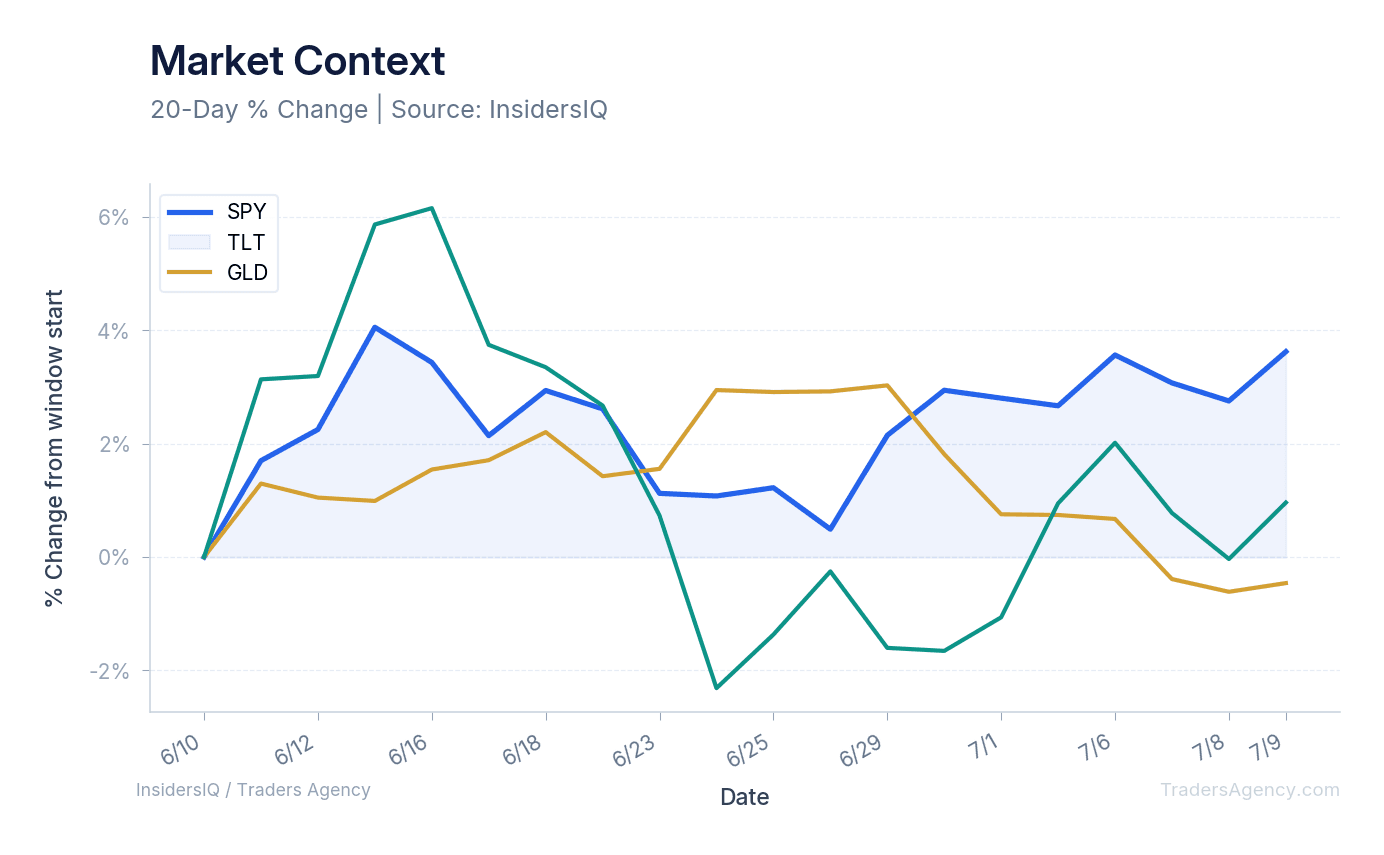
Equities continue to show strength with SPY up 3.62% over the last 30 days, but bond markets are flashing warning signs as TLT sits at a 0.46% decline over the same period. Gold is catching a bid, with GLD posting a 0.96% gain as investors seek traditional inflation hedges.
Key Divergence: SPY is up 3.62% over 30 days while TLT has dropped 0.46%. Stock investors are ignoring the inflation threat. Bond traders are taking the Fed's warning seriously. GLD's 0.96% gain confirms smart money is quietly building defensive positions.
This divergence tells a clear story. Stock investors are currently shrugging off the inflation threat, pushing SPY higher on momentum. Bond traders, on the other hand, are selling off long-term treasuries like TLT, pricing in sustained higher rates. The positive movement in GLD shows that institutional capital is already rotating into traditional inflation hedges.
Sentiment Is Flashing a Warning of Its Own
Current market sentiment metrics reveal a clear disconnect between retail traders and institutional warnings.
Sentiment Check: The Fear and Greed index registers a bullish 68, signaling strong market complacency. WallStreetBets sentiment sits at a nearly neutral 0.03 with 2,748 mentions, showing chatter but zero conviction.
We're tracking this divergence closely. A Fear and Greed reading of 68 suggests equity markets are priced for perfection. The retail crowd, evidenced by the muted 0.03 sentiment score on WallStreetBets, appears completely undecided on the macroeconomic direction. The 2,748 mentions show people are talking, but the neutral sentiment proves they lack conviction. When retail complacency meets a formal central bank warning, volatility usually follows.
Want expert trading insights delivered daily?
Join thousands of traders who rely on Traders Agency for market analysis and trade ideas.
Join Traders AgencyWhat Should Traders Watch After This Fed Warning?
Our team is monitoring several specific areas as this inflation warning digests across markets. The structural changes to the economy require a tactical approach to portfolio management. Here's where we're focusing:
- Tariff Implementation: Any new trade restrictions will immediately impact import-heavy sectors and consumer goods pricing.
- Iran War Developments: Escalation in the Middle East would increase geopolitical risk and inflationary pressure.
- AI Infrastructure Costs: The massive capital required for the AI buildout will continue to add inflationary pressure.
- Fed Policy Direction: We're watching how the Federal Reserve adapts monetary policy in response to these inflationary pressures.
- Treasury Yields: The ongoing weakness in TLT will serve as the primary indicator for institutional inflation expectations.
How to Position Ahead of Stepped-Up Inflation
Traders must align their portfolios with the reality of higher structural costs. The current 3.62% 30-day gain in SPY shows that broad equities have momentum. However, the 0.46% drop in TLT indicates that fixed-income markets are preparing for sustained higher rates.
We recommend watching the precious metals sector closely. The 0.96% gain in GLD over the last 30 days provides a blueprint for defensive positioning. If the Iran war escalates or AI buildout costs accelerate, gold will likely see increased institutional inflows. Traders should balance their long equity exposure with strategic hedges in commodities or short-duration bonds.
The Bottom Line
The central bank has clearly outlined the new threats to price stability: tariffs, the Iran war, and the AI buildout. Our team is using the weakness in TLT and the strength in GLD as leading indicators for the next major market move. We're adjusting our models to account for these specific inflationary pressures as we look toward future monetary policy decisions. The window to position ahead of this shift is narrowing. Act accordingly.
Want expert trading insights delivered daily?
Join thousands of traders who rely on Traders Agency for market analysis and trade ideas.
Join Traders AgencyKey Takeaways
- The Federal Reserve identified three specific drivers of 'stepped-up' inflation in its latest report: tariffs, the Iran war, and the AI infrastructure buildout.
- The inclusion of AI infrastructure costs as an inflationary force is a new signal for the tech sector, suggesting capital-intensive buildout spending is now bleeding into broader price metrics.
- The Fed's framing marks a departure from previous inflation narratives, meaning traders can no longer rely on older monetary policy pricing models.
- The report's team is using weakness in TLT and strength in GLD as leading indicators for the next major market move.
- Traders holding equities, bonds, or precious metals are advised to consider hedging long equity exposure with commodities or short-duration bonds given these compounding pressures.
DISCLAIMER: Traders Agency does not offer financial advice. The information provided is for educational purposes only and should not be considered financial advice. Traders Agency is not responsible for any financial losses or consequences resulting from the use of the information provided. Trading carries inherent risks and may not be suitable for all individuals. You are advised to conduct your own research and seek personalized advice before making any investment decisions, recognizing the potential risks and rewards involved.
See more from Traders Agency on Google
Make us a preferred source and our market analysis will appear more prominently in your Google Search, Top Stories, and AI results.
Add to Preferred Sources