
You've probably noticed precious metals hitting record highs recently and wondered who is actually driving that massive demand. The answer is central banks, and their central bank gold buying behavior is creating structural shifts that retail traders can use to their advantage. We'll walk you through exactly how this institutional accumulation alters market mechanics, how to track the data, and how to position your portfolio alongside the biggest players in the world.
What Is Central Bank Gold Buying?
Bottom Line: Central bank gold buying is not a short-term catalyst but a structural supply reduction that creates durable price support over years. Retail traders who learn to read the institutional data and size positions conservatively can trade alongside the largest buyers in the world without taking on the risk of holding through deep drawdowns. The edge here is not prediction, it is alignment.
Central bank gold buying is a macroeconomic process where national reserve banks purchase physical gold to diversify their foreign exchange reserves. When sovereign nations start hoarding physical assets at this scale, it creates permanent changes in supply and demand dynamics that directly affect the price you see on your trading screen.
Key Concept: When central banks buy gold, they are removing physical bars from the global supply chain and locking them in vaults for decades. This permanent removal of supply forces buyers in the futures and ETF markets to bid up prices to find willing sellers, creating a structural price floor.
To understand why this works, think of the gold market as a medium-sized swimming pool. Retail traders and jewelry buyers are like people taking cups of water out of the pool. A central bank is like a fleet of fire trucks draining thousands of gallons at once. Their sheer size permanently alters the water level.
This permanent removal of supply creates a baseline level of support that prevents severe price crashes during normal market corrections. These institutions do not trade on margin or look for quick flips. They are strategic, long-term accumulators, and that consistency is what makes their behavior so tradeable.
What Does It Mean If Central Banks Are Buying Gold?
If central banks are buying gold, it means national governments are actively diversifying their foreign exchange reserves away from fiat currencies. This signals a structural shift in how sovereign wealth is stored and protected. For traders, this translates into a long-term bullish tailwind for precious metals.
The mechanics are straightforward: institutional accumulation creates a supply shortage in the physical market. This shortage establishes a strong price floor and drives long-term upward momentum. When you align your trades with this direction, you're trading with the largest, most patient buyers on the planet.
Central Bank Gold Purchases by Year: Key Trends Since 2022
To trade this trend effectively, we need to look at the raw data. The World Gold Council's demand reports show a historical shift that began in 2022. Before this period, sovereign institutions were often net sellers of precious metals.
Starting in 2022, we saw a massive acceleration in institutional demand. The data reveals that central banks purchased over 1,000 tonnes of gold annually for multiple consecutive years. This level of accumulation had not been seen since the gold standard was abandoned in 1971.
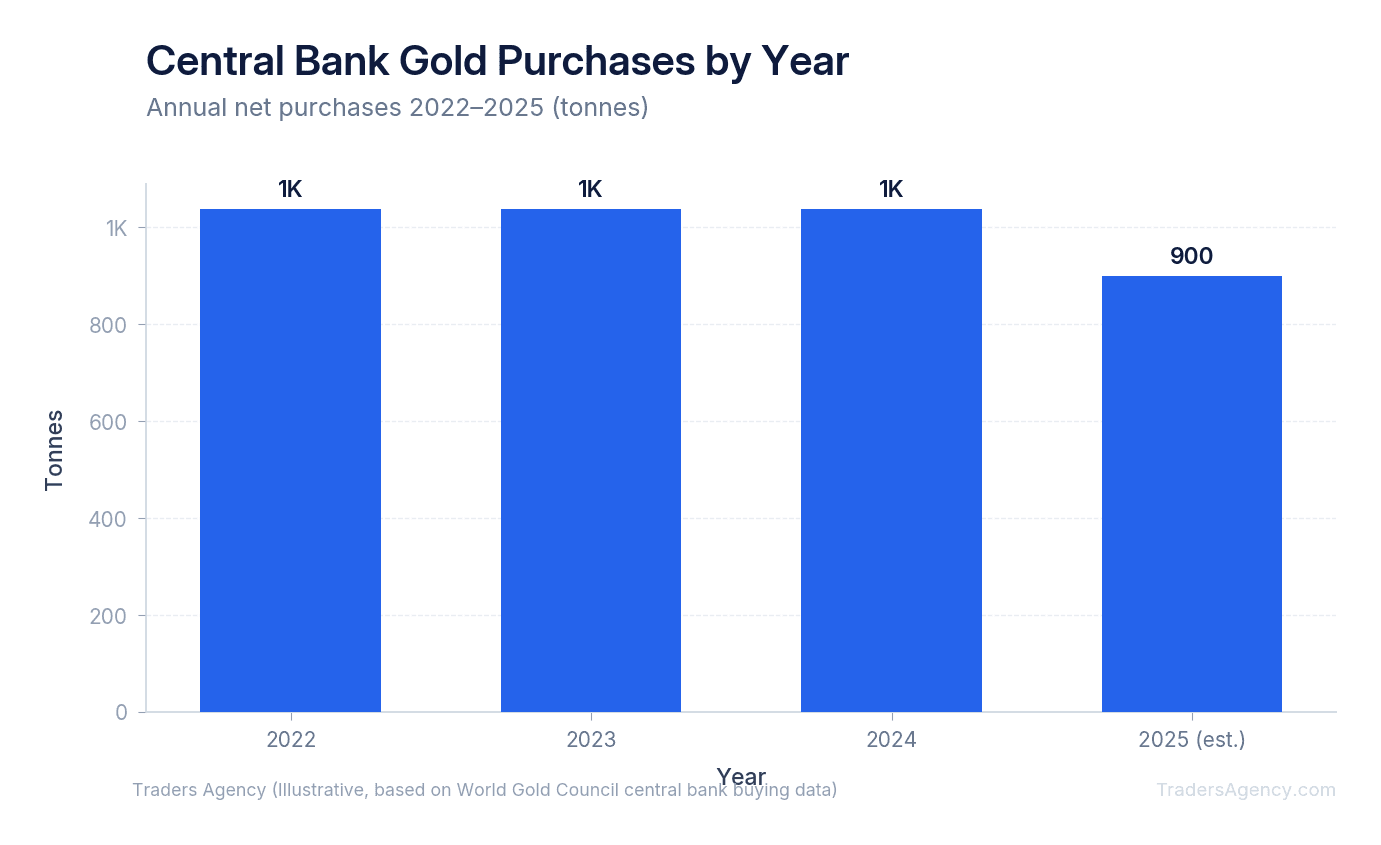
When we analyze central bank gold purchases by year, the trend becomes a clear trading signal. Consistent buying volume above the 800-tonne threshold indicates a structural shift in global finance rather than a temporary anomaly.
Our team recommends tracking this annual data to gauge long-term market sentiment. If the yearly accumulation remains elevated, traders should favor long positions during any short-term price corrections. You want to align your trades with the biggest players in the market.
Which Countries Are Buying the Most Gold in 2026?
China, India, and Poland are currently buying the most gold as we look toward 2026. These nations are aggressively expanding their holdings to reduce reliance on the US dollar. By tracking central bank gold reserves by country, traders can identify which geopolitical regions are driving the current demand cycle.
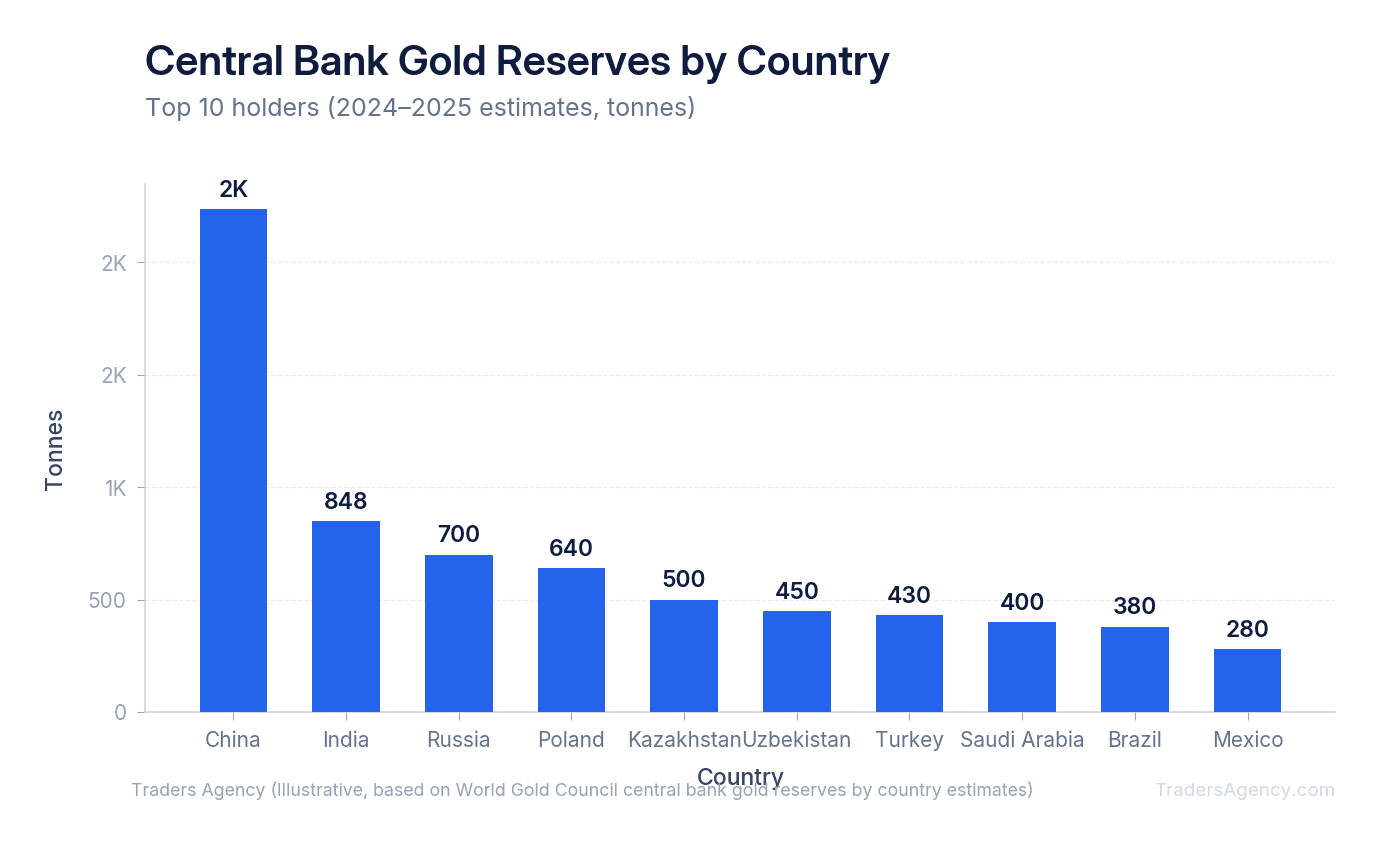
The People's Bank of China has been the most aggressive accumulator in recent years, consistently adding to their reserves for over eighteen months straight. The Reserve Bank of India follows closely behind, recently choosing to move its physical gold from the UK back to domestic vaults.
We teach our members that geography matters in commodity trading. When Eastern central banks dominate the purchasing data, it often correlates with periods of geopolitical friction. This friction creates a premium on physical assets that cannot be sanctioned or frozen by Western financial systems.
What Does the De-Dollarization Narrative Mean for Gold Prices?
You cannot trade the central bank gold buying trend without understanding de-dollarization. This is the deliberate process where countries reduce their dependence on the US dollar for international trade. Gold serves as the ultimate neutral reserve asset in this transition.
When nations fear their dollar reserves could be weaponized through sanctions, they immediately seek alternatives. Physical gold carries no counterparty risk. If a country holds the physical metal within its own borders, no foreign government can confiscate it.
Key Concept: De-dollarization drives gold demand because physical gold is the only reserve asset with zero counterparty risk. No government can freeze, sanction, or devalue another nation's gold holdings stored within their own borders.
This narrative translates directly into actionable price signals for intermediate traders. Every time a major geopolitical event threatens global trade routes, we see a spike in sovereign gold demand. This creates a predictable cycle of accumulation that drives prices higher.
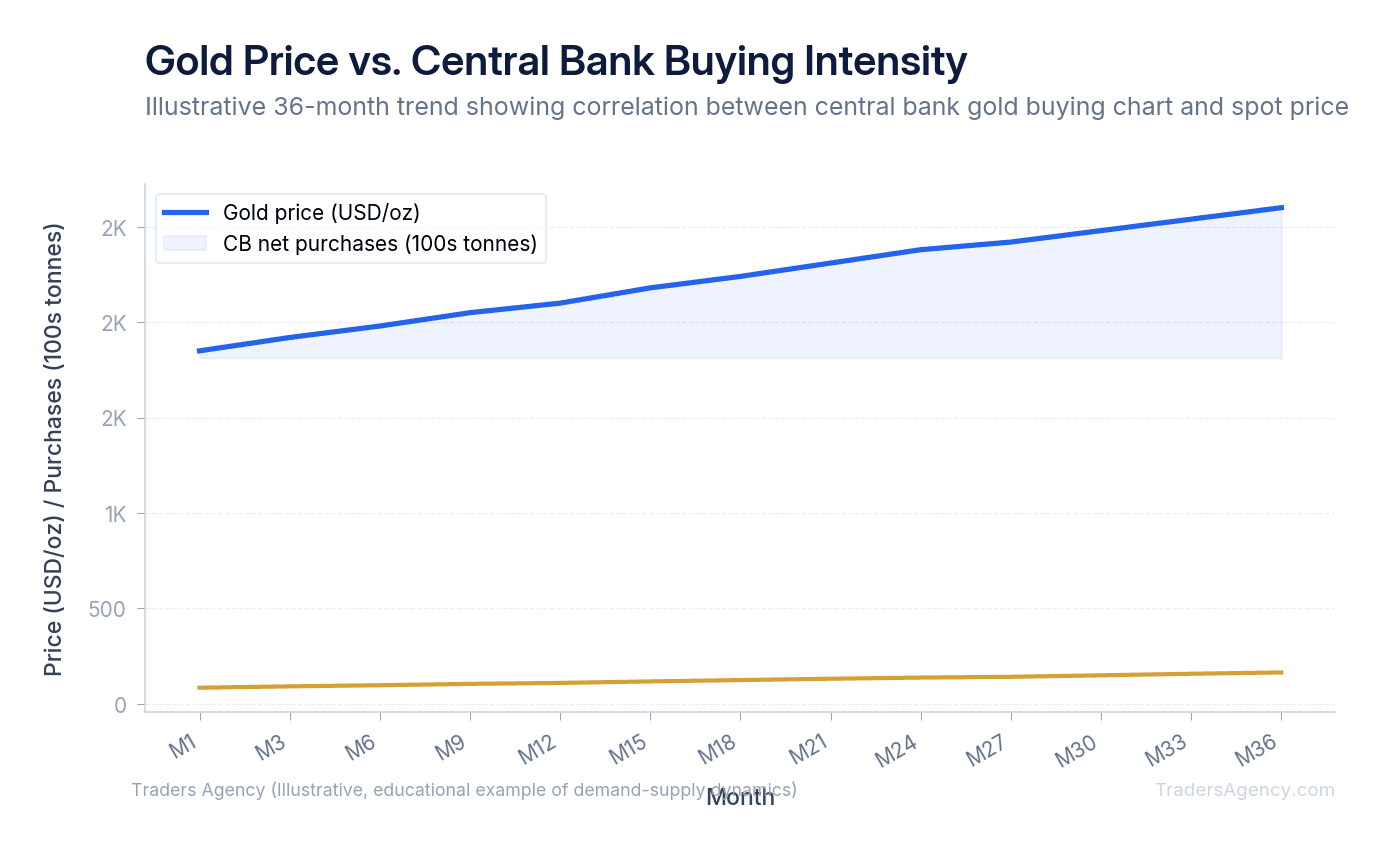
Our team prefers to buy gold futures when de-dollarization headlines peak. The correlation between anti-dollar sentiment and sovereign gold accumulation provides a reliable tailwind for long-term swing trades.
Want expert trading insights delivered daily?
Join thousands of traders who rely on Traders Agency for market analysis and trade ideas.
Join Traders AgencyHow Do You Read Central Bank Gold Data as a Trading Signal?
Many traders make the mistake of trying to day-trade based on central banks buying gold news. Sovereign purchases are reported on a significant delay. By the time the data becomes public, the immediate price action has already happened.
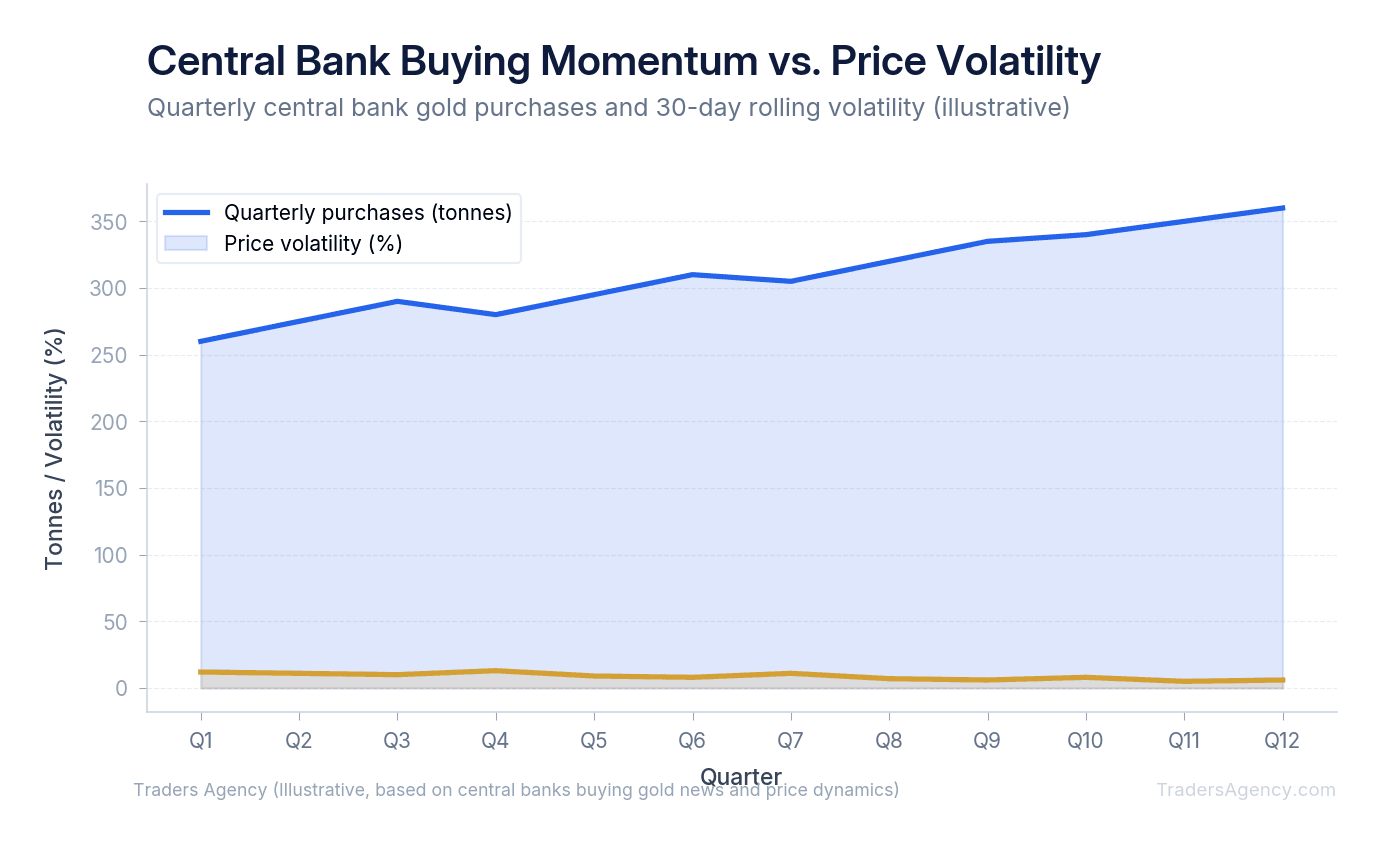
Instead, we use a central bank gold buying chart to identify macro support levels. Here is exactly how we teach our members to trade this data using a multi-week options swing trading strategy.
Step-by-Step: Trading the Central Bank Accumulation Signal
- Identify the Setup: Wait for the World Gold Council to release its quarterly demand trends report. Look for a quarter where net central bank purchases exceed 250 tonnes. This confirms the institutional bid is still active. Then pull up a daily chart of the SPDR Gold Trust (GLD) and wait for a technical pullback of at least 4% to 6% from the recent swing high. We know the central banks are buying, so we want to buy the dip alongside them.
- Execute the Trade: Enter a bull call spread on GLD with exactly 90 days to expiration to give the macro thesis time to play out. Assume GLD recently hit a high of $220 per share and a 5% pullback brings the price down to $209. Buy the $210 strike call for a $6.00 premium and sell the $220 strike call for a $2.50 premium. Your net debit (and maximum risk) is $3.50 per share, or $350 total per contract.
- Manage the Outcome: Apply strict risk management rules. Review the scenario table below and know your numbers before you enter the trade.
| Scenario | GLD Price at Expiration | Profit/Loss per Contract |
|---|---|---|
| Best Case | Above $220 | +$650 (max gain) |
| Breakeven | $213.50 | $0 |
| Worst Case | Below $210 | -$350 (max loss) |
| Trade Parameter | Value |
|---|---|
| Underlying | GLD at $209 |
| Long Call | $210 strike, $6.00 premium |
| Short Call | $220 strike, $2.50 premium |
| Net Debit | $3.50 ($350 per contract) |
| Days to Expiration | 90 days |
| Max Profit | $650 per contract |
| Max Loss | $350 per contract |
Are Central Banks Still Buying Gold in 2026?
Yes, central banks are still buying gold in 2026, continuing a multi-year accumulation trend. Despite higher price levels, institutional demand remains strong due to ongoing geopolitical tensions and currency diversification strategies. Traders should expect this sustained purchasing behavior to provide continued support for gold prices during market pullbacks.
Many retail traders assume that high prices will eventually deter sovereign buyers. We've found the opposite to be true. Central banks are price-insensitive buyers. They are not trying to buy low and sell high. They are trying to secure national wealth regardless of the current spot price.
If you're looking at 2026 projections, the baseline demand has permanently shifted. Before 2022, a strong year of sovereign buying was 500 tonnes. Today, that same volume would be considered a weak year.
Watch Out: Do NOT use this strategy if you are a high-frequency day trader. The institutional accumulation cycle plays out over months and years, not minutes and hours. Trying to scalp five-minute charts based on quarterly reserve data will only lead to frustration and losses.
How Can You Gain Exposure to Gold as Central Bank Demand Rises?
Once you understand the macro trend, you need the right vehicle to execute your trades. The CME Group provides extensive resources on gold futures contract specifications. Our team focuses on three primary methods for intermediate traders:
- Physical Gold: Buying actual coins or bars offers the most direct exposure. However, dealer markups and storage costs make this inefficient for active trading.
- Gold ETFs: Products like GLD or IAU track the spot price of gold. These are highly liquid and perfect for swing traders who want to capitalize on the central bank gold buying trend without managing futures contracts.
- Gold Futures: Trading the GC contract provides massive purchasing power. One contract controls 100 troy ounces of gold. We only recommend this for experienced traders who understand margin requirements and contract rollover mechanics.
When trading this thesis, position sizing is essential. We recommend allocating no more than 5% to 10% of your total portfolio to precious metals trades. Even with strong institutional backing, commodity markets can experience violent volatility.
Risk Warning: Always use stop losses, even when trading a long-term macroeconomic trend. A central bank might be willing to hold through a 20% drawdown, but your trading account likely cannot survive that kind of pressure. Stick to your risk parameters and let the institutional buyers provide the tailwind for your trend trades.
Want expert trading insights delivered daily?
Join thousands of traders who rely on Traders Agency for market analysis and trade ideas.
Join Traders AgencyKey Takeaways
- Central banks remove physical gold from the global supply chain permanently, locking bars in vaults for decades rather than trading them, which creates a structural price floor that futures and ETF buyers must bid above.
- Retail traders should allocate no more than 5% to 10% of total portfolio value to precious metals trades, even when institutional demand provides a strong tailwind.
- Unlike retail traders, central banks can absorb drawdowns of 20% or more without forced selling, meaning the trend can stay intact long after short-term volatility shakes out smaller positions.
- Tracking central bank gold purchase data gives retail traders an early signal on structural demand shifts before those moves are fully priced into spot markets.
- The de-dollarization narrative is a key driver behind current central bank accumulation, making gold buying a policy decision as much as a financial one.
DISCLAIMER: Traders Agency does not offer financial advice. The information provided is for educational purposes only and should not be considered financial advice. Traders Agency is not responsible for any financial losses or consequences resulting from the use of the information provided. Trading carries inherent risks and may not be suitable for all individuals. You are advised to conduct your own research and seek personalized advice before making any investment decisions, recognizing the potential risks and rewards involved.
See more from Traders Agency on Google
Make us a preferred source and our market analysis will appear more prominently in your Google Search, Top Stories, and AI results.
Add to Preferred Sources