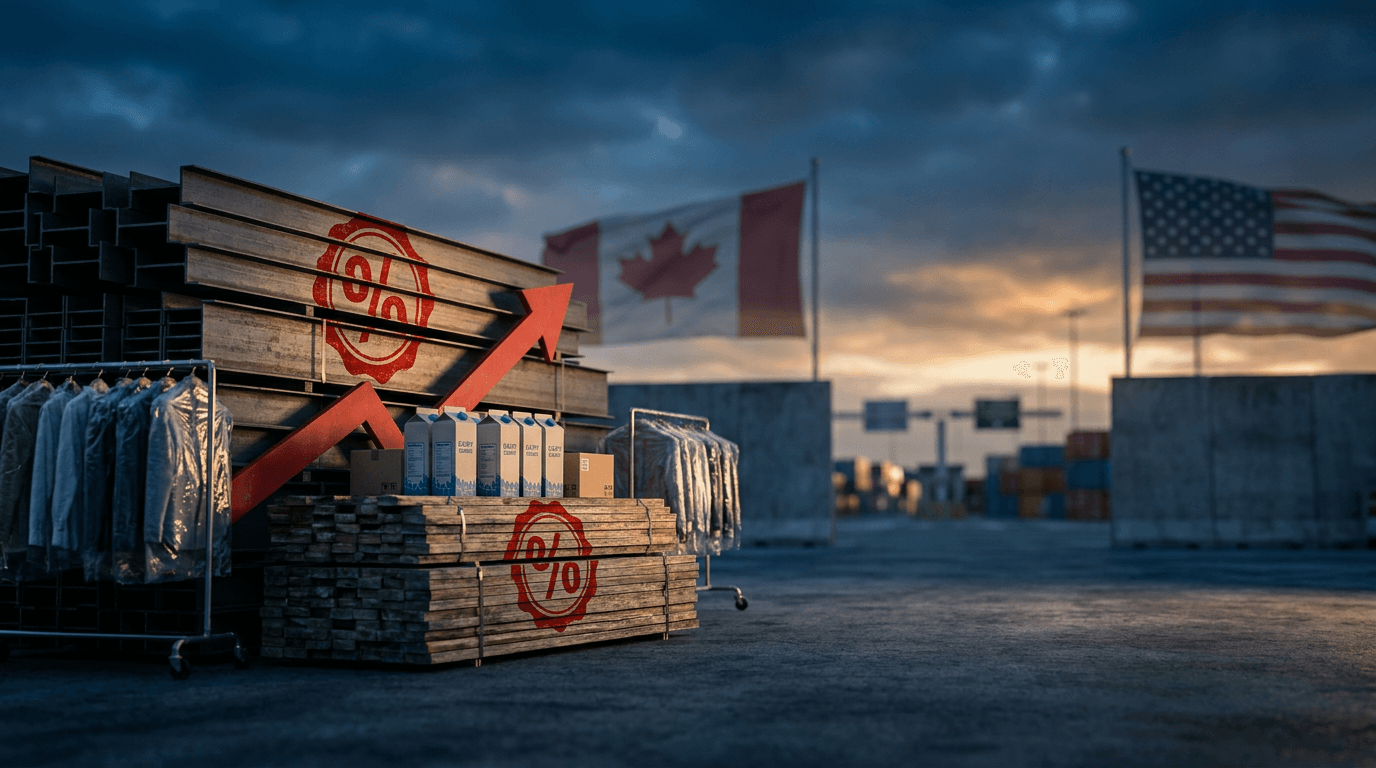
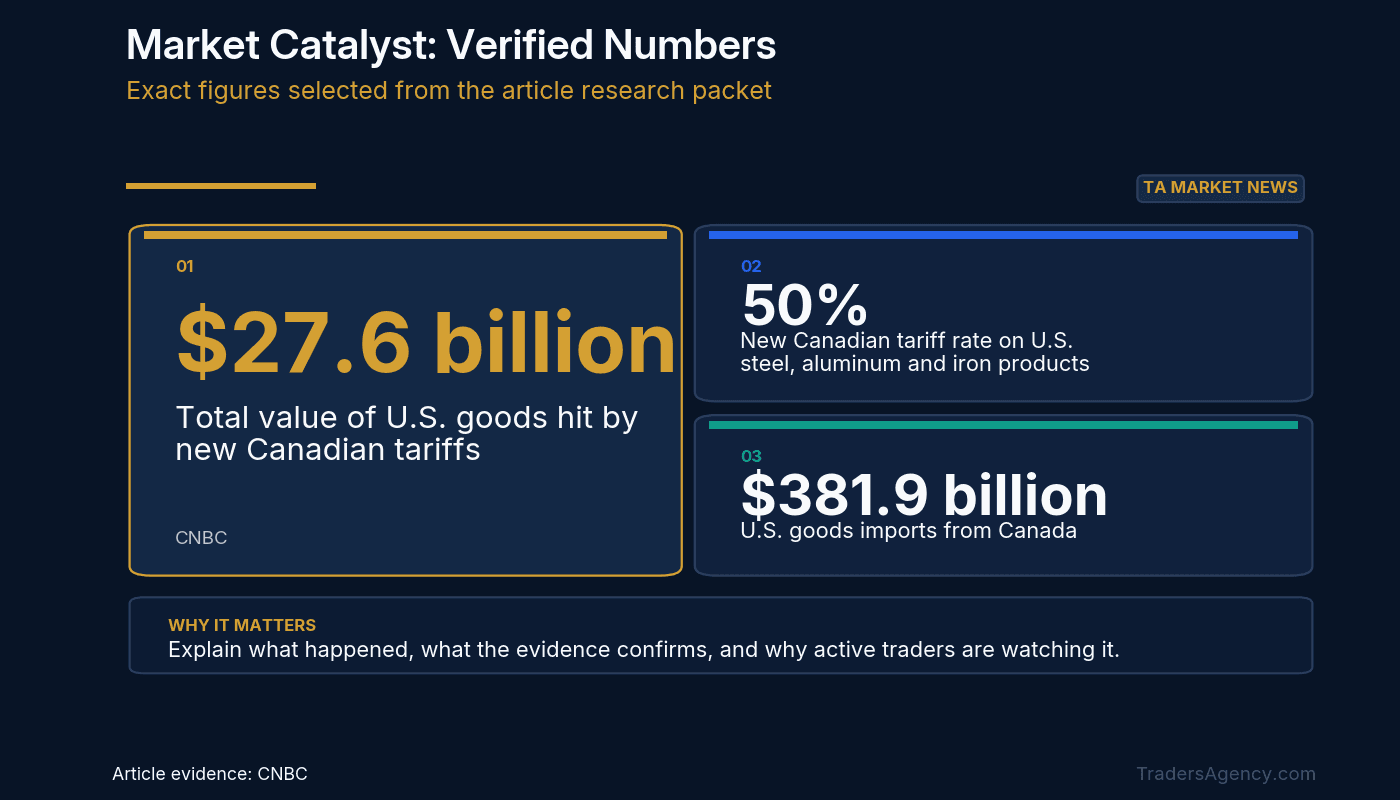
Canada's retaliatory tariffs are live as of this morning. The countermeasures took effect at 12:01 a.m. EDT Tuesday, applying duties of 15% to 50% on roughly $27.6 billion worth of American goods, with steel, aluminum and iron products absorbing the sharpest hit as their rate doubled to 50% overnight.
We've been tracking this fallout since talks between Washington and Ottawa collapsed at the end of August, and what we're looking at now is a live, dollar-for-dollar trade fight touching dairy, lumber, furniture, clothing, beauty products and industrial metals all at once. For anyone asking whether cross-border tariffs are actually in force right now, the answer is unambiguous: yes, and collection began this morning.
This matters for traders because the affected product categories map directly onto several sector ETFs and consumer-facing names with real exposure to the U.S.-Canada goods corridor. Our focus over the next few weeks is how quickly that exposure shows up in price action versus how much gets absorbed quietly inside supply chains.
The Numbers: Duties of 15% to 50% now apply to about $27.6 billion of U.S. goods entering Canada. The tariff on U.S. steel, aluminum and iron products doubled from 25% to 50%.
What Products Are Covered by Canada's Retaliatory Tariffs?
Canada's new duty schedule spans hundreds of American products, ranging from 15% to 50% and covering roughly $27.6 billion in U.S. goods. The list includes dairy, agricultural equipment, paper, household appliances and electronics, per CNBC's reporting.
Anyone hunting for the full retaliatory tariff list is looking for this same breakdown: a product-by-product schedule tying specific goods to specific rate tiers. Based on what has been reported so far, the highest-rate bucket is where traders should focus first.
How Do the New Tariff Rates Break Down by Sector?
The steepest increase hit metals. Canadian tariffs on U.S. steel, aluminum and iron products doubled to 50% from the prior 25% rate, CNBC reported, covering steel rods, bars and sheets along with prefabricated items such as bridges, towers, scaffolding, and door and window frames, per iNFOnews.ca.
Furniture, motorbikes, clothing and some beauty products were also placed in the highest tier, CNBC reported, which means U.S. apparel brands shipping into Canada are now facing top-rate duties. Dairy took a 50% duty on products like milk and cream and a 25% duty on fresh cheese and curd, per iNFOnews.ca. Softwood lumber, including pine, fir and spruce, faces a 25% Canadian tariff, while specific beauty categories, including perfumes, sunscreen, suntan products, lip and eye makeup, and manicure and hair products, now carry a 50% rate.
Our read: the metals doubling is the rate change we're weighting most heavily in the schedule, given the size of the increase from 25% to 50%. Existing Canadian counter-tariffs, including a 25% duty on the politically sensitive autos sector, remain in place alongside these new measures, CNBC reported, so this is not a one-time shock landing on a clean slate.
Why Did Canada Impose Retaliatory Tariffs on the U.S.?
The backdrop is a direct response to U.S. action. On Aug. 22, the U.S. launched tariffs on nearly $28 billion of Canadian goods, from hockey sticks and cement to honey, after talks broke down, per iNFOnews.ca. Canada's reciprocal list was drawn from that same set of tariffed products, including dairy, plywood and sunscreen.
Trade talks between the two countries fell apart at the end of August, with officials on each side blaming the other, as both CNBC and iNFOnews.ca reported. Canada described the new measures as a "dollar for dollar" response to U.S. levies, with its Department of Finance saying they would protect Canadian workers, producers and manufacturers by allowing them to better compete with U.S. products sold in the domestic market, per CNBC.
Which U.S. Industries Are Affected First?
We see three groups absorbing the earliest pressure:
- Metals producers and fabricators exposed to the now-50% Canadian rate on steel, aluminum and iron goods.
- Consumer goods exporters in furniture, clothing, motorbikes and beauty products, the categories CNBC flagged as hit with the highest tariff tier.
- Agricultural and dairy exporters, where duties run as high as 50% on items like milk and cream, per iNFOnews.ca.
The market context supports watching these groups closely. Materials-sector exposure via XLB has moved -0.47% over the past 10 days, and consumer discretionary exposure via XLY is down -1.44% over the same window, based on our verified pricing data. Industrials, tracked through XLI, are roughly flat at +0.08%, while the broad market via SPY is up +0.41%, which suggests the tariff fight has not yet spilled into a market-wide selloff.
What We're Watching: XLB at -0.47% and XLY at -1.44% over 10 days, against SPY at +0.41%. The pressure so far looks sector-specific, not systemic.
Want expert trading insights delivered daily?
Join thousands of traders who rely on Traders Agency for market analysis and trade ideas.
Join Traders AgencyWhat Is Exempt From the Tariffs?
Current reporting we've reviewed does not lay out a detailed exemption list for this schedule. What we do know is that the rate structure is tiered, running from 15% up to 50%, which implies not every product category is treated identically. A formal exemption breakdown has not surfaced in the coverage we're tracking.
For traders trying to classify exposure at the shipment level, the operative detail is the tariff code used to sort goods into the category that determines which rate tier applies. Until a fuller product-code list is published, we'd treat any exemption assumptions as unconfirmed.
Timeline: When Did the Tariffs Take Effect?
Canada's retaliatory tariffs took effect just after midnight EDT on Tuesday, September 8, per both CNBC and iNFOnews.ca. That timing lines up with the doubling of the steel and aluminum rate to 50%, meaning duties are being collected on shipments today, not on some future effective date.
What Should Traders Watch Next in the Tariff Fallout?
Economists cited by CNBC say the tariffed goods represent a relatively small slice of overall U.S.-Canada trade, but small- and medium-sized businesses in the hardest-hit sectors face a severe blow. Ottawa announced a $7.5 billion support package for businesses and workers last month, on top of an existing $25 billion provided since the broader U.S. tariff push began in April 2025, per CNBC.
The scale of the underlying relationship is worth keeping in view: the U.S. exported $333.6 billion in goods to Canada and imported $381.9 billion, with overlap in energy, vehicles, heavy machinery, aircraft, pharmaceuticals, gems and jewelry, furniture, clothing and food and drink, per CNBC. That breadth is why we're not treating this as a narrow, single-sector story.
Our watch list from here:
- Further escalation risk from Washington, given talks have already collapsed once
- Earnings commentary from steel, aluminum, furniture, apparel and dairy-adjacent companies with Canadian exposure
- Relative performance of XLB and XLY against SPY as tariff costs work through supply chains
The Bottom Line
Canada's retaliatory tariffs are a real, effective-today policy action with a clear dollar figure, $27.6 billion, and a clear flashpoint in the doubled 50% metals rate. We're watching materials and consumer discretionary exposure most closely, since those are the sectors where the tariff impact is most directly documented in current reporting. We're not treating this as resolved: talks have already broken down once, and existing measures like the 25% auto tariff remain layered on top.
Want expert trading insights delivered daily?
Join thousands of traders who rely on Traders Agency for market analysis and trade ideas.
Join Traders AgencyDISCLAIMER: Traders Agency does not offer financial advice. The information provided is for educational purposes only and should not be considered financial advice. Traders Agency is not responsible for any financial losses or consequences resulting from the use of the information provided. Trading carries inherent risks and may not be suitable for all individuals. You are advised to conduct your own research and seek personalized advice before making any investment decisions, recognizing the potential risks and rewards involved.
- CNBC: Canada tariffs up to 50% come into effect on $27.6 billion U.S. goods · accessed Sep 8, 2026
- iNFOnews.ca: Canada's retaliatory tariffs on American goods are now in effect · accessed Sep 8, 2026
See more from Traders Agency on Google
Make us a preferred source and our market analysis will appear more prominently in your Google Search, Top Stories, and AI results.
Add to Preferred Sources