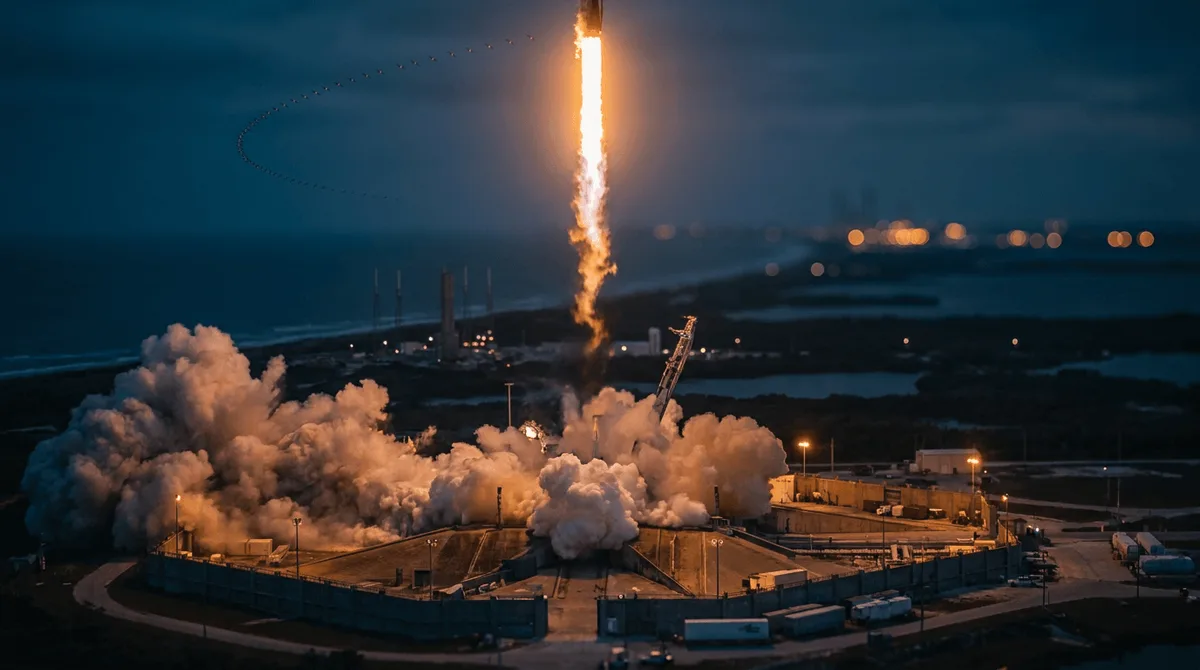
SpaceX (Nasdaq: SPCX) put another 27 Starlink satellites into low Earth orbit from Vandenberg Space Force Base on September 6, 2026, and the numbers attached to this flight are what caught our attention: the 103rd Falcon 9 mission of 2026, the 80th flight this year dedicated to Starlink, and a 19th landing for booster B1088, per reporting from CRBC News and Space.com.
The booster came home on the drone ship Of Course I Still Love You. That reuse count matters more than it sounds, and we'll show why below.
SpaceX trades publicly as Space Exploration Technologies Corp. on the Nasdaq Global Select Market and Nasdaq Texas under the ticker SPCX, so launch cadence and reuse economics feed directly into how the market values the company. The pace and repeatability on display here also shape how the entire space and satellite-broadband ecosystem gets valued, and that makes it worth a close read today.
The Numbers: 27 satellites deployed, the 103rd Falcon 9 flight of 2026, the 80th Starlink-dedicated mission this year, and a 19th flight and landing for booster B1088.
What Does the September 6 Vandenberg Mission Confirm?
Liftoff came at 10:26 a.m. EDT (1426 GMT; 7:26 a.m. local time), with the first stage returning to Earth roughly 8.5 minutes later for its Pacific drone-ship landing. The upper stage then carried the satellites to low Earth orbit and deployed them on schedule, 62 minutes after launch, per CRBC News and Space.com.
That kind of precision, repeated dozens of times a year, is what a launch program built for scale looks like in practice. When 80 of 103 flights in a single year go toward one constellation, the mission stops being a special event. It becomes a production line.
- 27 satellites deployed on this mission
- 103rd Falcon 9 flight of 2026
- 80th flight this year dedicated to Starlink
- 19th flight and landing for booster B1088
What Is SpaceX's Falcon 9 Launch Cadence in 2026?
We watch launch cadence the way other desks watch order flow. It is a leading indicator, not the whole story, but it tells us where capacity is heading before it shows up in quarterly financial disclosures.
80 of SpaceX's 103 Falcon 9 flights in 2026 have gone toward building out the Starlink megaconstellation. That is a heavily concentrated manifest, and it suggests the near-term schedule is weighted toward the company's own broadband build-out rather than external commercial or government payloads.
There's added texture on the turnaround side. Just four days before this mission, on September 2, SpaceX flew a separate Starlink mission from Vandenberg using booster B1063 on its 35th flight, landing on the same drone ship after deploying another 27 Starlink V2 Mini satellites, as reported by Basenor. Two Starlink launches from the same site inside a single week points to compressed turnaround, though it remains a short sample.
Satellite tracker Jonathan McDowell, cited by CRBC News and Space.com, puts the active Starlink network above 11,000 spacecraft, described in that reporting as the largest satellite constellation ever assembled. That scale is the backdrop for every one of these flights now.
Is SpaceX Still Launching Starlink?
Yes, and right now it is doing so exclusively from Vandenberg Space Force Base.
CRBC News and Space.com both report that SpaceX has paused Starlink launches from Florida until its Starship megarocket is operating from the Space Coast. For anyone asking whether the Starship program is quietly changing where and how often Starlink missions fly, that is the detail to hold onto. Until Starship is running from Florida, Vandenberg appears to be carrying the full Starlink load, which helps explain why cadence out of that single site has looked so compressed lately.
So if you are watching a live launch feed and wondering whether a Starlink mission flew overnight, the honest read on current reporting is that Vandenberg is the site to watch, not Florida, at least for now.
Want expert trading insights delivered daily?
Join thousands of traders who rely on Traders Agency for market analysis and trade ideas.
Join Traders AgencyWhat Does Booster B1088's 19th Flight Say About Launch Economics?
A 19th flight on a single booster puts B1088 roughly halfway to SpaceX's current reuse record, and that math carries real cost implications that should eventually show up in the company's reported launch economics.
The Benchmark: SpaceX's booster reuse record stands at 37 flights, set by booster B1067 during a Starlink mission on August 25, 2026, per CRBC News and Space.com. B1088's 19 flights put it near the halfway mark against that reference point.
Basenor's coverage frames the economics plainly: each additional flight on a single booster "chips away at the per-launch cost equation," which that outlet describes as the entire premise behind reusability. CRBC News makes a similar point, tying repeated booster reuse to lower launch costs and faster deployment of large constellations such as Starlink.
B1088 is not a Starlink-only workhorse, either. Its flight history, per CRBC News, includes national security and science payloads alongside constellation work: NROL-126, Transporter-12, SPHEREx, NROL-57, and 13 prior Starlink flights. A mixed manifest like that on one reusable core is its own data point on how far booster versatility has come.
Three things this reuse data tells space-sector traders
- Marginal launch costs may keep compressing as boosters log more flights, based on the per-flight cost framing in Basenor and CRBC News coverage.
- The 37-flight record set in August is the current reuse benchmark, per CRBC News and Space.com, and B1088's 19 flights sit near the halfway mark against it.
- Government and commercial payloads share the same hardware as Starlink missions, meaning reliability data from one mission type may inform confidence in the others.
Upcoming SpaceX Launches We're Watching
We are not treating any single Falcon 9 mission as a standalone trade trigger. The value is in the pattern, and the pattern is what anyone building a mental model of this sector should track.
- Cadence out of Vandenberg: With two Starlink missions flying from the same site inside four days in early September, we are watching whether that turnaround speed holds or proves to be a one-off cluster.
- Progress toward the 37-flight reuse record: B1088 near the halfway mark gives us a live benchmark to measure against B1067's record run.
- Florida's return to the schedule: CRBC News and Space.com report that Florida-based Starlink launches remain paused until Starship is operational on the Space Coast. Any change there could shift the geography of the entire launch schedule.
- Constellation size: Jonathan McDowell's tracking, cited by both outlets, puts the active network above 11,000 satellites. That figure is worth revisiting as a running scoreboard on deployment pace.
SpaceX's own manifest now sits behind a listed equity, with its Class A common stock trading on the Nasdaq Global Select Market and Nasdaq Texas under SPCX. Cadence, reuse economics, and constellation scale are exactly the benchmarks we use to frame both that name and the broader satellite-broadband and launch-services picture other public companies operate inside.
The Bottom Line
The September 6 Vandenberg mission is not the story on its own. The story is what it confirms about a Starlink launch schedule now running 80 dedicated flights deep into 2026, backed by a booster fleet measured against a 37-flight reuse record.
We are treating this as a cadence-and-cost story, not a single-event trade. We'll keep tracking the Vandenberg turnaround pace, the reuse-record math, and any sign that Florida-based Starlink flights could resume once Starship is running from the Space Coast.
For now, the data supports one clear read: the Starlink build-out appears to be accelerating on both frequency and per-flight cost efficiency, and that combination deserves attention from anyone following SPCX and the wider launch-services complex.
Want expert trading insights delivered daily?
Join thousands of traders who rely on Traders Agency for market analysis and trade ideas.
Join Traders AgencyDISCLAIMER: Traders Agency does not offer financial advice. The information provided is for educational purposes only and should not be considered financial advice. Traders Agency is not responsible for any financial losses or consequences resulting from the use of the information provided. Trading carries inherent risks and may not be suitable for all individuals. You are advised to conduct your own research and seek personalized advice before making any investment decisions, recognizing the potential risks and rewards involved.
- CRBC News: SpaceX Launches 27 Starlink Satellites From Vandenberg; Booster B1088 Lands On Drone Ship · accessed Sep 7, 2026
- Basenor: Starlink Group 15-24: 5 Details That Matter · accessed Sep 7, 2026
- Space: SpaceX Falcon 9 rocket launches 27 Starlink satellites, lands on ship at sea (video) · accessed Sep 7, 2026
- SpaceX: Space Exploration Technologies Corp. current listing verification · accessed Sep 8, 2026
- Nasdaq: Space Exploration Technologies Corp. current listing verification · accessed Sep 8, 2026
See more from Traders Agency on Google
Make us a preferred source and our market analysis will appear more prominently in your Google Search, Top Stories, and AI results.
Add to Preferred Sources