
You've seen the headlines: bitcoin ETF approvals, ticker symbols scrolling across financial news, and friends asking whether they should buy "the bitcoin fund" instead of bitcoin itself. If you've been curious but weren't sure where to start, you're in the right place: this is bitcoin ETF explained in plain language. By the end of this guide, you'll know exactly what a bitcoin ETF is, how it differs from owning bitcoin directly, what the major tickers mean, and how to place a trade. We'll also walk through costs, tax reporting basics, and how bitcoin exposure fits alongside stocks and bonds in a real portfolio.
Key Concept: A bitcoin ETF (exchange-traded fund) is a fund that trades on a stock exchange and is designed to track the price of bitcoin, letting you gain exposure without buying, storing, or securing the cryptocurrency yourself. Spot bitcoin ETFs were approved for trading in the United States in January 2024.
What Is a Bitcoin ETF?
Bottom Line: A bitcoin ETF is a convenience trade-off: you get easy stock-account access and simpler tax reporting, but you give up direct ownership and self-custody of the coins. The right choice depends on whether you prioritize simplicity and brokerage integration or direct control, and either way bitcoin's volatility means position size and periodic allocation checks matter more than which ticker you pick.
A bitcoin ETF is a fund that holds bitcoin (or bitcoin futures contracts) and issues shares that trade on a traditional stock exchange like the NYSE or Nasdaq. When you buy a share, you're buying a piece of that fund, not the underlying cryptocurrency itself.
That distinction matters because it changes how you hold your exposure. Instead of opening a crypto exchange account, generating a digital wallet, and safeguarding private keys, you simply buy a ticker symbol through the brokerage account you already have. The fund company handles custody, security, and the technical work of holding bitcoin.
There are two main types you'll run into:
- Spot bitcoin ETFs hold actual bitcoin in custody and aim to track its real-time price as closely as possible.
- Bitcoin futures ETFs hold futures contracts (agreements to buy or sell bitcoin at a future date and price) rather than the asset itself.
Spot bitcoin ETFs received approval from the U.S. Securities and Exchange Commission (SEC) in January 2024. Before that approval, futures-based products were the only ETF option available to U.S. investors, which is why older explainers from 2021 describe a very different set of choices than what exists today.
How Does a Bitcoin ETF Work?
A spot bitcoin ETF buys and holds actual bitcoin in secure custody, then issues shares that represent a proportional claim on that holding. As bitcoin's price moves, the fund's share price moves with it, minus a small management fee.
Here's the mechanical process in plain terms. The fund company (BlackRock, Fidelity, or Grayscale, for example) buys bitcoin on the open market and stores it with a custodian. It then creates ETF shares backed by that bitcoin and lists them on an exchange. When you buy a share through your brokerage, you're not buying bitcoin from a crypto exchange. You're buying a share of the fund that already owns it.
That's the core of how a bitcoin ETF works: it's a wrapper that converts a crypto asset into a familiar stock-market instrument. Fund managers handle the operational work (wallet security, blockchain transaction fees, custody audits) and the share creation and redemption process so you don't have to. In exchange, they charge an expense ratio, an annual fee calculated as a percentage of your investment.
Why This Structure Appeals to Beginners
Three things make this structure attractive if you're new to crypto:
- No private keys to manage. Losing a crypto wallet password can mean losing your funds permanently. An ETF removes that risk entirely.
- Familiar tax reporting. Your brokerage issues a standard 1099 form, just like any other stock or fund sale.
- Retirement account compatibility. Many brokerages allow bitcoin ETFs inside IRAs or 401(k)s, which isn't always true for direct crypto holdings.
Is a Bitcoin ETF Better Than Buying Bitcoin Directly?
The core trade-off is custody and convenience versus control and cost. An ETF is easier to buy and easier to tax-report, but it carries an ongoing fee and trades only during market hours. Direct bitcoin ownership gives you full control and round-the-clock access, but you manage security yourself.
When you buy bitcoin directly on a crypto exchange, you can transfer it to a personal wallet, use it for transactions, or move it between platforms. You also trade seven days a week, since crypto markets never close. An ETF only trades when the stock exchange is open, typically 9:30am to 4:00pm Eastern on weekdays.
The flip side: direct ownership makes you responsible for security. If you lose wallet access or fall victim to a scam, there's often no customer service line to call. Tax reporting also gets more involved, since every trade, transfer, or sale may need to be tracked individually. We hear this trade-off constantly from newer investors weighing the hassle of crypto tax software against the simplicity of a single brokerage statement.
| Feature | Spot Bitcoin ETF | Direct Bitcoin Ownership |
|---|---|---|
| Trading hours | Stock market hours | 24/7 |
| Custody | Fund manages it | You manage it |
| Tax reporting | Standard 1099 | Often more complex |
| Fees | Annual expense ratio | Exchange/network fees |
| Use as currency | No | Yes |
Key Bitcoin ETF Tickers to Know
Several major bitcoin ETF options launched or expanded following the 2024 approvals. Here are three of the most frequently discussed:
- IBIT: the iShares Bitcoin Trust, managed by BlackRock. One of the most actively traded spot bitcoin ETFs.
- FBTC: the Fidelity Wise Origin Bitcoin Fund, Fidelity's spot bitcoin product.
- GBTC: the Grayscale Bitcoin Trust, which converted from an older trust structure into a spot ETF.
BlackRock's bitcoin ETF has drawn an outsized share of investor attention since launch, driven in large part by BlackRock's size and reputation as an asset manager.
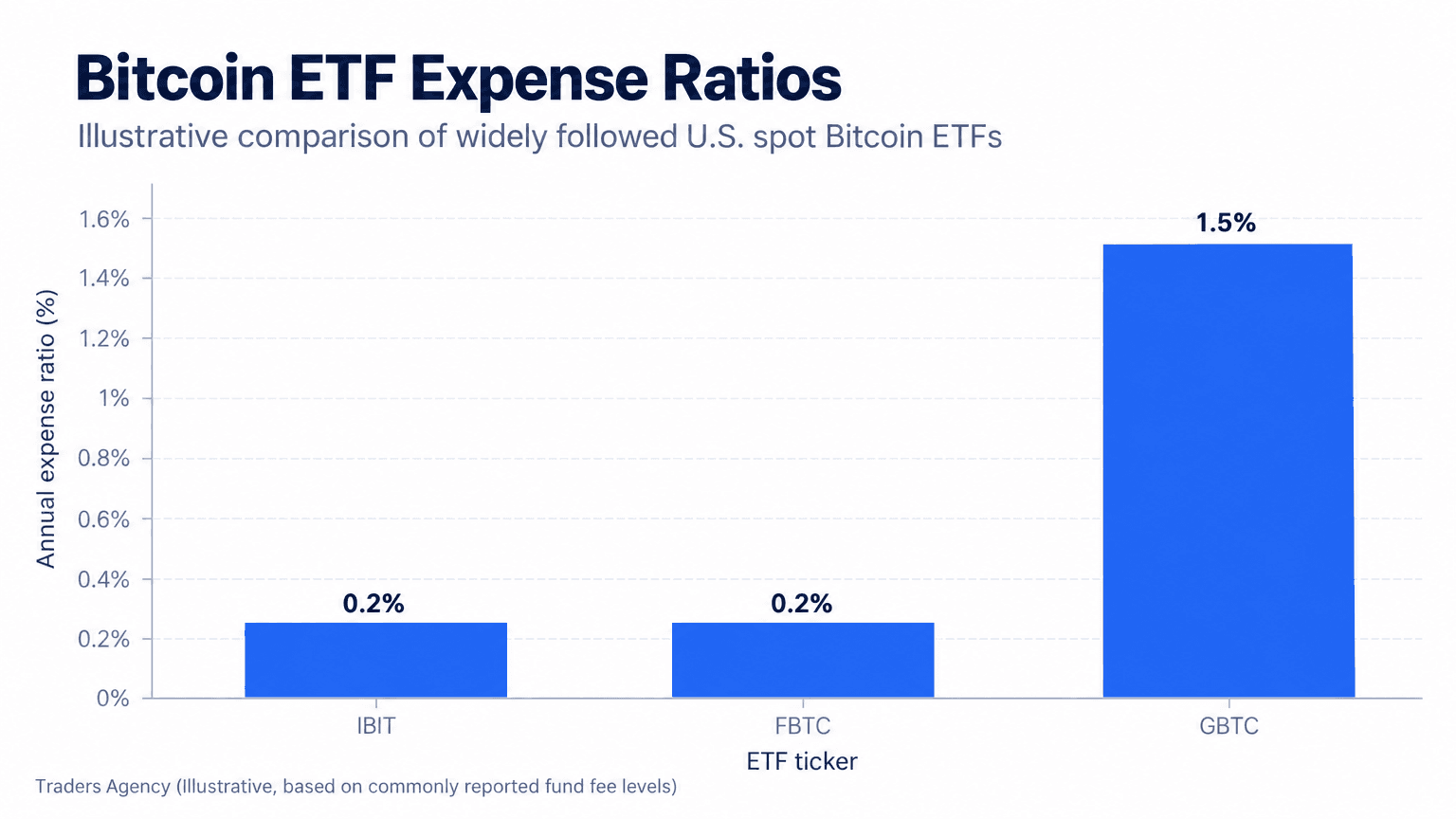
As the chart shows, expense ratios vary quite a bit between funds. A lower fee doesn't automatically make a fund better, but it does directly affect your long-term returns. We'll show you exactly how much that difference compounds next.
Want expert trading insights delivered daily?
Join thousands of traders who rely on Traders Agency for market analysis and trade ideas.
Join Traders AgencyWhat Are the Costs of a Bitcoin ETF?
Bitcoin ETFs charge an annual expense ratio, a percentage deducted from fund assets to cover management and custody. These fees typically range from roughly 0.25% to 1.50% depending on the fund, and they compound over time, quietly reducing your returns.
Let's work through a concrete example. Suppose you invest $10,000 and bitcoin's price produces a hypothetical 8% annual return, growing the position to roughly $14,693 over five years before any fees are applied.
| Scenario | Annual Expense Ratio | Value After 5 Years |
|---|---|---|
| No fees (baseline) | 0.00% | $14,693 |
| Low-cost fund | 0.25% | $14,520 |
| Higher-cost fund | 1.50% | $13,701 |
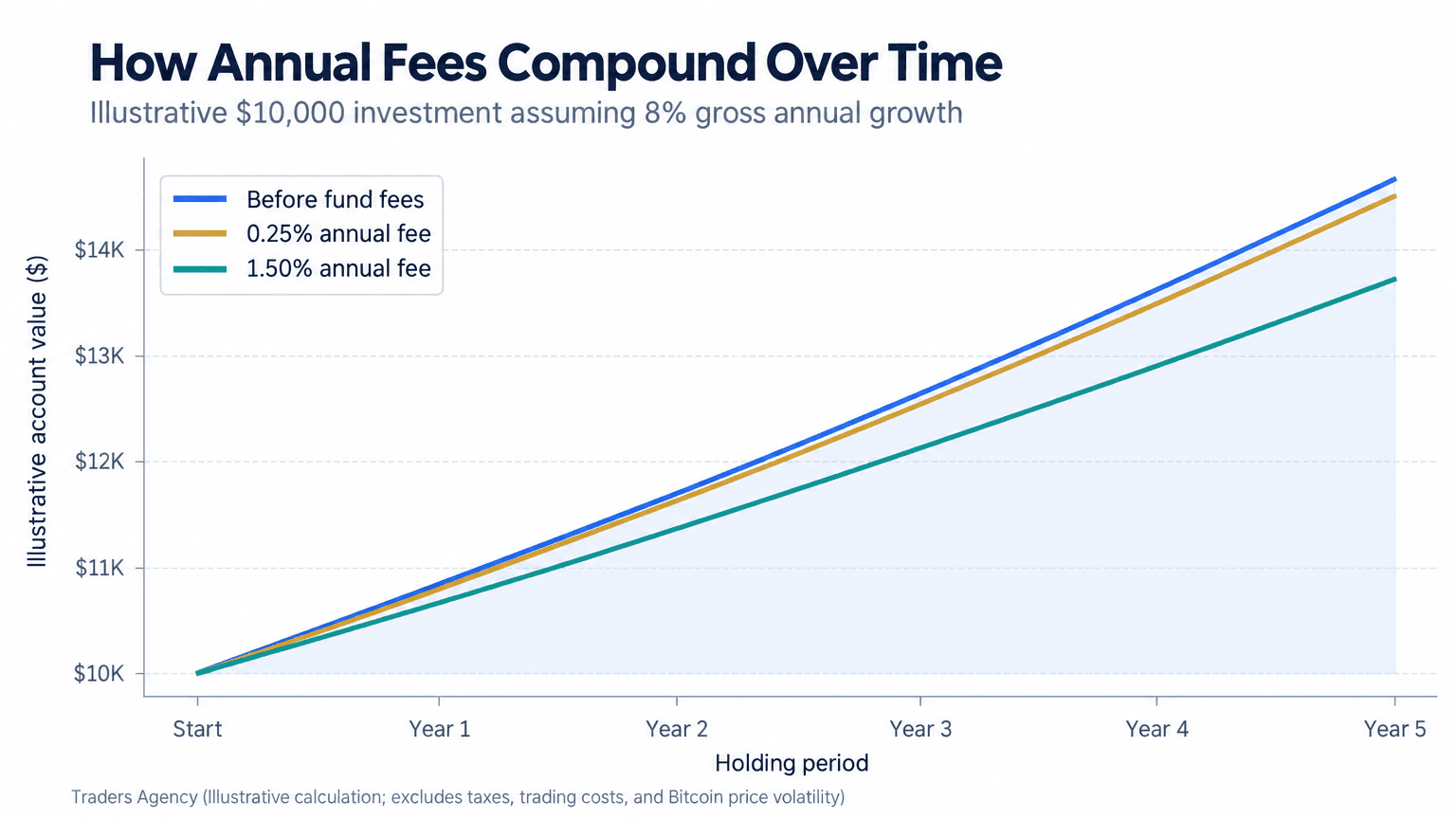
That's more than $800 of difference over five years between the low-cost and higher-cost fund, purely from the fee structure, with bitcoin's performance held constant in this example. This illustration excludes taxes and trading costs, and actual bitcoin ETF price movement will vary significantly based on the underlying asset's volatility.
Spot vs. Futures ETF Cost Differences
A bitcoin futures ETF carries an additional cost beyond the expense ratio: the cost of "rolling" futures contracts as they approach expiration. That rollover process can create a gap between the fund's performance and bitcoin's actual price over time, a gap known as tracking error. You can read more about how standardized futures contracts work at the CME Group.
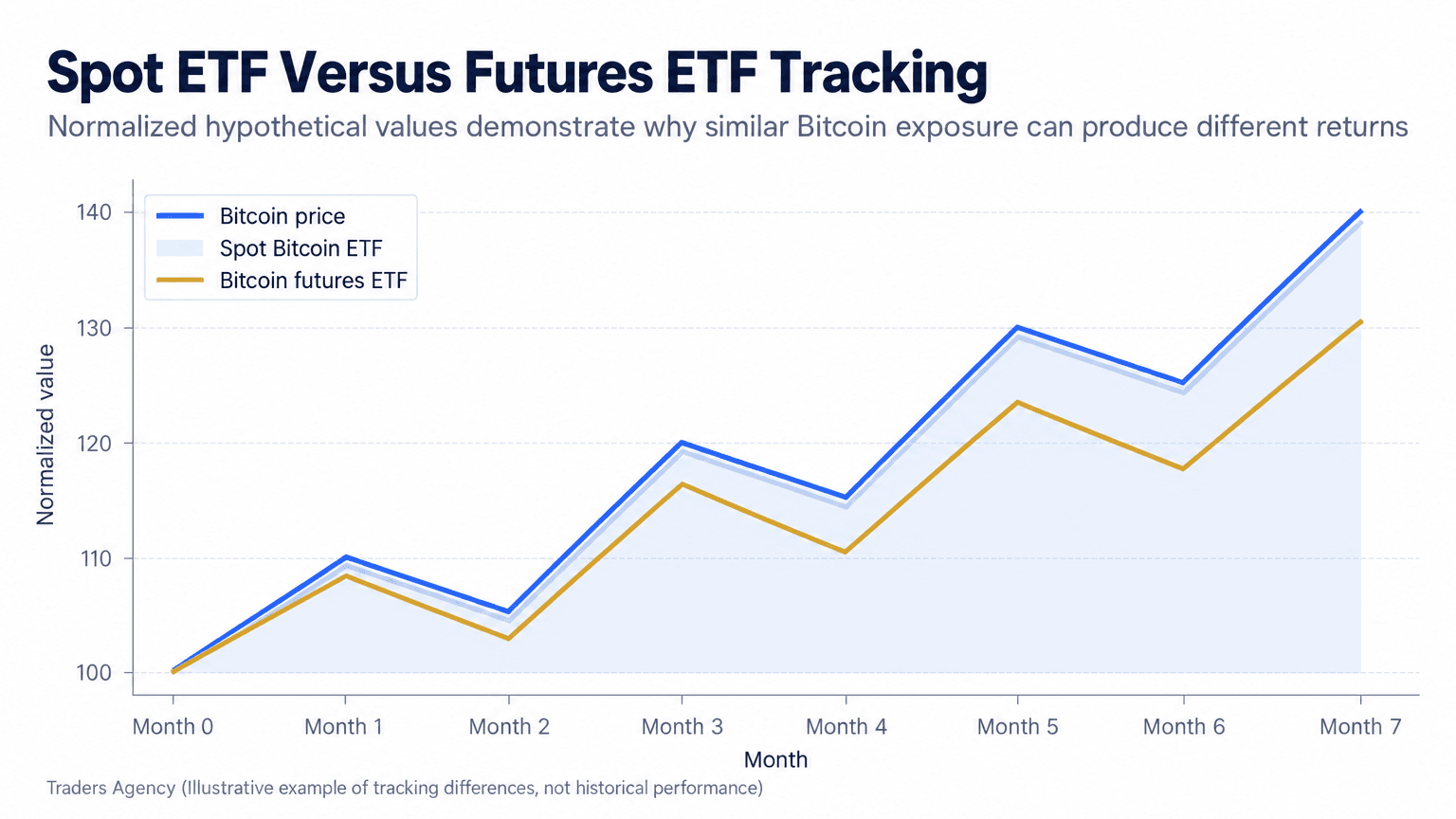
As the chart illustrates, a spot ETF generally tracks bitcoin's price more closely than a futures-based fund, because it holds the actual asset rather than a contract that needs periodic renewal.
How Do You Buy a Bitcoin ETF?
Buying a bitcoin ETF works just like buying any other stock or fund: you open a brokerage account, search the ticker symbol, and place an order. No crypto exchange account or digital wallet required.
Step-by-Step Process
- Step 1: Open or log into a brokerage account that supports ETF trading. Most major U.S. brokerages do.
- Step 2: Search for the ticker you're interested in, such as IBIT, FBTC, or GBTC.
- Step 3: Review the fund's expense ratio and recent price before you commit to an order.
- Step 4: Decide on order type. A market order executes immediately at the current price, while a limit order lets you set the maximum price you're willing to pay.
- Step 5: Enter the number of shares or dollar amount and submit the order.
- Step 6: Monitor your position alongside the rest of your portfolio, exactly like any other holding.
This simplicity is exactly why so many beginners start here: there's no new platform to learn, no seed phrase to write down, and no separate tax software needed for basic buy-and-hold investors.
When Should You Use a Bitcoin ETF, and When Should You Avoid One?
A bitcoin ETF makes the most sense for investors who want portfolio exposure to bitcoin without managing crypto infrastructure themselves, particularly inside retirement accounts or alongside existing stock holdings. It's a poor fit for active crypto traders who need 24/7 access or plan to use bitcoin for transactions.
Good Fit Scenarios
- You already have a brokerage account and want bitcoin exposure without opening new accounts.
- You want bitcoin inside a tax-advantaged account like an IRA.
- You prefer simple, consolidated tax reporting over tracking individual crypto transactions.
Situations to Avoid
- You want to use bitcoin for actual purchases or transfers. ETF shares can't be spent or moved off-platform.
- You want to trade on weekends or outside market hours.
- You're chasing short-term price swings without accounting for expense ratios and, in futures funds, tracking error.
Watch Out: A common mistake we see is treating a bitcoin ETF purchase as identical to buying bitcoin itself and expecting the same long-term performance. Fees and tracking differences mean the two aren't perfectly interchangeable, especially over multi-year holding periods.
How Does Bitcoin Correlate With Stocks and Other Assets?
Bitcoin's relationship with traditional markets like the S&P 500 isn't fixed. It shifts over time, sometimes moving closely with stocks and other times decoupling entirely, which changes how much real diversification a bitcoin ETF adds to your portfolio.
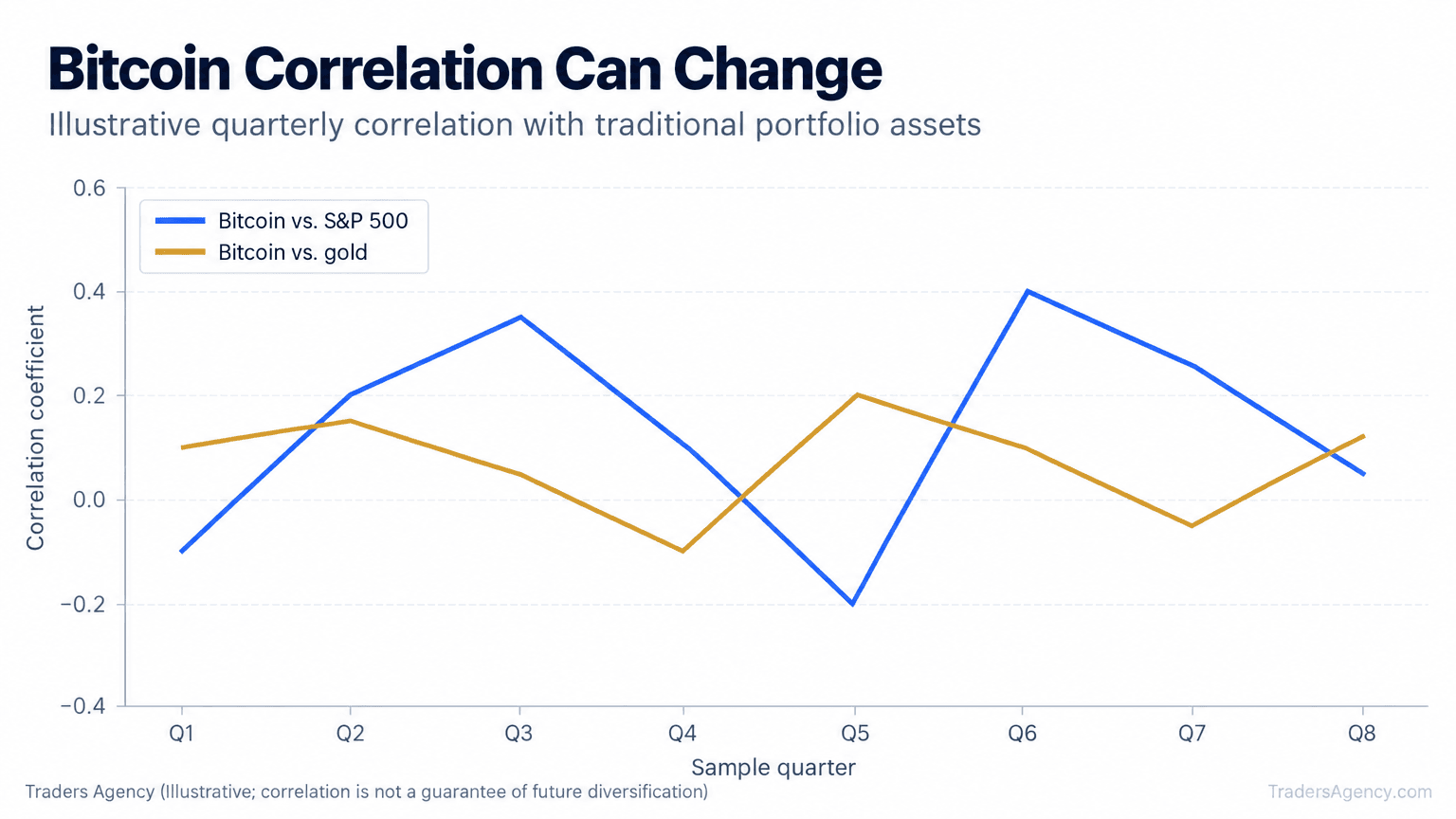
That variability means you shouldn't assume bitcoin will cushion your portfolio during a stock market downturn. Our view: treat it as a separate, high-volatility allocation rather than a reliable hedge, similar in spirit to how some investors approach gold, but with considerably larger price swings.
Risk Management Basics
- Position sizing: Many investors treat bitcoin exposure, ETFs included, as a small satellite allocation (commonly in the low single-digit percentage range of a total portfolio) rather than a core holding.
- Volatility awareness: Bitcoin has historically experienced far larger price swings than most stock indices, so size your position accordingly.
- Diversification check: Don't assume correlation with stocks will stay low forever. Revisit your allocation periodically instead of setting it once and forgetting it.
Understanding these fundamentals is the real answer to the bitcoin ETF question. It's less about picking a single ticker and more about matching the structure to how you want to hold risk, report taxes, and spend your time.
Want expert trading insights delivered daily?
Join thousands of traders who rely on Traders Agency for market analysis and trade ideas.
Join Traders AgencyDISCLAIMER: Traders Agency does not offer financial advice. The information provided is for educational purposes only and should not be considered financial advice. Traders Agency is not responsible for any financial losses or consequences resulting from the use of the information provided. Trading carries inherent risks and may not be suitable for all individuals. You are advised to conduct your own research and seek personalized advice before making any investment decisions, recognizing the potential risks and rewards involved.
See more from Traders Agency on Google
Make us a preferred source and our market analysis will appear more prominently in your Google Search, Top Stories, and AI results.
Add to Preferred Sources