
You've probably seen it happen on your trading screens. A heavily shorted stock suddenly explodes 50% or 100% higher in a matter of days, leaving traders scrambling to figure out what just occurred. With a short squeeze explained in simple terms: it is a rapid increase in the price of a stock that occurs when there is a lack of supply and an excess of demand, driven by short sellers being forced to cover their positions. We're going to walk you through exactly how these explosive market events work, how to spot them before they happen, and the strict risk management rules our team requires for these highly volatile trades.
Many retail traders lose money by chasing these spikes too late. By the time you finish reading, you'll understand the mechanics of forced buying, the specific metrics to track, and how to protect your capital when volatility goes vertical.
What Is a Short Squeeze and Why Does It Happen?
Bottom Line: Short squeezes are mechanical events driven by forced buying, not momentum or sentiment alone. Spotting one early requires tracking specific data points like short interest, days to cover, and borrow rates, not just price action. The traders who profit are the ones who enter with a plan, size their position for the volatility, and exit before the reversal hits.
A short squeeze happens when a heavily shorted stock rapidly rises in price, forcing short sellers to buy back shares to close their losing positions and prevent further losses. This sudden wave of forced buying drives the stock price even higher, creating a self-feeding loop of upward price action.
To understand this, we need to look at the mechanics of short selling. When traders short a stock, they borrow shares from their broker and sell them into the open market. Their goal is to buy those shares back later at a lower price, return them to the broker, and pocket the difference.
Here's the catch: if the stock price goes up instead of down, their losses are theoretically unlimited. A stock can only fall to zero, but it can rise infinitely.
When positive news or sudden buying pressure hits the market, the stock price climbs. Short sellers start receiving margin calls from their brokers. A margin call requires the trader to deposit more cash or close their position immediately. To exit the trade, they must buy shares at the current market price. This forced buying acts like gasoline poured on a fire, pushing the price up and triggering even more margin calls for other short sellers.
Key Concept: A short squeeze is a structural market event where forced buying from trapped short sellers creates a self-reinforcing cycle of rising prices. The buying isn't voluntary. It's driven by margin calls and the mathematical reality of unlimited loss potential on short positions.
What Metrics Signal That a Short Squeeze Is Building?
Our education team teaches members to look for specific data points before considering a squeeze play. You cannot rely on gut feeling or social media hype alone. You need hard data to confirm the setup.
Here are the primary metrics you must evaluate:
- Short Interest: This is the total number of shares currently sold short but not yet covered. We look for stocks where short interest is at least 20% of the public float. The public float represents the shares actually available for regular trading.
- Days to Cover: Also known as the short interest ratio, this divides the total short interest by the average daily trading volume. It tells you how many days it would take all short sellers to buy back their shares at normal volume levels. We prefer a ratio of 5 or higher.
- Cost to Borrow: This is the annualized fee brokers charge to lend shares to short sellers. When this fee spikes above 10% or 20%, it means shares are becoming incredibly hard to locate.
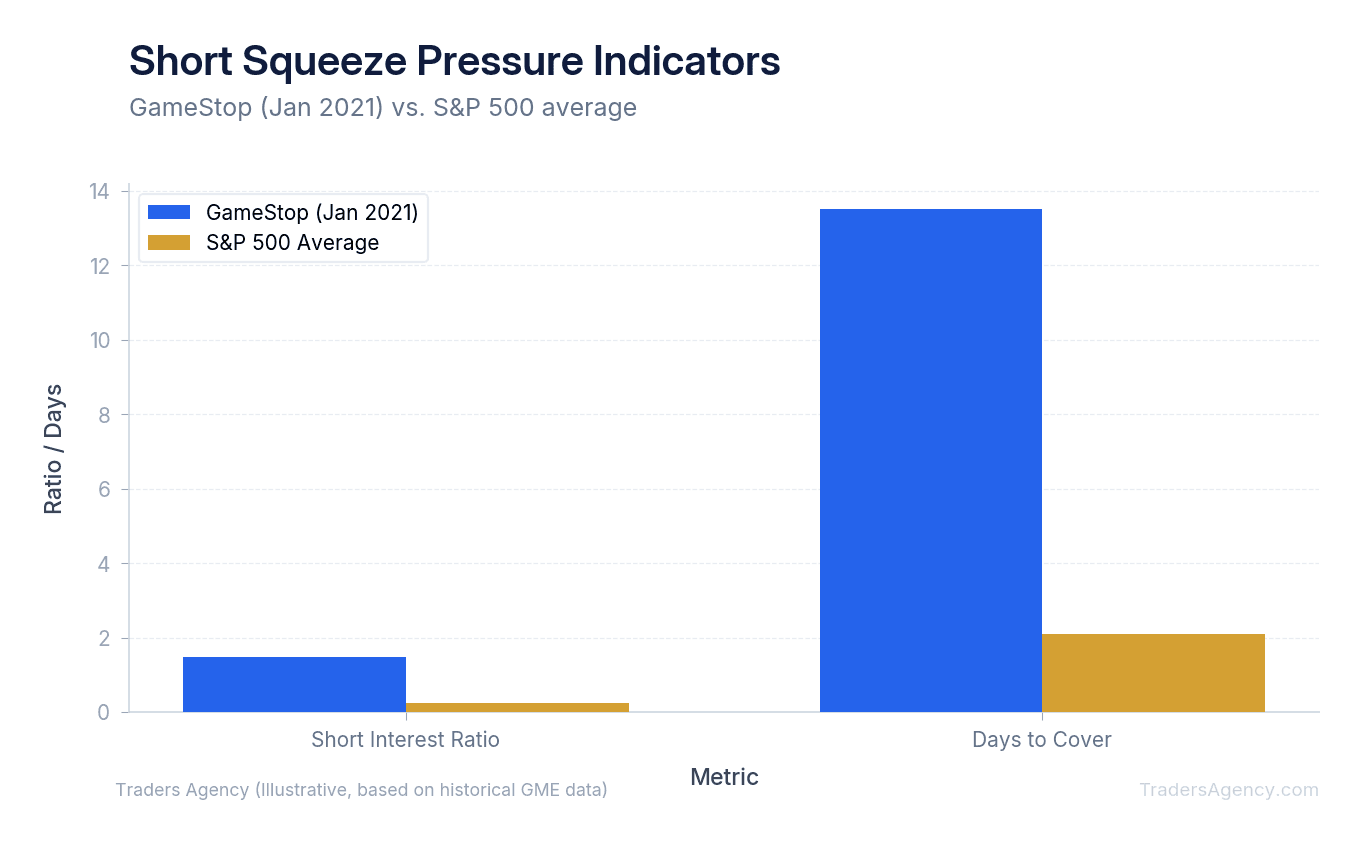
| Metric | What It Measures | Our Threshold |
|---|---|---|
| Short Interest | % of float sold short | 20%+ of public float |
| Days to Cover | Days for shorts to close at avg. volume | 5+ days |
| Cost to Borrow | Annualized fee to borrow shares | 10%+ (higher = better signal) |
When you combine a high short interest ratio with a soaring cost to borrow, you have the foundational ingredients for a squeeze. The SEC provides educational resources on short selling regulations that explain these mechanics in detail. Tracking these metrics is your first step in identifying potential setups.
How Do You Know If a Stock Is Being Short Squeezed?
You'll see a massive, sudden spike in trading volume accompanied by vertical price action that ignores broader market trends. The stock will break through key resistance levels with unusual speed, and options premiums will become extremely expensive due to skyrocketing implied volatility.
Before the actual squeeze happens, you'll often see a buildup phase. The stock might consolidate near a support level while short interest remains stubbornly high. Then a sudden influx of retail buying pressure begins to push the price up slightly.
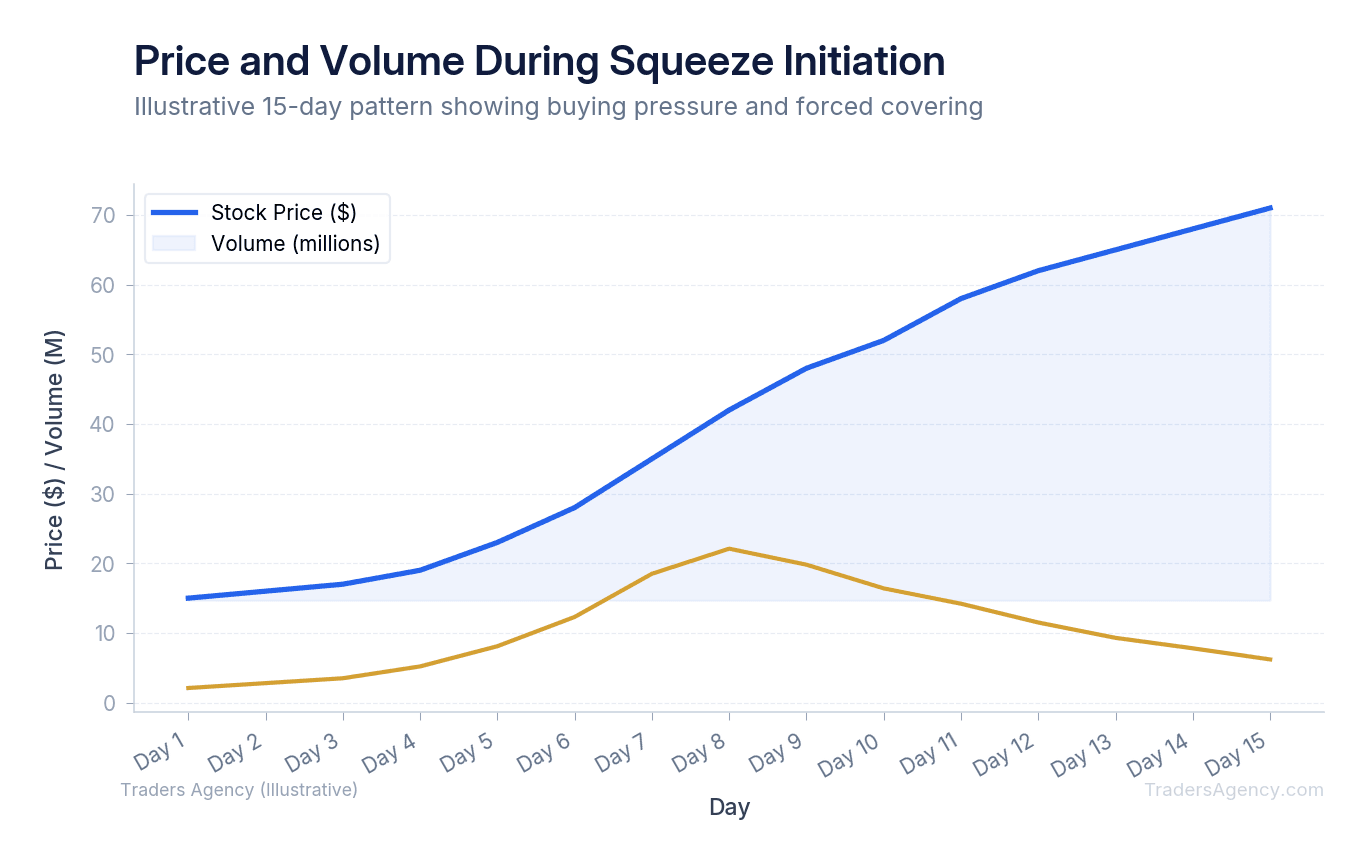
We prefer to watch the options chain during this phase. A surge in call option buying can trigger a secondary effect called a gamma squeeze. Market makers who sell those call options must buy the underlying stock to hedge their risk. As the stock price rises, they're forced to buy even more shares, adding massive buying pressure to the system.
Key Concept: A gamma squeeze happens when market makers are forced to buy increasing amounts of stock to hedge the call options they've sold. This creates a second engine of forced buying on top of the short sellers covering their positions.
What Triggers a Short Squeeze? Events That Light the Fuse
A stock can have terrible fundamentals and massive short interest for months without ever squeezing. You need a trigger event to force the initial price spike and panic the short sellers.
Common triggers include:
- Unexpected positive earnings reports that shatter analyst estimates and force short sellers to rethink their thesis.
- Major corporate announcements such as new product launches, acquisitions, or leadership changes.
- Regulatory approvals or favorable legal rulings that clear a path for future revenue.
- Coordinated buying campaigns on social media platforms where retail traders collectively target heavily shorted stocks.
Retail traders organizing on social media have become a massive force in modern markets. These communities can manufacture buying pressure rapidly. They target stocks with high short interest and collectively buy shares and call options to force institutional short sellers into a corner. This is the modern short squeeze explained in its most current form: retail coordination meets structural vulnerability.
Want expert trading insights delivered daily?
Join thousands of traders who rely on Traders Agency for market analysis and trade ideas.
Join Traders AgencyStep-by-Step Example: The GameStop Short Squeeze
To make this practical, we need to look at a real-world scenario. The 2021 GameStop (GME) event is the perfect short squeeze explained through actual numbers. Here's exactly how this historic trade unfolded.
- The Setup and Initial Conditions: In late 2020, GME had a short interest of over 100% of its public float. This meant more shares were shorted than actually existed for public trading. The days-to-cover metric was extremely high, and the stock was trading around $4 per share (split-adjusted). Institutional investors were heavily betting on the company going bankrupt.
- The Trigger Event: A massive wave of retail traders on social media realized the short sellers were dangerously overexposed. They began aggressively buying GME shares and out-of-the-money call options. Traders were buying $10 and $15 strike call options that were incredibly cheap at the time.
- The Execution and Gamma Squeeze: As the price pushed past $10, then $20, short sellers faced massive margin calls. They were forced to buy shares at any price to stop the bleeding. Simultaneously, market makers had to buy millions of shares to hedge the massive volume of call options being purchased. This created a dual-engine squeeze.
- The Outcome and Reversal: The stock violently squeezed to an intraday high of $120 (split-adjusted) in January 2021. Traders who bought early saw historic gains. Options premiums exploded, turning $50 contracts into $5,000 contracts overnight. However, those who bought at the absolute top suffered devastating losses when the buying pressure evaporated and the stock inevitably crashed back down.
| GME Squeeze Timeline | Price (Split-Adjusted) | Key Event |
|---|---|---|
| Late 2020 | ~$4 | Short interest exceeds 100% of float |
| Early January 2021 | $10 - $20 | Retail buying wave begins, margin calls start |
| Late January 2021 | $120 intraday high | Peak squeeze, gamma squeeze compounds buying |
| February 2021 | Rapid decline | Buying pressure exhausted, violent reversal |
Watch Out: The GME squeeze created life-changing gains for early participants, but traders who bought near the top lost 70% or more within days. Timing your entry and exit is everything in a squeeze trade.
How Is a Short Squeeze Different From a Pump-and-Dump?
Many newer traders confuse a short squeeze with a pump-and-dump scheme, but the mechanics are entirely different. A pump-and-dump relies on false information and coordinated marketing to trick unsuspecting investors into buying a worthless stock. The insiders then sell their shares, causing the price to crash.
A short squeeze is a structural market event. It's driven by the mathematical reality of forced buying and margin calls. The buying pressure comes from trapped short sellers who have no choice but to buy shares to cover their obligations.
While both events result in rapid price spikes and subsequent crashes, the data behind a squeeze is visible to anyone. You can track the short interest, the days to cover, and the options chain volume. A pump-and-dump is completely opaque and relies on deception. We teach our members to stick to data-driven setups and ignore social media rumors that lack structural market backing.
How Do You Know When to Exit a Short Squeeze Trade?
You should exit when the trading volume begins to dry up while the price stalls, or when the short interest data shows that the majority of short sellers have already covered their positions. We teach our members to scale out of their positions on the way up rather than trying to guess the exact top.
Timing the exit is the hardest part of trading a squeeze. The price action is entirely disconnected from the underlying value of the company. Once the forced buying stops, the stock will collapse rapidly.
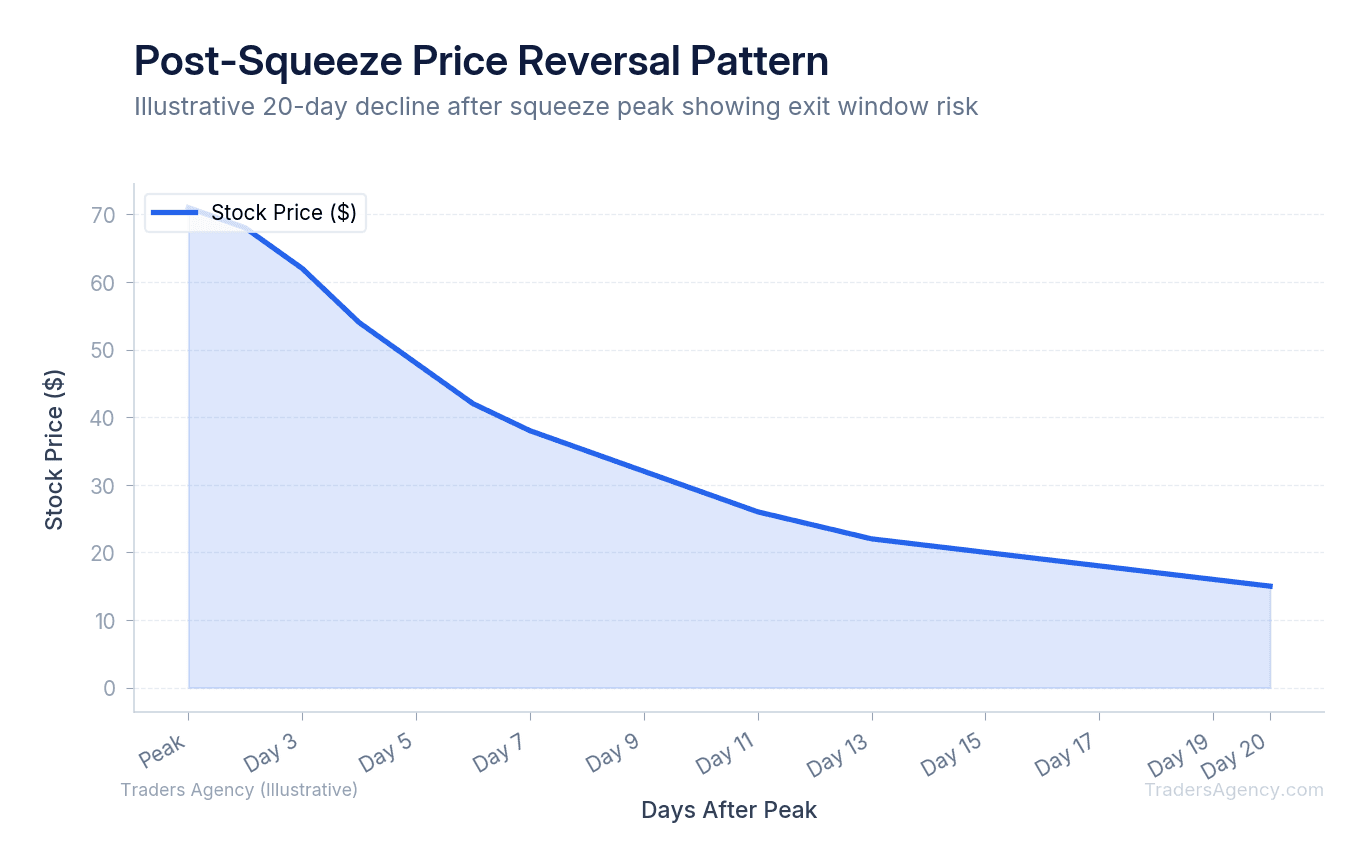
Don't wait for the stock to start falling before you take profits. Once a squeeze peaks, the drop is usually faster and more violent than the climb. We prefer to sell a quarter or half of our position at predetermined profit targets, such as a 50% or 100% gain. This secures your initial capital while letting the rest run with a trailing stop loss.
Many traders use the Volume Weighted Average Price (VWAP) as a guide. If a squeezing stock violently breaks below the VWAP on a 5-minute chart, it's often a signal that the momentum has broken and the reversal has begun.
Why Most Short Squeeze Plays Fail (And How to Avoid the Trap)
Our team wants to be completely honest with you. The vast majority of heavily shorted stocks never squeeze. They're heavily shorted for a very good reason: the underlying companies are failing.
Buying a stock simply because it has high short interest is a recipe for disaster. If no trigger event occurs, the stock will continue a slow, painful grind to zero. You must combine short interest data with technical analysis and clear buying volume.
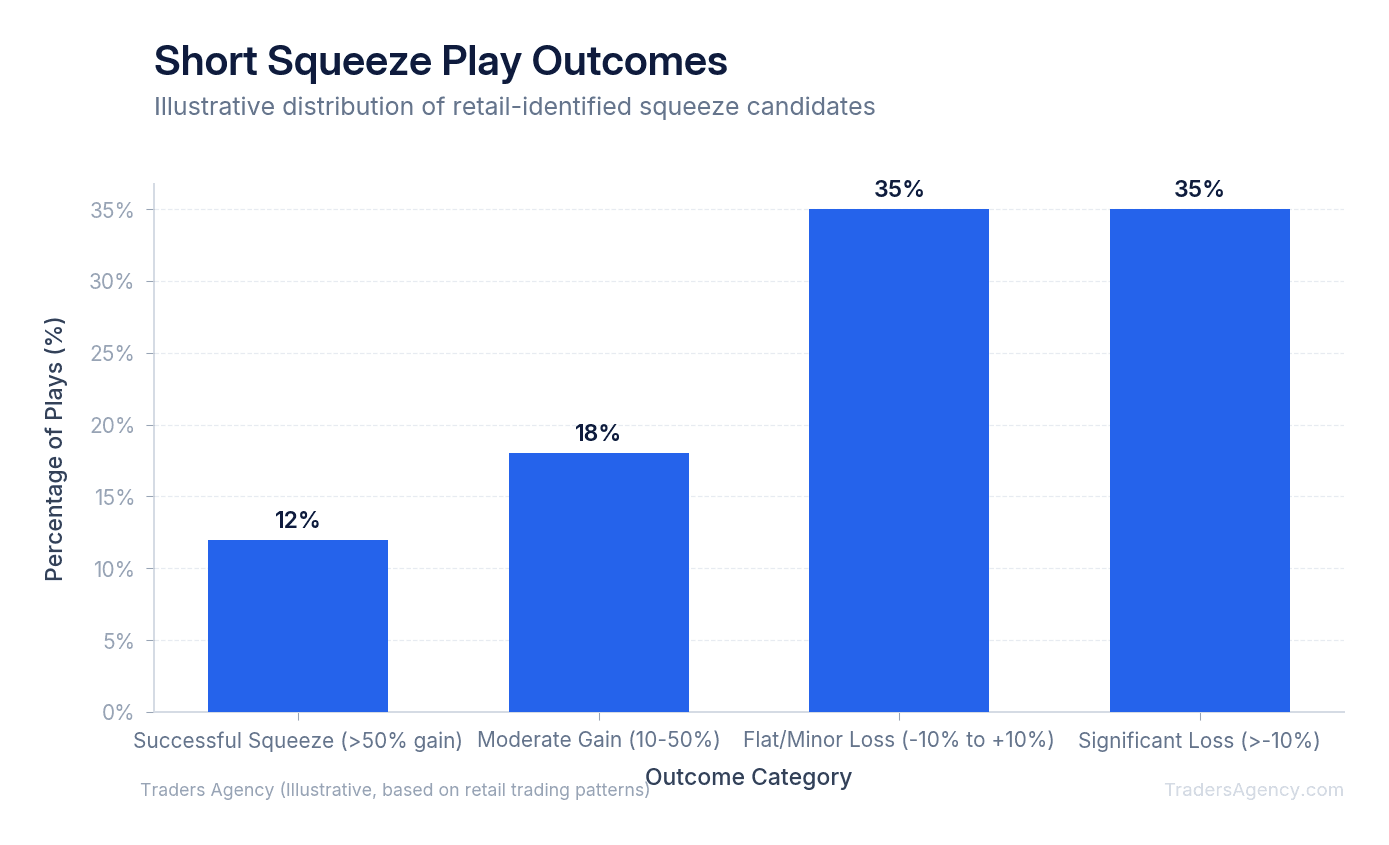
Risk management is your only defense against the extreme volatility of these trades. Here's what we teach our members to protect their capital:
- Keep Position Sizing Small: Never allocate more than 1% to 2% of your total account equity to a single squeeze play. These are highly speculative trades. If the trade goes against you, a small position size ensures you live to trade another day.
- Use Hard Stop Losses: Define your maximum acceptable loss before you enter the trade. If you buy a stock at $10 hoping for a squeeze, set a strict stop loss at $8.50. If the stock drops below your support level, get out immediately. Do not hold and hope.
- Avoid Chasing the Gap: If a stock has already squeezed 200% in pre-market trading, the opportunity is likely gone. Buying at the top makes you the exit liquidity for institutional traders and early retail buyers. We prefer to look for the next setup rather than chasing a runaway train.
Risk Warning: A short squeeze is a tactical, short-term trade. It is not a long-term investment strategy. Most squeeze candidates never actually squeeze, and the ones that do can reverse just as violently. Never risk more than you can afford to lose, and always have your exit plan defined before you enter.
By understanding the mechanics, tracking the right data, and managing your risk strictly, you can spot these opportunities without blowing up your account. Now that you have the short squeeze explained from setup to exit, the difference between profitable squeeze traders and everyone else comes down to preparation, discipline, and knowing when to walk away.
Want expert trading insights delivered daily?
Join thousands of traders who rely on Traders Agency for market analysis and trade ideas.
Join Traders AgencyKey Takeaways
- A short squeeze is triggered when short sellers are forced to buy back borrowed shares as prices rise, creating a self-reinforcing loop of upward price pressure that can push a stock 50% to 100% higher in days.
- Short interest as a percentage of float is one of the most reliable early indicators: the higher the percentage, the more fuel exists for a potential squeeze if sentiment shifts.
- The GameStop squeeze is a textbook case of how retail coordination combined with extreme short interest can overwhelm institutional short positions, but most squeezes do not follow the same script.
- Chasing a squeeze after the initial spike is one of the most common ways retail traders lose money. Entry timing and a defined exit plan before the trade is placed are non-negotiable.
- Distinguishing a short squeeze from a pump-and-dump matters because the exit strategy is different. Squeezes are driven by forced mechanical buying; pump-and-dumps are driven by manufactured hype with no structural support.
DISCLAIMER: Traders Agency does not offer financial advice. The information provided is for educational purposes only and should not be considered financial advice. Traders Agency is not responsible for any financial losses or consequences resulting from the use of the information provided. Trading carries inherent risks and may not be suitable for all individuals. You are advised to conduct your own research and seek personalized advice before making any investment decisions, recognizing the potential risks and rewards involved.